2027 Social Work Practice Scheduling Policies: Questions About Access and Sustainability
Audited and Verified:
Our Editorial and Data Verification Process
Research.com uses government datasets, official education statistics and primary institutional information to support its career and degree guides. Our review process checks factual accuracy, occupational definitions, source dates and the requirements associated with the credentials discussed.
How This Article Was Fact-Checked
Our editorial team verifies salary estimates, employment projections, education requirements and program information against original data providers and official organizations. Salary figures are checked against the relevant occupational definitions and reporting periods. Information about licensure, accreditation and required in-person training is reviewed separately.
Fact-checked and verified on:

Co-Founder and Chief Data Scientist
A social work service can exist on paper and still be difficult to use if appointments conflict with work, caregiving, transportation, or a client's immediate needs. Scheduling also determines whether staff have enough time for documentation, consultation, and recovery between demanding encounters.
This guide is for social workers, agency leaders, and students assessing a placement or job. It explains how to evaluate appointment rules, caseloads, and staffing alongside the education and career choices that affect them, so readers can distinguish a workable schedule from one that merely looks efficient.
Key Things You Should Know
- Judge a scheduling policy by both timely access and staff capacity: appointment availability alone does not show whether clients can attend or workers can provide appropriate follow-up.
- No universal caseload number defines a sustainable social work job. Compare client complexity, travel, documentation, supervision, crisis coverage, and protected non-appointment time.
- Education and earnings do not settle the scheduling question: online study still involves scheduled field learning, while the BLS reports a $61,780 median annual wage and 6% projected growth for social workers overall.
What are social work practice scheduling policies?
Social work practice scheduling policies are the rules an organization uses to allocate staff time and arrange services. They can govern appointment lengths, hours of operation, intake priority, outreach visits, crisis coverage, cancellations, waitlists, supervision, and documentation time. A policy may be written centrally, while actual schedules depend on staffing, funding, and the needs of a school, hospital, public agency, or community program.
The distinctions below help identify what a policy is trying to accomplish - and what it may inadvertently constrain.
| Policy element | Access question | Sustainability question |
| Hours and appointment slots | Can clients attend without losing wages or arranging difficult travel? | Who covers evenings, absences, and urgent needs? |
| Visit length and spacing | Is there enough time for the service and an accessible handoff? | Is time reserved for records, consultation, and travel? |
| Caseload and intake limits | How quickly can someone begin or resume service? | Does assigned work fit available hours and worker competence? |
| Cancellation and waitlist rules | Can people rebook fairly after a missed visit? | Can released slots be filled without constant overbooking? |
Scheduling cannot be evaluated apart from the work performed. A brief benefits referral and an intensive, multi-agency case may occupy the same calendar slot but require very different follow-up. The social work graduate career pathway overview can help readers distinguish roles before comparing their schedules.
How do scheduling policies affect clients' access to social work services?
Access means more than finding an open slot. A client must be able to learn about the service, make contact, attend in an available format, and obtain appropriate follow-up. A weekday-only schedule may work for some clients but exclude people with inflexible shifts; remote appointments may remove travel while creating privacy, device, or connectivity barriers. Interpreters, accessible facilities, and coordination with other providers can also affect when an appointment is genuinely usable.
Agencies should examine time to first contact separately from time to a completed appointment. They can compare those measures across referral sources and, where lawful and appropriate, groups facing known access barriers. Looking only at the percentage of calendar slots filled can reward full schedules even when people with the greatest barriers never reach them.
Workforce preparation is one longer-term part of service access: agencies need staff whose training fits the work, not simply more appointments on a calendar. For readers considering entry-level roles, exploring recognized online BSW education is a separate step from checking whether a particular employer offers adequate appointment coverage and supervision.
How do caseloads and appointment schedules affect social worker burnout?
A caseload count is a poor stand-alone measure of workload. Two workers with the same number of clients may face different levels of crisis response, travel, coordination, paperwork, and emotional demand. Back-to-back appointments can leave no realistic time for records or consultation; a calendar that treats those tasks as invisible work may shift them into evenings or lead to delays.
For a more useful workload review, compare assigned work with actual paid hours. Include direct service, outreach, documentation, meetings, supervision, travel, and on-call duties. Then ask whether the schedule permits breaks, safe handoffs, and coverage during leave. If workers routinely cannot finish necessary tasks within paid hours, changing the number or distribution of appointments is more meaningful than advising them to manage time better.
New practitioners should also check whether a proposed caseload leaves room for required oversight. Academic field instruction and any later, board-approved clinical supervision are different arrangements; scheduling one does not substitute for the other. The clinical social work experience documentation questions are particularly relevant when evaluating an employer's promise of supervision alongside its productivity expectations.
A missed appointment can mean a client no longer needs service, but it can also reflect a lost shift, transportation failure, disability-related barrier, childcare problem, or difficulty receiving reminders. Automatic discharge after a fixed number of no-shows may open capacity while disproportionately cutting off people who need help overcoming those barriers. Conversely, leaving unused slots unfilled can prolong waits for everyone else.
A workable policy states how clients are reminded, how they can cancel or reschedule, whether fees apply, when outreach follows a missed visit, and how urgent needs are triaged. It should make room for staff judgment within documented criteria rather than requiring an improvised exception each time. Waitlists need an ownership rule: someone must review referrals, update contact information, identify changing urgency, and explain what happens if the agency cannot offer timely service.
Students observing these systems in field education should ask who may contact clients and who makes scheduling or discharge decisions; trainees should not be treated as unsupervised coverage for a full caseload. Readers comparing how graduate programs arrange and oversee agency learning can consult graduate social work placement coordination options.
Scheduling decisions should respect client dignity, self-determination, privacy, accessibility, and professional competence. The NASW Code of Ethics offers professional guidance, but it is not a substitute for applicable law, a licensing board's rules, payer requirements, or an agency's approved procedures. Relevant obligations can differ by state and setting.
Practical safeguards include limiting identifying details in shared calendars and reminders, obtaining appropriate consent for communications, arranging language access, and making reasonable accessibility arrangements where required. Agencies also need clear coverage and referral procedures when a worker is absent or a service cannot be offered promptly. Telepractice may improve availability, but a convenient appointment time does not itself establish permission to practice across state lines; verify the client's location and applicable authorization rules.
For clinical career planning, MSW programs and state licensure education requirements addresses an educational question distinct from an employer's scheduling policy or a board's decision to issue a license.
What are the salary and job outlook for social workers?
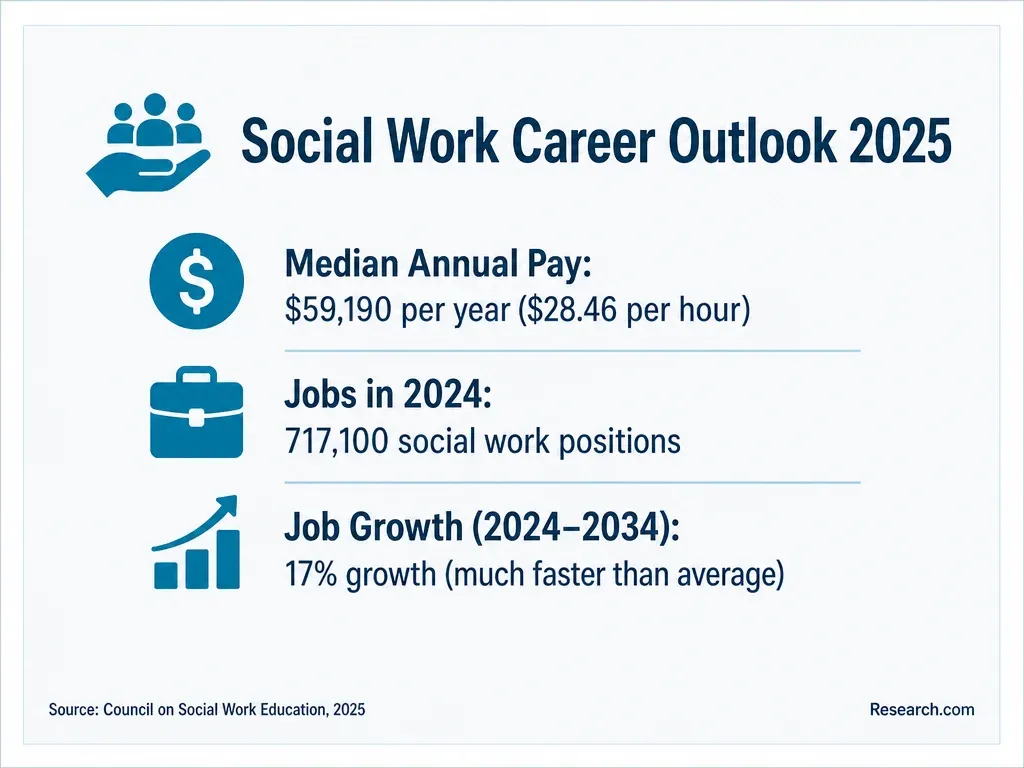
U.S. Bureau of Labor Statistics figures report a May 2025 median annual wage of $61,780 for social workers across specialties and 6% projected employment growth from 2025 to 2035. The listed medians differ by occupation: $59,550 for child, family, and school social workers; $67,880 for healthcare social workers; and $60,280 for mental health and substance abuse social workers. Their respective projected growth rates are 4%, 8%, and 10% over the same period.
These are occupational measures, not offers to new BSW or MSW graduates or premiums for taking an undesirable schedule. Pay also varies with geography, employer, experience, and role. Use a guide to comparing social worker pay by location alongside actual postings, then weigh wages against paid hours, benefits, travel, on-call duties, and available supervision.
A sustainable opportunity should make its workload and compensation understandable together. Strong occupational growth does not guarantee that a particular agency has the funding or staffing to maintain manageable caseloads.
Other Things You Should Know About Social Work
Yes. They can ask, but availability depends on the agency's staffing and service model. If an alternative time is unavailable, ask what other formats, locations, or referral options the agency offers.
Often, with the client's agreement and subject to privacy, safety, and setting-specific rules. Confirm the arrangement in advance so everyone understands the support person's role.
Follow the agency's closure and communication procedures. Staff should know who contacts clients, whether remote service is permitted, and how urgent needs are directed to appropriate coverage.
Not automatically. The approved placement, agency procedures, and field instructor determine which scheduling tasks a student may perform and what supervision is required.
- Evaluating the Impact of Patient No-Shows on Service Quality | nih.gov https://pmc.ncbi.nlm.nih.gov/articles/PMC7280239/
- Work at Home/Telework as a Reasonable Accommodation | U.S. Equal Employment Opportunity Commission https://www.eeoc.gov/laws/guidance/work-hometelework-reasonable-accommodation
- Telehealth Privacy and Security Tips for Patients | hhs.gov https://www.hhs.gov/hipaa/for-professionals/privacy/guidance/telehealth-privacy-security/index.html
- NASW Standards for Social Work Case Management | nycourts.gov https://www.nycourts.gov/reporter/webdocs/nasw_standards_socialwork_casemgt.htm
- Americans with Disabilities Act Title III Regulations | ADA.gov https://www.ada.gov/law-and-regs/regulations/title-iii-regulations/
- Section 7: Measuring Value in a Care Management Program | Agency for Healthcare Research and Quality https://www.ahrq.gov/patient-safety/settings/long-term-care/resource/hcbs/medicaidmgmt/mm7.html
- Accessible NYC 2025 Report - Other Agency Initiatives https://www.nyc.gov/site/mopd/publications/accessiblenyc-2025-report-other-agency.page
- Safety Planning and Follow-up - Population Health Institute https://uwphi.pophealth.wisc.edu/evaluation-research/current-evaluation-projects-2/firearmcrisisstrategylibrary/safety-planning-and-follow-up/
- Open Access Scheduling | adoc.us https://www.adoc.us/quality-improvement/qi-provider-tips/open-access-scheduling/
- Healthcare Access in Rural Communities Overview | Rural Health Information Hub https://www.ruralhealthinfo.org/topics/healthcare-access