2027 Social Work Organizing Across Agencies: Coordination Without Shared Management
Audited and Verified:
Our Editorial and Data Verification Process
Research.com uses government datasets, official education statistics and primary institutional information to support its career and degree guides. Our review process checks factual accuracy, occupational definitions, source dates and the requirements associated with the credentials discussed.
How This Article Was Fact-Checked
Our editorial team verifies salary estimates, employment projections, education requirements and program information against original data providers and official organizations. Salary figures are checked against the relevant occupational definitions and reporting periods. Information about licensure, accreditation and required in-person training is reviewed separately.
Fact-checked and verified on:

Co-Founder and Chief Data Scientist
A housing agency, school, clinic, and benefits office may all serve the same person, yet none can direct the others. Social workers and human services professionals need ways to coordinate services without assuming shared authority or unrestricted access to records.
This guide explains how to build workable agreements, manage referrals and confidentiality, and recognize when a coordination problem needs escalation. It also helps students and career changers decide which education, field experience, or credential - if any - fits the work they want to do.
Key Things You Should Know
- Coordinate through client-defined goals, named contacts, agreed referral steps, and follow-up - not by treating another agency's staff as your own.
- A shared referral does not create blanket permission to exchange records; applicable law, consent, and each organization's policies control disclosure.
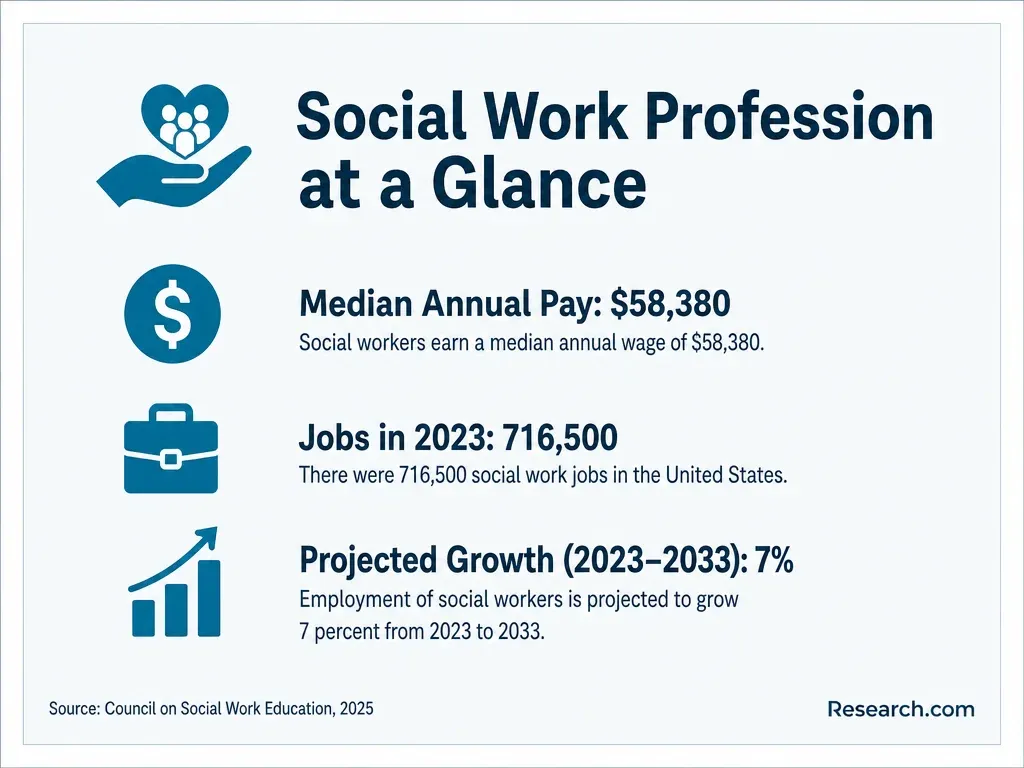
- Many coordination jobs do not require independent clinical licensure. For context, the U.S. Bureau of Labor Statistics reports a $61,780 median annual wage for social workers overall in May 2025, not a guaranteed wage for coordinators.
What is interagency coordination in social work?
Interagency coordination means aligning services delivered by separate organizations around a person's or community's goals. A social worker might help a family connect school supports, housing assistance, healthcare, and public benefits while each provider retains its own supervisor, eligibility rules, records, and legal duties.
Coordination is more than sending a referral. It includes checking whether the receiving service is available, clarifying who will contact the person, addressing barriers such as transportation or language access, and confirming an appropriate next step. The person receiving services should help define priorities; a professional's idea of an efficient referral is not necessarily the person's preferred plan.
Interagency work spans generalist case management and community practice. It is not automatically psychotherapy or clinical treatment. Someone whose goal is to provide therapy rather than organize access to services should compare that goal with choosing a clinically focused social work master's program and the separate requirements for clinical licensure.
How do social workers coordinate agencies without shared management?
Without a common chain of command, coordination depends on clear responsibilities and reliable communication. Start with what the client wants accomplished, then distinguish tasks your organization controls from decisions that belong to a partner agency. A memorandum of understanding can define a recurring partnership, but it cannot override consent requirements, eligibility rules, or an agency's statutory responsibilities.
A practical workflow makes cooperation possible even when staffing or funding changes:
- Agree with the client on the goal, preferred contacts, accessibility needs, and what information may be shared.
- Identify a contact at each agency and confirm its referral criteria, capacity, response channel, and expected timeframe.
- Assign an owner and due date to each task; record whether the referral was received, accepted, declined, or still pending.
- Use brief case conferences when needed, with an agenda, appropriate participants, and a record of decisions rather than unnecessary case details.
- Escalate stalled tasks through each agency's designated supervisor or partnership contact, then revise the service plan with the client if an option is unavailable.
A closed-loop referral confirms what happened after a referral was sent; it does not presume that enrollment or treatment occurred. For students, a placement with multiple referral partners can make this distinction observable. Compare schools' actual placement responsibilities and local agency relationships using a social work master's placement support comparison guide, then ask the field office whether a proposed site permits supervised interagency work.
What degrees and licenses are needed for interagency social work?
The required qualification follows the job's duties and jurisdiction, not the number of agencies involved. Some navigator and service-coordination jobs accept related human services education or experience. Positions designated as social worker may require a BSW, MSW, or state license; clinical assessment or psychotherapy carries different requirements from arranging services. Check the posting, employer classification, and state rules before enrolling in another degree.
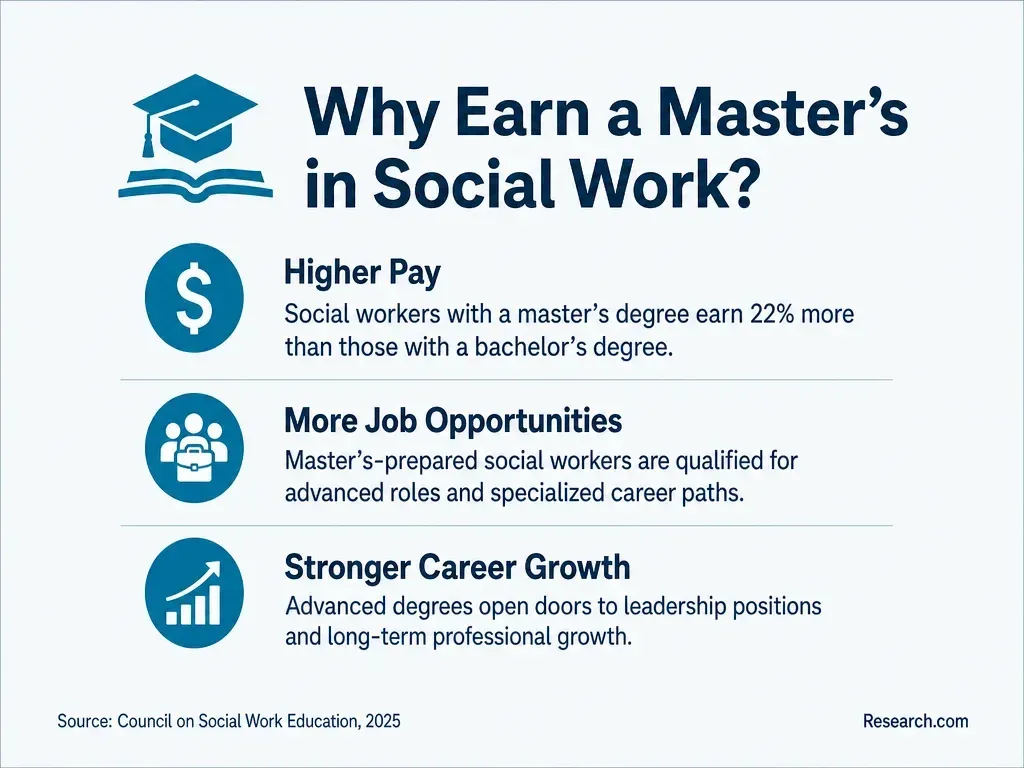
A BSW commonly prepares graduates for generalist social work roles. An MSW can support more specialized practice, supervision, or roles whose employers require graduate education. Applicants with a qualifying BSW may be eligible for an advanced-standing MSW under a school's rules; applicants from other disciplines generally consider a traditional or foundation MSW. Compare advanced standing vs standard MSW coursework against your actual prior degree and the work you intend to do.
Neither degree alone issues a license. State boards determine license categories and requirements, including examinations or supervised experience where applicable. A DSW or PhD is usually unnecessary for coordinating referrals; targeted training in benefits, facilitation, privacy, or program operations may be more direct for an experienced professional.
Look past job titles to the mix of client contact, system navigation, documentation, and authority. The comparison below shows common functions - not universal hiring requirements.
| Role or setting | Typical coordination work | Qualification question to check |
| Community resource navigator or case manager | Connect people with housing, food, benefits, and community services | Does the employer accept relevant experience or require a social work degree? |
| Hospital or healthcare social worker | Plan transitions and connect patients with community supports | Is an MSW or state license required for the assigned duties? |
| School social worker | Coordinate family, school, and outside supports | What state education credential and employer qualifications apply? |
| Public-sector program coordinator | Manage referral partnerships, service gaps, or contracts | Does the civil-service classification favor social work, public administration, or another background? |
For career changers, prior experience in healthcare operations, education, advocacy, or nonprofit partnerships may transfer well. The gap may be supervised client engagement and ethical documentation rather than another management credential.
If a target job specifically requires an MSW, investigate accessible entry routes to graduate social work study without assuming that an easier admissions route changes field or licensing requirements. When comparing offers, ask about caseloads, referral-network capacity, supervision, travel, safety procedures, and authority to resolve stalled cases.
Coordinate the task without automatically sharing the file. Explain proposed disclosures in terms the client can understand, obtain any authorization required for the particular information and recipient, and send only what is permitted and needed. Confirm the recipient's identity and use approved communication and record systems. A partner's participation in a meeting does not, by itself, grant access to every participant's records.
The governing rules depend on the setting and records involved. HIPAA may govern a covered healthcare provider's disclosures; FERPA may govern education records; 42 CFR Part 2 may impose additional requirements on covered substance use disorder records. State privacy laws, mandatory-reporting duties, contracts, and agency policy may also matter. Exceptions and permissible disclosures are fact-specific, so workers should consult current organizational privacy guidance or qualified counsel rather than treating a general release as universal permission.
Document the client's preferences, the authorization or other basis for a disclosure, what was shared, with whom, and the coordination outcome under agency policy. Keep these case records separate from any documentation needed for clinical-license supervision. Anyone tracking the latter should review social work clinical experience recordkeeping considerations; routine referral notes do not establish board-approved clinical hours.
Useful preparation connects person-in-environment assessment to the systems that determine service access. Courses in social policy, case management, community practice, ethics, research literacy, and program evaluation can help students interpret eligibility rules, negotiate responsibilities, and identify gaps in a referral network. Skills practice should include consent conversations, concise handoffs, accessible communication, and documenting whether a referral actually progressed.
In field education, look for supervised opportunities to map a service network, participate in an approved case conference, follow up on referrals, or assess a process bottleneck using information the agency permits students to access. A field instructor and faculty liaison should agree on learning objectives and evaluate performance; observing a meeting alone does not demonstrate coordination competence. Students considering planning a shorter MSW pathway should verify that its course sequence and placement schedule still allow these learning opportunities.
What are the salary and job outlook for social workers in coordination roles?
The U.S. Bureau of Labor Statistics does not report one wage for "interagency coordinator." Its social work categories provide context when the job's duties and qualifications genuinely match that occupation. The figures below are May 2025 U.S. median annual wages and projected employment changes for 2025-2035.
| BLS occupation | Median annual wage | Projected growth |
| Social workers, all specialties | $61,780 | 6% |
| Child, family, and school social workers | $59,550 | 4% |
| Healthcare social workers | $67,880 | 8% |
| Mental health and substance abuse social workers | $60,280 | 10% |
These occupation-wide figures are not starting salaries, MSW premiums, or forecasts for an individual agency. A navigator position that does not meet the social worker occupational definition may belong to a different wage category. Compare actual postings by setting, required credentials, region, and public-sector pay grade; social work master's earnings across states can supply additional geographic context without replacing an employer's stated range.
Other Things You Should Know About Social Work
Confirm the change with its designated contact, update referral guidance, and tell affected clients about available alternatives. Escalate a recurring service gap through partnership or funding channels rather than continuing to send referrals that cannot be accepted.
Generally, coordination should respect an informed client's preferences. Explain realistic alternatives and any limits arising from eligibility, safety, or legal duties; document the decision according to agency policy.
The agency responsible for a program applies its own eligibility rules. A coordinator can help obtain clarification, identify an appeal process when available, and look for other services, but cannot approve benefits on another agency's behalf.
Start with agreed process measures, such as referral response time, accepted referrals, and reasons referrals stall. Define who may access each measure and report aggregated results where appropriate; avoid claiming improved client outcomes from referral counts alone.
- Care Coordination | Agency for Healthcare Research and Quality https://www.ahrq.gov/ncepcr/care/coordination.html
- Interprofessional collaboration between social workers... - PMC https://pmc.ncbi.nlm.nih.gov/articles/PMC10675993/
- OVC Model Standards - Office of Justice Programs https://ovc.ojp.gov/sites/ovc/files/model-standards/6/program_standards_4.html
- Summary of the HIPAA Privacy Rule | hhs.gov https://www.hhs.gov/hipaa/for-professionals/privacy/laws-regulations/index.html
- Closed Loop Referral (CLR) FAQ - DHCS - CA.gov https://www.dhcs.ca.gov/calaim-transforming-medi-cal/closed-loop-referral-clr-frequently-asked-questions/
- Improving Coordination of Related Agency Responsibilities | Administrative Conference of the United States https://www.acus.gov/document/improving-coordination-related-agency-responsibilities
- 3 Case Management in the Community Context - NCBI - NIH https://www.ncbi.nlm.nih.gov/sites/books/NBK571729/
- NASW Standards for Social Work Case Management | nycourts.gov https://www.nycourts.gov/reporter/webdocs/nasw_standards_socialwork_casemgt.htm
- The benefits from culturally responsive community-based research partnerships | apa.org https://www.apa.org/research-practice/conduct-research/culturally-responsive-partnerships