2027 Social Work Caseload Mix: Why Case Complexity Matters Alongside Numbers
Audited and Verified:
Our Editorial and Data Verification Process
Research.com uses government datasets, official education statistics and primary institutional information to support its career and degree guides. Our review process checks factual accuracy, occupational definitions, source dates and the requirements associated with the credentials discussed.
How This Article Was Fact-Checked
Our editorial team verifies salary estimates, employment projections, education requirements and program information against original data providers and official organizations. Salary figures are checked against the relevant occupational definitions and reporting periods. Information about licensure, accreditation and required in-person training is reviewed separately.
Fact-checked and verified on:

Co-Founder and Chief Data Scientist
Two social workers may each have 30 open cases but face very different demands. One may coordinate routine follow-ups; the other may handle urgent safety concerns, multiple service systems, and extensive documentation. For students, new practitioners, supervisors, and agency staff, that difference matters when evaluating a placement, job offer, or staffing plan. This guide explains how caseload mix affects available time, client care, and worker well-being - and offers a practical way to judge whether the work is manageable.
Key Things You Should Know
- Case count is not workload: Thirty cases needing an estimated one hour each per month represent 30 hours; 30 needing two hours each represent 60 hours, before meetings and other duties.
- No single safe number fits every role: Urgency, travel, documentation, service availability, supervision, and worker experience all affect capacity.
- Assess the mix, then the support: Ask how an agency estimates case time, responds to surges, and protects supervision and documentation time - not only how many cases it assigns.
What is a social work caseload mix?
A caseload is the set of people or families assigned to a worker. Caseload mix describes the different types of work within that set: needs and goals, urgency, stage of service, required contacts, coordination across systems, and the time each case is likely to demand. Workload is broader still. It includes cases plus documentation, travel, meetings, outreach, training, and other assigned responsibilities.
Consider two hypothetical housing-services caseloads with the same number of households. One consists mainly of established clients awaiting scheduled check-ins. The other includes new intakes, imminent housing loss, language-access needs, and referrals involving several agencies. The second mix may require substantially more time even though the count is identical. These are planning examples, not labels for clients or predictions about outcomes.
Students considering case-management work should look for opportunities to practice assessment, service coordination, and documentation under supervision. A guide to social work bachelor's quality and career preparation can help frame questions about those opportunities, but a program's format alone does not establish workplace readiness.
Why does case complexity matter alongside caseload size?
Complexity changes both the time a case requires and how predictable that time is. A routine follow-up may fit a scheduled contact. A case involving an urgent safety concern, an interpreter, several providers, and changing eligibility for services may interrupt planned work and require consultation or additional records. The point is not that a person is inherently "complex"; needs, systems, and available resources interact to create work.
Counting open cases also obscures case stage. Intake and assessment often demand different work from maintenance or closure. A manageable average can therefore become unmanageable when many new referrals arrive together. Supervisors should examine the distribution of urgent and time-intensive work, not just divide total cases evenly among staff.
Some roles call for more specialized preparation than general service coordination. For a worker considering clinical duties, clinical MSW coursework and career goals are worth comparing with the actual job description. Coursework can build assessment skills, but it does not replace workplace support or confer independent clinical authority.
What is a manageable social work caseload?
A manageable caseload is one a worker can serve within available paid time, role boundaries, and required standards while completing contacts, documentation, consultation, and follow-up. There is no universal case-count threshold across US settings. An agency's target is useful only if it reflects its population, service model, travel area, staffing, and required contact frequency.
A simple capacity check starts with time rather than a headline number. Suppose 30 cases each require an estimated two hours of case-related work in a month: that is 60 hours. The estimate still needs room for unexpected needs, team meetings, supervision, training, and non-case duties. If those hours do not fit, a worker cannot solve the gap merely by organizing a calendar more tightly. Estimates should be revisited against actual time, not treated as fixed scores for individual clients.
For an early-career worker, a reasonable assignment also includes a graduated onboarding period, access to consultation, and clear escalation procedures. Students exploring shorter online MSW degree options should distinguish a faster academic schedule from preparation to carry a full workplace caseload; field learning and supervised performance remain important.
Agencies can combine case counts with estimated or observed time, urgency, and service requirements. A useful measure is transparent enough for staff to question and flexible enough to change when circumstances change. The table separates factors that are often collapsed into a single count.
| Measure | What it reveals | What it can miss |
| Open-case count | Number of current assignments | Different time demands and non-case work |
| Case stage and required contacts | Expected intake, follow-up, and closure activity | Unplanned events or difficulty reaching services |
| Time per case or activity | Staff capacity needed for direct and indirect work | Time that workers cannot record accurately |
| Urgency and coordination indicators | Need for prompt attention or work across systems | Changes over time and structural barriers |
| Non-case workload | Meetings, travel, supervision, training, and reporting | How competing demands interrupt casework |
Weights or tiers can help with planning, but they should not become a substitute for professional judgment. Agencies should define each measure, review assignments with staff, and check whether recorded activity reflects actual work. They should also protect client confidentiality: a staffing dashboard generally needs workload indicators, not unnecessary identifying details.
Students can ask how a placement teaches this distinction in practice. Planning local placements through an online MSW program includes checking whether the site can provide appropriate assignments, field instruction, and feedback - not just access to a large number of cases.
The same case count means different things in different service models. When comparing positions, ask what the worker is expected to do for each assigned person and which duties belong to other team members. The examples below describe common sources of workload, not standard caseload sizes.
| Setting or role | Workload features to examine | Question for the employer |
| Child and family services | Family contacts, court or agency deadlines, travel, and safety-related procedures | How are urgent assignments and coverage handled? |
| Healthcare discharge or care coordination | Short timelines, interdisciplinary communication, and transitions between services | How much same-day work is expected? |
| Behavioral health case management | Ongoing engagement, referrals, coordination, and role-specific risk procedures | Which tasks require a licensed clinician or supervisor? |
| School or community services | Outreach, family and agency coordination, and competing schedules | Is the role measured by assigned cases, school population, or program duties? |
A case-manager title does not establish a uniform scope of practice or credential requirement. For career planning, compare actual duties and qualifications alongside social work master's employment pathway comparisons. Some coordination roles accept other human-services preparation; clinical or protected social work roles may require a qualifying degree and state license.
When assigned work consistently exceeds available capacity, contacts, documentation, coordination, and follow-up compete for the same hours. Workers may have less opportunity to build trust or consult a supervisor. Those pressures can contribute to exhaustion and turnover, though caseload mix alone does not explain burnout; organizational support, safety, autonomy, compensation, and service availability also matter.
For clients, an overloaded system can mean delays or fragmented coordination. That is an organizational risk, not evidence that an individual worker is failing. Agencies can monitor missed contacts, overdue documentation, overtime, vacancies, and staff feedback together, then investigate causes without using any one metric as a shortcut to blame.
When evaluating a job, consider compensation alongside workload and support. A guide to comparing social worker pay by location can provide wage context, but a higher salary does not by itself offset unsustainable expectations or show what a particular employer will pay.
What are the salary and job outlook for social workers managing cases?
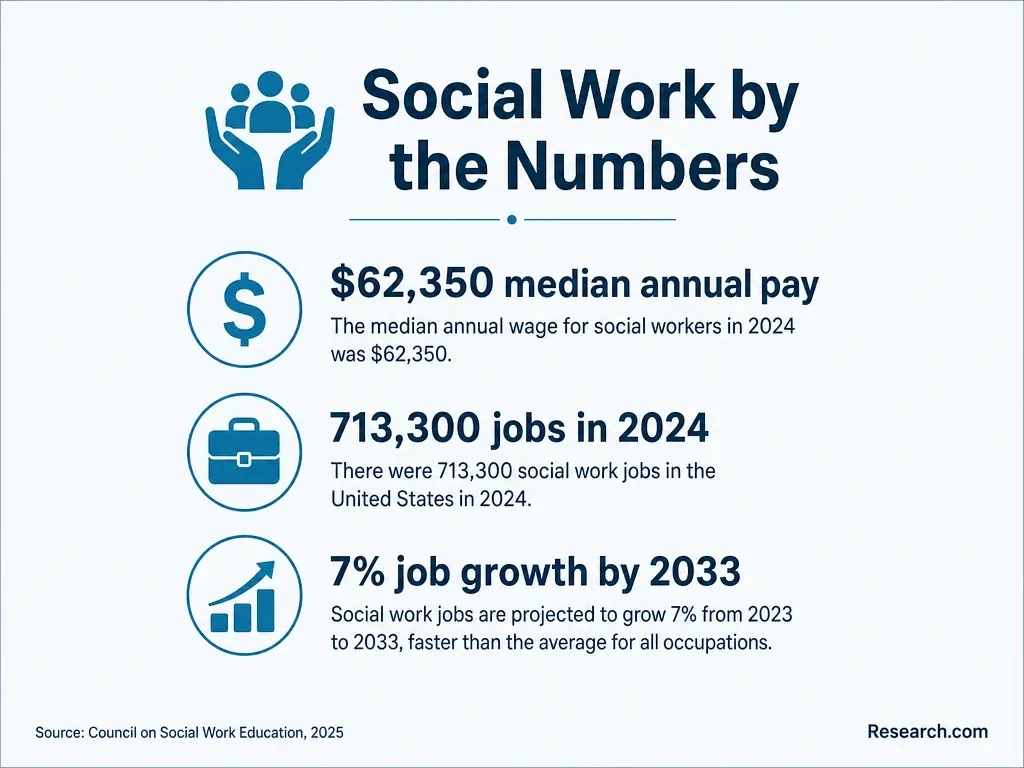
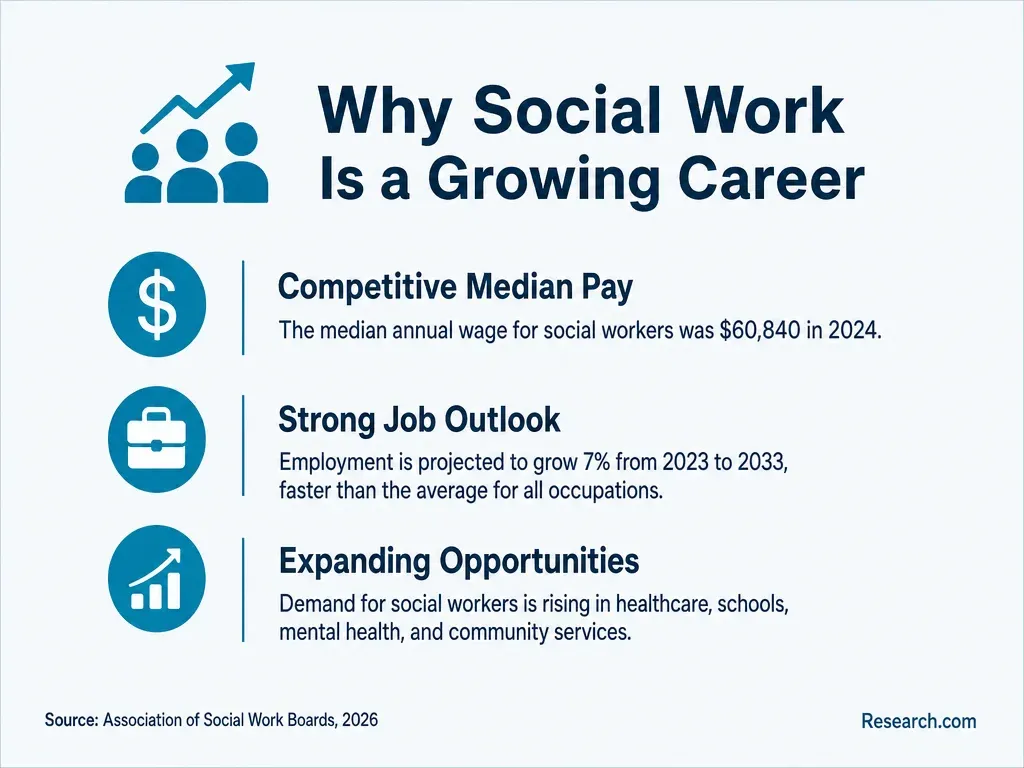
The US Bureau of Labor Statistics reports wages by occupation, not by "case manager" caseload size, MSW concentration, or license alone. Its May 2025 median annual wages and 2025-2035 employment projections offer context for social work roles that may involve case management:
| BLS occupation | May 2025 median annual wage | Projected employment growth, 2025-2035 |
| Social workers, all specialties | $61,780 | 6% |
| Child, family, and school social workers | $59,550 | 4% |
| Healthcare social workers | $67,880 | 8% |
| Mental health and substance abuse social workers | $60,280 | 10% |
These medians include workers with different experience, locations, employers, and qualifications. Projected growth describes occupations, not guaranteed openings at a chosen agency or pay for a new graduate. A job titled "case manager" may also fall outside these BLS social-worker categories, so match the duties to the occupation before using a figure in a career decision.
If further education is required for your target role, compare its full cost with realistic local wages and any employer support. Lower-tuition Master of Social Work pathways may help with that comparison, but tuition is only one cost: field schedules, travel, and reduced paid work can matter too.
Other Things You Should Know About Social Work
Yes. Ask for the typical range, how assignments are made, how long onboarding lasts, and what happens when referrals surge. Request examples of available supervision and administrative support rather than relying on a single number.
Not automatically. Closure and outreach depend on the service agreement, client circumstances, agency policy, and any applicable legal duties. A supervisor can clarify what documentation and follow-up are required.
Approved scheduling and records tools may reduce duplicate work, but they can also add data-entry demands. Check privacy rules, access controls, and whether the tool saves time in actual practice before using it with client information.
The worker can bring specific workload evidence to a supervisor through agency channels. If the concern involves immediate safety or a professional obligation, follow the relevant escalation, reporting, and consultation procedures promptly.
- NASW Standards for Social Work Case Management | nycourts.gov https://www.nycourts.gov/reporter/webdocs/nasw_standards_socialwork_casemgt.htm
- Caseload and Workload Management | akleg.gov https://www.akleg.gov/basis/get_documents.asp
- Social Workers, Burnout, and Self-Care: A Public Health Issue | nih.gov https://pmc.ncbi.nlm.nih.gov/articles/PMC10987033/
- Understanding caseload and workload approaches | education.gov.uk https://support-for-social-workers.education.gov.uk/employer-standards/standard-3/caseload-and-workload
- Burnout and Turnover Intention Among Social Workers | tandfonline.com https://www.tandfonline.com/doi/full/10.1080/03643100801922357
- Workload and Caseload Management | psu.edu https://militaryfamilies.psu.edu/resources/view/workload-and-caseload-management/
- NASW Standards for Social Work Case Management | socialworkers.org https://www.socialworkers.org/Practice/NASW-Practice-Standards-Guidelines/NASW-Standards-for-Social-Work-Case-Management
- What is Caseload Management? | Behave Health https://behavehealth.com/glossary/caseload-management
- The Impact of Case Management on the Healthcare System | CMSA https://cmsa.org/the-impact-of-case-management-on-the-healthcare-system-3/