2027 School District Social Work Coordinator: Responsibilities, Education, and Career Fit
Audited and Verified:
Our Editorial and Data Verification Process
Research.com uses government datasets, official education statistics and primary institutional information to support its career and degree guides. Our review process checks factual accuracy, occupational definitions, source dates and the requirements associated with the credentials discussed.
How This Article Was Fact-Checked
Our editorial team verifies salary estimates, employment projections, education requirements and program information against original data providers and official organizations. Salary figures are checked against the relevant occupational definitions and reporting periods. Information about licensure, accreditation and required in-person training is reviewed separately.
Fact-checked and verified on:

Co-Founder and Chief Data Scientist
A school district social work coordinator may guide services across multiple schools rather than carry one school's caseload. For social workers considering the move - and students planning toward it - the distinction matters: strong direct practice is a foundation, but district leadership also requires staff support, policy judgment and coordination with education teams.
This guide explains the work, qualifications, pay evidence and training choices, so you can assess whether the role fits your experience and what to verify before pursuing another degree or credential.
Key Things You Should Know
- District coordinators typically oversee school social work services, support practitioners and connect school-level needs with district policy; the title does not have one national job description.
- An MSW and substantial school experience are common qualifications, but state school-service credentials, social work licenses and administrator requirements depend on the position and jurisdiction.
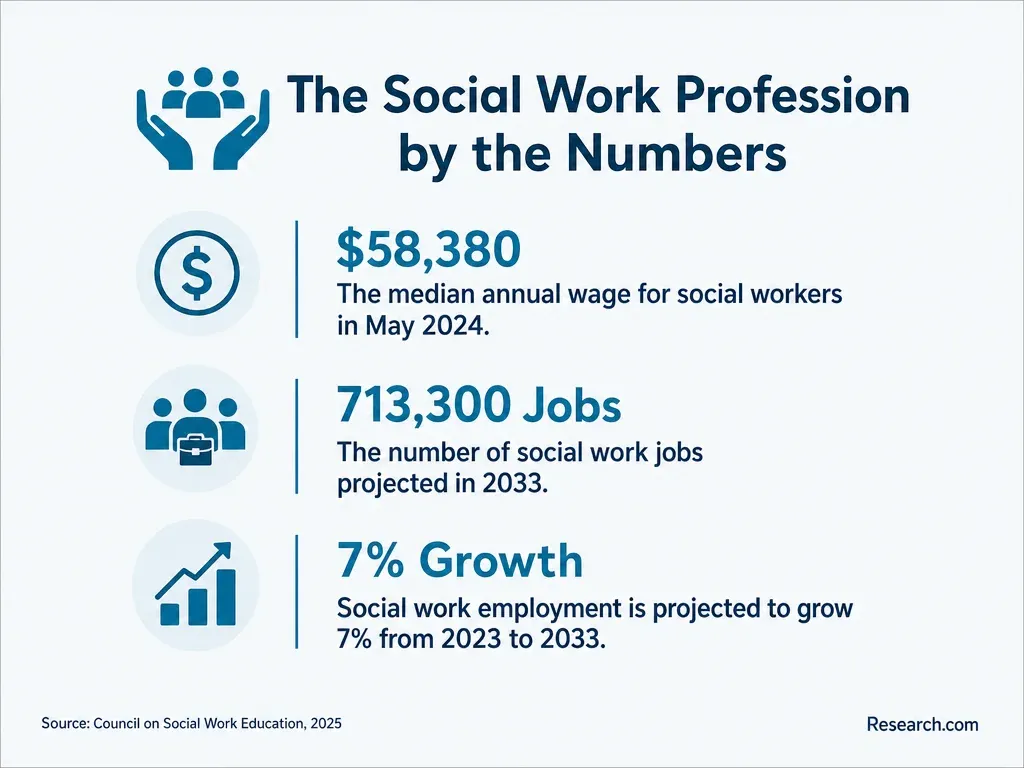
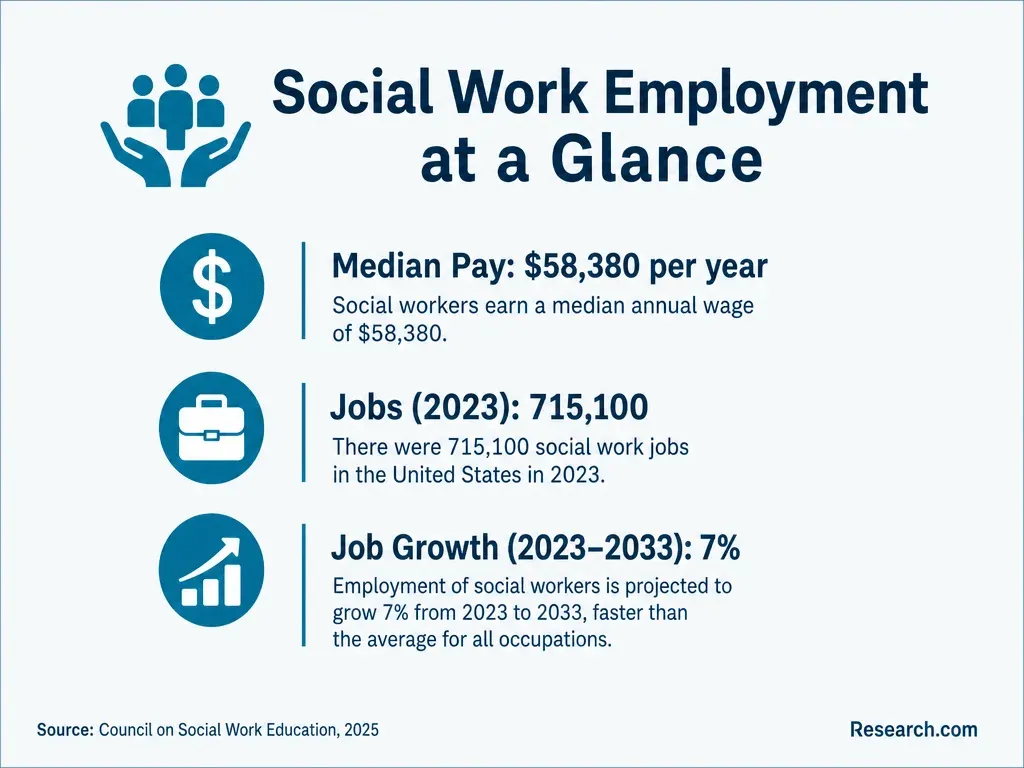
- The U.S. Bureau of Labor Statistics reports a $59,550 median annual wage for child, family and school social workers in May 2025 and projects 4% employment growth from 2025 to 2035; neither figure specifically describes coordinators.
What does a school district social work coordinator do?
A school district social work coordinator helps make social work services consistent and workable across schools. Depending on the district, the position may supervise or coach social workers, coordinate referrals and crisis-response planning, develop procedures, monitor service capacity, and represent social work in meetings with special education, student services and community partners. Some coordinators also serve students directly; others have primarily administrative duties.
The defining shift is from managing individual cases to supporting a districtwide system of practice. A coordinator might identify a referral backlog, work with principals and social workers to understand its causes, and propose staffing or workflow changes. That is different from independently making a student's clinical diagnosis or replacing each school's established safety and reporting procedures.
Before applying, compare the posting's actual authority with its title. Ask whether the coordinator evaluates staff, assigns caseloads, controls a budget, provides clinical supervision, travels between buildings or participates in after-hours response. Those differences can change both the required credentials and the job's fit. For context on adjacent options, see comparing jobs that use a social work master's degree.
What education is required to become a school district social work coordinator?
There is no single national degree requirement for this job title. District postings commonly seek an MSW, particularly when the coordinator guides school social workers or performs duties tied to a state school social work credential. A BSW may qualify someone for certain school-based or human services positions, but it should not be assumed sufficient for a district coordinator vacancy. The posting and applicable state rules decide.
For someone starting out, a BSW develops generalist social work preparation; social work bachelor's accreditation questions matter if the plan includes later MSW study or licensure. A graduate with a qualifying BSW may be eligible for an advanced-standing MSW, subject to the program's rules. Someone with a bachelor's in education, psychology or another field can generally consider a traditional or foundation MSW instead; that other bachelor's degree does not itself confer advanced standing.
An experienced school social worker should compare job postings before committing to a DSW, PhD or second master's degree. Those awards can serve particular leadership or research goals, but they do not automatically satisfy a missing state school credential or substitute for district-level experience. If postings instead emphasize staff development, budgets and implementation, targeted supervision or public-sector management training may be the more direct next step.
What licenses and school credentials do coordinators need?
Requirements can come from separate authorities: a state education agency may regulate school social work qualifications, a social work board regulates licenses and practice scope, and the district may impose additional hiring standards. A coordinator who provides clinical services or clinical supervision must also satisfy the rules governing those activities. An MSW alone does not authorize independent clinical practice.
The distinctions below help when reading a posting that lists several credentials together. Each serves a different purpose, and one should not be treated as an automatic substitute for another.
| Qualification | What it establishes | What to verify |
| Social work degree | Completion of an academic program | Required degree level and whether the program meets applicable education rules |
| State school social work credential | Eligibility for specified school-service duties | Issuing agency, grade or setting coverage, and renewal conditions |
| State social work license | Authority to practice within that license's scope | License category, status, supervision and clinical privileges |
| District or administrator qualification | Eligibility for a particular leadership position | Whether the vacancy requires supervisory experience or an additional credential |
Read the position description alongside current state education-agency and licensing-board requirements, then ask human resources which qualifications are mandatory on the start date. When considering a degree, online social work master's programs and state board requirements is a useful comparison topic, but the relevant authorities must confirm eligibility for your jurisdiction and intended duties.
The strongest preparation usually combines school-based service with evidence that you can improve how other professionals work. Direct practice teaches student and family engagement, school-team collaboration, documentation and referral judgment. District coordination adds coaching, conflict resolution, implementation planning and the ability to explain service needs without exposing confidential student information.
Useful experience includes contributing to multidisciplinary meetings, orienting newer staff, improving a referral process, building community partnerships and interpreting service data responsibly.
For a public-sector applicant, familiarity with staffing limits, budget cycles and district decision-making can be more relevant than another clinical course. An educator or human services manager changing careers may bring valuable leadership skills but still need the social work education and school qualifications specified in the posting.
Students can look for placements where they will observe both school-level practice and how services are coordinated across a district. Ask who supervises the learning, what tasks students may perform and whether the site can offer meaningful collaboration with school teams. Comparing faculty and agency support for MSW fieldwork can help frame those questions; a placement or prior job counts toward a program requirement only when the program approves it.
How can you choose an accredited social work program that meets state requirements?
Start with the state and district where you intend to work, then work backward to a program. Confirm the institution's accreditation and the exact BSW or MSW program's Council on Social Work Education accreditation status for your expected cohort.
Check separately with the state education agency about school social work qualifications and with the social work board about any license you may need. Neither institutional accreditation nor a program's general licensure claim settles every school-employment requirement.
Ask the program to identify its degree route, any school-focused curriculum, field-placement support in your location and restrictions on enrolling or placing students in your state. Get written clarification about requirements that could delay completion. Admissions details are secondary to career eligibility but still affect your options; for example, online MSW reference policy comparisons can help applicants prepare, provided they verify the current policy with each program.
Finally, take two or three actual coordinator postings to an admissions adviser and the relevant state authorities. Ask which stated qualifications the proposed degree addresses - and which would still require a separate credential, license or years of experience. That check is more useful than choosing a program solely because it advertises a school social work concentration.
Other Things You Should Know About Social Work
It depends on the contract. Ask whether the position follows the school year or has a longer administrative work year, and whether summer planning or student-service duties are expected.
Some do, but the amount of direct service varies widely. Clarify the expected caseload and whether student contact is routine, occasional or limited to consultation.
Not necessarily. School social work and teaching credentials serve different purposes. Check the state's rules and the exact district posting rather than assuming either credential substitutes for the other.
Ask how success is measured, who supervises the role, which decisions it can make, how staff support is organized and what resources are available across schools. The answers reveal whether the job's authority matches its responsibilities.
- Role of School Social Worker | NC DPI https://www.dpi.nc.gov/educators/specialized-instructional-support/school-social-work/role-school-social-worker
- Characteristics and Outcomes of School Social Work Services | nih.gov https://pmc.ncbi.nlm.nih.gov/articles/PMC10187493/
- | Protecting Student Privacy - Department of Education https://studentprivacy.ed.gov/
- Individuals with Disabilities Education Act (IDEA) | ed.gov http://www.ed.gov/laws-and-policy/individuals-disabilities/individuals-disabilities-education-act-idea
- Responding to Behavioral Crises | web https://www.schools.nyc.gov/school-life/special-situations/responding-to-behavioral-crises
- A Model for School-based Crisis Preparedness and Response | ojp.gov https://ovc.ojp.gov/sites/ovc/files/publications/bulletins/schoolcrisis/pg3.html
- Manager, Mental Health Services | nocccd.edu https://www.nocccd.edu/documents/manager-mental-health-services
- The Role of a School Social Worker from an Administratorâ | stthomas.edu https://researchonline.stthomas.edu/view/pdfCoverPage
- Special Education School Social Work Guidelines | dsisd.net https://www.dsisd.net/special_ed/school_social_work
- Prepare For Your Education | Council on Social Work Education https://www.cswe.org/prepare-your-education