
2027 Oncology vs Palliative Care Social Work: Shared Skills and Different Career Focuses
Audited and Verified:
Our Editorial and Data Verification Process
Research.com uses government datasets, official education statistics and primary institutional information to support its career and degree guides. Our review process checks factual accuracy, occupational definitions, source dates and the requirements associated with the credentials discussed.
How This Article Was Fact-Checked
Our editorial team verifies salary estimates, employment projections, education requirements and program information against original data providers and official organizations. Salary figures are checked against the relevant occupational definitions and reporting periods. Information about licensure, accreditation and required in-person training is reviewed separately.
Fact-checked and verified on:

Co-Founder and Chief Data Scientist
Oncology and palliative care social workers often support the same people, but their teams and day-to-day priorities can differ. That distinction matters if you are choosing a field placement, evaluating a job offer, or deciding whether you need an MSW or additional clinical training.
This guide compares the work, qualifications, pay context, and educational choices so you can pursue the setting that fits your interests - and avoid assuming that a specialty label tells you everything about the role.
Key Things You Should Know
- Oncology social work follows people affected by cancer across diagnosis, treatment, survivorship, recurrence, and sometimes end-of-life care; palliative care social work focuses on quality of life and support during serious illness, including illnesses other than cancer.
- Both roles use psychosocial assessment, family support, resource navigation, and teamwork. An MSW and appropriate state license may be required for particular jobs, but neither a concentration nor a specialty certificate independently authorizes clinical practice.
- The closest broad labor-market category, healthcare social workers, had a May 2025 median annual wage of $67,880 and projected employment growth of 8% from 2025 to 2035; those figures do not establish a pay difference between the two specialties.
How do oncology and palliative care social work differ?
Oncology describes a disease-focused service area; palliative care describes an approach to improving quality of life during serious illness. Palliative care can accompany treatment intended to cure or control cancer. An oncology social worker may therefore provide palliative support, and a palliative care social worker may serve people with cancer.
The comparison below shows which questions typically organize each role. Actual duties depend on the team, service line, and job description.
| Career focus | Oncology social work | Palliative care social work |
| People served | People with cancer and their families, across the cancer-care continuum | People with serious illnesses and their families, including but not limited to cancer |
| Common priorities | Adjustment to diagnosis, treatment access, financial and practical barriers, survivorship, recurrence | Distress related to illness, family communication, care preferences, caregiving strain, transitions in care |
| Typical team relationships | Oncology clinicians, navigators, infusion teams, and survivorship services | Interdisciplinary palliative teams working across medical specialties and care settings |
If you want to follow the effects of one disease through treatment and survivorship, oncology may fit better. If you prefer working across diagnoses and helping teams address the broader experience of serious illness, consider palliative care. Both paths can involve difficult conversations; neither is defined solely by end-of-life work. To see how these roles fit among MSW careers across different practice settings, compare actual postings rather than relying on specialty titles.
What degrees prepare you for oncology or palliative care social work?
A BSW prepares graduates for generalist social work roles, which may include resource coordination or patient support where an employer and state rules permit. Many hospital-based positions - particularly those involving complex psychosocial assessment or clinical services - seek an MSW. A traditional MSW can admit applicants with a bachelor's degree in another field; advanced-standing MSW entry generally requires a qualifying BSW and depends on the program's rules.
For either specialty, prioritize a program that offers healthcare field learning, strong supervision, and coursework relevant to illness and families over one that simply advertises a specialty name. A DSW or PhD is generally unnecessary for entry-level practice; those routes are more relevant to particular leadership, teaching, or research goals. If you already hold an eligible BSW, comparing advanced standing and standard MSW pathways can help you avoid repeating foundational study. Relevant experience can strengthen an application or job candidacy, but it does not replace a degree required by an employer or licensing board.
What licenses and certifications apply to these social work careers?
There is no single nationwide oncology or palliative care social work license. State boards set license categories, educational criteria, examinations where applicable, and requirements for supervised experience. Employers may require a license even for duties a state does not reserve exclusively for independently licensed clinicians. An MSW, field placement, or passed exam alone does not grant independent psychotherapy authority.
Specialty credentials can document additional experience or training, but they are separate from state licensure and are not automatically required for either career. Before paying for one, check its current eligibility rules and whether target employers recognize it. For a clinical job, confirm the required license level, permitted duties, supervisor qualifications, and whether the position supports your state's post-degree supervision requirements. Start with MSW programs and state licensure education requirements, then obtain a determination from the relevant state board rather than treating a program's general claim as approval.
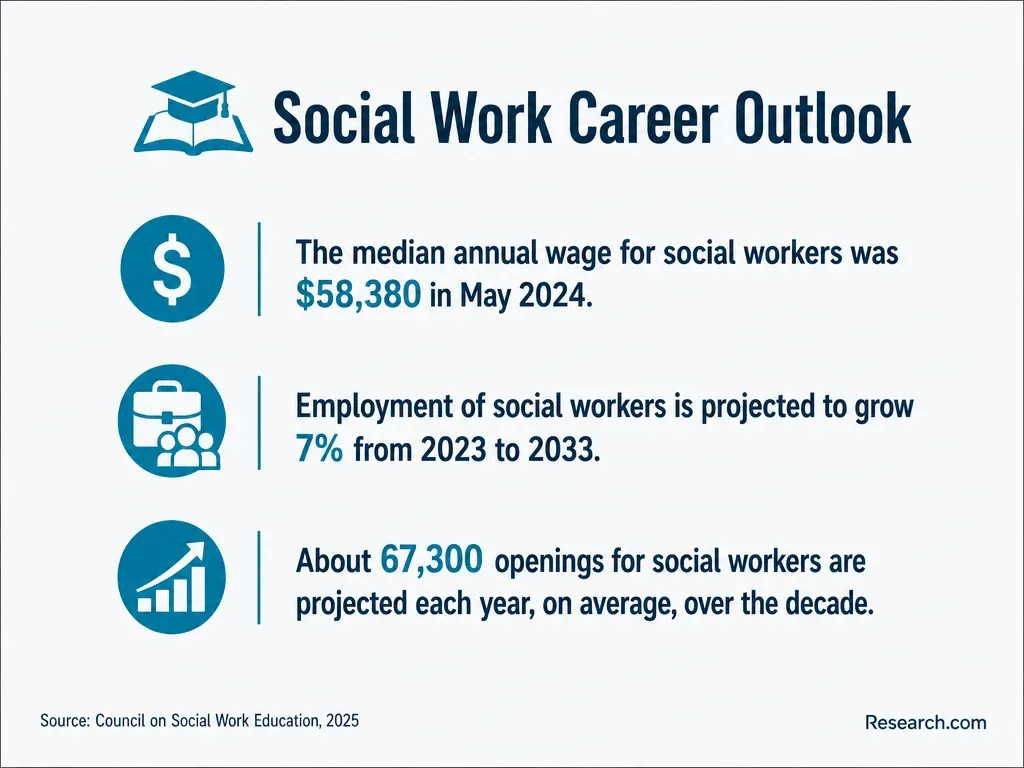
The U.S. Bureau of Labor Statistics does not publish separate national wage or growth estimates for oncology and palliative care social workers. Its healthcare social workers category is the closest broad comparison: the May 2025 median annual wage was $67,880, with employment projected to grow 8% from 2025 to 2035. That category includes other healthcare roles and cannot show which of these two specialties pays more.
For a realistic comparison, inspect local postings for required license level, hospital versus community employer, on-call duties, and benefits alongside salary. A position with a higher advertised wage may also require independent licensure or a more demanding schedule. Social work earnings across different state markets provide context, but use the employer's stated pay range and requirements to judge a specific opportunity.
Look for coursework addressing healthcare systems, person-in-environment assessment, grief and loss, chronic or serious illness, ethics, and work with families. For oncology, learning about treatment-related practical barriers and survivorship is useful; for palliative care, seek instruction on interdisciplinary communication and changing care needs. A course title alone cannot establish competence.
Field learning provides a better test of fit when the school approves the site and learning agreement. Ask whether a prospective placement offers observed psychosocial assessment, resource coordination, team meetings, documentation feedback, and regular field instruction. A cancer-center placement may expose you to palliative needs, while a palliative team may serve many people with cancer; ask about the actual caseload. Employment or volunteering does not automatically satisfy academic field requirements. Students considering a BSW route can compare online BSW program structures while checking how each school arranges and evaluates local placements.
How long do social work degrees take, and what do they cost?
A BSW usually follows a four-year undergraduate sequence, though transfer credit and enrollment pace change an individual timeline. A traditional MSW commonly takes about two academic years of full-time study; qualifying advanced-standing routes can be shorter. Part-time study, course sequencing, and placement availability can extend either route. A doctoral degree is not normally needed to begin work in these specialties.
Compare total cost to completion, not tuition alone: include fees, books, field-related travel, screening, possible reduced work hours, and later licensing expenses. Request each school's written cost estimate and field schedule, then compare them with realistic local job requirements and pay ranges. MSW tuition planning alongside career expectations is more useful than assuming either specialty will generate a particular return on the degree.
Other Things You Should Know About Social Work
No. Palliative care can be provided alongside treatment for a serious illness. Hospice is a distinct model of care with its own eligibility and service arrangements.
Yes, where employers offer those roles. Ask about training and supervision for developmentally appropriate communication, caregiver support, and working within pediatric team policies.
Ask about typical caseload, referral volume, orientation, supervision, documentation, on-call coverage, and access to interpreters and community resources. Those details often reveal more about workplace fit than the job title.
Some roles include bereavement support or referrals; others transfer follow-up to another team or community service. Confirm the employer's responsibilities and the limits of the position.
- Delineation of core roles of oncology social workers in... - PMC https://pmc.ncbi.nlm.nih.gov/articles/PMC11629305/
- Palliative Care in Cancer - NCI https://www.cancer.gov/about-cancer/advanced-cancer/care-choices/palliative-care-fact-sheet
- Palliative care | who.int https://www.who.int/news-room/fact-sheets/detail/palliative-care
- Levels and Eligibility Requirements | North Carolina Social Work Certification and Licensure Board https://www.ncswboard.gov/levels-and-eligibility-requirements/
- Hospice and Palliative Social Work | socialworkers.org https://www.socialworkers.org/Practice/NASW-Practice-Standards-Guidelines/NASW-Practice-Standards-for-Serious-Illness-Care-Hospice-and-Palliative-Social-Work
- Oncology social worker | Social Work | Research Starters | EBSCO https://www.ebsco.com/research-starters/social-work/oncology-social-worker/
- Role of the Hospice and Palliative Care Social Worker | Palliative Care Network of Wisconsin https://www.mypcnow.org/fast-fact/role-of-the-hospice-and-palliative-care-social-worker/
- Scope and Standards of Practice | AOSW https://aosw.org/resources/scope-and-standards-of-practice/
- Palliative Care | American Cancer Society https://www.cancer.org/cancer/supportive-care/palliative-care.html


