2027 Community-Based Participatory Practice in Social Work: Partnerships and Shared Decision-Making
Audited and Verified:
Our Editorial and Data Verification Process
Research.com uses government datasets, official education statistics and primary institutional information to support its career and degree guides. Our review process checks factual accuracy, occupational definitions, source dates and the requirements associated with the credentials discussed.
How This Article Was Fact-Checked
Our editorial team verifies salary estimates, employment projections, education requirements and program information against original data providers and official organizations. Salary figures are checked against the relevant occupational definitions and reporting periods. Information about licensure, accreditation and required in-person training is reviewed separately.
Fact-checked and verified on:

Co-Founder and Chief Data Scientist
A community program can be well funded and still miss what residents need if they have little say in its design. Community-based participatory practice gives people affected by a problem meaningful influence over priorities, services, and evaluation - not merely a chance to comment after decisions are made. This guide is for social work students, practitioners, and human services professionals who want to build those partnerships. It explains how shared decision-making works, where ethical and organizational limits apply, and which education or career steps are worth taking for your intended role.
Key Things You Should Know
- Participation is substantive when community partners can influence the question, resources, decisions, and interpretation of results - not just attend meetings.
- A useful partnership agreement specifies who decides what, how residents are compensated, how information is protected, and what happens when partners disagree.
- A BSW, MSW, or other degree may support this work, but many organizing and program roles do not require clinical licensure; check the actual job duties before choosing a credential.
What is community-based participatory practice in social work?
Community-based participatory practice is an approach in which social workers and people affected by a social issue work together to define the issue, choose a response, carry it out, and assess whether it helps. The community is a partner with knowledge and decision-making power, not simply a source of clients or survey responses. The approach may inform housing outreach, school-family partnerships, neighborhood safety initiatives, or improvements to public benefits access.
It overlaps with community-based participatory research, but practice is broader than research. A resident advisory group redesigning referral hours may be doing participatory practice without conducting a formal study. Either way, participation does not mean every person agrees or that professional obligations disappear. Social workers remain responsible for confidentiality, honest communication, role boundaries, and applicable law.
The distinction matters when choosing preparation. Someone aiming to organize residents and improve services should look for community and policy learning; someone aiming to provide psychotherapy needs different clinical preparation and, eventually, the authority required by their state. A guide to clinical MSW education options addresses that separate goal.
How do social workers build partnerships and share decisions with communities?
Start by learning who is already organizing around the issue, including informal leaders and people who are usually excluded from agency meetings. Then negotiate decision rights before requesting stories, data, or endorsements. A practical sequence is:
- Ask community partners which problem they want addressed and what earlier agency efforts got wrong.
- Agree on specific decisions residents can make or share, such as priorities, outreach methods, meeting times, or success measures.
- Budget for interpretation, accessibility, transportation, childcare, and compensation where feasible; unpaid participation can exclude those most affected.
- Record consent, privacy expectations, use of community contributions, and a process for resolving disagreements.
- Report back on decisions and results, including recommendations the agency could not adopt and why.
Shared power must be real but cannot exceed an agency's legal authority, funding conditions, or a professional's licensed scope. A social worker can invite residents to shape an outreach program without allowing a committee to access confidential case files or make an individual clinical decision. If a proposed role includes regulated practice, comparing graduate social work programs for licensure planning is a separate step from designing the partnership.
What degrees prepare you for community-based participatory social work?
Choose education according to the work you want to do, not the assumption that the highest degree gives communities the most influence. A BSW provides generalist social work preparation; an MSW can add specialized community, policy, or organizational study. A traditional MSW can admit graduates of other disciplines, while advanced standing generally requires a qualifying BSW and satisfaction of the individual program's rules.
For a nonprofit organizer or program coordinator, relevant experience and targeted training may be more direct than another degree if employers do not require one. An MPH or MPA may fit a primarily public health or government-management goal. A practice-oriented DSW can support experienced practitioners pursuing applied leadership, while a research-oriented PhD better fits a goal of producing original scholarship. If doctoral study is genuinely necessary, comparing social work doctorate completion timelines can help identify scheduling questions to ask programs; neither doctorate automatically grants new practice privileges.
Look for instruction in community organizing, social policy, program evaluation, research methods, ethics, and work with organizations - not only courses labeled "macro practice." Strong assignments require students to examine whose priorities shaped a program, how decisions were documented, and whether results were returned to participants.
A relevant field placement might involve a resident coalition, housing organization, school-community initiative, or public agency. Ask the field office whether students can participate in community meetings, receive supervision on power and conflict, and contribute to an approved project with a feasible deliverable. Compare these opportunities when reviewing accredited BSW coursework and placement comparisons. A current job or volunteer role counts as field education only if the program approves the arrangement and its learning requirements.
A useful student deliverable could be an accessible meeting plan or a summary of themes from feedback the agency has authorized the student to use. It should not include identifiable client information or claim community approval that was never obtained.
What are the salary and job outlook for community-based social workers?
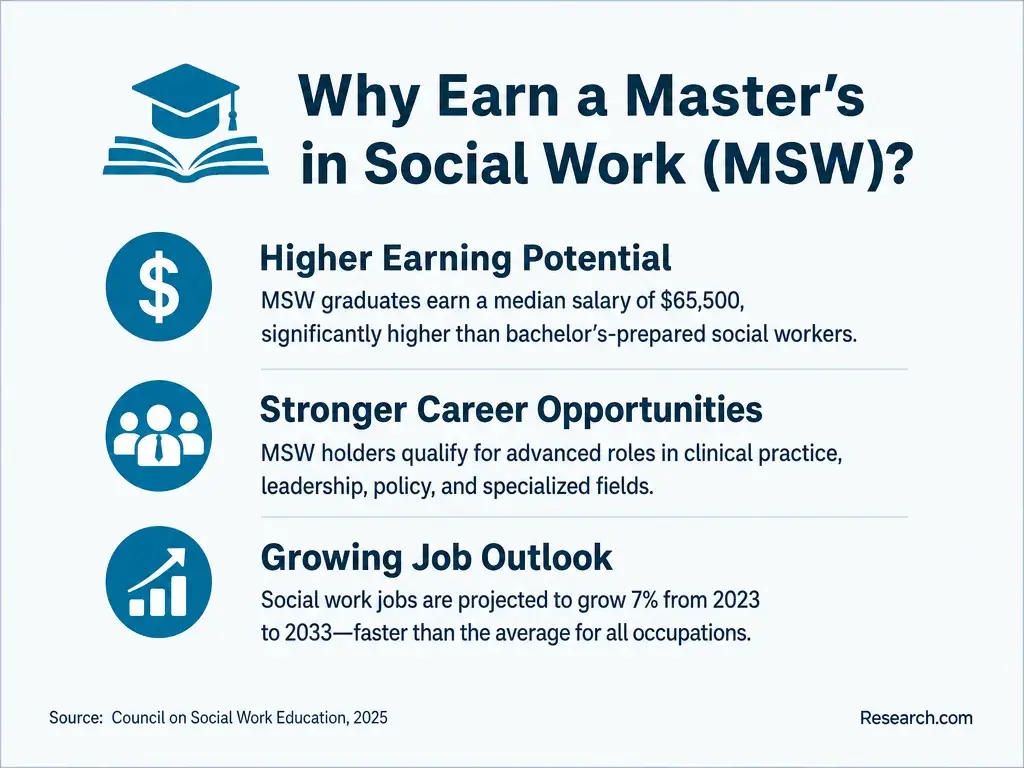
There is no single federal wage category for "community-based participatory social worker." The following U.S. Bureau of Labor Statistics figures provide context for social work occupations, not a predicted salary for a community organizer or an individual graduate.
| U.S. occupation | Median annual pay, May 2025 | Projected employment growth, 2025-2035 |
| Social workers, all specialties | $61,780 | 6% |
| Child, family, and school social workers | $59,550 | 4% |
| Healthcare social workers | $67,880 | 8% |
| Mental health and substance abuse social workers | $60,280 | 10% |
These categories include many jobs centered on individual services rather than community governance. For a specific offer, compare the employer's pay range, location, funding stability, qualifications, and time spent on organizing versus casework. Salary context for geographically mobile MSW graduates can inform a location comparison, but local job postings are more useful for estimating pay in a particular participatory role.
Other Things You Should Know About Social Work
Compensation can reduce barriers and recognize expertise. Agree on amounts and eligibility in advance, check funder and agency rules, and explain any effect on benefits or taxes without assuming one rule applies to everyone.
No single resident or organization represents everyone. Seek perspectives across affected groups, be clear about how participants were selected, and avoid presenting an advisory group's views as unanimous community consent.
Document the disagreement and the reasons for the agency's constraints. Share what can still change, invite a workable alternative, and report back rather than describing consultation as agreement.
Not always. Routine program feedback and research can have different oversight requirements. Before collecting or sharing information, ask the agency and relevant institutional reviewers what approvals, consent, and privacy safeguards apply.
- Skills for Developing and Maintaining Community... - PMC https://pmc.ncbi.nlm.nih.gov/articles/PMC6742583/
- A Best Practices Guide for Recruitment, Hiring and Retention | chairs-chaires.gc.ca https://www.chairs-chaires.gc.ca/program-programme/equity-equite/best_practices-pratiques_examplaires-eng.aspx
- Read the Belmont Report | hhs.gov https://www.hhs.gov/ohrp/regulations-and-policy/belmont-report/read-the-belmont-report/index.html
- Collaborative Governance Model: Authority and Accountability | Strategic Growth Council https://sgc.ca.gov/tools/catalyst-models/collaborative-governance/authority-accountability/
- Harnessing the Power of Community Engagement for Population Health | cdc.gov https://www.cdc.gov/pcd/issues/2025/25_0189.htm
- Section 2. Community-based Participatory Research | ku.edu https://ctb.ku.edu/en/table-of-contents/evaluate/evaluation/intervention-research/main
- Research Ethics and Informed Consent | Educational Research Basics by Del Siegle https://researchbasics.education.uconn.edu/ethics-and-informed-consent/
- Assessing Meaningful Community Engagement | NAM https://nam.edu/perspectives/assessing-meaningful-community-engagement-a-conceptual-model-to-advance-health-equity-through-transformed-systems-for-health/
- Principles for Partnering with Community Organizations | buffalo.edu https://socialwork.buffalo.edu/about/diversity-and-social-justice/principles-partnering-community-organizations.html