2027 Changing MSW Concentrations Mid-Program: Credits, Field Placement, and Graduation Timing
Audited and Verified:
Our Editorial and Data Verification Process
Research.com uses government datasets, official education statistics and primary institutional information to support its career and degree guides. Our review process checks factual accuracy, occupational definitions, source dates and the requirements associated with the credentials discussed.
How This Article Was Fact-Checked
Our editorial team verifies salary estimates, employment projections, education requirements and program information against original data providers and official organizations. Salary figures are checked against the relevant occupational definitions and reporting periods. Information about licensure, accreditation and required in-person training is reviewed separately.
Fact-checked and verified on:

Co-Founder and Chief Data Scientist
Changing your MSW concentration can redirect your training toward the work you want to do, but the timing matters. A course that counts toward your degree may not satisfy the new concentration, and a placement already underway may need different learning objectives or an entirely new site.
For current MSW students - especially those balancing fieldwork with jobs or caregiving - this guide explains what can carry over, what might delay graduation, and which written approvals to obtain before you commit.
Key Things You Should Know
- You may be allowed to switch concentrations, but the MSW program must approve the change; admission to the degree does not guarantee a place in every specialization or field sequence.
- Completed courses and documented field hours do not automatically satisfy the new concentration. Ask for a revised degree audit and field-learning review before changing your schedule.
- Graduation and cost depend chiefly on required courses, when they are offered, placement availability, and aid eligibility - not simply on the number of credits you have already earned.
Can you change your MSW concentration after starting the program?
Often, yes, but the decision belongs to your program. An MSW concentration is a defined set of specialized courses and, frequently, related field-learning requirements. Schools may call it a specialization, focus, or practice area. A change can require advisor approval, an application, available seats, a minimum grade or academic standing, and field-office clearance.
Start with the catalog and handbook that apply to your entering cohort. Ask the MSW director or advisor for the change procedure and effective term, then confirm whether a separate field-placement decision is needed. If you entered through advanced standing, ask specifically whether the new concentration fits its compressed specialized sequence; understanding advanced standing versus standard admission can help clarify why the two routes are not interchangeable. Do not withdraw from a required course or accept a new placement until the program confirms the plan in writing.
Will your completed credits count toward a new MSW concentration?
Credits can remain on your transcript without fulfilling the requirements you need to graduate under the new concentration. The crucial distinction is between earned credit and credit applied to a specific requirement. A revised degree audit should show both, including any institutional residency or maximum-elective limits.
This comparison shows why the number of credits already earned is not, by itself, a reliable measure of how close you are to finishing.
| Completed work | Possible treatment after a switch | What needs confirmation |
| MSW foundation or generalist courses | Often continue to meet shared degree requirements | Whether the new plan uses the same catalog requirements |
| Specialized course from the former concentration | May become an elective or excess credit | Whether an approved substitution meets the new requirement |
| Field seminar and placement credit | May remain earned credit without completing new specialized field requirements | Approved competencies, evaluations, and remaining field sequence |
| Certificate or outside graduate coursework | May count only within program limits | Equivalency, transfer, residency, and elective rules |
Send the advisor relevant syllabi and your current degree audit, and request written decisions on substitutions rather than relying on course-title similarities. If excess credits mean another term of enrollment, compare the resulting charges using online MSW tuition and fee considerations; an accepted credit does not necessarily prevent an additional tuition bill.
How does changing MSW concentrations affect your field placement and hours?
The field office must determine whether your current agency, field instructor, supervision, and learning tasks can support the new concentration's competencies. For example, a placement centered on individual clinical services may not offer enough approved opportunities for community organizing or policy work. Conversely, changing to a clinical focus does not automatically turn prior macro-practice activities into clinical learning.
Ask the field director to review your learning agreement, logged hours, supervision records, and evaluations. The school may approve revised objectives at the same site, arrange additional tasks, require a different placement, or schedule another field term. Do not assume recorded hours disappear - or that they automatically meet the new requirements. If a site change is possible, ask who secures it and when onboarding can begin. A guide to choosing an MSW program with structured field support can also help you frame questions about matching and placement responsibility.
Academic field hours are part of the degree. They are not automatically post-degree supervised hours toward clinical licensure, even if the activities appear similar.
Not necessarily. A switch may fit your original graduation date if your completed work satisfies shared requirements, the new courses are available on time, and the field office can approve a compatible placement. The greatest delay risk is a required course or field sequence offered only in certain terms.
Request a term-by-term graduation plan showing remaining courses, prerequisites, field seminar, placement start and end dates, and the earliest realistic completion term. Ask whether a course substitution, summer offering, or different approved placement could preserve your timeline. Faster graduate social work study routes may provide useful context, but an accelerated schedule cannot bypass the requirements your program applies to your cohort.
If you work or provide care, test the revised plan against actual agency hours, live classes, travel, and onboarding - not just the published course load. A nominally on-time plan is less useful if its field schedule is impossible for you to complete.
The cost is program-specific. Calculate the difference between your approved current plan and proposed new plan, including extra tuition and fees, books, placement travel, screening, childcare, and paid work you might forgo during another field term. A course that becomes an unused elective may still be a sunk cost, even when it remains on your transcript.
Contact financial aid before adding or dropping courses. Ask whether the new plan changes your enrollment intensity, satisfactory academic progress, maximum eligibility period, scholarship terms, employer reimbursement, or assistantship obligations. If an assistantship is part of your budget, review MSW assistantships and study workload considerations alongside the proposed field schedule. Aid and work arrangements are determined by their own rules; program approval of a switch does not guarantee continued funding.

CSWE accredits social work programs, not individual concentrations as separate licenses. Switching concentrations within the same accredited MSW program ordinarily does not, by itself, change the degree program's accreditation status. Verify the exact program and applicable accreditation status with the school, particularly if the proposed change also involves a different institution or degree route.
Licensure is a separate state-board decision. Some states or employers may examine particular coursework, field experiences, or other qualifications for a target role. Ask the board in the state where you intend to practice about its education rules, and ask your program how the proposed plan documents relevant coursework and field learning.
Understanding which social work hours may count is especially important if your long-term goal is clinical licensure: MSW field education does not automatically replace required post-degree supervised practice. Neither a clinical concentration nor graduation grants independent clinical authority.
The answer depends on the new concentration's required sequence and what your program approves from your completed work. A move toward clinical practice might involve different assessment or intervention courses; a move toward macro practice might require policy, community practice, administration, or evaluation coursework. The particular titles and prerequisites vary by school.
Compare the old and proposed plans course by course, including field seminars, electives, and any capstone. Ask which requirements permit substitution and whether a prerequisite must be completed before the next course is offered.
If a specific license is your goal, compare the plan with the applicable board's rules rather than assuming a concentration label settles eligibility; understanding degree and licensing expectations for MSW study provides a starting point for that distinction.
They can. A school may offer different concentrations, electives, course rotations, or field-site networks by format or campus. Even when the concentration name is identical, an online student may face live class meetings, skills sessions, placement geography restrictions, or required visits that affect whether a mid-program switch is feasible.
Ask for the course schedule and field-placement rules for your format and location, not just the general program catalog. Check whether switching requires a campus or modality change and whether that changes tuition or authorization to enroll and complete fieldwork where you live. For a broader comparison of formats, see understanding online social work degree choices. Online coursework does not remove agency-based field obligations.
A concentration can make your coursework and field experience more relevant to a target job, but employers also assess the actual population served, demonstrated skills, license status, and experience. Check several job postings before switching: if they require an MSW and particular experience but not a named concentration, a new placement or elective may be more useful than delaying graduation.
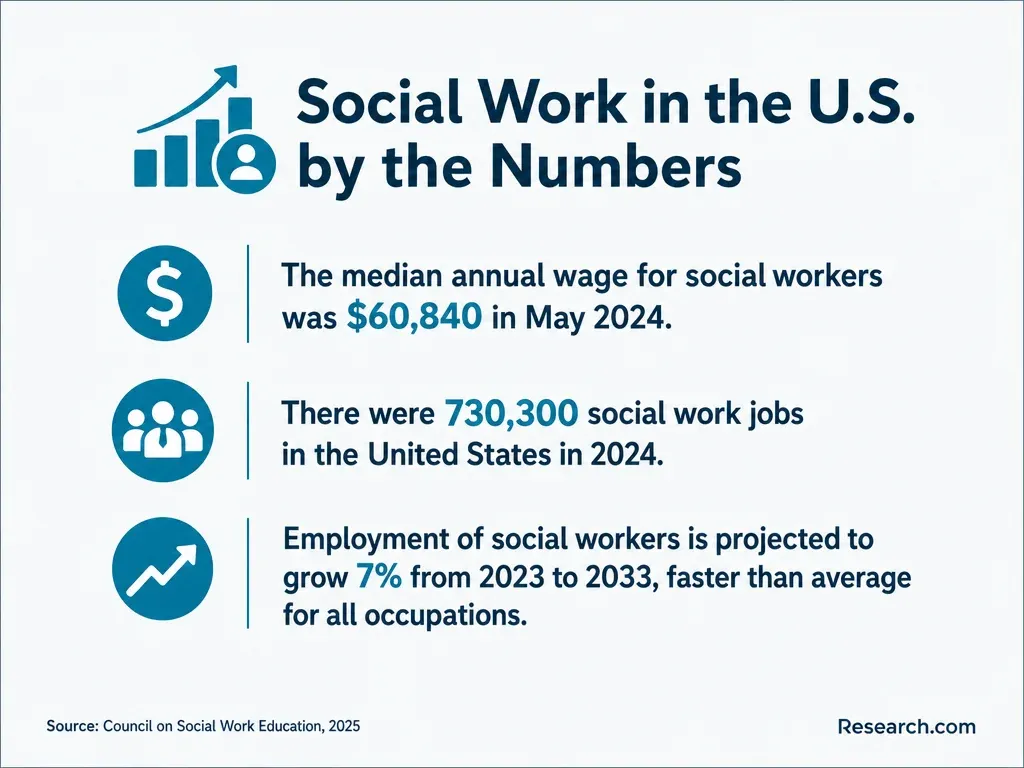
U.S. Bureau of Labor Statistics figures illustrate why setting matters more than a concentration label when comparing broad career markets. For May 2025, BLS reports a median annual wage of $67,880 for healthcare social workers and $60,280 for mental health and substance abuse social workers, with projected employment growth of 8% and 10%, respectively, from 2025 to 2035.
These are occupation-wide U.S. figures - not starting salaries or outcomes for graduates of either concentration. Local wages, employer requirements, and licensing rules may differ; MSW salary comparisons by state can help put a target location in context.
What are your alternatives if you cannot change your MSW concentration?
A denied or impractical switch does not necessarily close off your target career. The best alternative depends on the gap: missing course content, unsuitable field experience, an employer qualification, or a state-board requirement. First, ask the program which options it will approve without changing your concentration.
Possible routes include a relevant elective or approved course substitution, a revised learning agreement at your current site, a different approved placement, or targeted training after graduation. If the target role requires a license or specific education, verify those requirements before paying for a certificate or relying on work experience. A guide to professional pathways after an MSW can help you identify roles that value your existing preparation.
Before deciding, obtain a written comparison of both paths: requirements met, requirements still missing, field approvals, earliest graduation term, and estimated additional cost. That record makes it easier to choose based on the qualification you need rather than the concentration name alone.
Other Things You Should Know About Social Work
That depends on the university's records policy. Ask the registrar how the concentration is recorded and request an example of the notation if it matters to an employer.
Possibly, but a return may require another approval and may not restore a previous course seat or placement. Ask the program about reversal rules before filing the first change.
Ask which catalog requirements govern your cohort and whether the change affects your degree audit. A renamed concentration does not necessarily mean your requirements have changed.
You can ask, but the program may restrict changes or require an academic recovery plan first. Get the decision and any conditions in writing from the authorized program office.
- Disbursing Title IV Funds | 2025-2026 Federal Student Aid Handbook https://fsapartners.ed.gov/knowledge-center/fsa-handbook/2025-2026/vol4/ch2-disbursing-title-iv-funds
- Program Completion & Graduation | solacc.edu https://catalog.solacc.edu/content.php
- Field Education Program FAQ | University of Nevada, Reno https://www.unr.edu/social-work/field/faq
- Academic Rules - Course Catalog - Syracuse University https://coursecatalog.syracuse.edu/graduate/academic-rules/
- Graduate Policies & Procedures - San José State University https://catalog.sjsu.edu/content.php
- Financial Implications: Withdraw from IU: Register | Student Central https://studentcentral.indiana.edu/register/withdraw/financial-implications.html
- School of Education - Answers - Syracuse University https://answers.atlassian.syr.edu/wiki/spaces/SOE/pages/157225487/Field+Instruction+Manual+Social+Work
- Graduate Major Concentrations | Rice University https://graduatecouncil.rice.edu/proposal-guidelines/graduate-major-concentration-proposal-guidelines
- Master of Social Work Field Education Manual | Academics at Walden University https://academicguides.waldenu.edu/msw-field-education-manual/field-education
- Online MSW Advanced Standing Pathway | Columbia MSSW https://onlinemsw.socialwork.columbia.edu/online-msw-advanced-standing/