
Most Affordable Welding Schools & Training - Budget-Friendly Welding Trade Programs in Davenport for 2026

Co-Founder and Chief Data Scientist
Looking for the most affordable welder trade schools in Davenport for 2026? This article introduces a carefully crafted welder trade school programs ranking developed by the Research.com team of data scientists. It’s designed to help you make an informed decision about which programs truly stand out in quality and value.
Whether you’re starting a new career or upgrading your skills, earning a welder diploma or certification opens doors to rewarding job opportunities. Reading this guide will give you clarity and confidence on your educational path.
Key benefits of finishing welder trade school in Davenport
- Graduates of welder trade schools in Davenport can expect an average hourly wage around $22.16, with opportunities to earn more as they gain experience or specialize.
- Career paths include manufacturing welding, which offers annual salaries averaging $47,621, along with chances to work in construction, repair, or advanced welding roles.
- Completing a welder trade school online provides flexibility and faster completion times, allowing students to balance work or family commitments while gaining valuable skills.
- Most Affordable Welding Schools & Training - Budget-Friendly Welding Trade Programs in Davenport for 2026
- What can I expect from welder trade schools in Davenport?
- Where can I work after finishing welder trade schools in Davenport?
What can I expect from welder trade schools in Davenport?
Expect hands-on training combining classroom lessons with practical labs at Davenport trade schools like Eastern Iowa Community Colleges. Graduates often mention how mastering techniques such as Gas Metal Arc Welding (GMAW) and Shielded Metal Arc Welding (SMAW) in well-equipped facilities gave them confidence on day one of their jobs. You'll learn to read blueprints, interpret welding symbols, and follow essential safety protocols, often earning an OSHA 10 General Industry Card that employers value.
Programs are flexible: some students complete certificates in as little as eight weeks, while others pursue diplomas or associate degrees over two years. Many share how this flexibility helped them balance work or family commitments while advancing their skills. You should also be prepared to supply your own safety gear, like auto-darkening helmets and steel-toed boots, which is standard at local schools.
Students appreciate that these programs cover vital topics like plasma cutting and metallurgy, making them job-ready for manufacturing, repair, or fabrication roles in Davenport's strong welding job market. Financial aid options and scholarships can ease tuition costs, helping you focus on gaining practical skills that lead to steady employment.
Where can I work after finishing welder trade schools in Davenport?
Graduates from welder trade school programs in Davenport typically find jobs in manufacturing, construction, metal fabrication, and machinery maintenance. Many start at local manufacturing companies, working on assembly lines or creating custom metal parts. These positions offer hands-on experience and steady hours, which recent graduates often appreciate as they build their skills.
Some graduates land roles with companies like The George Evans Corporation or Allredi, where pay ranges from $18 to $28.50 per hour. These employers often provide flexible shifts, making it easier to balance work with further education or personal commitments. Part-time and contract welding jobs also exist, with wages varying between $17 and $43 per hour depending on specialization.
Others find opportunities in construction firms, contributing to infrastructure projects such as bridges and commercial buildings. Over time, experienced welders can move into maintenance roles or advance to supervisor and trainer positions, adding certifications along the way. Trade schools in Davenport prepare students well for these varied career paths, supporting a stable entry into the local job market.
After completing a welder trade school program in Davenport, graduates typically see starting salaries ranging from the low- to mid-$40,000s up to the mid-$50,000s annually. For example, many recent graduates from popular local trade schools report beginning their careers earning around $48,000 a year, which aligns with Salary.com's average annual entry-level salary of $48,253 as of June 2025.
Hourly wages help put this in perspective: welders in Davenport earn an average of $23.52 to $28.26 per hour, depending on experience and specialization. Graduates often share how these wages translate into steady paychecks, allowing them to cover living expenses comfortably while gaining on-the-job skills.
Manufacturing roles, a common path for trade school completers, offer salaries around $47,600 annually, with potential to grow as skills improve. Some more experienced welders report earnings closer to $62,000 a year, showing clear financial upside after gaining experience beyond initial training.
For those finishing a welder program in Davenport, the numbers reflect solid, realistic opportunities to build a rewarding career with growing income potential.
- Welding programs in Davenport offer hands-on training in key techniques like GMAW, SMAW, FCAW, and GTAW, with classes available during day and evening hours.
- Entry requirements typically include a high school diploma or GED, with some programs allowing high school students to start early and earn a certificate before graduation.
- Tuition costs vary, but Iowa's Last-Dollar Scholarship may cover most or all tuition for eligible students, and financial aid is widely available.
- Certificate programs can be completed in less than a year, while associate degrees take up to two years to finish.
- Starting salaries for welders in Iowa average around $40,000 per year, with experienced welders earning between $55,000 and $60,000 annually depending on certifications and specialization.
Completing a welder trade school program in Davenport typically takes between six months and one year, depending on the intensity and structure of the course. Many students at well-known Davenport trade schools find that accelerated programs, often offered as full-time day classes, allow them to finish in as little as six months, enabling them to enter the workforce quickly and start earning.
On the other hand, part-time or evening welding courses cater to those balancing work or family commitments, extending completion time closer to a year. Graduates frequently share their satisfaction with this flexibility, noting how it helped them manage real-life responsibilities while gaining hands-on skills.
For example, a typical student attending a popular Davenport trade school might spend mornings in practical welding labs and afternoons in classroom theory, completing their certification efficiently. These programs emphasize practical experience, so students feel confident stepping into welding roles immediately after graduation, which adds to their enthusiasm and motivation throughout the course.
On-campus welder trade school programs in Davenport focus heavily on hands-on training, dedicating about 80% of the time to practicing welding in fully equipped labs. Graduates from schools like Tulsa Welding School often recall spending long hours mastering techniques under the watchful eyes of skilled instructors, which built their confidence and real-world skills quickly. This direct interaction with equipment and peers creates a learning environment that many find motivating and supportive.
In contrast, online programs mainly offer theoretical lessons such as blueprint reading and safety protocols but lack supervised, practical welding sessions. Online students frequently share that while the flexibility helps manage their schedules, they must independently find local workshops or return to campus to complete essential hands-on training. This can be frustrating for those eager to develop tactile skills essential for certification and employment.
For Davenport students aiming to enter the welding workforce, on-campus programs provide immediate feedback and networking opportunities that online formats cannot fully replicate, making them a more reliable path to mastering the trade.
The average cost of welder trade school in Davenport varies depending on the institution and program length. For example, graduates from the Blong Technology Center, a popular local option, report a total cost of about $9,332 covering tuition, books, fees, and other expenses for their Structural Welding program. This figure gives a practical benchmark for those considering welding program tuition fees in Davenport Iowa, helping students plan their budgets with clearer expectations.
Some graduates appreciate that the tuition includes access to modern equipment and hands-on training, which prepares them confidently for the workforce. Nearby, others have chosen a more intensive option like a seven-month program in Moline, Illinois, combining theory and practice, although specific costs for that program are less transparent. Meanwhile, others aiming for advanced skills look to programs like Kirkwood Community College in Cedar Rapids, where the estimated total cost can reach around $21,547.75 for in-state students, reflecting the investment required for specialized welding technologies.
Students often find that understanding these cost variations upfront helps them weigh options realistically, even exploring scholarships and grants to ease the burden. For those seeking alternatives, there are affordable options through online platforms that offer training in related fields, such as cheapest maintenance technician training online, to consider alongside traditional programs.

Welder trade school students in Davenport often start by completing the Free Application for Federal Student Aid (FAFSA), which opens doors to federal grants, loans, and work-study programs. Graduates from popular local schools share how the Pell Grant helped cover significant costs without the stress of repayment, making it easier to focus on hands-on training. Federal loans, both subsidized and unsubsidized, provide additional support; subsidized loans pause interest while you study at least half-time, easing financial pressure during school.
State aid is a game-changer for many. Iowa's Last-Dollar Scholarship covers remaining tuition after federal and state aid, often allowing students to attend tuition-free. For example, several Davenport welding students who met the FAFSA deadline and income limits saw their tuition fully covered, removing a major barrier to completing their programs.
Local trade schools and community colleges also offer scholarships and grants based on need or merit, plus work-study options that combine earning with real welding experience. Connecting with your school's financial aid office early can unlock personalized aid opportunities tailored to welding students in Davenport.
To enroll in a welder trade school program in Davenport, students typically need a high school diploma or GED. This basic educational foundation ensures you're ready for the technical coursework ahead. Graduates from local trade schools often recall how this prerequisite helped them quickly grasp essential concepts.
Beyond formal education, schools in Davenport usually expect you to demonstrate basic math skills, as welding requires precise measurements. Some programs may ask for a simple skills assessment or an interview to gauge your commitment and readiness.
Physical fitness is another practical requirement. Welding demands manual dexterity and stamina, so being comfortable with hands-on work and standing for extended periods is essential-something many successful graduates highlight as key to their positive experience.
Additional prerequisites might include:
- Proof of residency or age (usually 18+)
- Basic understanding of safety protocols
- Ability to pass a drug screening or background check, depending on the school
These requirements set you up to thrive in Davenport's welding programs, making the hands-on training smoother and more rewarding. Many graduates emphasize that meeting these criteria helped them stay confident and focused throughout their studies.
Welder trade school programs in Davenport focus on a practical mix of classroom learning and hands-on training to prepare students for real-world welding jobs. Graduates often recall starting with essential workplace safety courses, including OSHA 10-hour General Industry training, which builds confidence by emphasizing safe practices in industrial settings.
Core courses typically include:
- Introduction to Welding and Welding Fundamentals that explain welding processes and metal properties
- Gas Metal Arc Welding (GMAW/MIG), Shielded Metal Arc Welding (SMAW/Stick), Flux Core Arc Welding (FCAW), and Gas Tungsten Arc Welding (GTAW/TIG) taught both theoretically and in well-equipped labs
- Blueprint reading and interpreting welding symbols to prepare students for project specifications
- Metallurgy basics, welding defects, and metal cutting methods like plasma and oxy-acetylene cutting
For example, at Eastern Iowa Community Colleges, students spend extensive lab hours honing welding techniques, which many graduates say made them feel ready for the workforce. Black Hawk College offers intensive short courses such as a 6-week Production MIG Welding program, where students experience a majority of hands-on practice, often boosting their confidence quickly. Personal protective equipment is always a must, reinforcing the program's real-world readiness.
Students enrolled in welder trade school programs in Davenport typically specialize in techniques that directly prepare them for diverse welding careers seen in local industries. For instance, Eastern Iowa Community Colleges offer training in Gas Metal Arc Welding (GMAW), which is valued for its speed and adaptability in manufacturing settings.
Other popular specializations include Shielded Metal Arc Welding (SMAW), or stick welding, favored by graduates working in outdoor and heavy-duty welding jobs due to its reliability in tough conditions.
Kirkwood Community College focuses on Gas Tungsten Arc Welding (GTAW), ideal for welders who want to produce precision welds on thin materials, a skill praised by employers requiring high-quality finishes. Additionally, Flux Core Arc Welding (FCAW) is taught for thicker metal work suited to the construction sector.
Blueprint reading and welding symbols are core parts of the curriculum, ensuring students can accurately interpret project plans, a necessity in any welding role.
Lastly, Oxy-Fuel Welding and Cutting rounds out the practical skills necessary for cutting and brazing tasks. Many graduates recall how hands-on learning at these schools made the techniques tangible and sparked their confidence.
Understanding what trades are in demand locally helps students choose the specializations that best align with career opportunities in Davenport's welding industry.
Choosing from the affordable welder trade schools in Davenport means focusing first on accreditation and hands-on training. Graduates from Eastern Iowa Community Colleges often share how their AWS-accredited program gave them confidence with real MIG and TIG welding tasks, bridging the gap between theory and daily work demands. Meanwhile, students at Midwest Technical Institute praise the access to up-to-date equipment and career placement support, which eased their transition into local industries.
Program length and flexible schedules matter too-whether you need evening classes to balance work or a quicker path to certification. Many find that schools offering tailored schedules help maintain motivation and life stability during training.
When budgeting, remember to compare tuition and aid options carefully. Some students reduce costs by choosing scholarships alongside their course. For those seeking more cost-effective pathways, checking out cheapest online welding trade school programs can expand your options beyond Davenport's borders.
Finally, look at instructor expertise and job placement rates. Knowing your teacher has real-world experience and that the school actively supports employment will give you peace of mind as you start welding your career.

Welder trade school graduates in Davenport enjoy a wide range of career paths thanks to the area's robust industrial landscape. Many find rewarding roles in manufacturing, working with metal fabrication, assembly, and advanced welding equipment such as gas metal arc welding (GMAW) or shielded metal arc welding (SMAW). Graduates from local trade schools quickly secure positions in small shops or large manufacturers where their practical skills are highly valued.
Construction is another key sector where welders contribute to infrastructure, commercial development, and bridge projects. Workshop experiences shared by recent graduates emphasize hands-on training that prepares them for high-demand roles as specialty trade contractors or maintenance workers. In addition, the transportation and defense industries offer jobs assembling, repairing, and modifying vehicles and equipment.
Job openings in Davenport also include roles like pipefitters, technicians, and maintenance mechanics, all of which leverage welding expertise. Graduates appreciate the ability to enter the workforce swiftly after programs lasting as little as eight weeks. If you're considering what is the difference between a trade school and a vocational program, many students find that local trade schools provide targeted welding education paired with career support.
- Manufacturing and fabrication
- Construction and infrastructure projects
- Transportation vehicle assembly and repair
- Defense equipment maintenance
- Pipefitting and mechanical technician roles
Graduates of welder trade schools in Davenport face a strong and diverse job market. With over 27 welder jobs and around 70 welding-related openings currently available, opportunities are abundant in manufacturing, construction, and fabrication sectors. Many graduates from popular local trade schools share that their hands-on training in interpreting technical drawings and mastering precise welding techniques directly matched employer expectations. This alignment helps them confidently step into roles ranging from fabricator/welder to pipefitter and maintenance mechanic.
Welding career opportunities Davenport 2026 look promising, especially as local employers seek candidates with solid foundational skills. Entry-level salaries typically range from $27,000 to $49,000 annually, slightly below the national average but with clear growth potential. Nearby cities show even higher wages, motivating graduates to build experience and certifications.
Those aiming to enter the welder job market in Davenport IA should consider that recent regional job posts offer between $18 and $23.75 hourly rates, which reflect the market demand. Graduates often describe the transition from training to employment as smooth and rewarding. To explore highest paying trade jobs that are easy to learn, welding clearly stands out as a practical path.
Most Affordable Welding Schools & Training - Budget-Friendly Welding Trade Programs in Davenport for 2026
# 1 position
Eastern Iowa Community College District - Welding Technology/Welder.
associateThe Welding Technology/Welder program at Eastern Iowa Community College District offers hybrid learning with some distance-education options. It trains students in various welding techniques, including arc welding, resistance welding, brazing, soldering, and high-energy beam welding. The curriculum covers welding metallurgy, structural design, safety, and industry codes and standards. Annual in-state tuition is $4,680. The program is accredited by the Higher Learning Commission.
# 2 position
Eastern Iowa Community College District - Welding Technology/Welder.
certificate or diplomaEastern Iowa Community College District offers a Hybrid Welding Technology/Welder program designed to teach technical skills for joining and cutting metal surfaces. The curriculum covers arc welding, resistance welding, brazing, soldering, and advanced welding techniques, along with safety, metallurgy, structural design, and applicable codes. The annual in-state tuition is $4,680. The program is accredited by the Higher Learning Commission.
Frequently Asked Questions about welder
After completing a welder trade school in Davenport, preparing for the job market involves several key steps. First, graduates should obtain industry-recognized certifications, such as those offered by the American Welding Society (AWS), which can significantly improve employment prospects. According to the U.S. Bureau of Labor Statistics, certified welders tend to earn higher wages and have better job stability.
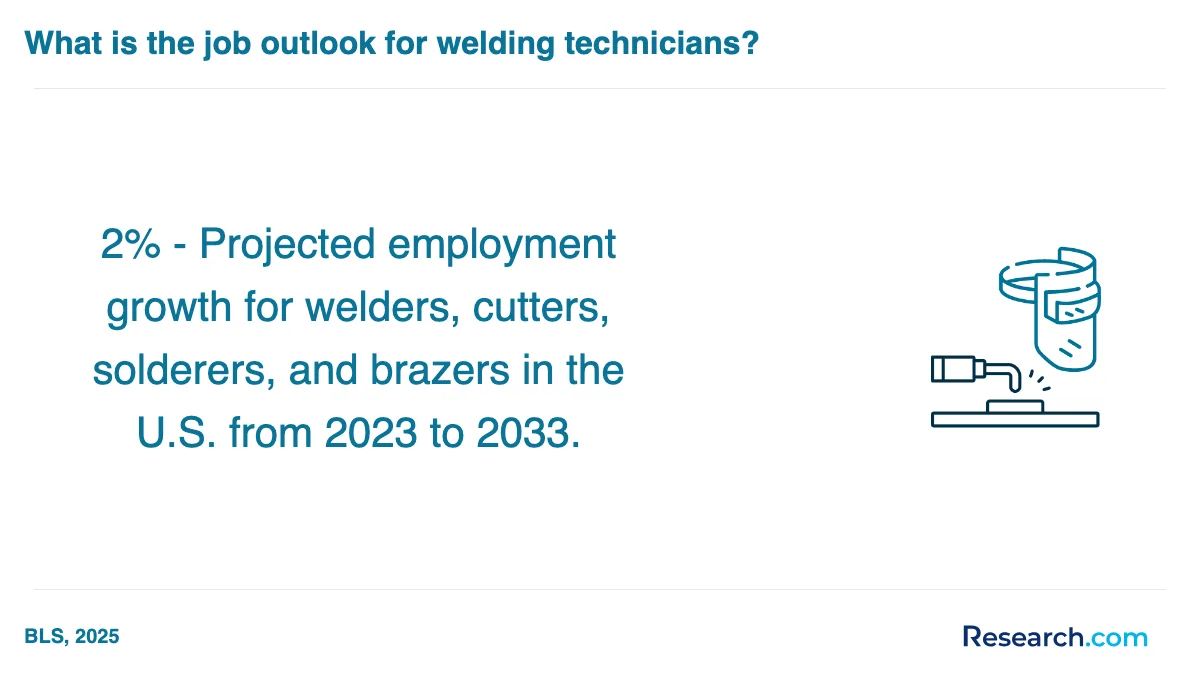
Networking with local employers through school job fairs or industry events in Davenport can open doors to apprenticeships or entry-level positions. Additionally, maintaining an up-to-date resume highlighting specific welding skills and hands-on experience is essential. Finally, staying informed about the demand for welders in the Davenport area, which is expected to grow by 3% through 2030, will help graduates target their job search effectively.
Employers in Davenport seek specific skills when hiring graduates from welder trade schools. Technical proficiency in various welding techniques, such as MIG, TIG, and Stick welding, is essential. According to the U.S. Bureau of Labor Statistics, welders with a broad skill set are more competitive in the job market.
Attention to detail and the ability to read blueprints accurately are also highly valued. These skills ensure welds meet safety and quality standards, which is critical in industries such as manufacturing and construction prevalent in Davenport.
Physical stamina and good hand-eye coordination are necessary due to the demanding nature of welding work. Additionally, soft skills like teamwork and communication improve workplace efficiency and safety.
Finding internships in Davenport relevant to welder trade school programs involves several practical steps. Start by contacting local trade schools and community colleges, as many have partnerships with area employers for internship placements. The Iowa Workforce Development office in Davenport also offers resources and job listings tailored to skilled trades, including welding.
Networking is essential; attending industry job fairs and events hosted by the Quad Cities Chamber of Commerce can connect students with potential employers. Companies in Davenport's manufacturing and construction sectors often seek welding interns, providing hands-on learning opportunities.
Additionally, online job platforms like IowaWORKS list welder internships specific to the Davenport area, offering up-to-date openings. According to recent data from the U.S. Bureau of Labor Statistics, welding apprenticeships and internships in Iowa have grown by approximately 5% annually, reflecting a steady demand for skilled welders in the region.
Obtaining a welder trade school diploma in Davenport significantly enhances career mobility and advancement opportunities. According to the U.S. Bureau of Labor Statistics, welders with formal training tend to earn 15-20% higher wages than those without credentials. Local employers in Davenport often prefer candidates who have completed accredited welding programs, which demonstrate practical skills and safety knowledge.
Trade school diplomas provide foundational expertise that enables graduates to qualify for specialized welding roles, such as pipefitting or structural welding. These roles typically offer higher pay and more job security. Additionally, many Davenport employers support continuing education, allowing diploma holders to pursue certifications that further improve their career prospects.
Overall, a welding diploma in Davenport serves as a key credential for upward mobility within the trade, backed by regional industry demand and recognized skill standards.
Part-time job opportunities in Davenport that complement welder trade school education often include roles such as welding apprentices, metal fabricators, and maintenance assistants. These positions provide practical experience alongside classroom learning. According to the U.S. Bureau of Labor Statistics, the Davenport area has a growing demand for skilled welders, with an average hourly wage around $20 to $25.
Many local manufacturing and construction companies offer part-time positions that allow students to develop essential skills like blueprint reading and equipment handling. Additionally, working as a welding supply store assistant helps students understand materials and tools.
Such jobs enhance technical skills and improve employability post-graduation.
If you're looking for affordable welding degree programs near Davenport, IA, there are several institutions to consider. Local community colleges and vocational schools often offer welding programs that are both comprehensive and budget-friendly. You can find detailed information on these programs through educational resources like Research.com to identify options that are both near you and meet your educational needs.
- Most Affordable Welding Schools & Training - Budget-Friendly Welding Trade Programs in Elgin for 2026
- Most Affordable Welding Schools & Training - Budget-Friendly Welding Trade Programs in Columbus for 2026
- Most Affordable Welding Schools & Training - Budget-Friendly Welding Trade Programs in Marietta for 2026
- Most Affordable Welding Schools & Training - Budget-Friendly Welding Trade Programs in Johnstown for 2026
- Welding | EICC https://eicc.edu/classes-programs/pathway/industrial/welding/default.aspx
- Welding Trade Schools in Davenport, FL - Welder Training https://weldingcareernow.com/welding-schools/davenport-fl
- Welding Technology - WTC Programs - Wilson Talent Center https://www.inghamisd.org/wtc/wtc-programs/welding-technology/
- Midwest Technical Institute Moline Illinois Trade School Campus https://www.midwesttech.edu/campuses/moline-il/
- Davenport, IA. Trade Schools | Trade School Guide https://toptrade.school/find/iowa/davenport/
- Training Center | Local Union 25 https://lu25.org/union/training-center.html
- Trade Schools and Technical Colleges - Davenport, IA & Online https://careerschoolnow.org/colleges/cities/davenport-ia
- Welding and Fabrication - Downriver Career Technical Consortium https://www.dctcschools.org/program_info/welding
- Job Bulletin https://www.governmentjobs.com/careers/davenport/jobs/newprint/1458047
- Welder Jobs in Davenport, IA (Hiring Now!) https://www.zippia.com/welder-davenport-ia-jobs/


