# 1 position

Audited and Verified:
Our Editorial and Data Verification Process
Research.com uses government datasets, official education statistics and primary institutional information to support its career and degree guides. Our review process checks factual accuracy, occupational definitions, source dates and the requirements associated with the credentials discussed.
How This Article Was Fact-Checked
Our editorial team verifies salary estimates, employment projections, education requirements and program information against original data providers and official organizations. Salary figures are checked against the relevant occupational definitions and reporting periods. Information about licensure, accreditation and required in-person training is reviewed separately.
Fact-checked and verified on:

Co-Founder and Chief Data Scientist

Reviewed by Karolina Broda
Fact-Checker and Data Verification
Choosing welding training in Yuma means comparing more than tuition: you need enough shop practice to pass a weld test, a schedule you can finish, and a path to local work. The U.S. Bureau of Labor Statistics projects 2.4% national growth for welders, cutters, solderers, and brazers from 2025 to 2035 - reason to assess opportunities, not assume a job is guaranteed. This guide explains credentials, costs, pay, and alternatives. It will also feature the Research.com data scientists' Best Welder Trade Schools in Yuma for 2027 ranking to help you identify programs worth considering.
Expect instruction in safety, blueprint and weld-symbol reading, metal preparation, machine settings, and repeated supervised practice. For a Yuma student, the consequential question is whether the shop teaches the processes and positions used by nearby employers - not merely whether the program is called "welding." Ask to see its current course sequence, shop schedule, and the welds students must demonstrate before completion.
Arizona Western College is a local option to investigate for current welding coursework and credentials; verify the active catalog and campus schedule before planning around a particular award. A short certificate can suit someone seeking an entry-level shop role. A longer credential may make sense if it adds substantial practice, fabrication skills, or related coursework. Employer training may be quicker and paid but narrower; a registered apprenticeship combines paid work with structured instruction when a suitable opening is available (Arizona Western College; U.S. Department of Labor).
Welding training is a hands-on occupational choice, not a substitute for an unrelated academic route such as accelerated bachelor's degree programs. Choose it if you want to build and test physical joints under shop conditions.
Potential settings include metal fabrication and repair shops, construction contractors, equipment maintenance, and agricultural operations that need metal components repaired or built. Yuma's agricultural economy makes repair and fabrication worth investigating, but a welding course does not establish that a particular employer is hiring. Check current postings for required processes, travel, schedules, and experience; some projects may require commuting or work beyond the immediate city.
Match training to the job: production fabrication may emphasize consistent shop welds, while field repair can require fitting, cutting, and working safely around existing equipment. If your priority is comparing earnings across occupations rather than welding specifically, review trade school careers that pay well before committing to a pathway.
A dependable Yuma-specific wage is not established here. Nationally, the May 2025 median annual pay for welders, cutters, solderers, and brazers was $53,750 (U.S. Bureau of Labor Statistics). That figure combines experienced and newer workers across locations and specialties; it should not be used as a first-job offer or a local earnings promise.
For a usable local estimate, compare current Yuma-area postings for the process you intend to learn and ask employers whether pay changes after a successful weld test. Factor in overtime, travel, and benefits separately. A higher-paying field assignment may also carry transportation costs or an unpredictable schedule.
There is no single required program length for employee welders in Arizona. A focused certificate may take months; a broader college pathway or registered apprenticeship takes longer because it covers more coursework or supervised work. Actual completion time depends on the provider's course calendar, available shop sections, and whether you attend part time (Arizona Western College; U.S. Department of Labor).
Ask for total scheduled clock or contact hours and supervised shop hours. Two programs with similar calendar lengths can offer very different amounts of torch time. If speed is the priority, compare the earliest point at which you could competently pass a target employer's weld test - not just the advertised graduation date. An unrelated option such as 2 year phd programs does not answer that occupational-entry question.
Online lessons can support welding theory, safety review, symbols, and blueprint reading. They cannot replace supervised practice setting equipment, preparing joints, controlling a weld pool, or correcting defects. A hybrid program is useful only if its in-person shop sessions are accessible from Yuma and provide enough practice for the intended job test.
Ask where and when hands-on work occurs, who supervises it, and whether materials and machine time are included. Do not treat an entirely online certificate as proof of practical welding ability or eligibility for an American Welding Society performance credential. General online learning lists, including top college courses for seniors online, are not substitutes for checking a welding program's shop requirements (American Welding Society).
A reliable Yuma-wide average is not available: programs differ in length, residency pricing, included supplies, and funding. Request a written, current estimate for the exact credential and attendance schedule rather than relying on a tuition headline. For Arizona Western College, confirm the applicable tuition category and current program fees directly with the college.
Your job-ready budget should include tuition, mandatory fees, books, consumable metal, PPE, tools, transportation to shop or work sites, and any separately charged weld tests. Add lost earnings if classes replace paid work. Then subtract aid you actually qualify for - not aid you merely hope to receive. Federal aid depends on institutional and program eligibility; workforce funding, scholarships, and paid employer or apprenticeship training may change the comparison (Federal Student Aid; U.S. Department of Labor).
The award depends on the pathway. A college may award a certificate or, for a qualifying longer program, an associate degree. An employer may document completed training; a registered apprenticeship awards an apprenticeship completion credential. Confirm the precise award in the current provider catalog or apprenticeship agreement (Arizona Western College; U.S. Department of Labor).
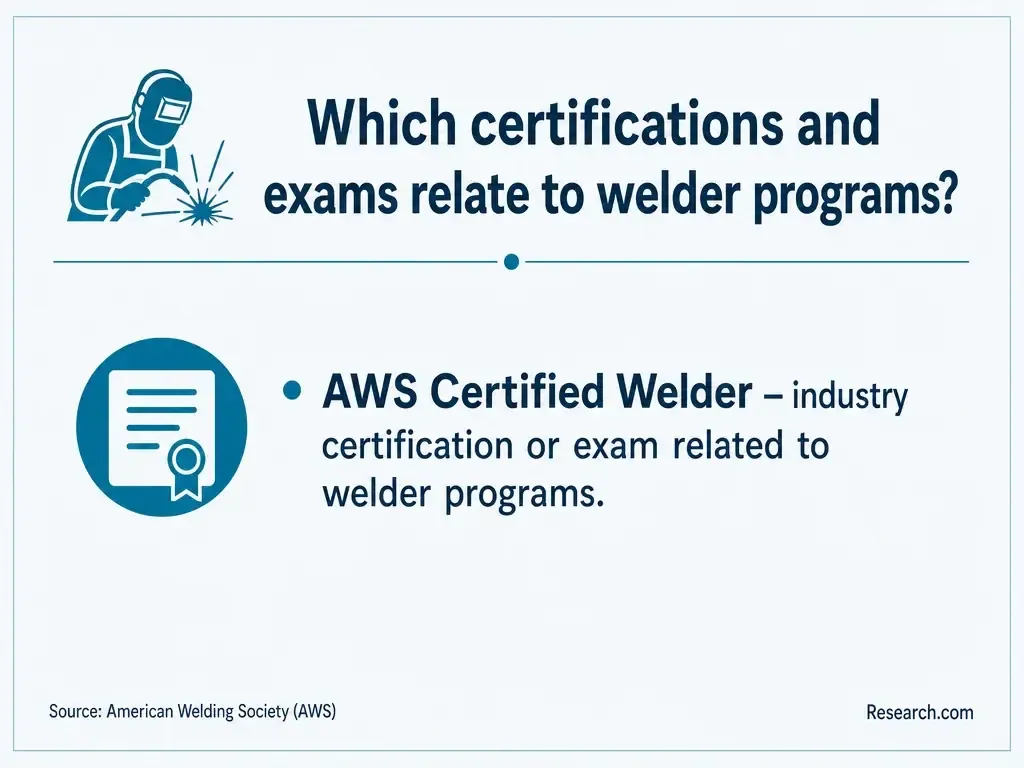
None of these automatically equals an American Welding Society Certified Welder credential. That certification is based on a performance test under an applicable procedure, and employers may administer their own tests for particular processes, materials, positions, or codes. Ask which tests training prepares you to attempt and whether testing is included (American Welding Society).
Requirements vary by provider and pathway. A college applicant should check its current admission, placement, age, and course-prerequisite rules; a registered apprenticeship applicant must meet the sponsor's published eligibility and selection rules. Employers may assess safety readiness and practical ability before hiring. Do not assume that college admission also secures an apprenticeship or a job (Arizona Western College; U.S. Department of Labor).
Before applying, ask whether classes require specific PPE, whether you can safely meet shop participation requirements, and whether a part-time schedule is available. If you already weld, ask about placement, prior-learning assessment, or credit for documented training - but obtain a written answer before counting on advanced standing.
Useful entry-level training links safety and fabrication to repeatable weld quality. Look for instruction in measuring and layout, joint preparation, cutting, reading drawings and symbols, selecting settings, and inspecting completed work. Common processes to ask about include shielded metal arc welding, gas metal arc welding, and gas tungsten arc welding; the right mix depends on the jobs you want (U.S. Bureau of Labor Statistics; American Welding Society).
The difference between programs is often practice depth. Ask which metals, thicknesses, joint types, and welding positions students actually use; how instructors give feedback; and whether students can repeat a failed weld. These details matter more to an employer test than a course title alone.
Arizona does not impose a general occupational license on someone simply employed as a welder. A business contracting to perform regulated construction work is a different matter: contractor licensing may apply, so prospective business owners should check the Arizona Registrar of Contractors before taking jobs independently. School accreditation, state school authorization, apprenticeship registration, contractor licensing, and an individual weld-performance certification serve different purposes (Arizona Registrar of Contractors; U.S. Department of Labor).
Certification is not a universal entry requirement, but an employer or project specification may require a particular qualifying test. Before paying for an exam, ask target employers which process, position, material, and code they accept. A school completion document alone does not establish that you have passed that test (American Welding Society).
Start with the work you want, then compare training backward from its required skills. A low-price course is poor value if it lacks the shop access needed for your target weld test; an accelerated course is a poor fit if its schedule makes completion unlikely. Rankings can narrow the search, but cannot verify today's open seats or your personal costs.
Use these checks before paying a deposit:
For return on investment, consider whether finishing is realistic and how long any earnings improvement would take to outweigh costs; do not treat an occupational median as your forecast. Broad comparisons such as college majors that make the most money answer a different question from whether a specific welding course leads efficiently to your intended work.
An initial pathway may lead to shop fabrication, repair, or a supervised construction role. With experience and relevant tests, a welder might pursue more demanding processes, field work, inspection-related responsibilities, or supervision. Advancement is not automatic: code-specific work and inspection roles may call for additional documented experience or credentials (U.S. Bureau of Labor Statistics; American Welding Society).
If your goal is independent contracting, evaluate business and Arizona contractor-license requirements separately from welding skill. If you want to earn while building that skill, ask registered apprenticeship sponsors and employers about openings; if you need a predictable class schedule before applying for jobs, a college certificate may fit better. The right route is the one that gets you the practical experience and recognized evidence of skill your target employer requests.
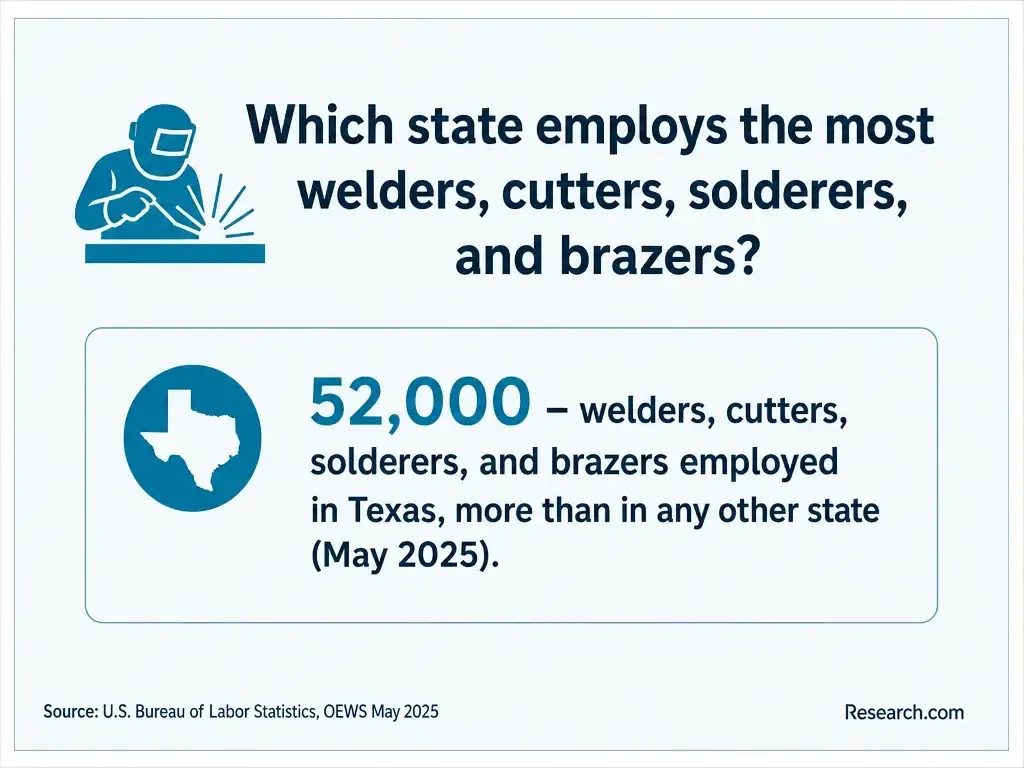
The U.S. Bureau of Labor Statistics projects 2.4% growth for welders, cutters, solderers, and brazers nationally from 2025 to 2035. This describes an occupation-wide forecast, not the number of Yuma vacancies or the odds that a particular graduate will be hired. Local demand can change with construction projects, equipment-repair needs, and employers' ability to train workers.
Before enrolling, sample recent postings over several weeks and ask providers which employers have hired students for the specific credential you are considering. If openings repeatedly require a process the course barely covers, seek additional shop practice or a different pathway. That check is more useful than relying on a national growth rate alone.
Education is a significant investment. The Research.com team created this ranking to help readers compare welding programs against other programs in the same occupation and location, rather than against unrelated schools. The team uses multiple datasets and checks outcomes, costs, recognition, and student support. Only programs with completions reported to IPEDS are eligible; a provider's absence does not mean its training is unavailable or inferior.
Best-program rankings assess student outcomes; earnings one year after completion and earnings relative to annual attendance cost; tuition, attendance cost, debt, and loan default; and accreditation, occupation-relevant recognition, and student support. Occupation-relevant programmatic accreditation or industry recognition receives 20% of the score, institutional accreditation 10%, and student support 10%. The remaining 60% covers outcomes, earnings, and costs, with entropy-based weights that give more weight to indicators that vary more across programs. Most-affordable rankings instead score only costs and debt, using entropy-based weights; they do not score accreditation or other quality indicators.
The ranking draws on the following sources. Some recognition databases cover other trades or health occupations; their inclusion in the broader methodology does not make those credentials welding requirements.
Use the ranking to narrow your options, then confirm current welding courses, shop access, prices, and employer connections directly with each provider. More detail on the approach appears in Research.com's methodology.
# 1 position
# 2 position
No. Compare its current offerings with employer training and available registered apprenticeships. Confirm openings and training locations before assuming a route is accessible.
Online theory can help, but welding requires in-person practice. Ask how a program supervises and evaluates actual welds.
Not universally. An employer may instead require its own weld test. Ask employers which evidence of skill they accept (American Welding Society).
It can be if its shop hours and processes match an attainable entry-level job. Compare the full cost and your opportunity to practice against paid-training alternatives.
Not necessarily. Arizona contractor-licensing rules may apply to regulated contracting work; check your planned business activity with the Arizona Registrar of Contractors.


