# 1 position


Audited and Verified:
Our Editorial and Data Verification Process
Research.com uses government datasets, official education statistics and primary institutional information to support its career and degree guides. Our review process checks factual accuracy, occupational definitions, source dates and the requirements associated with the credentials discussed.
How This Article Was Fact-Checked
Our editorial team verifies salary estimates, employment projections, education requirements and program information against original data providers and official organizations. Salary figures are checked against the relevant occupational definitions and reporting periods. Information about licensure, accreditation and required in-person training is reviewed separately.
Fact-checked and verified on:

Co-Founder and Chief Data Scientist

Reviewed by Karolina Broda
Fact-Checker and Data Verification
Choosing an affordable physical therapist assistant (PTA) program means checking more than tuition: the training must also support licensure and fit your schedule. The U.S. Bureau of Labor Statistics projects 23.0% growth in PTA employment nationwide from 2025 to 2035. For prospective students and career changers, this guide explains costs, clinical training, Virginia licensing, and career prospects. It also features a Most Affordable Physical Therapist Assistant Trade Schools in Virginia Beach for 2027 ranking, created by the Research.com team of data scientists to help students identify programs worth considering.
Expect supervised preparation for a defined healthcare role. PTAs carry out parts of a physical therapist's treatment plan, document patient responses, and report changes to the supervising therapist; they do not independently diagnose patients or establish treatment plans (U.S. Bureau of Labor Statistics). Training therefore combines classroom study, hands-on labs, and clinical education with patients.
The usual entry route is a PTA associate-degree program accredited by the Commission on Accreditation in Physical Therapy Education (CAPTE). A short therapy-aide certificate or employer orientation may prepare someone for support work, but it is not an equivalent route to PTA licensure (CAPTE; Virginia Board of Physical Therapy). If fast track programs appeal to you, check whether the calendar still accommodates required labs and clinical placements. A quicker schedule is valuable only if you can complete those components successfully.
Licensed PTAs work in outpatient therapy practices, hospitals, nursing and residential-care settings, and home healthcare (U.S. Bureau of Labor Statistics). Around Virginia Beach, a placement or job search may extend across Hampton Roads. That wider search can increase options, but commuting distance matters when clinical shifts and classes occur on the same day.
Ask a program where its recent students completed clinical education and whether placements require travel beyond Virginia Beach. A school's ability to arrange appropriate supervised experiences may matter more than its classroom address. Therapy-aide jobs can offer exposure to these workplaces, but aide employment does not replace PTA training or a Virginia license.
The U.S. Bureau of Labor Statistics reports a $68,380 national median annual wage for physical therapist assistants in May 2025. That is the midpoint for employed PTAs nationwide, across experience levels and settings - not a promised salary or a verified Virginia Beach wage. Use it as a broad career benchmark, not as the income figure in a personal loan-repayment calculation.
For a local decision, compare current Hampton Roads job postings by setting, schedule, and required experience. Ask programs for clearly defined graduate employment outcomes, including the reporting period and number of graduates counted. If you are changing careers, compare plausible entry-level offers with your current pay and the earnings you would forgo during clinical training.
PTA associate-degree programs commonly take about two academic years of full-time study, although prerequisites, course sequencing, and clinical scheduling can change an individual student's timeline (Commission on Accreditation in Physical Therapy Education; U.S. Bureau of Labor Statistics). There is no single nationwide PTA clock-hour figure to substitute for a program's published curriculum and clinical requirements.
Ask for the current term-by-term plan, including the length and timing of each clinical assignment. A working adult should also check whether courses are offered part-time and how that affects the time to licensure eligibility. Fewer months in school can reduce lost earnings, but an overloaded schedule may make completion harder.
Online or hybrid delivery may make lectures, readings, and some assessments easier to schedule. It cannot replace in-person practice of patient handling, therapeutic procedures, and supervised clinical care. An on-campus program may make lab access simpler, while a hybrid option may reduce routine trips to class but still require travel to labs and clinical sites (Commission on Accreditation in Physical Therapy Education).
Do not choose a program because it appears on a list of the easiest degree online. For PTA training, the useful question is where and when you will demonstrate practical competence. Obtain the lab schedule and clinical-placement policy in writing, and confirm that the specific program - not merely its institution - meets the education requirements relevant to Virginia licensure.
A reliable Virginia Beach-wide average PTA program price is not available from a single standardized source. Institutional tuition figures may cover other programs, while cost-of-attendance estimates can differ from the expenses a PTA student actually incurs. Request a current, program-specific budget before treating any advertised tuition as the cost of becoming job-ready (National Center for Education Statistics; Federal Student Aid).
The categories below show what to compare across programs. Ask each school which expenses are included, which are estimates, and when payments come due.
| Cost category | Why it matters for PTA students |
| Tuition and mandatory fees | Charges may vary with enrollment load and residency rules. |
| Books, supplies, uniforms, and health requirements | Clinical sites may require immunization documentation, screenings, or other clearance. |
| Clinical travel and living costs | Unpaid placements can add commuting costs and limit work hours. |
| Examination and licensing costs | Graduation is not the final expense before applying to practice. |
| Borrowing and lost earnings | Interest and time away from paid work affect the total return on training. |
Compare your likely net cost after eligible aid, not a school's sticker price alone. Federal aid eligibility depends on both the student and program; ask about scholarships and applicable workforce assistance without assuming either will be awarded (Federal Student Aid). A nonprofit accredited online university is not automatically a lower-cost or licensure-qualifying PTA option: institution type, delivery format, and PTA program accreditation answer different questions.
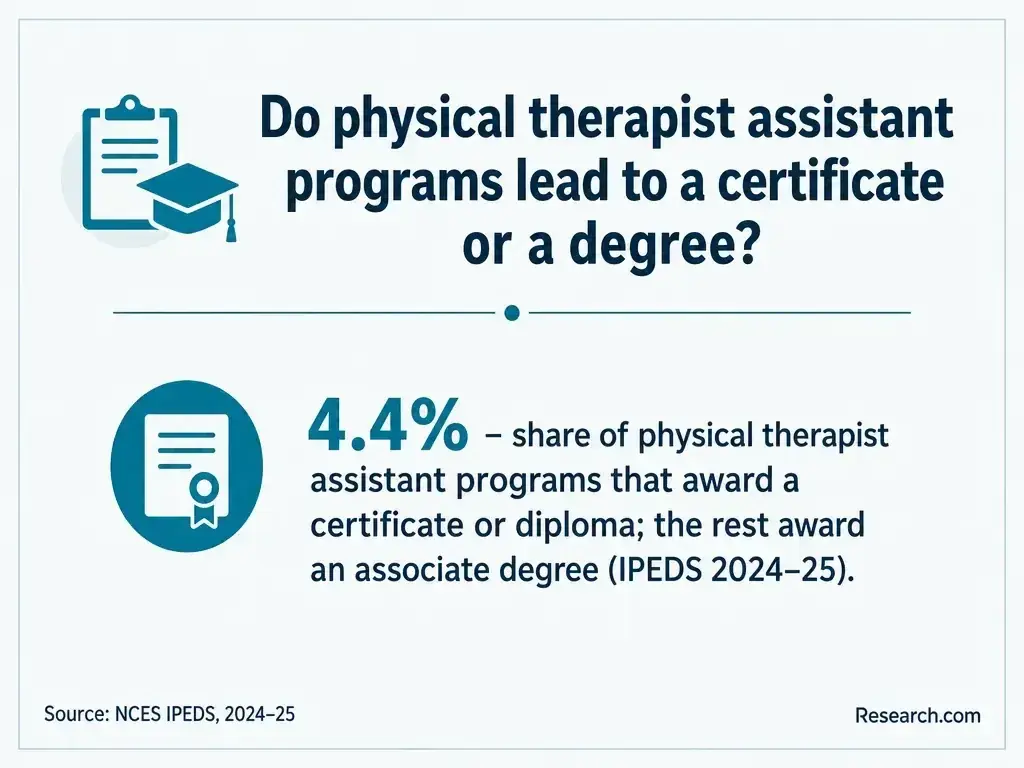
The standard educational credential for entry into the PTA occupation is an associate degree from a PTA program; the authority to practice comes separately through state licensure (Commission on Accreditation in Physical Therapy Education; Virginia Board of Physical Therapy). A certificate labeled "physical therapy aide" or "rehabilitation technician" is a different credential and should not be marketed or interpreted as a substitute for PTA preparation.
Check the exact credential on the school's current program page and whether the PTA program holds CAPTE accreditation. Searches for phd programs that do not require a dissertation concern a different educational goal; they do not help establish PTA entry eligibility. For this occupation, the decisive questions are the qualifying PTA program, clinical education, examinations, and Virginia license.
Admission is school-specific. Applicants may need prerequisite coursework, an application to the PTA program in addition to general school admission, and documentation that they can participate safely in clinical education. Clinical sites may set health, background-check, or other clearance conditions; ask which requirements must be met before enrollment and which apply before placement (institutional program policies; Commission on Accreditation in Physical Therapy Education).
Ask admissions staff for the current prerequisite list, selection process, clinical-clearance policy, and rules for transferring prior coursework. Transfer credit might reduce repeated classes, but it may not shorten a fixed-sequence clinical program. Before paying a deposit, clarify what happens if you meet academic requirements but cannot obtain a required clinical placement.
PTA training covers anatomy, movement, therapeutic exercise, physical interventions, patient communication, documentation, safety, and practice under a physical therapist's direction (Commission on Accreditation in Physical Therapy Education; U.S. Bureau of Labor Statistics). Labs let students practice procedures before applying them in supervised clinical settings.
When comparing curricula, look beyond course titles. Ask how students are assessed on safe transfers, adapting interventions within a treatment plan, recognizing when to alert the physical therapist, and recording patient progress. Clinical experience is essential because competent technique also depends on communicating with patients and working within the PTA scope of practice.
Yes. Virginia regulates physical therapist assistants through the Virginia Board of Physical Therapy. Applicants must meet the board's education and application requirements and pass the National Physical Therapy Examination for PTAs; applicants should check the board's current instructions for any additional examination or documentation requirements (Virginia Board of Physical Therapy; Federation of State Boards of Physical Therapy). Completing training alone does not authorize practice.
Distinguish the checks: institutional accreditation concerns the school; CAPTE accreditation concerns the PTA program; the examination tests entry-level knowledge; and the Virginia license authorizes practice in the state. State school authorization and an optional professional credential do not replace those requirements. If you might work outside Virginia, check that state's licensing board before enrolling rather than assuming the rules are identical.
Start with eligibility, then compare affordability. A program is a sound investment only if you can complete its practical training, qualify to seek licensure, and manage its total cost. The affordability ranking is a shortlist, not a substitute for checking fit or calculating a personal return on investment.
Use these checks when speaking with a program representative; request written answers where a requirement or expense could change your decision.
A common mistake is choosing the lowest advertised tuition while overlooking an impractical clinical commute or unverified program status. Another is treating the national median wage as a new graduate's guaranteed pay. If the program's schedule or debt burden does not work for you, consider waiting, reducing prerequisite costs where transferable, or exploring a therapy-aide role while evaluating future PTA options.
The direct path is licensed PTA work under a physical therapist's direction. Experience may support a move among outpatient, hospital, residential-care, and home-health settings, or a focus on particular patient populations, depending on employer needs and available supervision (U.S. Bureau of Labor Statistics). Continuing education and workplace experience can broaden skills, but an optional specialty interest is not a replacement for the entry license.
PTA training is a stronger fit for someone who wants sustained, hands-on patient care than for someone seeking the quickest route into any trade. If the latter is your goal, comparing what is the best career in trades may help you assess occupations with different training time, physical demands, and licensing rules. Therapy-aide employment is a possible way to test your interest, not an apprenticeship that converts automatically into a PTA credential.
The U.S. Bureau of Labor Statistics projects 23.0% growth in national PTA employment from 2025 to 2035. That indicates substantial nationwide demand, but it is not a forecast of Virginia Beach openings or an assurance that a particular graduate will be hired. Hiring prospects also depend on local employers, clinical experience, scheduling flexibility, and licensure.
For a local reality check, review current openings across Hampton Roads and note whether employers seek new licensees, particular care-setting experience, or travel between sites. Ask programs whether their clinical partners hire graduates and how they calculate placement results. This connects a national growth figure to the jobs you could realistically pursue after training.
Education is a significant investment, so Research.com designed the affordability ranking to help readers compare programs against other options in the same occupation and location. The team checks multiple education and recognition sources for credibility and accuracy. Only programs with completions reported to the Integrated Postsecondary Education Data System (IPEDS) are eligible; absence from the ranking does not establish that another training provider is unavailable or unsuitable.
The most affordable ranking scores tuition, cost of attendance, median student debt, and federal loan default rate. It uses an entropy-based method that gives more weight to cost and debt indicators that vary more across eligible programs. Accreditation and other quality indicators are not part of this affordability score. Research.com's separate best programs rankings also consider completion, retention, earnings, student support, accreditation, and occupation-relevant recognition; they should not be confused with this cost-focused ranking.
The following sources inform Research.com's trade-program rankings and data checks. Some cover other trades rather than PTA training specifically; for Virginia PTA eligibility, readers should separately verify program accreditation and licensing requirements.
Use the ranking to narrow a cost search, then confirm each PTA program's current accreditation, clinical placements, full price, and Virginia licensure pathway. More detail on Research.com's approach is available on its methodology page.
# 1 position
# 2 position

There is no single verified cheapest option for every student. Compare current program-specific net costs, including fees and clinical travel, among programs that meet your licensure and scheduling needs.
A therapy-aide certificate is not the standard PTA entry credential. Virginia applicants should verify that their PTA education satisfies the Virginia Board of Physical Therapy's requirements.
No entirely remote format can replace the hands-on labs and supervised clinical education integral to PTA preparation. Ask a hybrid program exactly where and when those activities occur.
Do not budget for clinical wages unless your program confirms a paid arrangement. Ask about placement schedules and travel so you can estimate how much paid work you can maintain.
No. Graduation and licensure are separate. Check the Virginia Board of Physical Therapy's current education, examination, and application requirements before enrolling.