# 1 position
Cincinnati State Technical and Community College - Baking and Pastry Arts/Baker/Pastry Chef.
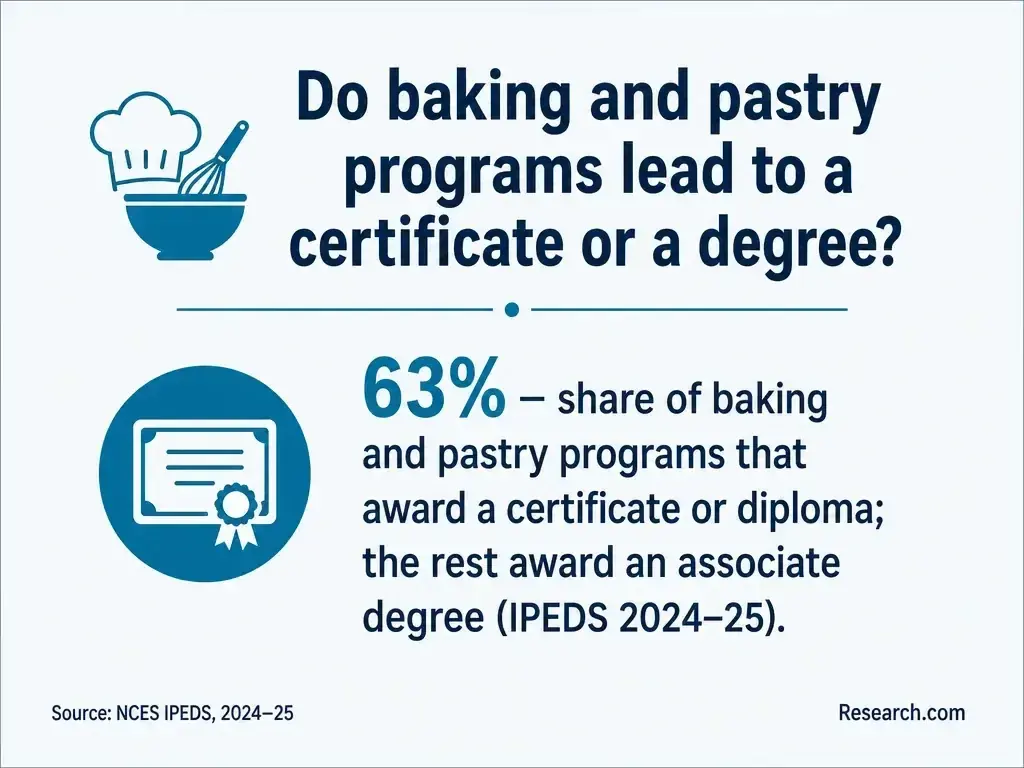
certificate or diploma

Audited and Verified:
Our Editorial and Data Verification Process
Research.com uses government datasets, official education statistics and primary institutional information to support its career and degree guides. Our review process checks factual accuracy, occupational definitions, source dates and the requirements associated with the credentials discussed.
How This Article Was Fact-Checked
Our editorial team verifies salary estimates, employment projections, education requirements and program information against original data providers and official organizations. Salary figures are checked against the relevant occupational definitions and reporting periods. Information about licensure, accreditation and required in-person training is reviewed separately.
Fact-checked and verified on:

Co-Founder and Chief Data Scientist

Reviewed by Karolina Broda
Fact-Checker and Data Verification
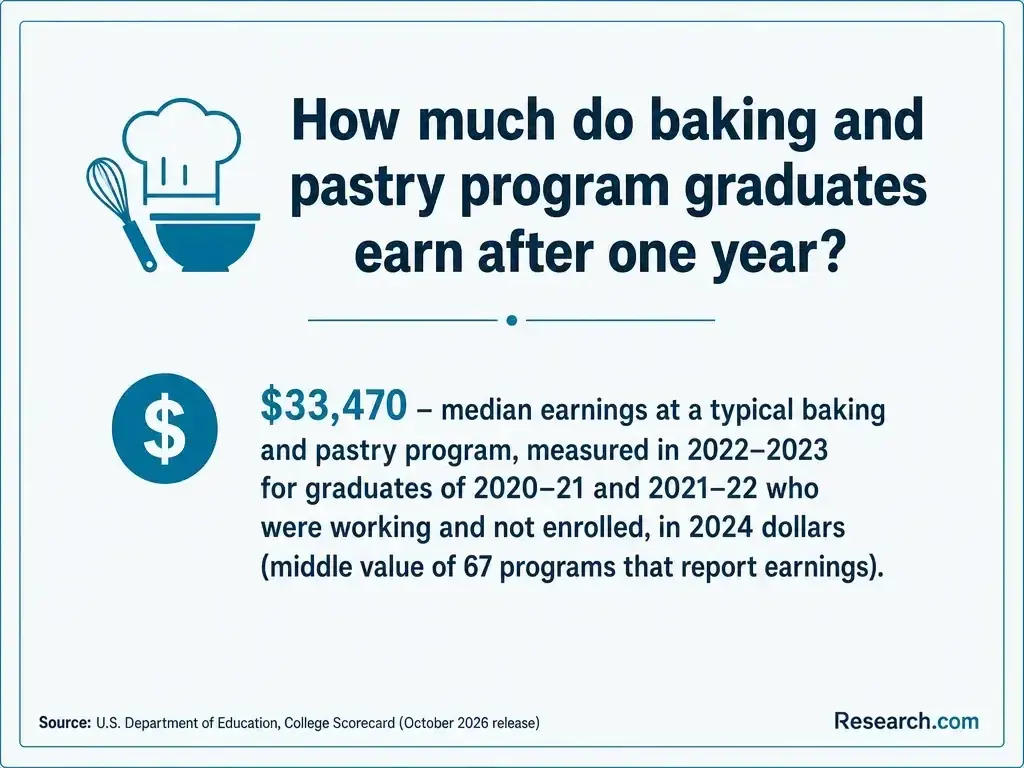
Can an online baking program teach you enough to work in a professional kitchen - and is it worth the cost? The U.S. Bureau of Labor Statistics reports a $37,160 median annual wage for bakers in May 2025, making training costs especially important to weigh against likely earnings. This guide explains hands-on requirements, credentials, costs, and alternatives for aspiring bakers and career changers. It also accompanies the Best Online Baking and Pastry Trade Schools for 2027 ranking, created by the Research.com team of data scientists to help students identify training programs worth considering.
An online baking and pastry training program typically combines remote instruction in formulas, costing, food safety, and production planning with practical assignments. The deciding question is where and how someone evaluates your baking. Producing a loaf at home is useful practice, but it is not identical to using commercial mixers, proofers, ovens, and sanitation procedures on a timed production shift.
Formats differ: a fully remote course may require students to supply ingredients and equipment and submit photos or videos; a hybrid program may schedule supervised kitchen labs; and a campus program may conduct most production training on site. Ask for the syllabus and the required lab or workplace hours rather than assuming the word "online" describes the entire program. A list of top online colleges may help you explore remote-study options, but for baking, confirm access to real kitchen practice before comparing schools by online convenience.
Baking training can support entry-level applications at retail bakeries, grocery-store bakeries, restaurants, hotels, wholesale production facilities, and catering businesses. The setting changes the skills you should prioritize: a restaurant pastry station emphasizes plated desserts and service timing, while a wholesale bakery emphasizes consistent batches, equipment use, and production schedules. The U.S. Bureau of Labor Statistics describes bakers working across retail and manufacturing settings.
Search local job postings before choosing a specialty. If nearby employers mostly seek early-shift production bakers, a program centered on elaborate plated desserts may be a poor match unless you can commute or relocate. Independent sales are another possible path, but operating a food business brings separate state and local rules for where food can be made and sold.
The U.S. Bureau of Labor Statistics reports a $37,160 median annual wage for bakers in May 2025. That is the midpoint for employed bakers nationwide - not a starting wage, a pastry-chef salary, or a forecast of what a particular credential will earn. Local pay, shift schedules, employer type, and experience can change an offer substantially.
Use the median as a reality check on borrowing. Compare entry-level postings in the area where you intend to work, then ask schools for occupation-specific earnings outcomes and how many graduates those figures represent. For someone already earning a wage, the relevant financial gain is the difference between plausible post-training and current earnings, not the full baker wage.
There is no single national completion time or required clock-hour minimum for baking trade school. A focused certificate generally takes less time than a broader diploma or associate degree, while part-time schedules extend the calendar. Schools set their own course and kitchen-hour requirements; a registered apprenticeship instead combines structured work-based learning with related instruction under its approved standards (U.S. Department of Labor).
Before choosing the fastest option, request its total instructional hours, supervised kitchen hours, weekly workload, and earliest available lab dates. An accelerated schedule may reduce time away from work but leave less room to repeat techniques or accommodate a job. Searches for quick college degrees address a different comparison: for baking, the more useful speed measure is time to demonstrable production skills and a viable first job.
Online is a delivery format, not a hands-on credential. Formula calculations, ingredient functions, menu planning, and some instructor feedback can work remotely. Evaluating dough handling, temperature control, equipment safety, sanitation, and production under time pressure is more convincing in a supervised kitchen or workplace. An at-home assignment may still be valuable, but ask what it can and cannot assess.
The comparison below focuses on practical access rather than assuming one format is universally better.
| Format | Practical training arrangement | Best fit and main trade-off |
| Online | Typically home-based practice and submitted work; verify whether supervised production is included. | Flexible for working learners with suitable space and equipment; may provide limited commercial-kitchen exposure. |
| Hybrid | Remote coursework plus scheduled in-person labs or workplace training. | Useful when travel to labs is manageable; schedules and commuting costs still matter. |
| On-campus | Regular access to school kitchens and direct observation. | Useful for learners needing equipment access and immediate feedback; less flexible around work and travel. |
For a rural student, the nearest required lab may determine whether a "mostly online" program is feasible. Get lab locations, dates, equipment requirements, and any placement responsibilities in writing.
There is no reliable single national "average cost" that covers online baking certificates, public-college programs, private career-school training, and paid apprenticeships on comparable terms. A quoted tuition figure also omits costs that can determine whether the program is affordable. Request a written, job-ready total: tuition, mandatory fees, ingredients and consumables, tools, uniforms and protective gear, books or software, travel to labs or worksites, and any required food-safety training or exam. Add lost earnings if attendance reduces your paid work.
Compare that total after grants, scholarships, eligible federal or state aid, and employer assistance - not just before aid. Federal Student Aid eligibility depends on the institution, program, and student; ask the school to identify the precise credential and aid eligibility rather than assuming every short course qualifies (U.S. Department of Education, Federal Student Aid). A paid apprenticeship or employer-sponsored route may reduce borrowing but can offer less scheduling flexibility. A search for an affordable online master's degree will not answer this trade-training cost question; compare the full baking-specific budget instead.
The award depends on the pathway: a short program may grant a certificate, a career-school program may award a diploma, and a community college may award an associate degree. A registered apprenticeship documents completion under approved apprenticeship standards; an employer's training may instead lead to an internal qualification or work experience without a school credential (U.S. Department of Labor). Similar-sounding awards do not necessarily include similar kitchen practice.
Ask what appears on the final credential, who issues it, and whether documented competencies or credits can transfer into a later program. Prior bakery experience may qualify for prior-learning credit or advanced standing, but only if the receiving provider permits it. Searches for easiest phd degree programs online concern a different kind of credential; baking employers are more likely to need evidence that you can safely and consistently produce the products in the job description.
Entry requirements vary by provider. A school may request an application, evidence of prior education, and placement information; an apprenticeship sponsor or employer may use an interview and assess whether applicants can meet the job's schedule and physical demands. Do not assume a particular prior credential or age rule applies everywhere. Check the published requirements for the exact program or apprenticeship opening.
Practical readiness matters too. Confirm access to required equipment and ingredients for remote assignments, the ability to attend every scheduled lab, and whether a workplace placement is arranged by the provider or must be found by the student. Ask when food-safety documentation is needed and who pays for it. These details can make an otherwise accessible program impossible to complete.
Strong baking instruction connects ingredient science with repeatable production: measuring and scaling formulas, mixing and fermentation, pastry doughs, cakes and fillings, temperature control, allergen awareness, sanitation, waste control, and basic costing. Workplace practice adds timing, communication, and consistency across a batch - not just a successful individual item. The U.S. Bureau of Labor Statistics identifies production, equipment use, and food-safety practices as central to bakers' work.
Match the curriculum to your target role. Bread-focused applicants should look for substantial yeast-dough and fermentation work; aspiring restaurant pastry workers should check for plated-dessert and service practice. Request examples of assessed products, the equipment used, and the amount of instructor-observed work. A course can teach useful recipes without providing broad occupational preparation.
There is no general U.S.-wide occupational license required simply to work as a baker. Food-handler or food-protection requirements, however, can differ by state and locality and by whether you are an employee, manager, or business owner. The U.S. Food and Drug Administration's Food Code is a model for food-safety rules, not a substitute for checking the rules adopted where you will work.
Keep the requirements separate: institutional accreditation concerns the school; state authorization concerns its permission to operate; optional industry certification recognizes specified skills; and local food-safety rules govern particular work or operations. A program's accreditation does not automatically satisfy a local requirement. If you plan to sell from home, check applicable state and local food-business rules before assuming a school kitchen credential permits it.
The best program is the one that supplies the skills, practical access, credential, and cost structure for your intended job. A ranking can narrow the search, but it cannot establish whether you can reach a required lab or whether local employers value a particular credential. Public colleges, private career schools, and paid work-based routes all merit comparison; provider type alone does not determine return on investment.
Use this sequence to test each option against an actual job goal before paying a deposit:
Watch for red flags: an "online" label with unclear practical assessment, a tuition quote that excludes ingredients and travel, or an earnings claim presented as a likely starting salary. For a financial comparison, consider completion probability, debt and aid, lost earnings during training, your current pay, plausible post-training pay, and how long you expect the benefit to last.
Training may lead first to a baker, bakery production, pastry-assistant, or related food-production role. With demonstrated experience, a worker may specialize in bread, cakes, chocolate, or desserts, move into supervision, or pursue a food business. Those steps depend on employer needs, performance, and - in the case of operating a business - applicable food-business rules; the initial school credential does not itself confer a senior title.
Someone who wants immediate income and can secure a supportive bakery job may learn through paid work rather than school. Someone changing careers without kitchen access may gain more from a supervised certificate or diploma. If you are comparing what certificate can i get that pays well, treat baking as a craft-and-workplace decision, not a promise that a short credential will produce a particular wage.
U.S. baker employment is projected to grow 5.5% from 2025 to 2035, according to the U.S. Bureau of Labor Statistics Employment Projections. That signals national demand for the occupation, not a guaranteed opening in a specific town or a forecast for pastry specialists alone.
For a local decision, compare current postings by employer type, shift, experience requirement, and product focus. A market with several wholesale employers may reward production speed and equipment familiarity; an area dominated by restaurants may put more weight on dessert preparation and service experience. Choose practical training that matches the openings you could realistically take.
Investing in training is a consequential decision, so the Research.com team designed the ranking to compare baking and pastry programs with other programs in the same occupation and geographic market. Only programs with completions reported to the Integrated Postsecondary Education Data System (IPEDS) are eligible. That makes the comparison more consistent, but it also means a worthwhile apprenticeship, employer training program, or school that does not report completions to IPEDS may be absent.
Best-program rankings evaluate student outcomes; earnings and return on investment; costs and debt; and quality and recognition. Measures include completion and full-time and part-time retention, median earnings one year after completion, earnings relative to annual attendance cost, tuition, attendance cost, debt - including for students who withdrew - and federal loan default rates. Occupation-relevant programmatic accreditation or industry recognition accounts for 20% of the score, institutional accreditation for 10%, and student support for 10%. The remaining 60% covers outcomes, earnings, and costs, with weights distributed through an entropy-based method that gives more weight to indicators that vary more across programs. Most-affordable rankings score only tuition, attendance cost, median debt, and loan default rates using entropy-based weights; accreditation and other quality indicators do not contribute to that score.
The team uses the following data sources to check institutional information, outcomes, costs, and occupation-relevant recognition. Some sources cover other trades rather than baking; their inclusion in the broader ranking methodology does not make them baking accreditors.
This approach helps readers compare reported outcomes without mistaking a rank for a personal fit assessment. Verify current program format, practical training, and your own costs directly before enrolling. Research.com explains the ranking process further on its methodology page.
# 1 position
# 2 position
# 3 position

# 4 position
# 5 position
# 6 position
# 7 position
# 8 position
# 9 position
You can study techniques online, but professional readiness requires practice and feedback. Check whether the program assesses work in a supervised kitchen or whether you will need to gain commercial-kitchen experience separately.
Not generally. Employers may hire and train entry-level workers. A certificate can help show structured preparation, particularly if it includes relevant, observed production practice.
It can be a better fit if you want paid, structured workplace learning and can meet the sponsor's schedule and entry requirements. School may fit better if you need a particular curriculum or more flexible coursework. Compare actual openings, costs, and credentials.
No. Accreditation concerns educational oversight; it does not establish the amount of hands-on training or satisfy every local food-safety requirement. Check those separately.
Ask for the full job-ready cost, credential awarded, assessed kitchen hours, lab location, equipment access, placement responsibilities, and outcomes for the specific baking program.