2027 Online Data Science Master's Options for Professionals in Cincinnati, Ohio

Co-Founder and Chief Data Scientist
For a Cincinnati professional, choosing an online data science master's is less about finding the closest campus than finding a program that fits your career goal, work schedule, and budget. National online programs can be viable alongside options at nearby universities, but their technical depth and live-session requirements may differ substantially.
This guide shows you how to build a shortlist and what to confirm before applying.
Key Things You Should Know
- Start with the role you want: a data science degree, an analytics degree, and an AI-focused degree may prepare you for different work even when their course titles overlap.
- Compare nationally available online programs with nearby universities; Cincinnati location matters most for Eastern-time scheduling, optional campus access, employer support, and networking.
- Do not use national pay as a Cincinnati salary estimate: the U.S. median annual wage for data scientists was $120,230 in May 2025, according to the Bureau of Labor Statistics (BLS).
What Is an Online Data Science Master's Degree?
An online data science master's is a graduate degree that typically combines statistics, computing, and the use of data to answer practical questions. For a working professional, the important distinction is not the degree title alone: one curriculum may emphasize statistical modeling, another production software and data systems, and another business decision-making.
If your goal is to build predictive models and evaluate their reliability, look for substantial statistics and machine-learning work. If you want to manage data pipelines or deploy AI systems, examine the computing requirements as closely as the modeling courses. University degree options in artificial intelligence may be a better comparison set when building AI systems - not broader data analysis - is your main goal.
Which Online Data Science Master's Programs Serve Cincinnati Professionals?
Cincinnati residents need not restrict their search to Cincinnati-based institutions. Georgia Tech's Online Master of Science in Analytics, the University of Texas at Austin's online Master of Science in Data Science, and UC Berkeley's online Master of Information and Data Science are useful national programs to investigate. They are starting points, not a claim that their current admission, scheduling, or state-availability policies are identical.
This comparison distinguishes the programs by degree focus, which is more useful than comparing names alone. Confirm current curriculum and delivery details directly with each university before treating any option as a match.
| Program to investigate | Degree focus | Potential fit to examine |
| Georgia Tech - Online Master of Science in Analytics | Analytics | Applicants who want to compare analytical methods with organizational decision-making |
| University of Texas at Austin - Online Master of Science in Data Science | Data science | Applicants seeking a degree explicitly centered on data science |
| UC Berkeley - Master of Information and Data Science | Information and data science | Applicants interested in the relationship between technical work and information use |
Also ask the University of Cincinnati and other nearby institutions whether they currently offer a fully online graduate option matching your target skills. A nearby campus is valuable if you would actually use its events, faculty connections, or employer relationships; proximity alone does not establish that a degree is online or a better fit. If your priority is finishing sooner, comparing shorter data science graduate pathways can help you frame the trade-off between pace and curriculum coverage.
How Do You Choose an Accredited Online Data Science Master's Program?
First, verify that the university holds recognized institutional accreditation; then assess the specific degree. Institutional accreditation does not establish that a curriculum teaches the methods you need, that every course is available remotely, or that the university can enroll a student residing in Ohio.
Before applying, use the same questions for every school on your shortlist. This prevents an attractive program description from obscuring a scheduling or cost constraint.
- Does the university currently enroll Ohio residents in this online degree, and are any campus visits required?
- Which classes are live, when do they meet in Eastern time, and can you complete the degree part-time?
- Which required courses and projects directly support your intended role?
- What is the written, degree-specific estimate for tuition, required fees, and completion under your planned pace?
- Can you speak with an advisor about course availability, project supervision, and career support for remote students?
A common mistake is to choose by ranking or school location before checking these answers. Ask for the current catalog and policies that govern your entry term, not just a marketing-page summary.
What Do Online Data Science Master's Programs Teach?
Relevant curricula commonly span programming, statistics, data management, machine learning, and communicating results. The balance matters. A Cincinnati professional targeting retail forecasting, healthcare analysis, or financial-services analytics should inspect required courses and project opportunities for methods relevant to that work rather than assume an industry example in promotional copy represents sustained training.
Look beyond course titles for evidence of applied depth: assignments that require cleaning imperfect data, evaluating a model against an appropriate baseline, explaining limitations, and presenting results to a stakeholder. For roles involving pipelines or deployed models, investigate whether database design, cloud tools, or data engineering are required or merely optional. AI master's options for building data infrastructure skills provide another comparison if that work is central to your goal.
What Are the Admission Requirements for Online Data Science Master's Programs?
Requirements vary by university and degree. Expect to check the current policy for a bachelor's degree, transcripts, prerequisite coursework, application materials, and any test or English-language requirements that apply to you. Do not assume that professional experience replaces a formal prerequisite - or that a non-computing bachelor's degree automatically rules you out.
If you have worked in Cincinnati-area business, healthcare, or other data-heavy settings, explain the analytical problems you have solved and identify the mathematics or programming you still need. Ask admissions whether a course you plan to take will formally satisfy a prerequisite before paying for it. For applicants considering AI rather than data science, AI master's bridge course comparisons can help distinguish preparation options from admission guarantees.
How Long Do Online Data Science Master's Programs Take?
Completion time depends on required credits, course sequencing, term length, and how many courses you can take while employed. An advertised fastest finish may assume a heavier load than a full-time professional can sustain; a flexible part-time option may take longer if required courses are offered infrequently.
Request a term-by-term plan for your intended course load. Check whether a capstone has prerequisites, whether you can pause enrollment, and whether the university sets a maximum time to finish. If a program uses live sessions, convert meeting times to Eastern time before deciding that its pace is workable in Cincinnati.
How Much Does an Online Data Science Master's Cost?
There is no responsible single price for these options without current, program-specific tuition and fee schedules. The amount you pay may depend on credit load, residency rules, mandatory online fees, materials, and how long you remain enrolled. An Ohio address should not be assumed to produce an in-state rate at a university elsewhere.
Build a comparable estimate for each shortlisted program. These components help separate the advertised tuition rate from the amount you may actually need to fund.
- Calculate required credits multiplied by the tuition rate that applies to you.
- Add mandatory program, technology, and per-term fees for your expected number of terms.
- Add required materials and any travel for in-person activities.
- Subtract only employer tuition assistance or other funding whose eligibility and limits you have confirmed.
- Consider financing costs and any income you would forgo if the schedule requires reduced work hours.
Ask your employer whether assistance requires a minimum grade, continued employment, or repayment after leaving. Compare total estimated cost and the work you hope the curriculum will help you do; a higher future salary is possible, not an outcome the degree can guarantee.
What Jobs Can You Get With a Data Science Master's Degree?
Possible targets include data scientist, machine-learning practitioner, analytics specialist, and data-focused roles within an existing profession. Actual job titles and hiring requirements vary by employer. For an experienced Cincinnati professional, the most plausible next step may be a more technical role in the industry you already know rather than an immediate move into a senior data scientist position.
Choose a target role before comparing programs. Read current postings from employers you would consider, note the recurring technical requirements, and match them against required courses and project work. A portfolio project grounded in a credible business or operational problem can demonstrate skills; the credential alone does not show how you handle real data or communicate a result.
How Much Do Data Scientists Earn in Cincinnati and Ohio?
A current Cincinnati-specific or Ohio-specific data scientist wage figure cannot be verified here, so the national figure should not be presented as local pay. BLS reports a $120,230 U.S. median annual wage for data scientists in May 2025. That is a benchmark for an occupation across the country - not an entry-level offer, a master's-graduate outcome, or a prediction of what a Cincinnati employer will pay you.
For a local decision, compare current Cincinnati-area postings with the BLS Occupational Employment and Wage Statistics estimates for the Cincinnati metropolitan area and Ohio, checking the occupation, publication year, and geographic definition. Pay can also vary by employer and field; industry salary differences for data science graduates are worth considering if you are weighing a sector change. Evaluate any prospective raise against tuition and your current compensation, not against the national median alone.
What Is the Job Outlook for Data Science Professionals?
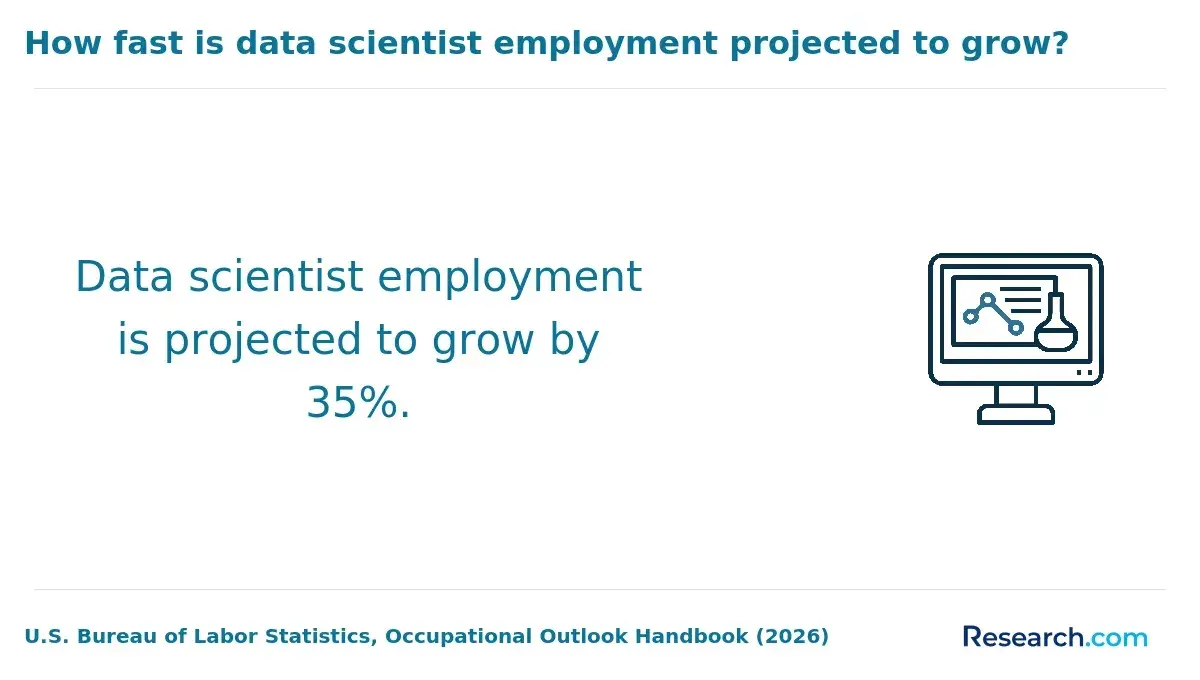
BLS projects U.S. employment of data scientists to grow 35% from 2025 to 2035. That indicates strong projected national growth for the occupation, but it is not a forecast for Cincinnati openings or a promise that graduates will find a job. Openings also differ in their expectations for software skills, statistical depth, and prior industry experience.
AI adoption makes curriculum fit especially important: compare what a program requires students to build, test, and explain, rather than relying on whether its description mentions AI. Revisit local job postings before enrolling and again as you select electives; the skills employers request can change during a multi-year degree.
Other Things You Should Know About Data Science
No. Campus proximity is useful mainly if you intend to attend events, meet collaborators, or use resources available to online students. Confirm access rather than assuming it.
Possibly, but obtain employer permission and check the program's project rules first. Confidential, patient, customer, or proprietary data may require restrictions or an alternative dataset.
Diploma wording is institution-specific. Ask the registrar for the policy for the exact degree if this matters to you.
It can help when a particular project or specialization drives your choice. Ask the program whether online students can work with the relevant faculty and how project supervision is assigned.
References
- Cost of Attendance (Budget) | 2025-2026 Federal Student Aid Handbook https://fsapartners.ed.gov/knowledge-center/fsa-handbook/2025-2026/vol3/ch2-cost-attendance-budget
- Paying For College | The Ohio Department of Higher Education https://highered.ohio.gov/wps/portal/gov/odhe/students/pay-for-college
- Data Science vs AI: Which Master's Degree Is Right for You? | CSP Global Concordia University, ST. Paul https://online.csp.edu/resources/article/masters-data-science-vs-artificial-intelligence/
- Tuition and Costs | Ohio University https://www.ohio.edu/admissions/tuition
- Data Science and AI Courses | du.edu https://ritchieschool.du.edu/data-science/courses
- Ohio Residency for Tuition Purposes | About the University of Cincinnati https://www.uc.edu/about/registrar/residency/ohio.html
- Course Info | CDS https://codas.uchicago.edu/course-info/
- How to Become a Data Scientist | Harvard SEAS https://seas.harvard.edu/news/how-become-data-scientist
- Co-op & Hiring | University of Cincinnati https://www.business.uc.edu/career-ready.html
- Data Science and Society (DATA) - UNC Catalog https://catalog.unc.edu/courses/data/