2027 MLIS Programs for Public Interest Technology Libraries

Co-Founder and Chief Data Scientist
Choosing an MLIS for public interest technology means looking beyond a program's technology electives. You need preparation to make digital information accessible, protect privacy, and help communities use technology on their own terms. The U.S. Bureau of Labor Statistics reports a May 2025 median annual wage of $68,270 for librarians and media collections specialists, but that broad figure cannot predict earnings in this specialty. This guide shows prospective students and career changers how to assess accreditation, coursework, applied projects, costs, and job fit before enrolling.
Key Things You Should Know
- Look for an ALA-accredited master's program with relevant, available courses and a way to complete a community-focused project; a technology elective alone is not a formal specialization.
- Match preparation to the work: digital inclusion, accessibility, privacy, information literacy, and responsible use of data matter alongside technical skills.
- Evaluate the degree against your target job and total cost. BLS projects 2.6% employment growth for librarians and media collections specialists from 2025 to 2035, not a guaranteed outcome for this specialty.
What are MLIS programs for public interest technology libraries?
These are library and information science master's programs that students can use to prepare for technology work serving a public benefit. "Public interest technology" describes the purpose of the work, not a standard MLIS accreditation category or a concentration that every school offers. A suitable program might combine librarianship with digital inclusion, accessible online services, privacy, community engagement, and stewardship of public information.
In practice, the work can mean teaching residents to evaluate online information, improving access to a digital collection, helping patrons navigate a government service, or assessing whether an AI-assisted discovery tool treats users fairly. Public libraries are an obvious setting, but academic, government, and special libraries also undertake relevant work. The strongest program choice depends on which community and service you want to support.
Which MLIS programs are accredited for public interest technology careers?
There is no separate ALA accreditation for public interest technology. Start with the American Library Association's current directory of accredited master's programs in library and information studies, then check each program's official catalog for the degree, courses, and applied opportunities you want. An accredited program may award an MLIS, MLS, Master of Science in Library Science, or another institution-specific LIS degree; the name alone does not establish its accreditation status.
Separate three questions when reviewing a school: Is the specific master's program ALA-accredited? Does it document a formal track, relevant electives, or only broad alignment with your goal? Can you actually take the needed courses during your enrollment? Institutional accreditation answers a different question, while a catalog listing does not mean an elective runs every term. Ask an adviser for recent course rotations and examples of approved projects before treating a program as a strong match.
Location and price may narrow your shortlist. A list of most affordable online library science programs in the South can help identify schools to investigate, but confirm each program's current ALA status, tuition eligibility, and public interest technology opportunities directly with the institution.
What careers can an MLIS prepare you for in public interest technology libraries?
An MLIS can prepare you to deliver and manage information services with public-benefit goals. Job titles vary, and "public interest technology librarian" is not a universal title. The table distinguishes library-centered roles from adjacent jobs for which an MLIS may be only one qualifying background.
| Potential role | Typical work | How the MLIS fits |
| Digital inclusion or technology services librarian | Teach digital skills, assess community needs, and connect patrons with accessible tools and services. | Librarian positions commonly seek a library science master's; employers may also value instruction and outreach experience. |
| Digital collections or metadata librarian | Make collections findable, usable, and responsibly described across systems. | LIS training in metadata and access is directly relevant; technical and project experience can strengthen an application. |
| Privacy or information policy specialist | Review information practices, support policy development, and explain risks to colleagues or users. | An MLIS can provide a user-centered perspective, but some positions favor policy, legal, security, or other specialized experience. |
| Civic technology or digital service worker | Research user needs and improve access to public-facing information or services. | An MLIS is one possible route; hiring may instead emphasize UX research, software, policy, or service-design experience. |
For library positions, combine the degree with evidence that you can work with communities: an accessible resource guide, a consent-aware user study, or a digital literacy workshop you helped evaluate. If your target role is primarily software engineering or public policy, compare those qualifications with an MLIS before committing. A broader view of library science specializations and pay can help you frame that comparison without assuming one salary applies to every role.
What do public interest technology library MLIS programs teach?
Relevant preparation usually combines LIS foundations with selected technology and community-facing work. The table shows what to look for in a curriculum; these are evaluation criteria, not a claim that every school offers the same courses.
| Learning area | Why it matters for public interest technology | Evidence to seek in a program |
| Information organization and discovery | Metadata and classification choices affect whether people can find and understand resources. | Course descriptions or projects involving metadata, search, digital collections, or knowledge organization. |
| Information literacy and community services | Public-benefit services must respond to actual needs rather than presumed technology gaps. | Instruction, reference, outreach, or community-engagement work with opportunities to assess results. |
| Accessibility, privacy, and policy | Digital services can exclude users or expose sensitive information if these concerns are overlooked. | Relevant coursework and projects that address inclusive design, data practices, or information ethics. |
| Applied technology | Graduates may need to assess platforms, improve workflows, and collaborate with technical colleagues. | Documented opportunities to work with digital systems, user research, data, or service design. |
Pay particular attention to applied work. A project that tests an accessible catalog interface with appropriate consent may demonstrate more relevant judgment than a course title alone. Ask who supervises projects, whether community partners are available, and how students handle patron privacy. If an institution advertises a "pathway," determine whether it is a formal concentration, a suggested group of electives, or an independent plan you would build with an adviser.
Are online or campus-based MLIS programs better for public interest technology?
Neither format is inherently better. Online study can make an accredited program accessible while you keep working or volunteering locally. Campus study may make it easier to use nearby labs, meet partners, or participate in in-person projects. The better option is the one that lets you complete the right coursework and gain relevant experience within your schedule and budget.
Check the delivery details rather than relying on an "online" label. Ask whether required and preferred courses are synchronous, when they run, whether group work crosses time zones, and whether a practicum can be arranged near you. Likewise, confirm whether a campus program's community partnerships align with the population you hope to serve. Students comparing scheduling approaches can use a flexible online MLIS competency model as another point of comparison, while verifying how any particular program assesses learning and schedules its courses.
What are the admission requirements for public interest technology MLIS programs?
Requirements vary by institution. Applicants should expect to review the school's published rules for a bachelor's degree, transcripts, application materials, and any program-specific prerequisites or tests. Do not assume that programming experience is required - or that work experience waives an academic requirement - without checking the particular program.
Your application can connect your interests to a feasible service goal. Experience in library assistance, teaching, community organizing, accessibility work, UX research, or public service can help explain your direction, even if your undergraduate major is unrelated. Before applying, ask whether you can pursue electives outside the department, how relevant prior graduate coursework is evaluated for transfer, and whether a proposed community-based project would qualify for academic credit. Admission and transfer decisions remain school-specific.
How long do MLIS programs for public interest technology libraries take?
Completion time depends on a program's required credits, your course load, course sequencing, and any practicum or capstone. Many students plan around roughly two years of full-time graduate study, while part-time study may take longer; a published accelerated option may shorten the schedule but increase the term-by-term workload. Confirm the timeline for the courses you need, not just the fastest advertised path to graduation.
If speed matters, map required courses and desired electives by term before enrolling. Ask whether a specialized elective runs often enough to fit your plan and whether a community project needs advance approval. A comparison of cheap accelerated library masters may provide starting options, but a shorter general MLIS path is not necessarily the shortest route to relevant preparation.
How much do public interest technology MLIS programs cost?
There is no single price for this pathway: public interest technology is usually an area of preparation within a broader degree. Compare the tuition you would actually be charged for all required credits, then add mandatory fees, materials, and any travel or practicum expenses. An online label does not establish that you qualify for in-state tuition.
Build two estimates: the gross cost of completing the degree and your likely out-of-pocket cost after confirmed funding. Keep any amount you may borrow separate from both. A library science program cost time comparison can help start a shortlist, but use current university tuition schedules and your expected enrollment status for a decision. Financial aid eligibility and loan terms should be checked for your enrollment period with each school's aid office.
For return on investment, compare those costs with your current earnings and the qualifications in actual job postings. If an employer would support targeted training but not require an MLIS for your goal, a course, certificate, or supervised project may be the lower-risk next step. If the roles you want commonly request an ALA-accredited library science master's, that requirement changes the calculation.
What salaries and job outlook can MLIS graduates expect?
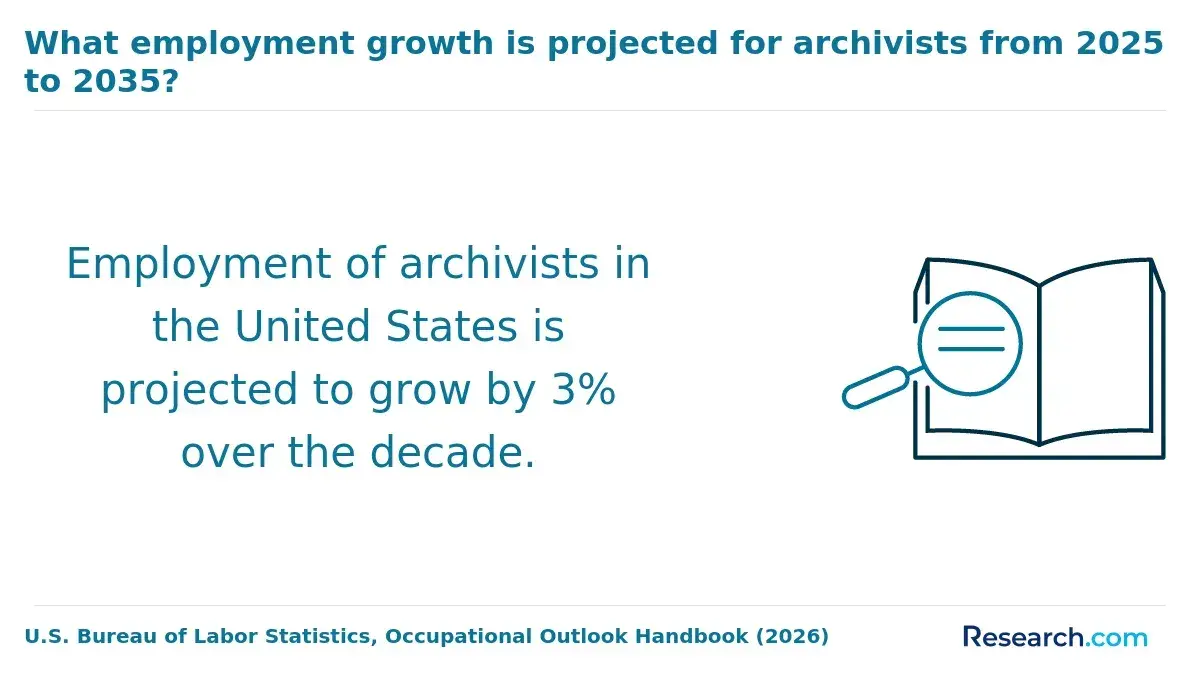
The U.S. Bureau of Labor Statistics reports a May 2025 median annual wage of $68,270 for librarians and media collections specialists and projects 2.6% employment growth from 2025 to 2035. These are national occupational figures, not starting salaries, MLIS graduate outcomes, or forecasts specifically for public interest technology roles. They offer context, but cannot tell you what a particular employer will pay.
Search job postings in your intended location and setting to see which positions require an MLIS and which accept other backgrounds. Compare the duties, salary range when published, technical expectations, and required experience. A digital services job emphasizing community instruction may reward different preparation from one centered on software development, even when both aim to improve public access.
Which certifications and skills support public interest technology library careers?
No single public interest technology certification is universally required for library work. Employers may value demonstrated ability to teach, conduct community-centered research, evaluate accessibility, protect privacy, organize digital information, and collaborate across technical and nontechnical teams. The right additional credential depends on a job's actual duties; avoid paying for one before checking postings in your target field.
Build a portfolio that shows decisions, not just tools. For example, document how you identified an access barrier, consulted intended users, revised a service, and assessed the result. Remove personal or patron information and obtain permission before sharing partner work. For school librarian positions, check the relevant state education authority's licensure or endorsement rules separately: ALA accreditation of a master's program does not by itself establish state eligibility.
Other Things You Should Know About Library Science
Possibly. Ask the program whether the placement meets its learning goals, supervision rules, and approval process before accepting an offer. A relevant nonprofit placement is not automatically eligible for credit.
Do not publish identifiable patron information simply because it appears in a class or practicum project. Follow the library's privacy policies, obtain required permissions, and use a de-identified description of your work when appropriate.
No. Many roles focus on instruction, access, research, policy, or service design. Technical fluency helps you collaborate and evaluate tools, but coding requirements depend on the position.
It can be relevant, particularly for information access and user research. Government hiring criteria vary by position, so compare postings carefully; an MLIS may be accepted alongside other degrees or experience rather than required.
References
- Public Library Initiative | LSC https://www.lsc.gov/initiatives/public-library-initiative
- Data Competencies | NNLM https://www.nnlm.gov/resources/data/data-competencies
- Iterative and Inclusive Program Design Model | Strategic Growth Council https://sgc.ca.gov/tools/catalyst-models/program-design/engagement-strategies/
- Practicum and Capstone: COPHP MPH | Health Systems and Population Health https://hspop.uw.edu/cophpmph/program-experience/practicum-capstone/
- Library Science Careers - UW Information School https://ischool.uw.edu/programs/mlis/careers
- Defining Public Interest Technology: Key Questions to Consider | dli-cornell-tech https://dli.tech.cornell.edu/post/defining-public-interest-technology-key-questions-to-consider
- Online Library Science Degree | MLIS Program at Mizzou Online https://online.missouri.edu/degrees-programs/mu/education/library-and-information-science/mlis
- Library and Information Science - MLIS - Kent State Online https://onlinedegrees.kent.edu/degrees/master-of-library-and-information-science
- Master of Library and Information Science | Dominican University https://www.dom.edu/academics/grad-phd/library-and-information-science/mlis
- What is Public Interest Technology? - MIDAS https://midas.umich.edu/what-is-public-interest-technology/