
2027 MLIS Programs for Medical Literature Search Specialists

Co-Founder and Chief Data Scientist
Choosing an MLIS for medical literature searching means looking beyond a program's name: the courses, supervised projects, and access to health-sciences research tools matter more than a generic promise of specialization. The U.S. Bureau of Labor Statistics projects 2.6% employment growth for librarians and media collections specialists from 2025 to 2035, so preparation for specialized roles deserves careful scrutiny.
This guide helps prospective students compare program evidence, plan practical training, estimate costs, and decide whether an MLIS fits their career goal.
Key Things You Should Know
- Prioritize an ALA-accredited LIS master's program where you can verify health-sciences coursework and complete a documented search or evidence-synthesis project, a relevant elective is not necessarily a formal concentration.
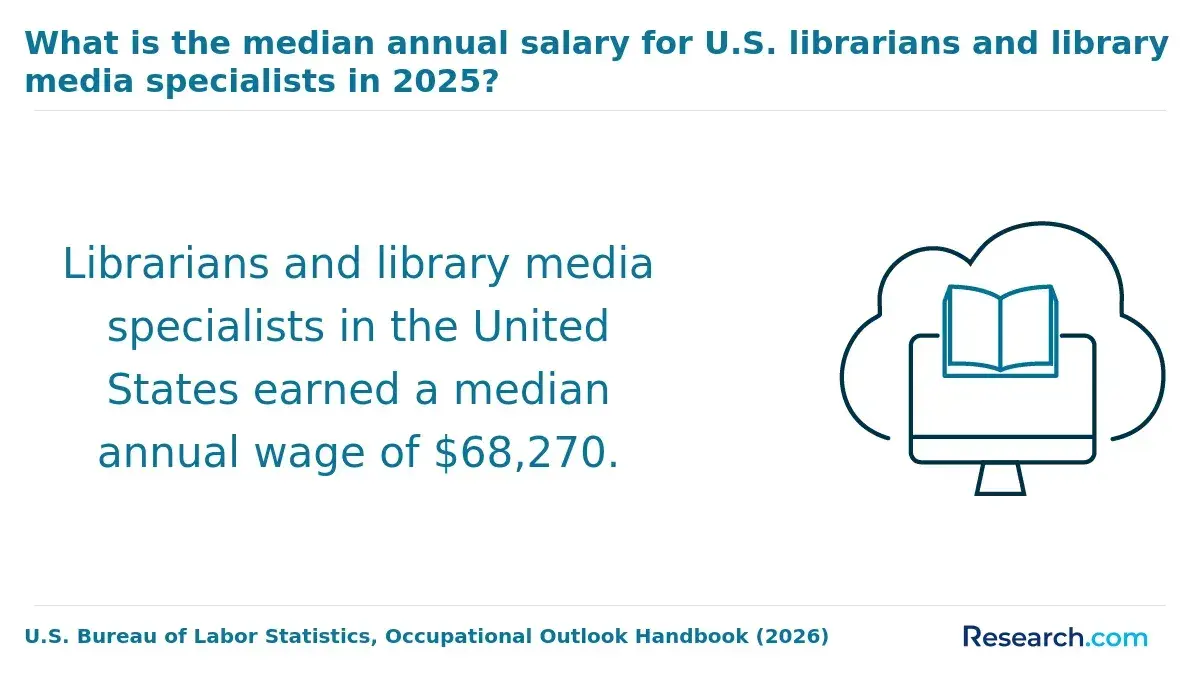
- The May 2025 median annual pay for librarians and media collections specialists was $68,270, but that broad occupational figure is not a medical-search-specialist salary or a graduate outcome.
- Before enrolling, confirm when specialized courses run, whether a health-library placement is feasible, and the full cost of the credits and fees you will actually need.
What is a medical literature search specialist?
A medical literature search specialist finds and documents research evidence for clinicians, researchers, guideline developers, or health organizations. Depending on the employer, the job may be titled medical librarian, health sciences librarian, information specialist, clinical librarian, or evidence synthesis librarian. The specialist translates a research question into searchable concepts, selects appropriate databases, builds reproducible search strategies, manages results, and explains the search's scope and limitations.
For a systematic review, that can mean combining subject headings such as Medical Subject Headings (MeSH) with keywords, adapting the strategy across databases, recording search dates, and supplying a search history the team can reproduce. Search specialists may also teach database use, support citation management, or advise on responsible use of AI-assisted discovery. They help teams find and assess evidence; they do not provide clinical advice merely by performing a search.
What degree is needed to become a medical literature search specialist?
An ALA-accredited master's degree in library and information science is a common qualification for professional medical librarian positions. The credential might be called an MLIS, MLS, Master of Science in Library Science, or another institution-specific LIS degree. Check the particular master's program in the current ALA accreditation directory, a university's institutional accreditation does not establish ALA accreditation for its LIS program.
There is no universal legal requirement to hold an MLIS to conduct medical literature searches. Research organizations may also hire people with clinical, public health, epidemiology, or research-methods training, particularly when the position combines searching with evidence appraisal. Conversely, an MLIS alone does not establish competence with biomedical databases. Compare job postings for your intended setting, then choose the degree and applied training that address the requirements employers actually list.
Applicants who already have graduate coursework should ask each school whether relevant credits can count toward its LIS degree; acceptance and limits are school-specific. Guidance on online library masters advanced standing can help frame that conversation, but prior study should not be assumed to shorten the degree.
Which MLIS programs prepare students for medical literature searching?
Look for an ALA-accredited LIS program with documented health-information learning opportunities and a realistic way to practice searching for a research team. Without confirming current catalogs, course schedules, and placements, no named school should be treated as a verified medical-search pathway. A concentration is a formally designated program option; individual electives or a student-designed project are different forms of preparation.
The distinctions below help you compare program descriptions without mistaking a promising catalog entry for an available training path.
| Evidence of fit | What it establishes | What to confirm |
| Named health-sciences concentration | The school formally organizes a specialized pathway. | Its requirements, current status, and whether its courses fit your schedule. |
| Relevant elective courses | Specific skills may be taught without a formal concentration. | When the courses next run and whether online students can enroll. |
| Practicum or applied project | Students may be able to produce work for a portfolio. | Placement approval, supervision, location, and access to research databases. |
| General LIS curriculum | Core research and information-service skills may transfer to this work. | How you will acquire specialized biomedical search experience. |
Request a recent course rotation and ask whether students have completed health-related search projects, not just whether such projects are theoretically allowed. Compare total program expense alongside those opportunities; a library science program cost comparison is a starting point, not a substitute for each school's current tuition schedule.
Are online or campus-based MLIS programs better for medical librarianship?
Neither format is inherently better. An online program may let a working student remain near a hospital or university library where they can seek relevant experience. A campus-based program may offer convenient access to local faculty, research teams, and placements. In either format, the decisive questions are whether specialized courses are accessible and whether the student can complete substantive search work.
Online does not necessarily mean self-paced: live sessions, group work, prescribed course sequences, and local practicum hours can constrain a schedule. Campus attendance does not guarantee a health-library placement. Ask whether database instruction uses the resources you need, whether off-site students can use licensed tools, and who arranges and supervises applied work. Compare MLIS program format and cost in light of those requirements rather than choosing solely by delivery label.
What courses do MLIS programs offer for medical literature searching?
Useful coursework can include health sciences librarianship, advanced reference or information retrieval, evidence synthesis, research methods, information literacy instruction, and database searching. Course titles vary, and a catalog listing does not mean a class runs every term. Ask for recent syllabi or assignment descriptions to see whether students actually develop, translate, and document search strategies.
For this specialty, a strong assignment goes beyond finding articles in PubMed. It might require defining a clinical or public health question, combining MeSH and keywords, explaining database choices, adapting syntax for another source, deduplicating results, and reporting the complete strategy and search date. Familiarity with guidance such as PRISMA for reporting reviews and PRESS for peer review of search strategies can also be useful when the curriculum includes evidence synthesis.
Choose electives to close specific gaps. A student with clinical training may need deeper instruction in information retrieval and teaching; a student with traditional library experience may need more practice with biomedical terminology and review methods. If no dedicated health course is available, ask whether an independent project with an appropriately qualified supervisor can produce equivalent, assessable work.
What are the admission requirements for medical librarianship MLIS programs?
Admission requirements belong to the specific LIS program, not to medical librarianship as a field. Applicants generally need a bachelor's degree and must follow the school's published application instructions, which may request transcripts, a statement of purpose, recommendations, and a résumé. Policies on GPA, standardized tests, prerequisite courses, and international credentials vary; do not assume a science degree is required unless the program says so.
Use the statement of purpose to connect your experience to concrete work: research assistance, clinical information services, teaching, database use, or participation in a review. If your background is outside health care, explain how you plan to gain subject familiarity. Ask admissions staff separately about entry requirements and ask program faculty or advisers about access to specialized courses and placements; admission to an MLIS does not guarantee either.
How long do medical librarianship MLIS programs take and cost?
Completion time depends on required credits, enrollment pace, prerequisite or elective sequencing, and any practicum. A student cannot reliably infer the fastest route from an advertised minimum completion time if the needed health-related elective runs infrequently. Before choosing a pace, map the required courses and your proposed specialty work term by term. Discussions of fast online librarian degree options are most useful when checked against an individual school's current schedule.
There is no responsible single tuition figure for this pathway: prices differ by institution, residency classification, enrollment status, and academic year. Build a personal estimate from the published per-credit rate multiplied by required credits, then add mandatory fees, books or equipment, and any travel or placement expense. Confirm whether an additional term would create more fees. This yields an estimated program expense, not necessarily what you will pay out of pocket or borrow.
Ask about scholarships, assistantships, employer support, and eligibility for federal aid under the rules applicable to your enrollment period. Funding is not guaranteed. Weigh any borrowing against your current earnings and the qualifications in jobs you would realistically pursue, rather than assuming that a broad librarian salary represents your post-graduation pay.
What careers can you pursue with an MLIS focused on medical literature?
Specialized search skills can lead to roles in hospitals, academic health centers, government, research organizations, and other settings that produce or use evidence reviews. Titles overlap, so assess responsibilities rather than assuming every "medical librarian" opening is primarily a search job. The following roles show where the MLIS is most directly relevant and where other preparation may also matter.
| Role | Typical work | Qualification consideration |
| Health sciences or clinical librarian | Searching, teaching, and information services for health professionals. | Professional librarian postings commonly seek a relevant LIS master's degree; clinical familiarity strengthens the application. |
| Evidence synthesis information specialist | Designing, documenting, and updating complex searches for review teams. | Demonstrated search methods may be as important as the degree title; requirements vary by employer. |
| Research information or knowledge specialist | Organizing evidence, monitoring literature, or supporting research workflows. | Some positions accept other research or information-management backgrounds. |
A portfolio containing an anonymized search question, complete strategy, database translations, search log, and explanation of revisions can demonstrate skills more clearly than an elective title alone. Observe confidentiality and licensing restrictions before sharing work. For roles with especially specialized expectations, reviewing competitive library science careers can help you distinguish an entry-level opportunity from one that expects substantial prior practice.
How much do medical literature search specialists earn?
The Bureau of Labor Statistics reports a May 2025 median annual wage of $68,270 for librarians and media collections specialists. It also projects 2.6% employment growth for that occupation from 2025 to 2035. These are useful national benchmarks, but the category covers many types of librarians and does not isolate medical literature search specialists.
Pay for a particular opening will depend on its employer, location, responsibilities, and required experience. Compare posted salary ranges for the jobs you want, and account for benefits and current earnings when evaluating an MLIS. Do not treat the occupational median as a program-specific graduate salary or as a predicted return on tuition.
Which certifications and standards support medical literature search careers?
The Medical Library Association's Academy of Health Information Professionals (AHIP) is a professional recognition pathway, not a universal license to conduct medical searches. Its eligibility and documentation rules should be checked directly before planning around it. Employers may value professional development, but a credential does not replace evidence that you can build and explain a sound search.
In evidence synthesis, PRISMA supports transparent review reporting, while PRESS offers a framework for peer review of electronic search strategies. Neither is a substitute for learning database-specific syntax and documenting what was searched. When assessing a program or preparing a portfolio, look for opportunities to apply these practices to real or realistic research questions rather than simply listing standards by name.
Other Things You Should Know About Library Science
Yes, if a team has a suitable student or assistant role. Ask whether a librarian or experienced information specialist can supervise your searches, and clarify which databases you may access and what work you may retain for a portfolio.
Not necessarily. Search design, database syntax, documentation, and communication are more central to many search roles. Programming may help with larger review workflows, but check the requirements of the jobs you want before prioritizing it.
Ask the host organization first. Remove confidential details, respect database licensing terms, and obtain permission where work belongs to a research team. A new strategy built around a public question can demonstrate the same skills if sharing the original is inappropriate.
Not automatically. Discuss contributions and authorship expectations with the research team at the start of a project. Keep a clear record of your search design, revisions, and other substantive work so the team can assess and credit your contribution appropriately.
References
- Medical Subject Headings - Home Page https://www.nlm.nih.gov/mesh/meshhome.html
- MeSH and text-word search strategies: precision, recall... - PMC https://pmc.ncbi.nlm.nih.gov/articles/PMC8830400/
- Systematic Reviews | CDC Library https://www.cdc.gov/library/research-guides/systematic-reviews.html
- Cost of Attendance | nyu.edu https://www.nyu.edu/admissions/financial-aid-and-scholarships/cost-of-attendance.html
- Systematic Reviews: Step 3: Conduct Literature Searches | unc.edu https://guides.lib.unc.edu/systematic-reviews/search
- Mastering Medical Information: The Role of AHIP in Medical Librarianship | UCR Library https://library.ucr.edu/news/2024/01/30/mastering-medical-information-role-ahip-medical-librarianship
- Medical Librarianship - SJSU - School of Information https://ischool.sjsu.edu/post/medical-librarianship
- Cost of Attendance (COA) | fitnyc.edu https://www.fitnyc.edu/admissions/costs/cost-of-attendance.php
- Comparing College Costs - The City University of New York https://www.cuny.edu/financial-aid/tuition-and-college-costs/comparing-college-costs/
- Keyword vs. Subject Searching - Systematic Reviews | Research Guides at UC Davis https://guides.library.ucdavis.edu/systematic-reviews/controlled-vocabularies


