2027 Document Classification Capstones: What to Look for in a Data Science Master's

Co-Founder and Chief Data Scientist
A document classification capstone can be strong evidence of applied data science - or little more than a polished demo. If you are choosing a master's program to build skills in natural language processing, compare what students can actually do: obtain suitable documents, define useful labels, test against realistic baselines, and explain errors and risks. This guide will help you judge a program's curriculum and project support before you commit, even if it does not advertise a document classification capstone by name.
Key Things You Should Know
- Look for a capstone that tackles a defined labeling problem with appropriate data, a baseline, meaningful evaluation, and an account of privacy and errors—not just a high accuracy score.
- Ask whether students can access usable documents, technical supervision, compute resources, and permission to show their work; a capstone requirement alone does not establish those conditions.
- Career demand is a reason to build demonstrable skills, not a promised outcome: the U.S. Bureau of Labor Statistics projects 35% growth in data scientist employment from 2025 to 2035.
What is a data science master's capstone project?
A capstone is an applied project in which students bring together methods learned across a degree to address a defined problem and communicate the result. Requirements vary: a program might use an individual project, a team engagement with an external sponsor, or a broader applied research course. Do not assume that a capstone requirement lets you choose document classification as your topic.
In document classification, a model assigns one or more labels to text-based records, such as routing customer requests to teams or identifying document types for review. A substantial project goes beyond fitting a model. It establishes who needs the labels, how documents and labels are obtained, what mistakes cost, and whether the system performs on documents unlike those used for training.
For example, an invoice-routing project might compare a simple text-based classifier with a more complex model. The decision is not merely which scores higher: it is whether either model can reliably distinguish rare categories, flag uncertain cases for human review, and handle new templates without exposing sensitive invoice details.
What should a data science capstone demonstrate?
A convincing document classification capstone shows the full chain from problem definition to defensible conclusions. When reviewing student examples or proposing your own project, look for these connected forms of evidence:
- Problem and labels: A stated user, a clear definition for each category, and a plan for ambiguous or multi-label documents.
- Data and permissions: An account of where documents came from, whether their use is authorized, how labels were checked, and how private information is protected.
- Methods and baselines: A straightforward comparison model before more complex approaches, with a reason for any added complexity.
- Evaluation: A test set separated in a way that reflects future use, per-category results, and an examination of costly errors. Overall accuracy alone can conceal poor performance on uncommon but important classes.
- Reproducibility and use: Documented preprocessing, code or an equivalent technical record, limitations, and an explanation of how people would review uncertain predictions.
Generative AI can assist with classification, but a capstone should still test its output against appropriate alternatives and address unreliable predictions and disclosure of document contents. If governance is central to your goals, compare that practical project requirement with AI master's curricula with ethical decision-making. A course title mentioning ethics is less informative than a project that applies those principles to real data-handling choices.
How do you evaluate a data science master's program?
Start with evidence of what students complete, not the capstone's name. Published syllabi, project descriptions, faculty interests, and anonymized student work can reveal more than a broad promise of "hands-on learning." A program may be an excellent fit even without a named document classification track if students can propose the topic and receive appropriate supervision.
Ask a program representative questions that distinguish a feasible project from an appealing idea:
- Can students propose a document classification project, and who approves the topic and dataset?
- What NLP instruction comes before the capstone, and who can advise on evaluation and text-data problems?
- Are datasets, computing resources, and sponsor connections available, or must students arrange them independently?
- What deliverables are assessed: a report, working prototype, presentation, reproducible code, or stakeholder feedback?
- Can students publish a sanitized portfolio version, and who decides what sponsor-owned work may be shared?
Alumni can sometimes provide a clearer account of project access and supervision than promotional examples. If introductions matter to your decision, assess the actual opportunities for mentorship and project feedback rather than assuming AI graduate study and access to alumni networks necessarily translate into a document classification sponsor. A red flag is a program that advertises industry projects but cannot explain how students obtain data or permission to use it.
What accreditation should a data science master's program have?
Check the institution's accreditation with its named accreditor and confirm that the degree is offered under that institution's current authority. Accreditation applies to institutions or, in some cases, specific programs; do not assume that a data science degree has separate specialized accreditation just because the university is accredited.
For this particular decision, accreditation is a baseline check, not proof of capstone quality. After verifying institutional status, examine the project requirements, supervision, and access to appropriate data. If you need employer reimbursement or plan to pursue further study, ask the employer or receiving institution which accreditation and degree conditions it recognizes before enrolling.
What courses are included in a data science master's curriculum?
Curricula differ by institution. For a document classification capstone, the useful question is whether required courses and available electives prepare you to execute the project—not whether the catalog contains every current AI term.
Look for a progression from programming and statistics to machine learning, data management, and evaluation. Natural language processing is especially relevant, whether taught in a dedicated course or as a substantial elective: useful coverage includes text representation, classification, model assessment, and limitations. Data engineering or database work matters when documents need cleaning, versioning, and controlled access.
Read course descriptions and assignments where available. A passing mention of text analysis does not provide the same preparation as a dedicated course, and a dedicated course does not guarantee that students will apply its methods in a supervised capstone. If the curriculum lacks NLP depth, ask whether an elective, independent study, or qualified adviser can fill that gap before the project begins.
What are the admission requirements for a data science master's degree?
Requirements depend on the school and may include a bachelor's degree, academic transcripts, evidence of quantitative or programming preparation, recommendations, and application statements. Verify the current policy for each program rather than treating a general admissions checklist as a guarantee of eligibility.
For a prospective document classification student, readiness means being able to work with code, reason about statistical evaluation, and learn how text data differs from tidy tabular data. An applicant without prior NLP experience may still be well prepared if the curriculum teaches it before the capstone. Conversely, familiarity with an AI tool does not replace the ability to inspect data and explain model errors.
If an application essay is a barrier, machine learning master's applications without essays offer a related comparison point. Check each school's current requirements and curriculum separately: a simpler application does not establish that the program supports your intended project.
How long does a data science master's degree take and cost?
There is no reliable single duration or price for a data science master's. Course load, prerequisites, scheduling, residency rules, fees, and whether a capstone needs an additional term can all change the total. Request the current degree plan and tuition schedule from each school, then calculate the cost for your expected pace—not only the advertised per-credit price.
For a document classification project, ask whether suitable computing resources, software, and dataset access are included. Also consider the time needed to secure permission for documents and labels. A lower-cost or faster degree loses some of its advantage if you must build a viable project without adequate support.
If your primary goal is AI rather than the broader data science curriculum, compare lower-tuition artificial intelligence degree options on the same total-cost basis. Choose by relevant coursework and project access as well as price; an AI-labeled degree does not automatically offer a stronger text-classification capstone.
Are online data science master's capstones as rigorous as campus projects?
They can be, but delivery format alone does not establish rigor. Compare the same evidence in either format: project scope, adviser feedback, assessment standards, access to documents and computing, and the quality of final deliverables. An online project with regular technical review may serve you better than a campus project with little supervision; the reverse is also possible.
Online students should confirm how meetings, teamwork, sponsor contact, and final presentations are scheduled. Ask whether remote access permits work with the proposed data and whether restrictions would force a different topic. These operational details matter more than the word "online" on a program page.
If speed is important, use a guide to shorter online data science master's degrees to identify questions about pacing. Confirm that an accelerated schedule still leaves time for dataset approval, iteration, and evaluation; a rushed capstone may produce a weaker portfolio artifact.
What careers can a data science master's capstone prepare you for?
A well-executed document classification project can provide relevant evidence for data scientist, machine learning, NLP, and applied AI roles, as well as analytics work involving records, support requests, or other text. The fit depends on the job: some roles emphasize model development, while others put more weight on data pipelines, evaluation, or communication with operational teams.
Use the capstone to show what you did and why it mattered: the labeling decisions you made, the baseline you challenged, the errors you investigated, and the limits you would explain to a stakeholder. A prototype is not the same as a production system, so describe deployment experience only if the project actually included it. Compare job postings for your target roles with the project deliverables before selecting a program.
What salary and job outlook can data science graduates expect?
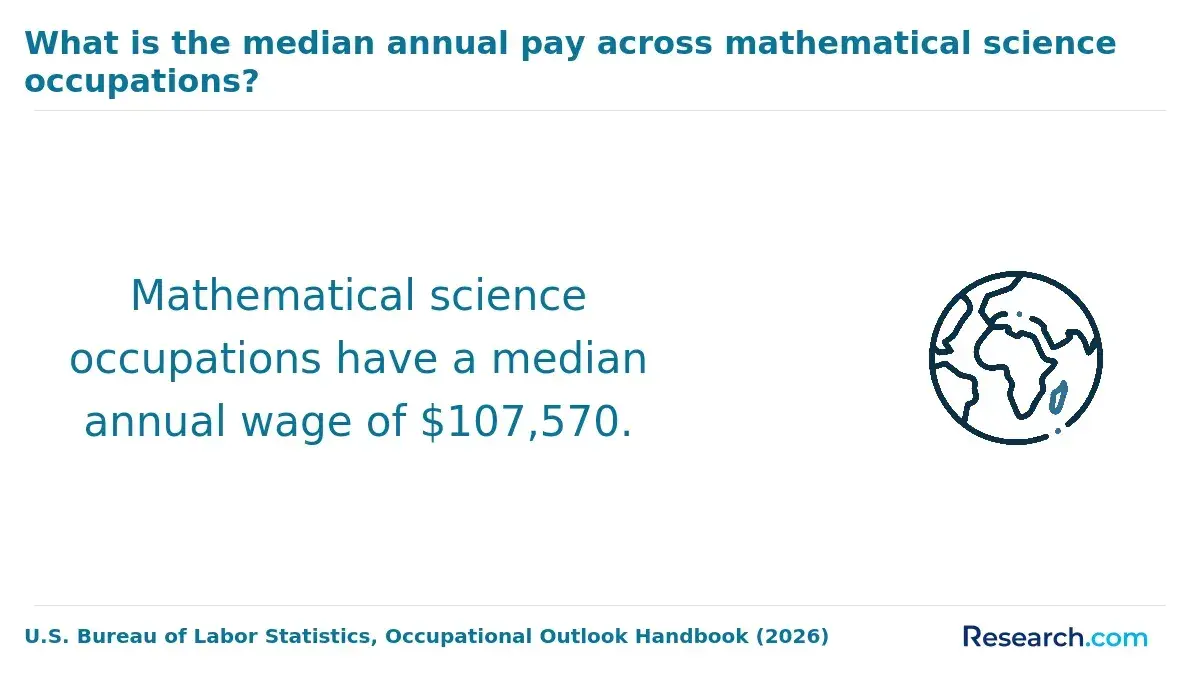
The U.S. Bureau of Labor Statistics reports a median annual wage of $120,230 for data scientists in May 2025. That is an occupation-wide figure, not the expected salary of a new master's graduate or evidence that completing a capstone causes a particular pay increase. Experience, responsibilities, employer, and location can all affect an individual offer.
BLS projects data scientist employment to grow 35% from 2025 to 2035. The projection signals potential demand, but it does not identify how many openings will require document classification or a master's degree. Treat the capstone as a way to demonstrate relevant skills, then judge its value against your target jobs and the full cost of the program.
Other Things You Should Know About Data Science
Yes. Keep a clear record of your own contributions, decisions, and code or analysis. In interviews, distinguish the team's overall result from the parts you personally designed, tested, or communicated.
They can be useful when real documents cannot be shared, provided the project explains how they were created and what real-world variation they may miss. Ask an adviser whether the resulting evaluation meets the program's capstone standards.
Not necessarily. Some approaches can be trained and evaluated with modest computing resources. Estimate resource needs after defining the dataset and comparison models, rather than choosing a method solely because it requires specialized hardware.
Not necessarily. A capstone generally emphasizes applying skills to a defined problem, while a thesis may emphasize an original research question. Schools set their own requirements, so compare the expected deliverables if you may later apply to research-focused programs.
References
- Partnering with Students to Develop a Capstone for a... - PMC https://pmc.ncbi.nlm.nih.gov/articles/PMC11732519/
- Capstone Projects - UVA School of Data Science https://datascience.virginia.edu/degrees/info/capstone-projects
- Thesis/Capstone for Master's in Data Science | Northwestern University https://sps.northwestern.edu/masters/data-science/thesis-capstone.html
- Capstone Requirement - Data Science in Biomedicine MS https://datasciencebiomedicine.ucla.edu/academics/requirement
- Capstone Research Projects | Khoury College of Computer Sciences https://www.khoury.northeastern.edu/research/capstone-projects/
- Master's in Data Science: Capstone Project | NYU CDS https://cds.nyu.edu/masters-in-data-science-capstone/
- Capstone - Office of Sponsored Projects - The University of Utah https://osp.utah.edu/policies/procedure-library/capstone.php
- Data Science Capstone Experience - Purdue Online https://www.purdue.edu/online/data-science/data-science-capstone-experience/
- Independent Research Project as Capstone - Data Science https://datasciencemajor.stanford.edu/research-impact/independent-research-project-capstone
- Faculty Advisor Role | Capstone SSM - University of Minnesota https://capstonessm.cfans.umn.edu/faculty-advisor-role