2027 Data Science Master's Programs for Professionals Seeking Data Product Ownership

Co-Founder and Chief Data Scientist
A data science master's can help a working professional move toward data product ownership - but only if it builds more than modeling skills. Data product owners must connect technical decisions to user needs, delivery priorities, and measurable results.
This guide helps analysts, engineers, and product professionals decide whether a master's is worth pursuing, what to look for in a program, and when a less extensive option may be a better fit.
Key Things You Should Know
- Choose a program with substantial statistics and data engineering and opportunities to define problems, work with stakeholders, and evaluate a deployed or deployable product.
- A master's is most useful when it closes a genuine technical or cross-functional gap; experienced product professionals may get more immediate value from targeted coursework and a strong project.
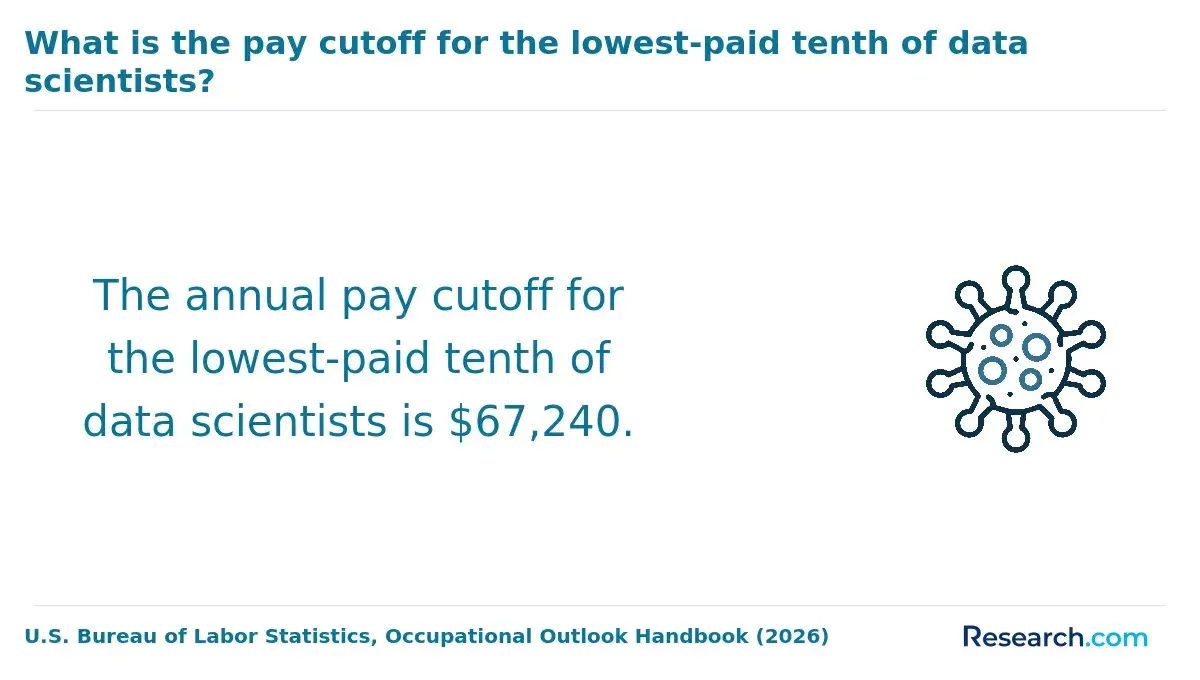
- The U.S. Bureau of Labor Statistics reports a $120,230 median annual wage for data scientists in May 2025 and projects 35% employment growth from 2025 to 2035. Neither figure predicts data product owner pay or a graduate's outcome.
What Is a Data Science Master's Program for Data Product Ownership?
It is generally a data science master's selected for its relevance to product decisions - not a standardized degree with a "data product owner" curriculum. The role typically involves deciding which data capability to build, whose problem it solves, how teams will deliver it, and whether it works. Depending on the employer, the product might be an internal forecasting tool, a customer-facing recommendation feature, or a reusable data set.
Titles vary. A product owner may focus on a team's backlog and delivery, while a product manager may have broader responsibility for strategy and outcomes. Before choosing a degree, compare the responsibilities in your target job postings rather than relying on the title alone. If your goal is primarily AI product strategy rather than broad data science, AI degree comparisons based on career interests can help clarify the distinction.
Why Pursue a Data Science Master's Degree for Product Leadership?
The strongest reason is to gain enough technical judgment to challenge assumptions and make defensible trade-offs. An owner of a churn-prediction product, for example, should be able to ask whether the training data represents future users, whether false positives are costly, and how the prediction will change an actual decision. A master's can provide structured practice with those questions alongside feedback from instructors and collaborators.
A degree is less compelling if your main gap is product delivery and you already work effectively with data scientists and engineers. In that case, product experience, focused technical study, or a cross-functional project may be a faster way to demonstrate readiness. In specialized settings such as healthcare, domain constraints can also shape the right curriculum; professionals considering that path may compare AI master's programs for healthcare technology careers rather than assume a general program covers their needs.
What Do Data Science Master's Programs Teach Aspiring Data Product Owners?
Look for a combination of technical depth and work that connects analysis to delivery. The table shows why common curriculum components matter; a course title alone does not establish how deeply a program teaches them.
| Curriculum component | Relevance to data product ownership |
| Statistics and experimental design | Helps assess uncertainty, evaluation claims, and whether a change improved an outcome. |
| Machine learning and model evaluation | Builds judgment about model limitations, error costs, and ongoing performance. |
| Data engineering and databases | Clarifies data availability, quality, integration, and maintenance constraints. |
| Privacy, ethics, and governance | Supports decisions about appropriate data use, access, and risk. |
| Applied or team-based project | Creates an opportunity to connect a user problem, technical approach, and measurable result. |
For product ownership, the most revealing project is not necessarily the one with the most sophisticated model. Look for evidence that students identify users, establish a baseline, explain trade-offs, and specify how a solution would be adopted and monitored. Ask to see project briefs or descriptions of capstone expectations; a program that only mentions "real-world applications" may not require these deliverables.
Are Online Data Science Master's Programs Suitable for Working Professionals?
Yes, if the operating schedule fits your job and the program still provides meaningful collaboration. "Online" does not tell you whether lectures are recorded, meetings are mandatory, exams have fixed times, or group projects require coordination across time zones. Those details matter more to a professional with unpredictable work hours than the delivery label itself.
Ask the program for a sample course schedule and recent syllabus, then check expected weekly work, live-session attendance, project deadlines, and any campus visits. Compare a faster schedule against the time needed to produce a credible product-focused project; data science master's timelines and cost trade-offs offer additional context. A flexible pace is valuable, but only if it lets you sustain the work and finish.
What Are the Admission Requirements for a Data Science Master's Degree?
Requirements vary by institution. Programs may assess prior coursework or demonstrated preparation in programming, calculus, linear algebra, and statistics, alongside academic records and professional experience. A product manager's stakeholder work or an analyst's business knowledge can strengthen an application, but neither automatically fulfills a formal mathematics prerequisite.
Compare each program's published requirements with your transcript before applying. If you have a gap, ask whether a graded course, approved prerequisite, or foundation pathway satisfies it - and obtain the answer from the program. Guidance on AI graduate admission through foundation courses may help you frame that conversation, but its examples do not establish another program's admissions policy.
How Long Do Data Science Master's Programs Take and What Do They Cost?
Both depend on the school, credit requirements, enrollment pace, and residency or fee policies. There is no reliable single 2026 price or completion time for programs suited to data product ownership. To compare offers fairly, request the current per-credit tuition, required credits, mandatory fees, and any additional charges for online study, then calculate the cost at the pace you can actually maintain.
Budget separately for materials, technology, possible travel, and financing costs. Account for employer tuition assistance and any work hours you might forgo. An online data science master's affordability guide can help you identify candidates, but confirm each school's current charges directly. The common mistake is choosing the lowest advertised tuition without checking required fees, remaining credits, or whether the schedule is feasible.
Which Accreditation Should You Look for in a Data Science Master's Program?
Confirm that the university holds recognized institutional accreditation. That is a more useful initial check than expecting a separate accreditation label for every data science degree. Verify the institution's status through the accreditor or the U.S. Department of Education's accreditation records, and check the status for the campus or institution awarding the credential.
Accreditation establishes an institutional quality-review framework; it does not establish that a particular curriculum teaches product ownership well. Evaluate that fit separately through course descriptions, project requirements, and access to relevant faculty. Online applicants should also confirm that the institution can enroll students in their state.
What Careers Can a Data Science Master's Degree Prepare You For?
Potential paths include data product owner or manager, analytics product manager, technical product manager, and - in candidates with the appropriate modeling and programming skills - data scientist. The degree alone does not qualify someone for every title. Employers may weigh prior delivery experience, domain expertise, technical work, and evidence that a candidate influenced a product decision.
A realistic transition builds on your existing role. Analysts can use their familiarity with metrics and stakeholders while developing delivery and data-engineering judgment. Engineers may need more practice defining user value and prioritizing competing requests. Existing product managers can strengthen their statistical and model-evaluation skills. In each case, a project that documents a problem, constraints, decision, and outcome is stronger evidence than a credential without applied work.
How Much Can Data Product Owners and Data Scientists Earn?
The U.S. Bureau of Labor Statistics reports that the median annual wage for data scientists was $120,230 in May 2025. That occupational figure is useful context if you are considering a technical data science role; it is not a verified median for data product owners. Product titles span different responsibilities, so compare compensation using job postings that match your intended scope, industry, and location.
BLS also projects 35% growth in data scientist employment from 2025 to 2035. Growth indicates demand across that occupation, not a promise of a product role or a salary increase from a master's. When assessing a degree's financial value, compare its full cost with plausible opportunities available to you with and without it.
What Certifications Strengthen a Data Product Owner's Career Path?
A product-management or agile certification may help you learn shared delivery terminology; a cloud or analytics certification may help demonstrate familiarity with a platform used by your target employer. Neither substitutes for evidence that you can set priorities, work with technical teams, and assess whether a data product creates value.
Choose a certification only after reviewing target job descriptions. If they repeatedly name a particular method or platform you lack, a relevant credential plus a practical project may be worthwhile. If they emphasize ownership of outcomes and cross-functional delivery, put more effort into documenting that experience than collecting additional badges.
Other Things You Should Know About Data Science
Only with the employer's permission and in line with its confidentiality and data-use policies. If approval is unavailable, use public or synthetic data and explain the business context without disclosing proprietary information.
No. An internal dashboard, forecasting service, or governed data set can be a product when it has identifiable users, a purpose, and someone accountable for its usefulness and maintenance.
Define other credible measures before launch, such as data quality, adoption, task completion, or decision time. Explain what those measures cannot prove, particularly when several changes occur at once.
Not necessarily. A simpler, well-evaluated approach can be more persuasive if it solves a defined user problem and can be maintained responsibly.
References
- Cost of Attendance (Budget) | 2025-2026 Federal Student Aid Handbook https://fsapartners.ed.gov/knowledge-center/fsa-handbook/2025-2026/vol3/ch2-cost-attendance-budget
- Data Science Curriculum | UC Berkeley School of Information's Online Master's Programs https://ischoolonline.berkeley.edu/data-science/curriculum/
- Capstone Project - MS in AI Systems - University of Florida https://msais.eng.ufl.edu/capstone-project/
- Graduate Admissions: How to Apply - Mathematical Sciences https://math.utdallas.edu/graduate/how-to-apply/
- Business analytics vs data science: Which career is right for you? | Uncover IE https://www.ie.edu/uncover-ie/business-analytics-vs-data-science-master-in-business-analytics-and-data-science/
- MS in Data Science, Curriculum & Specializations | Northwestern University https://sps.northwestern.edu/masters/data-science/curriculum-specializations.html
- All Capstone Projects - Duke MIDS https://datascience.duke.edu/capstones/
- Data governance & quality management - Innovation and breakthroughs across different fields - ScienceDirect https://www.sciencedirect.com/science/article/pii/S2444569X24001379
- Capstone Sponsorships - Columbia's Data Science Institute https://datascience.columbia.edu/partnerships/engage/capstone-sponsorships
- What preparations do I need for graduate education? | Statistics & Data Science Graduate Interdisciplinary Program https://stat.arizona.edu/what-preparations-do-i-need-graduate-education