2027 Clinical Trial Recruitment Capstones: What to Look for in a Data Science Master's

Co-Founder and Chief Data Scientist
A clinical trial recruitment capstone can be compelling evidence of healthcare data science skills - but only if the project addresses a real recruitment decision without overstating what the data can prove. For prospective master's students, the key question is whether a program provides the methods, data access, supervision, and time to do that work responsibly. This guide explains how to judge a proposed capstone and compare programs before enrolling.
Key Things You Should Know
- Look for a capstone that defines a recruitment decision, uses data students can legally access, and measures performance against a meaningful baseline - not just a polished prediction model.
- Ask who approves projects, arranges data access, advises on clinical constraints, and reviews privacy and bias; a healthcare elective alone does not establish that support.
- The U.S. Bureau of Labor Statistics reports a $120,230 median annual wage for data scientists in May 2025, but that occupation-wide figure is neither an entry-level salary nor a capstone-specific outcome.
What is a clinical trial recruitment capstone in a data science master's program?
It is a supervised final project that applies data science to a defined enrollment problem: for example, forecasting whether a trial site will meet its enrollment target, identifying bottlenecks between screening and consent, or estimating how eligibility rules affect the pool of potentially eligible patients. Its purpose is to inform a decision, not to automate a clinical or enrollment judgment without human review.
A strong proposal specifies the decision-maker, the outcome being measured, when the prediction would be made, and what action could follow. "Predict trial enrollment" is too vague; "flag sites at risk of missing next quarter's target using information available today" is testable. Programs may offer general capstones rather than guaranteed clinical trial projects, so confirm topic approval and data arrangements before treating this as a reason to enroll.
Data source determines what a project can credibly claim. These common options have different strengths and limitations.
| Data source | Potential project value | Important limitation |
| Public trial records | Study-level questions about trial characteristics and recruitment status | Limited visibility into individual screening decisions or site workflows |
| Partner-provided operational data | Direct analysis of screening, outreach, or site enrollment | Access, permitted uses, and publication may be restricted |
| Synthetic or simulated records | Reproducible demonstration of a method | Results cannot establish real-world recruitment effectiveness |
Which data science skills should a clinical trial recruitment capstone demonstrate?
The best project shows more than model accuracy. Recruitment records can contain missing outcomes, changing eligibility rules, and differences between sites that make an apparently strong model unreliable when used elsewhere.
When reviewing a capstone description or student example, look for evidence of these linked skills:
- Data preparation and definitions: Document what counts as screened, eligible, approached, consented, and enrolled; avoid treating those stages as interchangeable.
- Appropriate modeling: Match the method to the decision, whether it is a site-level forecast, a funnel analysis, or an eligibility-text analysis. Explain why a simpler baseline would not suffice.
- Credible evaluation: Separate training and test data by time or site when appropriate, check calibration and error across relevant groups, and prevent information unavailable at decision time from entering the model.
- Reproducibility and communication: Preserve code, data definitions, assumptions, and limitations; translate results into a recommendation a trial team can assess.
AI can help analyze eligibility language, but a convincing capstone tests whether its output is accurate and useful rather than assuming automation improves recruitment. Students weighing this emphasis against a broader AI curriculum can use a guide to matching an AI degree to your professional goals.
How do clinical trial recruitment capstones prepare students for healthcare careers?
A good capstone lets students practice working across technical and clinical boundaries: agreeing on an outcome with a stakeholder, explaining uncertainty, and deciding when a model should not be used. That experience can support applications for analytics roles with research organizations, health systems, sponsors, or clinical technology companies. It does not replace clinical operations experience or guarantee a trial-focused job.
Portfolio value depends on what an employer can inspect. If a partner restricts its data, ask whether the program permits a sanitized methods report, synthetic demonstration, or approved summary of the problem, validation, and your individual contribution. A result you cannot discuss at all may offer less visible evidence than a well-documented public-data project.
If speed matters more than clinical trial specialization, compare the capstone opportunity with AI master's degrees with shorter completion times. A faster program is the better choice only if its coursework and project options still support the work you want to pursue.
What coursework supports clinical trial recruitment capstone projects?
Prioritize a sequence that teaches statistical inference, data management, machine learning evaluation, and applied research design before the capstone begins. Healthcare-focused instruction should cover how clinical data are generated and why recruitment, consent, and eligibility measures can be difficult to interpret. A course title is not proof of depth: examine assignments and prerequisites to see whether students actually validate models on messy, imperfect data.
Natural language processing can be useful for eligibility criteria or screening notes, while causal inference can help frame questions about changes to outreach or workflow. Neither is essential to every recruitment project. If your main interest is building models rather than understanding clinical operations, compare the curriculum with lower-cost machine learning master's degrees before paying for a healthcare-focused option.
Should you choose an online or campus-based data science master's program?
Choose by access to the project, not by delivery label. An online program can work well when remote students receive the same capstone advising, approved datasets, computing access, and stakeholder contact as campus students. Campus study may be more suitable when a project depends on in-person collaboration with a research team. Neither format, by itself, secures access to patient or trial operations data.
Ask whether capstone meetings are synchronous, whether team members must share working hours, and whether an external partner can participate remotely. For a broader comparison of programs built around employment goals, review career-oriented online data science degree options; then verify the clinical project arrangements of any program on your shortlist.
What accreditation should a data science master's program have?
Verify that the institution holds recognized institutional accreditation and that the specific master's program is an authorized offering. Do not assume a data science degree needs a separate clinical-trial accreditation: a recruitment capstone is an academic project, not a professional license or certification.
Accreditation is a baseline check, not evidence that a school can deliver this particular capstone. Ask separately about the project approval process, faculty expertise, and any requirements imposed by a clinical partner, privacy office, or research oversight body. Those requirements can vary with the data and project design.
What are the admission requirements for a data science master's degree?
Requirements vary by program, so check the current admissions page rather than assuming that a clinical background is required - or that one substitutes for quantitative preparation. Statistics, programming, and mathematical foundations are particularly relevant because a recruitment capstone must distinguish genuine predictive value from noise and bias.
Applicants with clinical research experience can use screening or enrollment work to demonstrate domain knowledge, while showing separately how they meet technical prerequisites. Applicants from computing or mathematics can explain how they plan to learn clinical workflows. Ask admissions whether prerequisite courses must be completed for credit before enrollment; self-study may help preparation without satisfying a formal requirement.
How long and how much does a data science master's program take?
There is no reliable single price or completion time for a clinical recruitment capstone: programs set different credit loads, schedules, tuition rates, and fees. Compare the published total for the pace you would actually take, including mandatory fees and any travel or residency requirement. Employer support, aid, and the cost of reducing work hours can change the calculation.
Capstone timing deserves special scrutiny. Ask when a topic and adviser are assigned, whether data approvals must be complete before enrollment in the capstone course, and what happens if a partner withdraws. A cheaper or shorter degree can become a poor fit if the project you need cannot be finished on its timetable. The online data science master's affordability guide can help build a shortlist, but confirm current charges directly with each institution.
What careers and salaries follow a clinical trial data science capstone?
Possible targets include clinical research data analyst, trial operations analyst, healthcare data scientist, and analytics roles supporting site selection or patient recruitment. Job titles and qualifications vary by employer; some roles emphasize clinical operations, while others require substantial software or modeling experience.
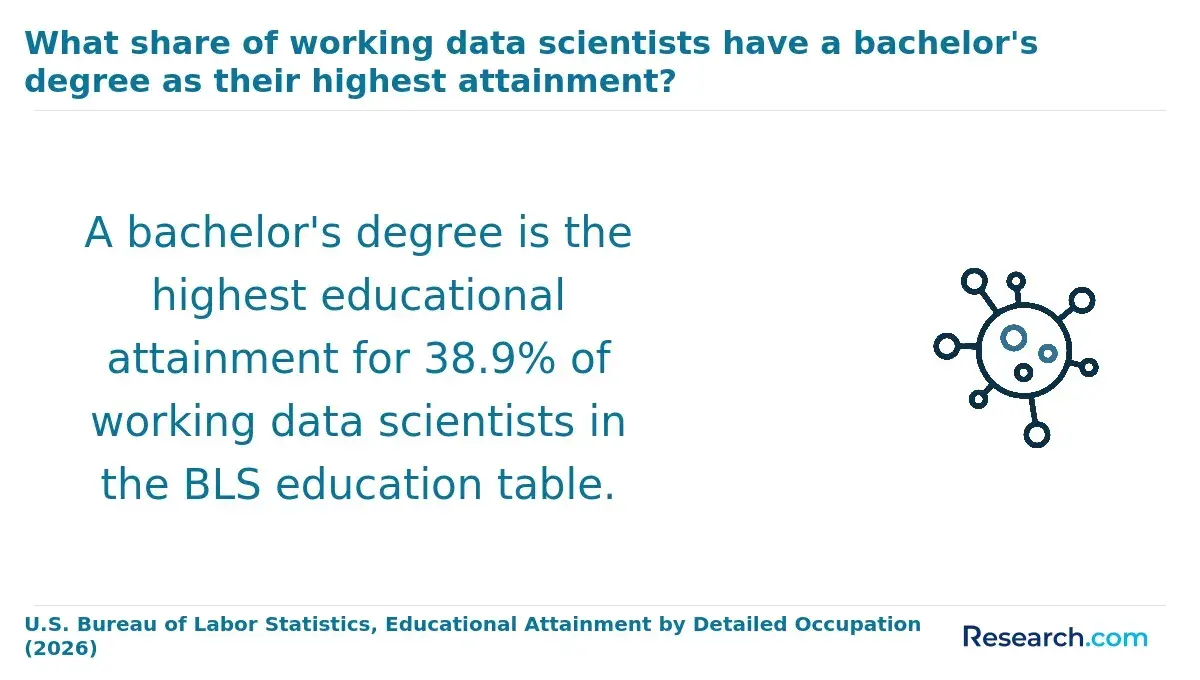
The U.S. Bureau of Labor Statistics projects 35% growth in data scientist employment from 2025 to 2035. That signals broad demand for the occupation, not a forecast for clinical trial recruitment jobs specifically. Its May 2025 median annual wage of $120,230 likewise describes employed data scientists across industries and experience levels, not what a new graduate should expect. Compare actual job postings with your prior experience and the capstone skills you can demonstrate.
How do you evaluate a reputable clinical data science master's program?
Request examples of completed projects and speak with a capstone coordinator, not only an admissions representative. The decisive issue is whether the school can support a feasible clinical recruitment question from proposal through defensible results.
Use these questions to separate a plausible opportunity from a promised-sounding topic with no delivery plan:
- Can students propose a clinical trial recruitment project, and who decides whether its scope is appropriate?
- What usable datasets, partner arrangements, or public-data alternatives have recent students actually had?
- Who advises on statistics and clinical context, and how are privacy and any required research approvals handled?
- What happens if access falls through, and what project material may graduates share with employers?
Be cautious if a program advertises healthcare projects but cannot describe its approval process, offers only model-accuracy examples without validation details, or implies that enrollment guarantees access to protected records. Choose it for this goal only when its answers support a project you can complete, evaluate, and explain responsibly.
Other Things You Should Know About Data Science
Possibly, but publication depends on the project, data-use terms, approvals, and collaborators. Discuss that goal before selecting a partner or dataset.
Yes. Keep a clear record of your own work and confirm what the team and program permit you to share.
Usually the method and reproducibility matter more than the language, but confirm any program or partner requirements before proposing your tools.
No. A capstone demonstrates academic project work; employers set their own experience and credential requirements for clinical research roles.
References
- Frequently Asked Questions | clinicaltrials.gov https://clinicaltrials.gov/policy/faq
- Real-world mastery of essential skills in a clinical research coordinator graduate program | nih.gov https://pmc.ncbi.nlm.nih.gov/articles/PMC12392342/
- Recruitment Planning | Penn Medicine Clinical Research https://www.med.upenn.edu/clinicalresearch/recruitment-planning.html
- Applied Data Science (MS) Student Capstone Projects | Bay Path University https://www.baypath.edu/academics/graduate-programs/applied-data-science-ms/student-capstone-projects/
- Doctor of Medicine/Master of Science in Clinical Research | Boston University https://www.bu.edu/academics/gms/programs/clinical-investigation/doctor-of-medicinemaster-of-science-in-clinical-investigation/
- UCSD ACTRI Research Compass Participant Recruitment https://actri.ucsd.edu/resources/compass/participant-recruitment/index.html
- Master's in Data Science: Capstone Project | NYU CDS https://cds.nyu.edu/masters-in-data-science-capstone/