
2027 Choosing a BS in Business Administration When You Want to Change Industries Without Starting College Over
Audited and Verified:
Our Editorial and Data Verification Process
Research.com uses government datasets, official education statistics and primary institutional information to support its career and degree guides. Our review process checks factual accuracy, occupational definitions, source dates and the requirements associated with the credentials discussed.
How This Article Was Fact-Checked
Our editorial team verifies salary estimates, employment projections, education requirements and program information against original data providers and official organizations. Salary figures are checked against the relevant occupational definitions and reporting periods. Information about licensure, accreditation and required in-person training is reviewed separately.
Fact-checked and verified on:

Co-Founder and Chief Data Scientist
You may already have college credits and years of useful work experience, yet job postings in a new industry still ask for a bachelor's degree or business skills you cannot easily demonstrate. A BS in Business Administration could help you bridge that gap without beginning college again - but only if your credits apply to the degree and its coursework supports the role you want. This guide is for career changers weighing that decision. It explains how to assess your existing strengths, identify missing skills, compare completion programs, and decide whether a degree or a shorter route offers better value.
Key Things You Should Know
- A BS in Business Administration can support an industry change, but its value depends on the target role, the experience you can transfer, and the requirements your previous credits actually satisfy.
- Ask each school for a degree audit: accepting a course as transfer credit does not mean it replaces a required business course, concentration course, or residency credit.
- The Bureau of Labor Statistics projects 7% growth for market research analysts from 2025 to 2035; that reflects demand for an occupation, not a hiring guarantee for business graduates.
What Is a BS in Business Administration, and Can It Help You Change Industries?
A Bachelor of Science in Business Administration is an undergraduate degree built around business functions such as accounting, marketing, management, operations, and quantitative decision-making.
It can help you translate experience from one industry into another by adding a recognized bachelor's credential and the vocabulary to discuss budgets, customers, processes, and organizational decisions. It does not replace knowledge of the new industry or proof that you can perform a particular job.
Start with the role you want, not the degree name. A hospital scheduler seeking an operations coordinator role at a manufacturer may already understand staffing, deadlines, and process bottlenecks; the gaps may be inventory concepts and spreadsheet analysis.
A teacher moving toward marketing may bring communication and audience awareness but need campaign measurement and relevant work samples. The second transition generally calls for more evidence of new functional skills.
Degree titles are not interchangeable guarantees of content. A BS, BBA, or specialized bachelor's program may offer different required courses and transfer rules.
If your goal is specifically HR, compare the business curriculum with a human resources program selection guide and the actual HR courses available at each school. A narrower program can be a better fit when you know the function you want and its required courses will not discard substantial prior credit.
Is a BS in Business Administration Worth It for Career Changers?
It may be worth finishing the degree if employers in your target roles commonly require a bachelor's, a school applies much of your previous coursework toward graduation, and you can use the program to build evidence of relevant skills.
It is less compelling if you already hold a bachelor's and need only a specific tool, industry credential, or supervised experience. In that case, targeted coursework, employer training, or a portfolio project may be more direct.
Separate an industry change from a function change. Moving from customer service in healthcare to customer operations in insurance can preserve much of your functional experience. Moving from customer service to financial analysis also requires substantial new quantitative preparation.
For a project-focused goal, compare a general business degree with specialized study and the costs of alternatives, including paying for project management bachelor's study with grants. Grants are not assured, and eligibility must be checked for your circumstances.
Before committing, collect several relevant job descriptions. Mark which requirements you already meet, which a proposed program teaches, and which still require workplace experience. That exercise tests whether finishing the degree addresses a real hiring barrier rather than merely adding a credential.
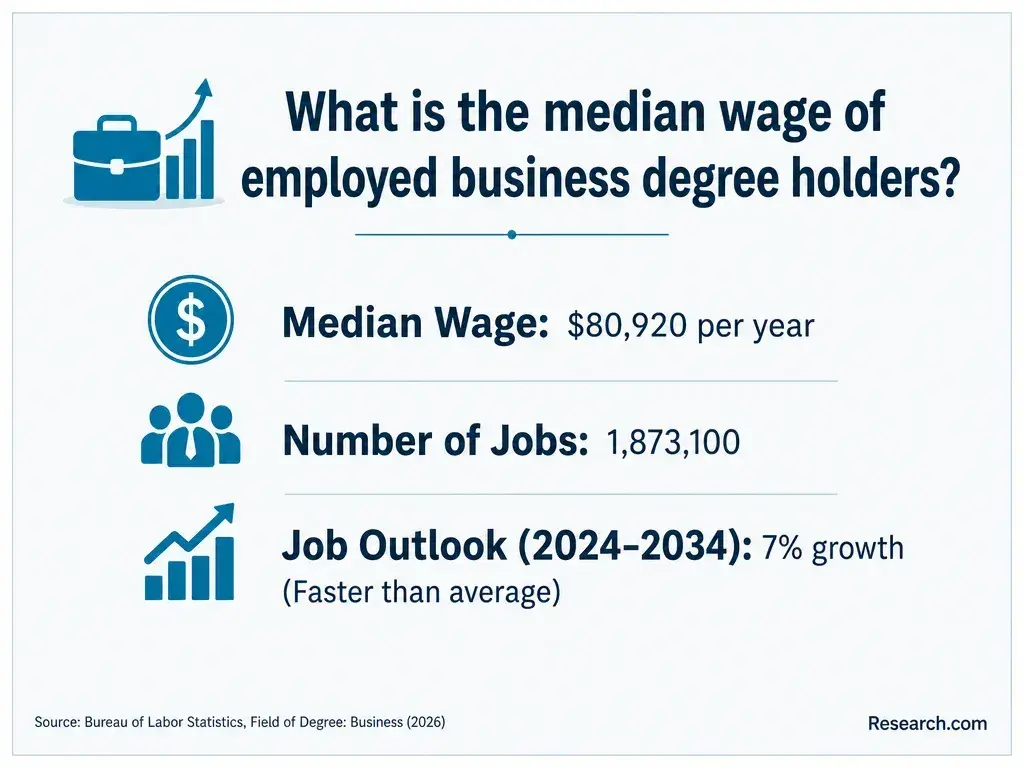
What Careers Can You Pursue With a BS in Business Administration?
A business administration graduate can pursue roles across industries, but the feasible entry point depends on prior responsibilities and demonstrated skills. The examples below distinguish a practical transition from a job title that may require more experience.
| Target role | Relevant prior experience | Evidence to develop |
| Operations or project coordinator | Scheduling, service delivery, logistics, or process tracking | Project schedules, spreadsheet reporting, and documented process improvements |
| Marketing coordinator | Customer communication, writing, events, or sales support | Campaign plans, audience research, and measurement work samples |
| HR assistant or specialist | Training, employee support, recordkeeping, or policy administration | Relevant HR coursework and examples of careful, confidential communication |
| Procurement or supply chain support | Purchasing, inventory, vendor contact, or fulfillment | Cost comparisons, inventory analysis, and sector-specific systems knowledge |
The Bureau of Labor Statistics reports a May 2025 median annual wage of $75,940 for human resources specialists. That occupation-wide median includes experienced workers; it is not an expected starting salary for someone changing industries. Check local postings for the actual experience and degree expectations attached to the jobs you intend to pursue.
Management and specialized analyst positions commonly call for substantial responsibility or deeper technical preparation. If project work is your specific destination and cost is a constraint, compare the business route with online project management programs for smaller budgets before assuming either degree is necessary for a coordinator role.
The business core commonly introduces financial statements, marketing, organizational behavior, operations, economics, statistics, and business communication. For a career changer, the important question is not whether a course title appears in a catalog; it is whether the course closes a gap between your existing experience and your target role. Check assignments, prerequisites, and available electives rather than assuming every business program develops the same depth.
For example, a service worker targeting operations might prioritize process analysis, spreadsheets, and supply chain coursework. A communications professional targeting marketing might prioritize customer research and analytics, then produce a campaign analysis using permitted or public data. A concentration may add relevant depth, but an informal group of electives is not necessarily an officially awarded concentration.
If supply chain is the clear destination, compare the business degree's electives and remaining credits with accelerated undergraduate supply chain programs. A specialized program is useful only if its extra depth outweighs any credits you would lose and its schedule is workable. Ask whether an internship or capstone is required and whether a current job could support an approved project; employment alone does not award academic credit.
Your completion time depends on the credits that apply to requirements, the courses left in sequence, your enrollment pace, and when required classes are offered. An associate degree or years of previous college study do not, by themselves, establish a graduation date. Applied-degree courses, older quantitative courses, and credits from other majors may be accepted as electives without satisfying the business core.
Request a written degree audit from each school showing general education, business core, concentration, elective, and institutional residency requirements separately. Then ask an adviser to map the remaining courses by term, including prerequisites and courses that run infrequently.
Compare that plan - not an advertised fastest possible timeline - with US fast-track undergraduate business degree options if speed matters. An accelerated calendar is not a shortcut around required work.
The relevant price is the cost to finish your particular degree, not the advertised tuition rate alone. Multiply each school's applicable remaining coursework by its charging structure, then add mandatory fees, materials, software, possible travel, and financing costs. Account for income you might forgo if study reduces your working hours. A school with lower per-credit tuition can cost more overall if it requires you to repeat courses or stay enrolled longer.
Compare official aid offers alongside the degree audits. Separate grants and scholarships from loans, and confirm eligibility, enrollment requirements, and satisfactory academic progress rules with the financial-aid office.
Employer tuition assistance may have reimbursement delays, grade conditions, or repayment terms. For a starting point on aid-eligible options, review business administration tuition budgets using federal student aid, then replace any published estimates with quotes for your own remaining requirements.
Choose the format that lets you complete relevant coursework and build connections while keeping your job and other commitments manageable. Online delivery can remove commuting, but it may still require live classes, scheduled exams, group meetings, presentations, or an internship. Campus study may provide easier access to local recruiting and classmates, but travel and fixed meeting times can limit your pace.
Ask for sample course schedules and assessment policies, not just a description of the program as "flexible." Check whether career services and employer events are accessible to online students in your area. If your target is project work, compare total costs of project management programs as an alternative - but apply the same checks for live attendance, fees, and usable career support to every format you consider.
Requirements vary by institution and sometimes by business major. A returning student may need official transcripts from every prior college; admission to the university may be separate from entry into the business program. Some programs require particular grades or introductory courses in mathematics, accounting, economics, or statistics, while others allow those courses after admission.
Before applying, check prerequisites before applying to business administration programs against each school's current catalog. Send course descriptions or syllabi when equivalencies are unclear, and ask the admissions office about eligibility and the transfer office or registrar about how credits will apply. If you already have a bachelor's, ask about second-degree rules; a postbaccalaureate certificate or targeted courses could be more efficient than another full degree.
First, verify the institution's recognized accreditation through the accreditor and the U.S. Department of Education's accreditation records. Then check any claimed business-school accreditation - such as AACSB, ACBSP, or IACBE - with that organization, including whether the specific program is within its scope. Institutional accreditation and business-program accreditation are different claims; neither alone establishes transfer outcomes or job placement.
Quality for a career changer also means dependable course availability, useful transfer advising, access to faculty, and career services that support the industry you are entering.
Ask for the current catalog, a proposed degree audit, internship or capstone rules, and the basis for any published outcomes. You can find online colleges with free admissions applications to reduce the cost of comparing options, but a waived application fee is not evidence of program quality.
What Certifications or Licenses Do Business Administration Graduates Need?
A general business administration degree does not itself require a universal professional license. Requirements depend on the work: regulated accounting and financial-services activities have separate rules, while many operations, marketing, and HR positions are governed chiefly by employer qualifications.
Voluntary certifications may be useful later, but eligibility can depend on experience, exams, or specific coursework; a concentration does not automatically confer a professional designation.
Check target job postings and the relevant licensing board or certifying organization before selecting electives or paying for an exam. If your goal requires a defined credential rather than another broad degree, compare that route's requirements and expense with a business administration degree affordability duration and value guide. The right choice is the one that resolves your actual qualification gap.
Other Things You Should Know About Business Administration
Yes. Describe comparable responsibilities and results - such as coordinating schedules, serving customers, or tracking budgets - using the target role's terminology. Be specific about the new industry knowledge you still need.
Not necessarily. First explore relevant assignments, volunteering, or a supervised project that fits alongside your job. Leave only after weighing the financial risk and the evidence that the change will improve your prospects.
Some will, especially for sector-specific work. Others may value transferable tasks more. Choose an opportunity that produces evidence of the function you want to perform, and explain the industry differences honestly.
Connect a demonstrated strength from your previous work to a responsibility in the new role. Then give a concrete example of how you have begun closing a relevant skill gap; avoid presenting the degree alone as proof of readiness.
- Accreditation in the U.S. | ed.gov http://www.ed.gov/laws-and-policy/higher-education-laws-and-policy/college-accreditation/accreditation-in-the-us
- Cost of Attendance (Budget) | 2025-2026 Federal Student Aid Handbook https://fsapartners.ed.gov/knowledge-center/fsa-handbook/2025-2026/vol3/ch2-cost-attendance-budget
- Credit for Prior Learning - The City University of New York https://www.cuny.edu/academics/academic-policy/credit-prior-learning/
- Ashworth College tuition https://www.ashworthcollege.edu/admissions/tuition/
- Why Is Accreditation Important? | ACE Blog https://ace.edu/blog/why-is-accreditation-important/
- Tuition & Fees Fall / Spring 2024 - 2025 - Finance Division https://busfin.uga.edu/finance-division/bursar/students-parents/bursar-tuition-fees/bursar-tutfees-2425/
- Turn Experience into College Credit | University of New Hampshire https://www.unh.edu/tipsguides/turn-experience-college-credit
- Learn About Tuition | Georgia State Online https://online.gsu.edu/learn-about-tuition/
- Gaining Career Related Experience: Are You Internship Ready? | Career Exploration and Success https://careers.rutgers.edu/news/gaining-career-related-experience-are-you-internship-ready
- Transferring Credit | Undergraduate Admissions | University of Houston https://www.uh.edu/undergraduate-admissions/apply/transfer/transferring-credit/


