2027 Choosing a BS in Business Administration: How to Check a Transfer Credit Maximum That Is Not a Personal Credit Guarantee
Audited and Verified:
Our Editorial and Data Verification Process
Research.com uses government datasets, official education statistics and primary institutional information to support its career and degree guides. Our review process checks factual accuracy, occupational definitions, source dates and the requirements associated with the credentials discussed.
How This Article Was Fact-Checked
Our editorial team verifies salary estimates, employment projections, education requirements and program information against original data providers and official organizations. Salary figures are checked against the relevant occupational definitions and reporting periods. Information about licensure, accreditation and required in-person training is reviewed separately.
Fact-checked and verified on:

Co-Founder and Chief Data Scientist
A business program may advertise a generous transfer credit maximum while still requiring you to repeat a course or complete more credits than you expected. If you are returning to college or moving from another school, that difference can change your graduation date and total cost.
This guide explains what the maximum means, how credits are evaluated, and which written answers to obtain before choosing a BS in Business Administration. You will be able to compare programs by the requirements you have left - not by the largest number in their transfer marketing.
Key Things You Should Know
- A transfer credit maximum is a policy ceiling, not a promise that your coursework will be accepted or satisfy business degree requirements.
- Compare written evaluations showing credits applied to general education, the business core, a concentration, and electives - not just a total of accepted credits.
- Confirm residency rules, prerequisites, course availability, and your remaining cost before committing; an accepted elective may not shorten your degree.
What Is a Transfer Credit Maximum for a Business Administration Degree?
A transfer credit maximum is the most credit an institution permits toward a particular degree from prior study or other approved sources. It is a ceiling under stated rules, not a statement about your transcript. A school may set separate limits by source - for example, coursework from a community college, examination credit, or credit for prior learning - and may require a minimum amount of study at the degree-granting institution.
The maximum also says little about where accepted credits will count. A course could meet a general education requirement, replace a business prerequisite, enter as a free elective, or receive no credit. For a returning student, the useful comparison is the number and sequence of requirements remaining after evaluation. Even when comparing cost-to-finish for shorter business administration programs, treat an advertised transfer ceiling as a screening detail, not a completion estimate.
Does a Transfer Credit Maximum Guarantee Your Credits Will Transfer?
No. The receiving institution decides whether prior learning qualifies for credit, whether it is equivalent to a course, and whether it fulfills a requirement in your catalog. Admission to the university - or even to its business major - does not settle those decisions.
This distinction is easiest to see in an evaluation. The categories below show why a large accepted-credit total can coexist with substantial coursework remaining.
| Evaluation result | What it means for completion |
| Credit not accepted | It does not contribute to the degree total or satisfy a requirement. |
| Accepted as a general elective | It contributes credit only if the degree has room for that elective. |
| Accepted as a specific equivalent | It may satisfy a named requirement, subject to the applicable catalog and program rules. |
| Accepted but not yet assigned | Its effect remains uncertain until the appropriate office resolves the evaluation. |
A prior management course, for example, might transfer as an elective rather than replace the required business-core course. If you are also weighing a specialized major, compare HR bachelor's transfer policies separately: acceptance into one degree does not establish applicability in another.
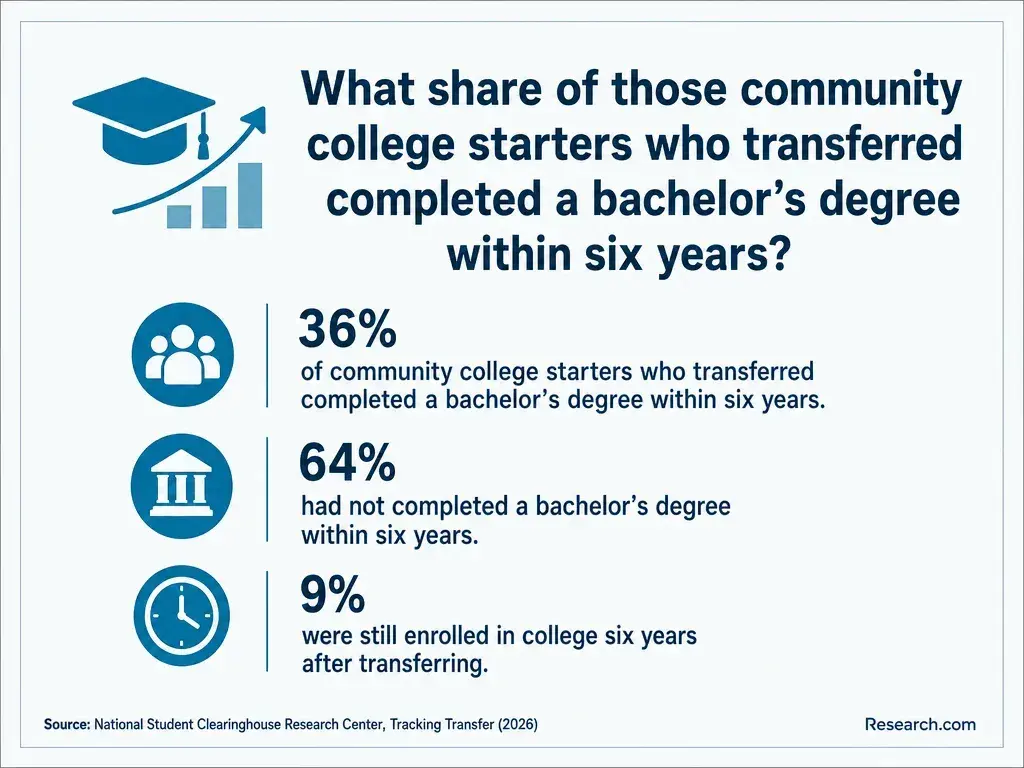
How Do You Verify Transfer Credits Before Choosing a Business Program?
Ask each prospective school to evaluate the same complete record against the specific BS in Business Administration and catalog you intend to follow. A preliminary estimate can help you narrow choices, but the receiving institution's approved evaluation and degree audit control the actual plan.
Use this sequence to move from an advertised maximum to a defensible enrollment decision:
- Collect official transcripts from every institution attended, plus course descriptions or syllabi for classes whose equivalency may be disputed. Identify examination, military, competency-based, or international learning separately.
- Ask admissions or the transfer office which records are needed for an official evaluation and whether any assessment remains provisional until admission or enrollment.
- Request a degree audit that assigns accepted credits to general education, business prerequisites, the core, any intended concentration, and electives. Ask who approves major-course substitutions.
- Have an academic adviser identify unmet requirements, prerequisite chains, courses offered infrequently, residency credits, and the earliest feasible completion schedule.
- Confirm appeal procedures and deadlines with the registrar or transfer office. Request written decisions on disputed equivalencies before relying on a revised schedule.
Compare audits, not just credit totals. A student considering business administration alongside a project-focused degree should also compare transfer policies at online project management colleges; the same transcript can produce different remaining requirements under different curricula.
Verify the institution's accreditation with the recognized accreditor and check that it covers the institution and location or delivery arrangement relevant to you. Institutional accreditation matters when evaluating a school's academic standing and potential federal-aid eligibility, but accreditation alone does not guarantee federal aid; confirm the school's and your own eligibility through its financial-aid office. A list of business administration colleges participating in federal aid programs can help identify schools to investigate, not replace that check.
AACSB, ACBSP, and IACBE are business-focused accreditors with differing scopes. If a school cites one, check the accreditor's listing to see whether the business unit or specific program you are considering is covered. Neither institutional nor business accreditation overrides the receiving school's transfer-equivalency and graduation rules.
A BS in Business Administration commonly combines general education with accounting, economics, finance, marketing, management, operations, quantitative coursework, and an integrative assignment or capstone. The exact mix varies. A concentration, if offered, adds specified requirements; taking a few related electives does not necessarily earn an official concentration.
For transfer planning, compare course sequences rather than course names alone. An accepted statistics course may satisfy a quantitative prerequisite, while an applied accounting course may not replace the program's required accounting sequence. Ask the business department to review unclear equivalencies before planning upper-level classes.
If your goal is supply chain work, compare the business degree's operations coursework with fast undergraduate routes into supply chain management. A specialized curriculum may be a better fit, but only an evaluation of your credits and its required courses can establish which route is shorter for you.
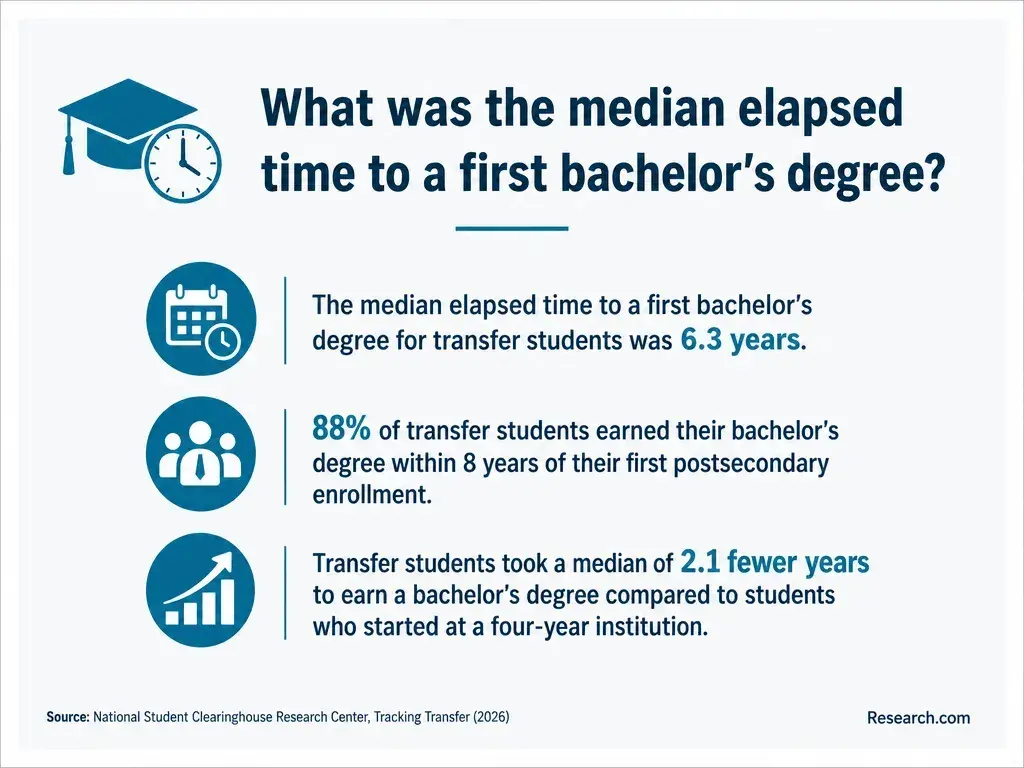
Schools typically request prior academic records, but admission standards vary by institution and applicant history. Some admit students directly to the business major; others require separate major admission or completion of specified prerequisites. Ask which decision is being made when you receive an offer. Being admitted does not mean all previous coursework has been accepted or applied.
If you studied outside business, ask whether mathematics, statistics, accounting, or economics must be completed before upper-level coursework rather than assuming your previous major makes you ineligible. If you already hold a bachelor's degree, check second-degree rules and whether earlier general education work can be used. Applicants deciding between general business and choosing a degree in human resources should obtain admission and transfer evaluations for each actual program, not assume they share requirements.
Your timeline depends on requirements remaining, their sequence, course availability, and how many classes you can take each term. Accepted credits that fill unused elective space may reduce neither time nor tuition. A required prerequisite or an unavailable upper-level course can delay completion despite a high transfer total.
For a useful cost comparison, request each school's written audit and a term-by-term plan. Price the courses still needed using the school's current tuition structure, then account for mandatory fees, books or software, possible travel, and borrowing costs. Ask the financial-aid office how your proposed enrollment and remaining applicable courses affect eligibility; do not assume every accepted elective helps you maintain progress toward the degree.
Comparing lower-tuition online business administration programs is a reasonable starting point, but a lower advertised rate may not mean a lower total bill if that school requires you to repeat more coursework.
Neither format makes a transfer maximum more reliable. Choose based on whether you can complete the remaining required courses on a workable schedule. Online courses may still have live meetings, fixed deadlines, group assignments, proctored assessments, or limited term availability. Campus courses may offer in-person support but introduce travel and scheduling costs.
When you compare nationally ranked online business programs, ask each school for the upcoming schedule of the specific core and concentration courses on your audit. For a working or returning student, that schedule is more informative than a general promise of flexibility.
Business administration coursework can support applications for roles in operations, sales support, human resources, marketing, or project coordination. The best fit depends on your prior work and the tasks you can demonstrate. A degree does not by itself qualify a graduate to manage staff or enter a specialized role.
For context, the U.S. Bureau of Labor Statistics reports a May 2025 median annual wage of $75,940 for human resources specialists. That is an occupation-wide median, not an expected starting salary for business graduates; employers may seek relevant HR knowledge and experience. If project work is your goal, compare the general business curriculum with low-cost project management degree options and the entry-level tasks in jobs you intend to pursue. Transfer fit and demonstrated work often matter more to this choice than a degree title alone.
Do Business Administration Graduates Need Licenses or Certifications?
There is no general license required simply to hold a BS in Business Administration. Particular jobs can have separate requirements: accounting licensure, financial-services licenses, and professional certifications each have their own eligibility rules. Completing a business course or concentration does not automatically satisfy them.
Before paying for an additional credential, identify the job you want and check the responsible licensing board, certifying organization, or employer's requirements. If project management is the target, compare certification eligibility and relevant experience with low-cost project management schools and aid options. The appropriate next step may be supervised project experience or targeted training rather than another degree.
Other Things You Should Know About Business Administration
Often you can submit it for a provisional review. The receiving school may require a final official transcript showing the completed course and grade before awarding credit.
Potentially, yes. Send records from every institution and ask the receiving school to evaluate each source under its transfer and degree rules.
Not necessarily. Schools may decline to award duplicate credit for substantially overlapping courses, even if both appear on your transcripts.
Ask for written approval before registering. The course must meet equivalency and residency rules, and your school must confirm that it will satisfy the intended requirement.
- Accreditation in the U.S. | ed.gov http://www.ed.gov/laws-and-policy/higher-education-laws-and-policy/college-accreditation/accreditation-in-the-us
- .14 Evaluation and Review Process for Transfer of Courses and Credits. | Library of Maryland Regulations https://regs.maryland.gov/us/md/exec/comar/13B.06.02.14
- Credit Transfer Tool | Transfer Credit Ohio https://transfercredit.ohio.gov/initiatives-upd/Credit-Transfer-Tool
- Transfer Dispute - Texas Higher Education Coordinating Board https://www.highered.texas.gov/transfer-dispute/
- Transfer Credit Policies and Processes - The College | UVA College of Arts & Sciences https://college.as.virginia.edu/transfer-credit-policies-and-processes
- How Do Transfer Credits Work When You Go Back to School? | Whitworth Online https://online.whitworth.edu/news-articles/how-do-transfer-credits-work-when-you-go-back-to-school/
- Undergraduate Transfer Credit Policy | nyu.edu https://www.nyu.edu/about/policies-guidelines-compliance/policies-and-guidelines/UndergraduateTransferCreditPolicy.html
- Requirements for Baccalaureate Degrees | University of South Alabama https://bulletin.southalabama.edu/academic-policies-procedures/requirements-baccalaureate-degrees/
- Transferring Credits to UCLA https://admission.ucla.edu/apply/transferring-credits
- Transfer Credit Policy - Hunter College - CUNY https://www.hunter.cuny.edu/students/admissions/undergraduate/apply/transfer/transfer-credit-policy/