2027 Cheapest Accredited Online Financial Technology Master's Programs With No Out-of-State Tuition Surcharge

Co-Founder and Chief Data Scientist
Choosing an online financial technology master's program can be difficult when a low per-credit price hides nonresident charges, fees, or required travel. This guide is for working professionals and career changers who want an accredited, residency-neutral option without sacrificing career relevance. U.S. Bureau of Labor Statistics projections published in 2024 show data scientist employment is expected to grow 36% from 2023 to 2033, illustrating the continuing demand for quantitative and technology skills used in fintech. Learn how to verify tuition, accreditation, format, aid, and likely return on investment before applying.
Key Things You Should Know
- A true no-out-of-state-surcharge program charges the same published online tuition to eligible students regardless of where they live, but it may still include separate technology, course, graduation, or residency costs.
- The cheapest option is not identifiable from tuition alone: calculate required credits × rate, then add mandatory fees, books, software, and any travel before comparing programs.
- For career value, prioritize recognized institutional accreditation, a curriculum in finance and analytics, flexible scheduling, and outcomes relevant to roles such as financial analyst, data analyst, risk analyst, product analyst, or fintech project manager.
What Does No Out-Of-State Tuition Surcharge Mean for an Online Financial Technology Master's Program?
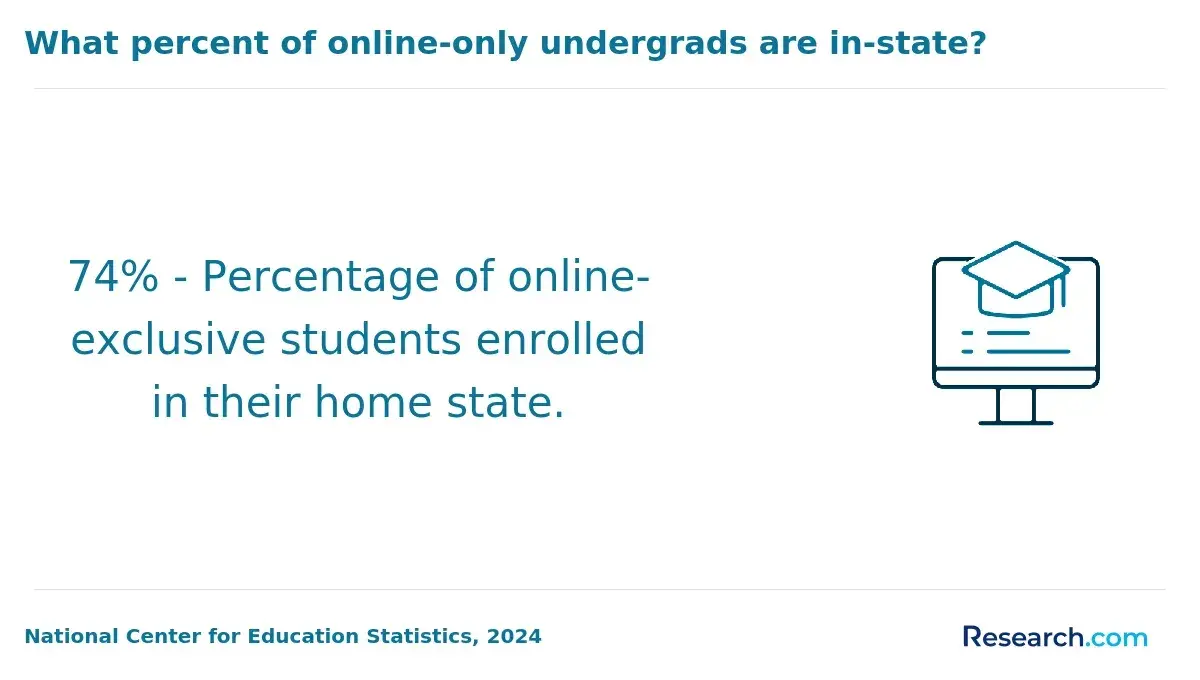
A no-out-of-state tuition surcharge means an online student who lives outside a university's home state is not charged the institution's higher nonresident rate for the applicable program. Schools may describe this model as "one tuition rate," "online tuition," "distance-learning rate," or "same tuition for all students." It is not the same as free tuition, in-state residency, or a universal waiver across every degree.
For a financial technology master's degree, the policy must apply to the exact online program, term, and enrollment type. A university can charge one rate for an online MS in Financial Technology while using separate resident and nonresident rates for campus-based graduate business courses.
This comparison shows why residency-neutral pricing can help, while also showing why it does not automatically produce the lowest total cost.
| Pricing model | How location affects tuition | Who may benefit most | Key caution |
| Residency-neutral online rate | Eligible online students pay one published rate | Out-of-state working professionals | Verify fees and whether every required course uses the rate |
| Resident and nonresident rates | Nonresidents generally pay more | In-state students or students with a valid waiver | Do not assume an online format removes the surcharge |
| Private university rate | Often one tuition rate regardless of residency | Students comparing predictable prices | A single rate can still be higher than public online tuition |
| Flat program price | Price is set by program or term rather than residency | Students who can confirm included services | Ask whether the price excludes fees, materials, or repeat courses |
A residency-neutral public program is often most useful for a nonresident who would otherwise face a large surcharge. A resident may still find that a traditional public university's in-state rate is less expensive. Compare the written tuition schedule rather than relying on the phrase "no out-of-state tuition."
One related comparison is data science degrees, especially for applicants deciding whether they want a broader analytics curriculum or a finance-centered technology curriculum. Fintech programs typically combine financial markets, payments, risk, regulation, data, and digital-product topics; data science programs usually place more emphasis on statistics, programming, and machine learning.
How Can Students Verify Accreditation for an Affordable Online Financial Technology Master's Program?
Accreditation is a quality-control check, not a ranking or a promise of job placement. For most online fintech master's programs, the essential check is institutional accreditation: the college or university should be accredited by an accrediting organization recognized by the U.S. Department of Education or the Council for Higher Education Accreditation. This matters for federal aid eligibility, employer confidence, credit transfer, and future doctoral study.
Business-school accreditation, such as AACSB accreditation, can be a useful additional signal when the fintech degree is housed in a business school, but it is not universally required for a legitimate fintech program. Technology, computer science, and interdisciplinary fintech programs may not have a programmatic accreditor analogous to those used in licensed professions.
Use the following checks before paying an application fee. They help distinguish a current, institution-wide credential from a marketing claim.
- Find the university in the Department of Education or CHEA accreditation directory and confirm its accreditation status is current.
- Match the institution's name, location, and legal entity to the school offering the online degree; similarly named institutions can be different entities.
- Read the program page and catalog to confirm the financial technology master's degree is officially awarded by that accredited institution.
- Ask admissions whether online students receive the same transcript and degree designation as campus students.
- If a business-school or specialized accreditation matters to your employer or doctoral plans, verify it directly with the school and accreditor.
Red flags include a school that will not name its accreditor, claims "international accreditation" without explaining U.S. recognition, or offers credits that it cannot document in an official catalog. Also ask whether third-party course platforms are instructional vendors or the actual degree-granting institution.
Applicants who may later change fields should make the same institutional check across alternatives, including cheapest online MSW programs. Accreditation expectations are especially consequential in social work because licensure rules can add program-specific requirements that fintech degrees generally do not have.
How Much Does the Cheapest Online Financial Technology Master's Program Cost in Total?
The cheapest online financial technology master's program is the one with the lowest total required cost for your situation, not necessarily the lowest advertised per-credit tuition. Because credit requirements, fees, and institutional pricing change, applicants should treat published tuition as a planning estimate and obtain a written program-specific estimate before enrolling.
Calculate the direct academic cost with this formula: required program credits × applicable tuition per credit + mandatory program and university fees. Then add expenses that are necessary to complete the degree, such as books, financial-data subscriptions, proctoring, software, background checks where applicable, and travel for any required residency.
This worksheet identifies the information needed to compare two programs on an equivalent basis.
| Cost component | What to confirm | Why it changes the comparison |
| Required credits | Total credits, prerequisite credits, and capstone credits | A lower rate can cost more when the degree requires more credits |
| Tuition rate | Online rate, residency rule, and whether it applies to all terms | The same school can use different rates by program or delivery method |
| Mandatory fees | Online learning, student services, technology, course, and graduation fees | Fees can materially increase the bill beyond tuition |
| Format expenses | Residencies, intensives, proctoring, hardware, and travel | "Online" does not always mean no in-person expense |
| Time-related costs | Rate changes, additional terms, and costs of repeating a course | Delays can increase the final price |
Ask the bursar or program office for the current academic-year rate, the total credits required for your catalog year, and a list of mandatory charges. Request clarification on whether tuition can change after enrollment and whether students who take fewer credits pay additional per-term fees. Avoid comparing a 30-credit program with a 36-credit program using only the per-credit price.
Students who are considering a more mathematical route into financial modeling can also compare an online math degree. A bachelor's-level option is not a substitute for a fintech master's, but stronger quantitative preparation may be more valuable than graduate specialization for some early-career applicants.
Usually, no. If a program genuinely has one online tuition rate for all eligible students, establishing state residency should not be necessary to receive that rate. However, residency can still matter for state grants, institutional scholarships, tuition waivers, military benefits, campus-course enrollment, and eligibility to switch into a different program.
Do not confuse three separate policies: an online rate available to everyone, an in-state rate available only after residency is established, and a temporary nonresident waiver. The first is residency-neutral; the second is residency-based; the third may have eligibility conditions or expiration dates.
Before relying on a quoted price, get answers in writing to these questions.
- Does the listed online tuition rate apply to this exact financial technology master's program for students living in every U.S. state?
- Must I maintain online-only enrollment, a minimum course load, employer affiliation, military status, or another condition to keep the rate?
- Are any required classes billed under a separate campus, business-school, or nonresident tuition schedule?
- Will moving to another state during the program affect tuition, authorization to enroll, financial aid, or required in-person activities?
Residency establishment may make sense when a public university offers a substantially lower verified resident rate and you already plan to move for reasons unrelated to tuition. It is usually a poor strategy to relocate solely for a master's tuition discount without calculating moving costs, residency waiting periods, lost income, and the possibility that graduate residency rules differ from undergraduate rules.
Public and private nonprofit universities can both offer a single online rate to students nationwide. Public institutions may have a lower base tuition, particularly for state residents, while private nonprofit institutions often provide predictable residency-neutral pricing and may offer institution-funded scholarships. Neither sector is automatically cheaper or better.
The useful comparison is between the specific programs' total direct costs and learning value, not between labels. A private university's higher tuition may be justified for a student who needs a particular curriculum, extensive career support, synchronous networking, or a shorter completion path. A public program may be the stronger value when it has comparable accreditation, curriculum, support, and a materially lower final bill.
This side-by-side framework highlights the trade-offs applicants should test with each school.
| Factor | Public university pattern | Private nonprofit university pattern | What to compare |
| Tuition structure | May vary by resident, nonresident, and online status | Often one rate, though not always | Total required tuition for your location and format |
| Fees | May include university and distance-learning fees | May bundle some services or charge separate fees | Mandatory charges per term and per program |
| Scheduling | Can include term-based cohort or course options | Can include cohort, accelerated, or asynchronous options | Whether the calendar works with employment |
| Curriculum | May draw from business, computing, and public-university resources | May offer focused professional or industry-oriented design | Courses in finance, programming, analytics, regulation, and risk |
| Financial support | Federal aid and potential state eligibility | Federal aid and potential institutional awards | Net price after grants, scholarships, and employer support |
Private does not mean for-profit, and nonprofit does not mean low cost. Confirm the institution's control and accreditation status, but make the decision from the offer you receive, including aid, rather than from its category alone.
Financial aid can reduce net cost, but it does not eliminate the need to compare prices. Eligible graduate students may use federal Direct Unsubsidized Loans, which have an annual borrowing limit of up to $20,500, and may have access to Graduate PLUS Loans subject to federal requirements. Loans must be repaid with interest, so they are financing tools rather than discounts.
Start with the FAFSA, then ask each university whether online fintech students qualify for institutional scholarships, graduate assistantships, payment plans, veterans' education benefits, or employer-partnership awards. Some aid is limited to full-time enrollment, particular terms, or students who file by an early deadline.
Use this order of operations to estimate what you may actually pay.
- Calculate the complete direct program cost, including mandatory fees.
- Subtract scholarships, grants, approved employer tuition assistance, and other nonrepayable funding.
- Determine how much cash you can pay without disrupting essential savings or obligations.
- Borrow only the remaining amount needed, then compare repayment implications before accepting loans.
- Recalculate after each aid offer because an award can make a higher-tuition program less expensive than a lower-priced alternative.
Employer assistance can be especially valuable for professionals already working in banking, payments, insurance, consulting, compliance, software, or analytics. Confirm whether reimbursement requires prior approval, a minimum grade, continued employment, or repayment if you leave the employer. Also determine whether the benefit covers fees, books, and repeated courses or tuition only.
A common mistake is treating the maximum loan eligibility as an affordable budget. Instead, compare anticipated borrowing with your expected career transition, existing debt, emergency savings, and the degree's practical relevance to your target role.
Program format affects both the invoice and the indirect cost of earning the degree. A fully online asynchronous program can reduce commuting and scheduling pressure for working students, while a hybrid program may provide networking or applied experiences but add travel and lodging. Verify whether "online" includes required campus residencies, synchronous attendance windows, or proctored examinations.
Financial technology master's degrees may be offered as MS programs with technical and quantitative coursework, MA programs with broader management or policy emphasis, professional master's programs built around applied projects, or academic programs with a thesis or research component.
A capstone commonly fits professionals seeking portfolio-ready work; a thesis may better suit students considering doctoral study. The best option depends on career goals, not delivery format alone.
Completion speed can change total expense in two opposing ways. An accelerated program may reduce the number of terms in which a school charges recurring fees and may let a student seek advancement sooner. However, it can require a heavier course load, reduce time available for work, and make a withdrawal or repeated course more costly. Part-time study may preserve income and improve learning sustainability, even if it adds terms.
Compare these format questions before deciding that the fastest program is the cheapest.
- Is the program fully online, hybrid, or online with required residencies or intensives?
- Are classes asynchronous, live at scheduled times, or a combination of both?
- Does tuition charge by credit, by term, or as a flat cohort price?
- How many courses can a working student realistically complete each term without risking poor performance?
- Does the curriculum require an internship, practicum, thesis, capstone, or team project, and are related costs included?
Interdisciplinary students should also assess whether a more creative or communications-focused credential supports their intended work. For a different professional direction, best online MFA programs can offer a useful comparison of portfolio-based graduate education, though an MFA serves different career goals than fintech training.
Transfer credits can reduce the number of credits you must pay for, but many master's programs limit transfer credit, require a minimum grade, and restrict the age or subject area of prior coursework. A fintech program may be more likely to consider recent graduate-level work in finance, economics, statistics, computer science, information systems, cybersecurity, or business analytics than unrelated courses.
Do not assume that a school will accept credits merely because another accredited institution awarded them. Transfer evaluation often happens after admission and can depend on syllabus content, learning outcomes, credit level, grades, and fit with the receiving program's curriculum. Some cohort programs do not accept transfer credits because the course sequence is tightly integrated.
To measure possible savings, multiply the number of approved transfer credits by the tuition rate that would otherwise apply, then check whether taking fewer credits changes scholarships, enrollment status, fees, or time to graduation. A transfer that saves tuition but causes a student to lose a larger institutional award may not reduce net cost.
Request a preliminary evaluation and provide official transcripts plus course descriptions or syllabi when asked. Ask whether transferred credits appear on the transcript, count toward graduation, satisfy prerequisites only, or affect the capstone requirement. Get the decision in writing before treating the credits as part of your budget.
Applicants comparing technically adjacent programs may find that an MFT online programs search illustrates an important contrast: transfer and practicum rules can be more restrictive in clinically oriented degrees because state licensure requirements may apply. Fintech degrees are generally not licensure programs, but schools still set their own academic transfer policies.
A cheap online financial technology master's degree can be worthwhile when it builds skills your target employers value, fits your current background, and can be completed with manageable borrowing. It is less compelling when the curriculum duplicates skills you already have, lacks the technical depth needed for your intended role, or requires debt disproportionate to the career benefit you can reasonably expect.
Fintech work is not a single occupation. Roles can include financial analyst, business intelligence analyst, data analyst, risk or fraud analyst, compliance analyst, product manager, payments specialist, blockchain analyst, and software or data professional working in financial services.
Responsibilities may include evaluating financial data, building dashboards or models, supporting digital-payment products, assessing risk, translating regulations into processes, or collaborating with engineering and business teams.
Salary data should be used as labor-market context, not as an expected graduate outcome. The U.S. Bureau of Labor Statistics reported a May 2024 median annual wage of $112,590 for data scientists.
That occupation typically requires strong statistical and computing skills, and compensation varies substantially by experience, industry, location, and job duties. A fintech master's may support a transition toward data-intensive finance work, but it does not by itself qualify every graduate for a data scientist role.
Evaluate career fit by mapping the curriculum to job postings you want within the next one to three years. Look for evidence of skills in financial modeling, SQL, Python or another relevant programming language, data visualization, cybersecurity awareness, digital payments, risk management, financial regulation, machine learning applications, and product or project work. The exact mix should match your target path.
A lower-priced program often has the best return when you already have relevant work experience and need structured technical-financial knowledge, a credential for internal mobility, or a portfolio capstone.
Paying more can make sense when the higher-cost program demonstrably offers a specialized concentration, employer access, live project experience, stronger support for your career pivot, or required preparation for further study. Compare those features against the additional net cost rather than assuming prestige or price determines outcomes.
How Should Students Compare the Cheapest Accredited Online Financial Technology Master's Programs?
Use a consistent comparison process for every program. The goal is to identify the lowest net cost among programs that are accredited, accessible from your state, and genuinely aligned with your desired fintech role. A program that is inexpensive but lacks the courses, support, or scheduling you need is not necessarily the best value.
Build a shortlist using the same fields for each school. The following comparison scorecard keeps marketing language from replacing verifiable details.
| Decision factor | What to record | Decision use |
| Accreditation | Institution, recognized accreditor, and status | Confirms legitimacy and supports aid and transfer decisions |
| Residency-neutral tuition | Written rate and eligibility conditions for your program | Shows whether nonresident pricing actually applies |
| Total required cost | Credits, tuition, all mandatory fees, and travel requirements | Produces a realistic comparison instead of an advertised price comparison |
| Net cost | Total cost minus confirmed grants, scholarships, and employer assistance | Shows the amount you must pay or finance |
| Curriculum | Finance, analytics, programming, risk, regulation, and capstone coverage | Tests alignment with target jobs and skill gaps |
| Format and timeline | Online requirements, live sessions, terms, pace, and completion window | Tests compatibility with work and family obligations |
| Career support | Advising, projects, networking, internships, and employer connections | Helps assess value beyond coursework |
Before you submit a deposit, ask admissions, the registrar, and financial aid for written confirmation of the tuition rate, required credits, mandatory fees, accreditation, state authorization, transfer decision, and aid terms. Review the catalog governing your entry term, because it usually contains the enforceable academic requirements.
Common mistakes include selecting the lowest per-credit rate without adding fees, assuming every online program at a university has the same tuition policy, and overlooking a required residency. Another frequent error is assuming that a program called "financial technology" teaches the same tools as every other fintech degree. Compare course titles, prerequisites, faculty expertise, capstone expectations, and elective options.
The strongest final choice is usually the program that meets four conditions: the institution is properly accredited, the full price is affordable without unsustainable borrowing, the format fits your life, and the curriculum closes a gap connected to a realistic job target.
Other Things You Should Know About Financial Technology
Requirements commonly include a bachelor's degree, official transcripts, a personal statement, résumé, and sometimes letters of recommendation. Programs may expect prior coursework or experience in statistics, calculus, programming, economics, finance, or business. Requirements vary, so applicants without a technical background should ask whether prerequisites can be completed before or during enrollment.
Some programs require standardized test scores, while others make them optional or waive them for applicants with qualifying academic records or professional experience. Check the policy for your intended term and ask whether submitting scores would strengthen an application when they are optional.
Useful complementary skills include spreadsheet modeling, SQL, Python, data visualization, financial statement analysis, basic cybersecurity awareness, and clear communication with technical and business stakeholders. Building a small portfolio of analyses, dashboards, or product case studies can help demonstrate applied capability.
A fintech master's is generally not a licensure degree. It may support preparation for employer-valued certifications in finance, analytics, cloud technology, cybersecurity, risk, or project management, but eligibility and exam requirements are set by the relevant certification organization. Confirm whether the curriculum covers the knowledge areas you need before assuming it provides certification preparation.
- Types Of Aid - Chestnut Hill College https://www.chc.edu/admissions-aid/financial-aid/types-of-aid/
- Types of Financial Aid https://www.hhloans.com/types-of-financial-aid/
- Average Cost of a Master's Degree: 2025 Analysis https://educationdata.org/average-cost-of-a-masters-degree
- 2025 Most Affordable Online Master's Programs https://www.onlineu.com/most-affordable-colleges/masters-degrees
- 11 tuition-free universities in the US for master's degrees https://studyinternational.com/news/tuition-free-universities-in-the-us/
- Best Master in FinTech Programs - Admission Info | ARINGO https://aringo.com/top-ranked-masters-programs-in-fintech/