2027 BS in Business Administration Math Planning: Completing Statistics Before Changing Schools
Audited and Verified:
Our Editorial and Data Verification Process
Research.com uses government datasets, official education statistics and primary institutional information to support its career and degree guides. Our review process checks factual accuracy, occupational definitions, source dates and the requirements associated with the credentials discussed.
How This Article Was Fact-Checked
Our editorial team verifies salary estimates, employment projections, education requirements and program information against original data providers and official organizations. Salary figures are checked against the relevant occupational definitions and reporting periods. Information about licensure, accreditation and required in-person training is reviewed separately.
Fact-checked and verified on:

Co-Founder and Chief Data Scientist
Taking statistics before changing schools can remove a prerequisite from your path to a BS in Business Administration - or leave you with credit that counts only as an elective. If you are transferring or returning to college, that difference can affect your course sequence, cost, and graduation date. This guide explains when finishing statistics first makes sense, how to check its place in the receiving school's degree audit, and what to do if the schools' requirements do not match.
Key Things You Should Know
- Complete statistics before transferring only if the receiving school confirms that the course will satisfy the intended requirement, not merely earn elective credit.
- Check the course's prerequisites and the next courses in your business sequence; finishing statistics early helps most when it removes a scheduling bottleneck.
- Compare the cost of taking statistics now with the receiving school's remaining requirements, residency rules, and financial-aid implications before enrolling.
What math courses does a BS in Business Administration usually require?
Many BS in Business Administration programs include a general education math course and statistics or business statistics. Some also require business calculus, finite mathematics, quantitative methods, or analytics.
A BS is not a uniform curriculum: one school may place statistics in the business core, while another accepts it for general education and requires a separate business analytics course.
The distinctions below matter because a course with a familiar name may not satisfy the requirement you expect.
| Course area | Typical role in degree planning | Potential transfer issue |
| College algebra or quantitative reasoning | General education requirement or preparation for later math | May not replace a required calculus or statistics course |
| Statistics or business statistics | Core quantitative requirement or prerequisite for analytics | General statistics may not be approved as business statistics |
| Business calculus or finite mathematics | Additional quantitative requirement at some schools | Statistics usually does not substitute for it |
Read the receiving school's catalog for your intended degree and catalog term, including prerequisite notes. If you are still determining which courses you need for admission rather than graduation, a business administration admissions preparation guide can help you separate entry requirements from degree requirements.
Should you complete statistics before transferring to another college?
Usually yes, if three conditions hold: the receiving school has approved the specific course for the requirement you need, you can meet its grade and prerequisite rules, and taking it now fits your transfer schedule and budget. It is especially useful when statistics unlocks upper-level business analytics, finance, or operations courses that you would otherwise have to postpone.
Waiting may be safer if your destination is undecided, the school has not determined whether general statistics satisfies its business core, or the course at your current college will not be offered before your planned transfer. A lower-priced class is not a saving if it becomes unused elective credit and you must take statistics again.
Also compare the academic calendar with your aid and enrollment plans. Taking one more course before transferring could affect when you start at the new school; taking it afterward could affect your first-term schedule.
Students considering a different major, such as project management, should make the same program-specific check rather than assume its course and funding rules match business administration. A guide to project management bachelor's aid application planning illustrates aid questions to raise with the relevant schools, not a substitute for their financial-aid determinations.
How can you verify that your statistics course will transfer?
Ask the receiving institution where the course will apply. Transfer acceptance means the school awards credit; requirement applicability means that credit fills a particular place in your BS degree audit. Those are separate decisions, and a preliminary equivalency listing may not be a final graduation ruling.
Use this sequence before registering, particularly if you are choosing between general and business statistics:
- Find the statistics requirement, minimum grade, prerequisite rules, and any course-recency policy in the receiving school's current catalog.
- Send the transfer office the prospective course's number, credit value, catalog description, and syllabus; include learning outcomes if available.
- Ask an academic adviser or business-program evaluator whether it will satisfy the named business-core or general education requirement, rather than transfer only as an elective.
- Request the determination in writing, then check the official degree audit after the final transcript arrives. Ask about a substitution or appeal if the posted credit differs from the approved plan.
If you might change majors, request a separate evaluation for each program. For example, colleges accepting coursework toward project management bachelor's study may apply a quantitative course differently from a business administration program at the same or another institution. Quarter-to-semester credit conversion, course level, and residency requirements can also change what remains to graduate.
Not universally. A college may require algebra, accept placement into statistics, permit another quantitative course, or let students enroll directly in an introductory statistics class. The statistics department's enrollment prerequisite and the business degree's graduation requirement are different rules: being allowed into statistics does not necessarily mean you have satisfied the degree's algebra requirement.
Check both courses at both schools. If algebra is needed only to enter statistics at your current college, ask whether the receiving school would require algebra separately. If your existing math skills are rusty, a preparatory course may still be worthwhile even when placement allows you to skip it.
Students weighing another business-related major should not assume the same math pathway applies; when you compare credit acceptance at online HR schools, check that program's quantitative requirements independently.
Focus on interpreting evidence for a business decision, not just obtaining a numerical answer. Useful foundations include descriptive statistics, probability, sampling and bias, confidence intervals, hypothesis tests, correlation, and introductory regression. Spreadsheet work matters when it requires you to check inputs, choose an appropriate measure, and explain a result clearly.
For example, a sample showing that sales rose after a promotion does not prove the promotion caused the increase. Seasonality or a change in customers might also matter. That distinction becomes valuable in marketing, finance, and operations coursework.
If you are considering faster-paced online supply chain college study, review your statistics foundation before entering compressed forecasting or operations classes; a faster course schedule does not make those concepts optional.
The degree's quantitative learning outcomes may be similar across formats, but the experience of completing them can differ. An online statistics class might use scheduled exams, remote proctoring, discussion deadlines, or group analysis. A campus class may provide in-person problem sessions but require travel at fixed times. Neither format is automatically easier or more flexible.
Before choosing where to take statistics, ask about tutoring, instructor office hours, permitted calculators or software, exam arrangements, and whether the course is offered when you need it. If transfer timing leads you toward business programs with accelerated online classes, confirm that statistics and the courses depending on it are offered in a workable sequence - not merely that the program advertises a short completion time.
Admission to the college, admission to its business major, and application of transfer credit can involve separate decisions. Schools may review prior college transcripts, grades, completed credits, and specified courses before admitting a student directly to the major. Some allow students to finish prerequisites after entering the institution; others require them before entry to upper-level business coursework.
Ask admissions whether statistics is required for admission or only for graduation, then ask the business adviser when it must be completed to stay on sequence. Submit transcripts from every college requested, even when a course appears on another school's transcript.
If application expenses are a concern while you compare destinations, no-application-fee online college choices may broaden your initial search; evaluate their actual business degree and transfer policies before applying.
For a transfer student, the useful estimate is not the number of credits a school accepts. It is the number of required credits and terms still remaining on the official degree audit. A statistics course that satisfies the business core may shorten the path if it unlocks later classes; the same course posted as an elective may leave the timeline unchanged.
Compare tuition and mandatory fees for the remaining courses at each school, plus books, software, exam costs, and any travel. Then account for required upper-level or in-residence credits and how often essential courses run.
Confirm with financial aid how your enrollment plan affects your eligibility rather than assuming every transferred credit reduces your bill. Lists of value-focused online business college choices can identify schools to investigate, but your own approved audit determines the more meaningful completion-cost comparison.
Verify that the institution holds recognized institutional accreditation, then check whether the business school or named program has additional accreditation, such as AACSB, ACBSP, or IACBE, if that distinction matters to you. These are different scopes of review: do not assume an accreditor's name on a school website covers every degree or location.
Accreditation does not establish that another college will accept a particular statistics course. Confirm both the school's accreditation status and its course-equivalency decision. If you are comparing accredited online business administration study with aid eligibility, also confirm the exact program, your enrollment status, and financial-aid requirements with the institution.
What careers and salaries can follow a business administration degree?
A BS in Business Administration can support applications for business operations, project coordination, marketing, HR, and related roles. Statistics is particularly useful when a role involves interpreting customer data, evaluating processes, or reporting results. The degree and a statistics course alone, however, do not establish specialist competence or qualify a new graduate for a management position.
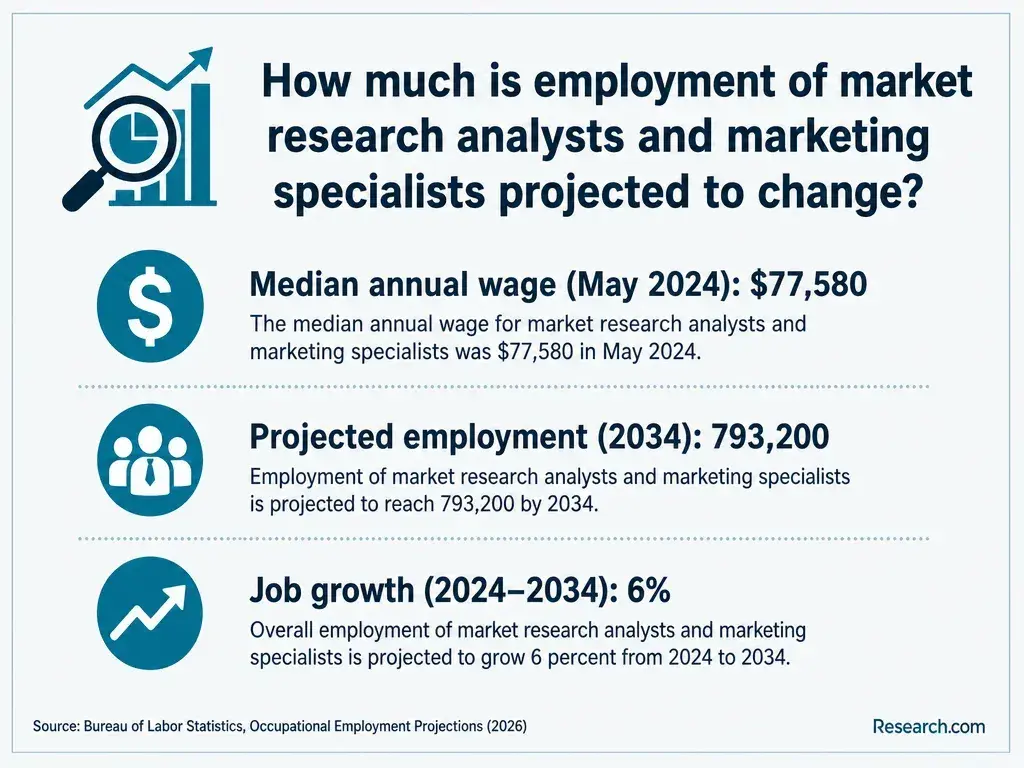
For context, the U.S. Bureau of Labor Statistics reports a $78,760 median annual wage for market research analysts in May 2025 and projects 7% employment growth from 2025 to 2035. That occupation-wide median is not an expected starting salary for a business administration graduate.
If project coordination is your target, compare job postings' analytical and experience requirements alongside the cost of further study; project management schools with competitive tuition are one alternative to investigate, not a necessary step for every applicant.
Other Things You Should Know About Business Administration
Possibly. The receiving school decides whether your score earns credit and whether that credit satisfies its business degree requirement. Check both decisions before relying on the exam in your graduation plan.
Ask the receiving school how it treats repeated courses. A repeat may affect degree credit or GPA calculations differently, and the original course may remain on your academic record.
Some schools permit this as visiting or concurrent enrollment, but require advance approval. Confirm the course equivalency, enrollment rules, and financial-aid treatment before registering elsewhere.
It depends on the receiving program's recency and equivalency policies. Send the original syllabus if requested, and ask for a written determination rather than assuming an older course is either valid or expired.
- Transfer Course Equivalency Information - University Registrar | The Ohio State University https://registrar.osu.edu/student-hub/transfer-credit/transfer-course-equivalency-information/
- Transfer Students - Undergraduate Admission https://admission.usc.edu/prospective-students/how-to-apply/transfer-students/
- Transfer Course Database - Rowan Sites https://sites.rowan.edu/registrar/transferring-credits/transfer-credit-evaluation-database.html
- Transfer Credit Policies and Processes - The College | UVA College of Arts & Sciences https://college.as.virginia.edu/transfer-credit-policies-and-processes
- Transferring Course Credit to WVU https://www.wvu.edu/admissions/undergraduate/admits/transfer/transferring-course-credit-to-wvu/
- Transfer Equivalency Database (TES®) - UO Registrar https://registrar.uoregon.edu/transfer/transfer-credit/transfer-equivalency-tools
- BS in Business Students - NYU Stern - New York University https://www.stern.nyu.edu/current-students/undergraduate/incoming-first-year-students/fall-class-registration/bs-business-students