2027 BS in Business Administration: Completing a Degree Before Applying for a Promotion
Audited and Verified:
Our Editorial and Data Verification Process
Research.com uses government datasets, official education statistics and primary institutional information to support its career and degree guides. Our review process checks factual accuracy, occupational definitions, source dates and the requirements associated with the credentials discussed.
How This Article Was Fact-Checked
Our editorial team verifies salary estimates, employment projections, education requirements and program information against original data providers and official organizations. Salary figures are checked against the relevant occupational definitions and reporting periods. Information about licensure, accreditation and required in-person training is reviewed separately.
Fact-checked and verified on:

Co-Founder and Chief Data Scientist
A promotion may be opening before you finish your BS in Business Administration. Waiting could mean missing the opportunity; applying too soon could mean failing a firm degree requirement. For employees with business experience and unfinished college credits, the right choice depends on the posting, the employer's eligibility rules, your expected graduation date, and the responsibilities of the next role.
This guide shows how to test whether completing the degree first is necessary, build a realistic completion plan, and present evidence of readiness alongside your education.
Key Things You Should Know
- Check the promotion rule before waiting: A required completed bachelor's degree is different from a preferred degree or permission to apply while enrolled.
- Get an official degree audit: Accepted transfer credits may not satisfy business-core, concentration, or residency requirements, so a preliminary credit estimate cannot establish your graduation date.
- Compare the degree's remaining cost with the opportunity: The timing matters most when graduation changes your eligibility; a degree does not replace the results and experience needed for the role.
What is a BS in Business Administration, and how can it support promotion opportunities?
A Bachelor of Science in Business Administration is an undergraduate degree combining general education with business subjects such as accounting, finance, management, marketing, operations, and quantitative decision-making. Requirements vary by school. A BS, BBA, and BS in Management may overlap, but their degree requirements and areas of emphasis are not interchangeable.
For an experienced employee, the degree can remove a formal eligibility barrier and strengthen skills used in a broader role: interpreting budgets, explaining trade-offs, improving processes, and coordinating people across functions. It does not itself establish that you have supervised staff, managed a budget, or delivered the outcomes the promotion requires. Compare the posting with your actual responsibilities, then identify which requirements coursework can address and which require workplace evidence.
If the opening emphasizes leading teams more than broad business analysis, compare the BS curriculum with fast-paced online organizational leadership bachelor's programs. Ask whether either degree satisfies your employer's specific rule before changing programs.
What careers can you pursue with a BS in Business Administration?
The most relevant career path is usually advancement from work you already know. An operations coordinator might seek responsibility for scheduling and process measures; an HR assistant might pursue specialist duties; a project coordinator might take ownership of timelines and stakeholder updates. These are different paths, and employers may expect functional experience as well as a degree.
Read the target job description task by task. Match each responsibility to a documented example, such as a report you prepared or a process you improved. For responsibilities you have not held, seek an approved stretch assignment or supervised project rather than relying on a management course as proof of experience.
Employees pursuing people-operations roles can compare business coursework with education options for future HR professionals. An HR-focused path may provide more relevant depth, but neither degree automatically qualifies someone for a specialist position or an HR credential.
Is a BS in Business Administration worth completing before seeking a promotion?
Complete the degree before applying only when the employer requires it by the application deadline or appointment date and will not accept an exception. If the degree is preferred, or completion by a later date is allowed, applying now may preserve an opportunity while you finish. Confirm the rule with HR rather than interpreting "bachelor's preferred" as "bachelor's required."
The following distinctions help you decide whether finishing first changes your eligibility or mainly strengthens your application.
| Employer's rule | Likely decision | What to confirm |
| Completed degree required at application | Finish first, unless HR confirms an exception. | Whether a pending final term qualifies. |
| Degree required before appointment | Consider applying while enrolled. | Appointment date and acceptable proof of completion. |
| Degree preferred, not required | Apply if your experience supports the role. | How experience and education are evaluated. |
| No degree rule | Decide whether completion serves a longer-term goal. | Which skills or results matter most for selection. |
Ask when the opening closes, when the selected employee must meet the requirement, and whether an in-progress degree can be listed. Then compare the likely benefit of finishing with tuition, forgone time, and the risk that the opening will close. A shorter route through short-term classes toward a bachelor's degree is useful only if its course sequence and workload fit your remaining requirements.
Programs commonly combine general education, an introductory business core, upper-level courses, electives, and sometimes a capstone or formal concentration. For promotion planning, course names matter less than whether the remaining work develops skills the next role actually uses. Accounting and finance can support budget discussions; operations and analytics can support process decisions; management and communication can help with team coordination. Introductory exposure is not a substitute for demonstrated responsibility.
Check prerequisite chains and course availability before choosing electives. A concentration can add relevant depth, but it may also require courses offered less often than the general business core. If your goal is supply chain advancement, compare the required courses and calendar - not just the advertised pace - with supply chain undergraduate programs with shorter terms. An elective cluster is not necessarily an officially awarded concentration.
Admission to a university, admission to its business major, acceptance of prior credits, and satisfaction of graduation requirements are separate decisions. A returning student may need official transcripts and must meet the school's academic-standing and major-entry rules. Some programs specify prerequisite coursework or minimum grades in subjects such as mathematics, statistics, accounting, or economics; others allow students to complete introductory requirements after admission.
Request an official transfer evaluation and degree audit showing where every accepted course applies: general education, business core, concentration, or electives. Ask the adviser about substitutions, course recency, repeat rules, and residency requirements. If earlier credits are primarily in HR, guidance on how to finish an HR bachelor's using previous college credits offers a comparison, but only the receiving institution can determine how those credits apply to its BS in Business Administration.
A bachelor's degree commonly requires about 120 semester credits in total, but your remaining time depends on the official audit, required upper-level and residency credits, course sequencing, and how many courses you can take while working. Accepted credits do not necessarily eliminate a required business course. Ask for a term-by-term plan that includes courses offered only in particular terms.
Calculate completion cost using remaining required credits and the school's tuition structure, then add mandatory fees, books, software, and any travel or proctoring expenses. Compare that amount with grants, loans, and any employer benefit you are actually eligible to use. Employer reimbursement may arrive after a passing grade and may carry service or repayment conditions, creating an immediate cash-flow burden even when the eventual net cost is lower.
If price is the constraint, compare ways to reduce tuition spending on an online business administration degree using your audited remaining requirements. The lowest advertised per-credit price may not yield the lowest completion cost if more courses must be repeated.
Choose the format in which you can reliably finish required courses without undermining your work performance during a promotion cycle. Online study can reduce commuting, but it may still involve scheduled discussions, group presentations, proctored exams, fixed deadlines, or an internship. Campus study may offer easier face-to-face access to faculty and classmates but require travel and attendance at set times.
Before enrolling, request schedules for the courses you still need, including the capstone. Ask about evening obligations, live sessions, exam windows, leave policies, and whether required classes run every term. Accelerated online business degree programs may shorten the calendar for some students, but compressed courses can increase weekly workload; verify the sequence against your job and promotion timeline.
Verify the institution's accreditation through the accreditor's own directory and confirm that the status covers the campus or online institution awarding your degree. Then check separately whether the business school or named program falls within any claimed AACSB, ACBSP, or IACBE accreditation. Institutional accreditation and business-specific accreditation have different scopes; neither guarantees that an employer will treat every degree as equivalent.
If you plan to use federal student aid, confirm the school's current eligibility and your own aid status with its financial-aid office. Comparisons of federal aid options at accredited business administration colleges can narrow your search, but they do not replace checking the institution's current status, program, and costs before committing.
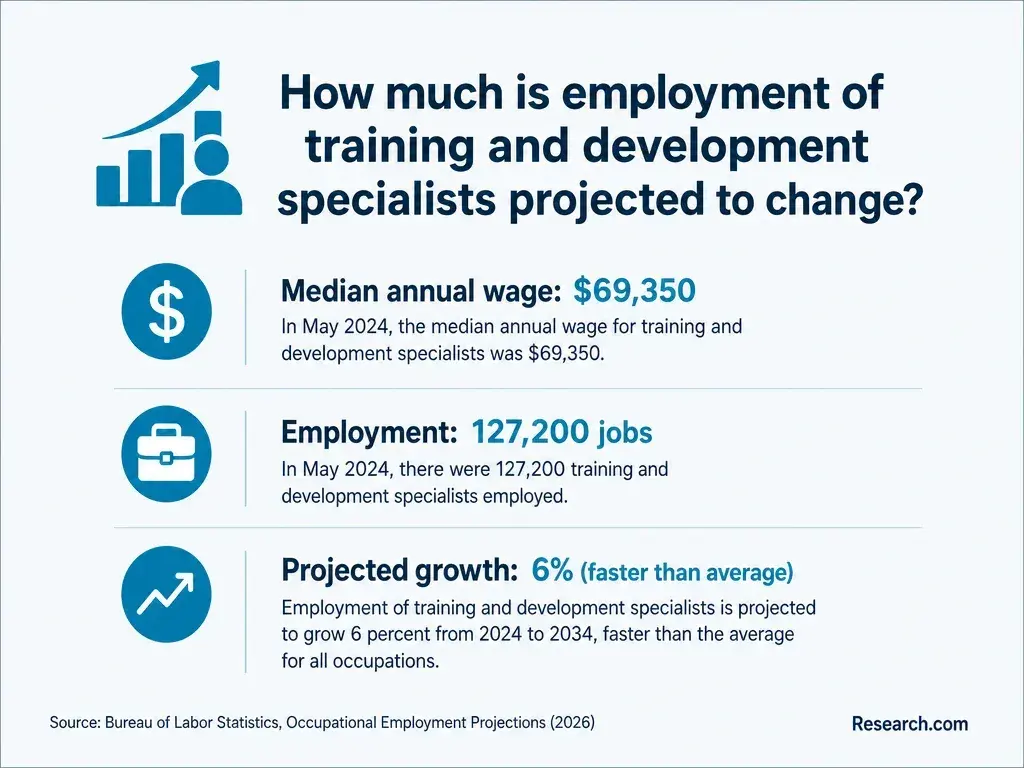
A BS in Business Administration has no single salary or job-growth rate: outcomes depend on the occupation, location, industry, and experience. For context, the U.S. Bureau of Labor Statistics reports a May 2025 median annual wage of $75,940 for human resources specialists and projects 6% employment growth for that occupation from 2025 to 2035. That occupation-wide median is not a starting salary or a forecast of what completing this degree will earn you.
For an internal promotion, your employer's pay band and the role's duties are more useful than a national median. Ask HR for the position's compensation range and compare it with your expected completion cost, while accounting for the possibility that you may not receive the promotion. When weighing outside opportunities, compare programs for online business programs for cost-conscious students against actual job postings in your target market, not an assumed graduate salary.
Which certifications or professional credentials complement a business administration degree?
Choose a credential only if it addresses a skill or hiring requirement for the promotion you want. A project-management credential may be relevant to delivery and scheduling duties; an HR credential may be relevant to personnel work. Each certifying body sets its own eligibility, examination, and renewal rules. A business degree - or a course bearing the same subject name - does not automatically confer a certification or professional license.
Compare the credential's requirements and cost with the depth of training the role needs. If project delivery is central to your next job, comparing project management tuition and mandatory fees may help you evaluate a specialized degree alongside a narrower credential. For many internal promotions, a documented record of completed projects and employer training may be more immediately useful than pursuing another qualification.
Other Things You Should Know About Business Administration
Yes, if you are enrolled and the application allows it. State the degree as "in progress" and give an expected completion date only if your academic plan supports it. Do not select "completed bachelor's degree" when you have not graduated.
Ask which responsibilities you should demonstrate, what evidence would show readiness, and whether there are suitable stretch assignments. Keep the conversation separate from any promise of selection.
An adviser can help you plan, but the school controls how it certifies enrollment, degree completion, and graduation. Ask the registrar what documentation is available and when it can be issued.
Ask HR whether you remain eligible for a later opening or another route to the role. Continue documenting relevant work results so completing the degree strengthens a future application rather than becoming your only evidence of readiness.
- Accreditation in the U.S. | ed.gov http://www.ed.gov/laws-and-policy/higher-education-laws-and-policy/college-accreditation/accreditation-in-the-us
- Employment Tests and Selection Procedures | U.S. Equal Employment Opportunity Commission https://www.eeoc.gov/laws/guidance/employment-tests-and-selection-procedures
- Frequently asked questions about educational assistance programs | Internal Revenue Service https://www.irs.gov/newsroom/frequently-asked-questions-about-educational-assistance-programs
- General Schedule Qualification Policies | U.S. Office of Personnel Management https://www.opm.gov/policy-data-oversight/classification-qualifications/general-schedule-qualification-policies/
- Accreditation Process | AACSB https://www.aacsb.edu/educators/accreditation/accreditation-process
- Maximize Your College Transfer Credits | Explore 4 Ways | UMass Global https://www.umassglobal.edu/blog-news/4-ways-transfer-students-can-maximize-college-credits-prior-experience
- 6 Jobs For Business Administration Majors | ASU Online https://asuonline.asu.edu/newsroom/online-learning-tips/jobs-business-administration-degree/
- How Long Does It Take to Get a Business Degree? | SCU https://www.scu.edu/business/blog/admissions/how-long-does-it-take-to-get-a-business-degree/
- Employer Tuition Reimbursement: How It Works and How to Pay for College | Winston-Salem State University https://ramsonline.wssu.edu/blog/employer-education-benefits/
- and Ask For - Employer Tuition Reimbursement Benefits | Harvard Extension School https://extension.harvard.edu/blog/how-to-use-and-ask-for-employer-tuition-reimbursement-benefits/