2027 BS in Business Administration: A Program's Maximum Time to Completion
Audited and Verified:
Our Editorial and Data Verification Process
Research.com uses government datasets, official education statistics and primary institutional information to support its career and degree guides. Our review process checks factual accuracy, occupational definitions, source dates and the requirements associated with the credentials discussed.
How This Article Was Fact-Checked
Our editorial team verifies salary estimates, employment projections, education requirements and program information against original data providers and official organizations. Salary figures are checked against the relevant occupational definitions and reporting periods. Information about licensure, accreditation and required in-person training is reviewed separately.
Fact-checked and verified on:

Co-Founder and Chief Data Scientist
A break from college does not necessarily mean you have lost your chance to finish a BS in Business Administration. But returning students can face three different limits: a school's degree-completion policy, changing course requirements, and a separate financial-aid timeframe.
Knowing which one applies matters before you choose classes or pay to reenroll. This guide explains how to find your actual deadline, what can happen if you pass it, and how to build a realistic plan around the credits you still need.
Key Things You Should Know
- There is no nationwide maximum number of years to complete a BS in Business Administration; the institution sets any degree or catalog deadline.
- A common full-time plan is about four years for a roughly 120-credit degree, but transfer credit, part-time enrollment, and course sequencing change the calendar.
- Federal financial-aid rules generally require an undergraduate program's maximum aid timeframe to be no longer than 150% of its published length; that is an aid limit, not an automatic graduation deadline.
What is the maximum time to complete a BS in Business Administration?
There is no universal maximum. Your school determines whether its BS in Business Administration has a time-to-degree limit, how long an older catalog remains available, and whether previously completed business courses remain applicable. Some students may continue under a newer catalog rather than lose the ability to graduate, but that can add requirements. Only the institution can confirm how its rules apply to your record.
Three policies are easy to confuse. The table separates them so you can ask the right office about the right deadline.
| Policy | What it governs | Possible consequence |
| Degree-completion or catalog limit | How long a particular set of academic requirements remains available | Readmission, a new catalog, or additional coursework may be required |
| Course recency or residency rule | Whether older courses count for specified requirements and how many credits must be earned at the school | Accepted credits may not satisfy the remaining major requirements |
| Satisfactory academic progress maximum timeframe | How long a student can receive federal financial aid while pursuing the program | Aid eligibility may end before the degree is finished |
Under federal satisfactory academic progress rules, a school's maximum timeframe for an undergraduate program cannot exceed 150% of its published length. For an illustrative 120-credit program, that ceiling is 180 attempted credits for aid purposes - not 180 credits available to spend freely and not a maximum number of years to graduate. Ask the financial-aid office how accepted transfer credits, repeats, and withdrawals are counted under its policy.
If you are comparing a longer return-to-school plan with fast-track bachelor's degree options, compare your remaining required courses, not advertised completion times. An accelerated calendar cannot remove a prerequisite or a required course offered only in certain terms.
How long does a BS in Business Administration usually take?
Starting from the beginning, a full-time student commonly plans on about four academic years for a degree requiring roughly 120 semester credits. A transfer or returning student may need much less - or longer than expected - depending on where accepted credits apply. A credit counted as an elective does not necessarily replace accounting, statistics, a concentration course, or an upper-division business requirement.
Calendar time also depends on course order. A student who needs introductory accounting before a later finance course cannot necessarily take both in the same term. Part-time study can make the weekly workload manageable while extending the time exposed to catalog changes or interruptions. When reviewing online business administration program cost-and-time comparisons, check whether the quoted timeline assumes full-time enrollment, summer courses, or a specific amount of transfer credit.
What happens if you exceed the degree completion deadline?
The outcome depends on which deadline you exceeded. Passing a catalog or degree-completion limit may require readmission or graduation under a newer catalog. An older course may still appear on your transcript but no longer meet a particular major requirement. Exceeding the financial-aid maximum timeframe can affect aid even if the school still permits you to enroll and finish.
Before retaking anything, obtain a current degree audit and written policy guidance. Use this sequence to identify the least disruptive path:
- Ask the registrar or academic adviser which catalog governs your degree and whether a return or extension petition is available.
- Have the business department confirm which completed courses satisfy current prerequisites, core courses, concentration requirements, and residency rules.
- Ask the financial-aid office for a separate satisfactory academic progress review, including any appeal process and its documentation requirements.
- Build a term-by-term plan that includes course availability, remaining cost, and a fallback if a petition is denied.
If the changed requirements make this degree a poor fit, consider whether an alternative transfer pathway serves your goal. For example, project management bachelor's routes for associate degree graduates may merit comparison, but a different program must still provide its own official credit evaluation.
Start by confirming that the institution holds recognized accreditation and that it covers your school and degree offering. Then check whether the business school or program also holds applicable accreditation from AACSB, ACBSP, or IACBE. Their scopes differ, so a claim that a university is accredited does not establish that its specific business degree has business-specific accreditation.
Accreditation is an important screening question, not proof that a school will accept your credits or let you retain an older catalog. If you use US business college rankings for online learners to build a shortlist, confirm each school's current accreditation and completion policies directly before applying.
Programs generally combine general education with a business core that may include accounting, economics, statistics, finance, marketing, management, operations, and business law. Some add electives, a formal concentration, and a capstone. The exact requirements matter to returning students because a prior course with a similar title may not be judged equivalent to a current requirement.
Pay particular attention to prerequisites and upper-division courses when estimating your finish date. If your intended path is human resources, compare the school's actual HR coursework with human resources degree costs and options; a few HR electives are not necessarily a formal concentration or a separate HR degree.
Yes, some institutions offer the degree online. Online delivery does not necessarily mean self-paced study or an unlimited completion window. Courses may have fixed deadlines, live meetings, group presentations, proctored exams, or a capstone that must be taken in a particular term. A leave of absence may also have separate academic and aid consequences.
For a workable schedule, request the upcoming course rotation and ask whether every remaining requirement can be completed online. Compare those answers with degree options for working business administration students, especially if employment limits the number of courses you can take each term.
Requirements vary by school and by whether you are a first-time, transfer, or returning applicant. A school may ask for prior transcripts and impose separate conditions for admission to the business major, such as specified introductory courses or academic standing. Readmission after an absence is not the same decision as whether old credits fulfill today's degree requirements.
Send official transcripts before relying on a completion estimate, then request an evaluation showing which credits apply to general education, the business core, electives, and any concentration. If a different major might use more of your prior study, fast-track online colleges for leadership majors offer another route to investigate - not a guarantee of faster graduation.
Your useful price is the cost to finish, not the advertised price of a full bachelor's degree. Multiply the school's applicable tuition rate by the credits its official audit says you still need, then account for required fees, books, software, and any travel or proctoring costs. A new catalog, repeated course, or delayed required class can raise the total; enrolling in fewer courses per term can change both cash flow and time to graduation.
Use online business administration school cost comparisons to identify schools worth pricing, then request an individualized estimate. Confirm aid eligibility separately: a low tuition rate will not resolve a satisfactory academic progress maximum-timeframe problem.
The degree can support applications for roles such as operations coordinator, marketing coordinator, HR specialist, or procurement staff member, depending on relevant coursework and experience. It does not automatically qualify a new graduate to manage employees or practice in a regulated occupation. If you already work in a business function, finishing the degree may help meet a stated bachelor's requirement; document your actual responsibilities alongside it.
Choose remaining electives or projects for the work you want to do. Someone targeting purchasing or logistics, for example, should compare the general degree's operations courses with supply chain program tuition time and earnings context before assuming the broadest degree is the best fit.
What salary and job outlook can business administration graduates expect?
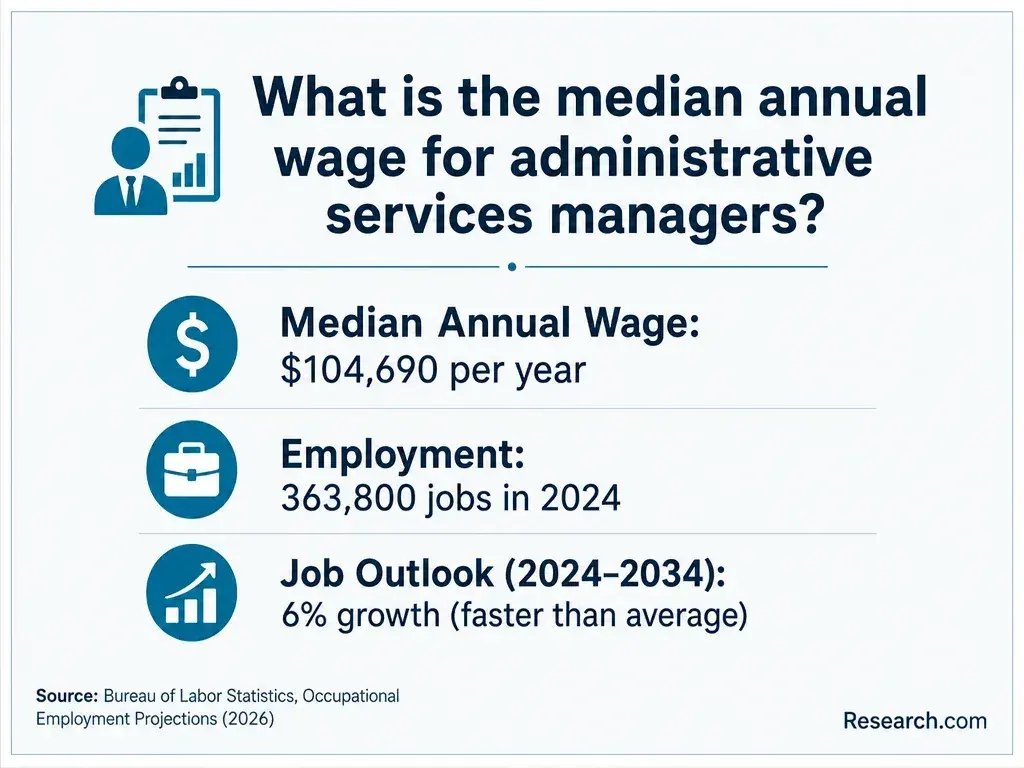
There is no single salary or job-growth rate for BS in Business Administration graduates. U.S. Bureau of Labor Statistics occupation-wide figures offer context, not a prediction of what a new graduate will earn. For example, the median annual wage for human resources specialists was $75,940 in May 2025, and employment in that occupation is projected to grow 6% from 2025 to 2035. Those figures include workers with differing experience and educational backgrounds.
Judge the value of finishing against the roles you can realistically pursue, your remaining cost, and whether employers require a bachelor's degree. If project work is your goal, compare job requirements and cost-conscious project management college options rather than treating an occupation-wide median as an expected return on any particular program.
Other Things You Should Know About Business Administration
Not necessarily. A school may count elapsed time from your original enrollment, while another policy may depend on enrolled terms. Get the leave and catalog rules in writing before pausing.
Only if the institution offers an applicable prior-learning assessment or approved substitution. Work experience alone does not automatically award credit or waive a requirement.
Possibly, if your completed courses fit another approved degree plan. Ask for an updated audit first; changing concentrations can also add requirements.
Your institution does. An academic adviser can help plan courses, while the registrar or designated degree-audit office confirms graduation requirements; the financial-aid office determines aid eligibility separately.
- School-Determined Requirements - FSA Partner Connect https://fsapartners.ed.gov/knowledge-center/fsa-handbook/2026-2027/vol1/ch1-school-determined-requirements
- Rule 3342-3-01.1 - Ohio Administrative Code https://codes.ohio.gov/ohio-administrative-code/rule-3342-3-01.1
- Program Integrity Questions and Answers - Satisfactory Academic Progress | U.S. Department of Education http://www.ed.gov/laws-and-policy/higher-education-laws-and-policy/program-integrity-information-questions-and-8
- Undergraduate Transfer Credit | University of Arizona Catalog https://catalog.arizona.edu/policy/courses-credit/credit/undergraduate-transfer
- Transfer Credit Policy | Pace University New York https://catalog.pace.edu/undergraduate/academic/academic-policies-general-regulations/transfer-credit-policy/
- Degree and Graduation Policies | University of Florida Catalog https://catalog.ufl.edu/UGRD/academic-regulations/degree-graduation-policies/
- Transfer Credit Policy | Point University Catalog https://catalog.point.edu/policy/standinghonors/creditforpriorlearning
- Transfer Credit and Credit for Prior Learning | gtcc.edu https://www.gtcc.edu/student-life/records-and-transcripts/transfer-credit-and-credit-for-prior-learning.php
- Transfer credit practices - UC Admissions https://admission.universityofcalifornia.edu/counselors/preparing-transfer-students/transfer-credit-practice.html
- Re-Enrollment | Policy Library | Miami University https://miamioh.edu/policy-library/students/undergraduate/academic-regulations/re-enrollment.html