
2027 Best Online Two-Year Degrees With Financial Aid Options

Co-Founder and Chief Data Scientist
An online associate degree can make college easier to fit around work, but the lowest advertised tuition may not produce the lowest bill - or lead to the job you want. The College Board reported average 2024-25 published tuition and fees of $4,050 for full-time, in-district students at public two-year colleges; online students may face different rates and additional costs.
This guide compares six degree fields, explains how financial aid changes the price, and shows what to verify about online requirements, transfer credit, and career qualifications before enrolling.
Key Things You Should Know
- Start with your goal: an AA or AS may suit a bachelor's transfer plan, while an AAS often emphasizes workforce preparation; confirm how the specific program handles both. Compare the full cost after grants, not tuition alone.
- The maximum Federal Pell Grant was $7,395 for the 2025-26 award year, but an individual award depends on eligibility and enrollment.
- Confirm that "online" fits your schedule and location: nursing and some healthcare programs require in-person clinical work, and an associate degree alone does not confer a professional license.
Top 10 Best Online Two-Year Degrees With Financial Aid Options
Business Programs
An online business administration AA or AS can be a practical choice if you plan to transfer into a bachelor's program; an accounting or business AAS may focus more on bookkeeping, payroll, and office operations. Compare required software courses, internship expectations, and whether credits apply to your intended bachelor's major. Business is broadly available online, but a general associate degree is not a shortcut to management: supervisory roles typically require relevant experience, and some employers prefer a bachelor's degree.
Healthcare Programs
Health information technology and medical coding programs may offer substantial online coursework and a clearer administrative career focus than a general health science degree. Allied-health programs involving patients, such as diagnostic imaging, usually require supervised in-person training and may have selective admission. Check whether the curriculum prepares students for the credential or occupation you want, whether local placements are available, and whether a grant will cover required supplies and exam fees. A health science AS may be better for transfer than immediate entry into a specialized job.
Information Technology Programs
Information technology, networking, and cybersecurity associate programs can combine online classes with remote labs. An AAS may emphasize help desk or network support skills; an AS may leave more room for transferable math and general education. Compare hands-on projects, equipment requirements, internship access, and whether courses align with - but do not substitute for - industry certification exams. Entry-level support work is a more realistic immediate target than a senior cybersecurity role, which generally requires substantial additional experience or education.
Nursing / Pre-Nursing Programs
An associate degree in nursing can be a route toward registered nurse licensure, but it is not an entirely at-home degree: students must complete supervised clinical training and typically lab work. Nursing admission may be selective even when the college has open admission. Pre-nursing AA or AS programs cover prerequisites but do not themselves qualify graduates for RN licensure. Before paying, confirm nursing-program approval, clinical placement arrangements, prerequisite sequencing, licensing-board requirements, and whether an RN-to-BSN pathway accepts the credits.
Criminal Justice Programs
A criminal justice AA or AS often makes sense for students who intend to transfer into a bachelor's program; an AAS may emphasize corrections, security, or public-safety practice. Online coursework does not replace physical testing, academy training, background checks, or other hiring requirements for sworn law-enforcement roles. Ask employers or a state agency what qualifications apply to your target job before choosing a specialization. For immediate employment, compare the degree with an academy or employer training route rather than assuming the degree is required.
Psychology / Counseling Programs
A psychology AA or AS is primarily a transfer foundation, covering introductory psychology, research, and general education. It can support applications for entry-level human-services work, but it does not qualify someone to practice independently as a counselor or psychologist; those professions require substantially more education and state-specific licensure. Check that psychology and statistics courses satisfy the intended bachelor's program. If your goal is a direct-to-work support role, compare human-services AAS programs with transfer-focused psychology degrees.
What Are the Best Online Two-Year Degrees for High-Demand Careers?
The best online two-year degree is the one that matches your career or transfer goal and remains affordable after aid. These fields offer different combinations of online access, work-based requirements, and immediate career relevance; the comparison is not a ranking of individual colleges.
| Field | Good fit when you want | Key trade-off to check |
| Business | Transfer options or office and accounting skills | General degrees may not lead directly to a specialized role |
| Healthcare administration | Medical records or coding-related preparation | Employer credentials and program focus vary |
| Information technology | Technical support skills and hands-on projects | Labs, equipment, and experience still matter |
| Nursing | A path toward RN licensure | Selective admission and in-person clinical training |
| Criminal justice | Public-safety preparation or transfer | Many jobs have separate hiring or academy requirements |
| Psychology | A foundation for a bachelor's degree | Professional counseling requires further education |
For a direct workforce goal, compare occupation-specific AAS programs with local job postings. For a bachelor's goal, prioritize an AA or AS with a documented transfer pathway. If time is the deciding factor, compare remaining credits and course sequencing rather than assuming the fastest degree to get will also be the best-funded or most useful.
How Much Do Online Two-Year Degrees Cost After Financial Aid?
Published tuition is not your final cost. The College Board's $4,050 public two-year in-district average for 2024-25 covers tuition and fees for a full-time academic year, not every online program or a complete degree. Grants may reduce what you pay; loans help cover bills now but must generally be repaid. Request a personalized, program-length estimate from each college.
This comparison separates charges and resources that are easy to confuse when evaluating an aid offer.
| Amount | What it includes or changes | Why it matters |
| Published tuition and fees | School charges before aid | Rates may differ by residency, enrollment, or online course |
| Additional program costs | Books, technology, equipment, travel, exams, or clinical expenses | A low tuition rate can still produce a high total bill |
| Grants and scholarships | Eligible funding that generally does not require repayment | Reduces the amount you must cover |
| Loans | Borrowed funding | Changes when you pay, not the degree's total cost |
Ask for the cost of all remaining credits, especially if you will study part-time or transfer prior coursework. Then compare expected grants and scholarships against school charges and necessary living expenses. An accelerated schedule is not cheaper if it requires more borrowing or prevents you from working.
Which Financial Aid Options Help Pay for Online Associate Degrees?
Start with the Free Application for Federal Student Aid (FAFSA). It helps schools determine eligibility for federal grants, work-study, and loans and may also be used for state or institutional aid. The maximum Federal Pell Grant was $7,395 in the 2025-26 award year; that ceiling is not a promise of a full award or a fixed deduction from every program's price.
Look beyond federal aid to state grants, college scholarships, employer tuition assistance, military or veterans' education benefits, and payment plans. Eligibility and deadlines differ. Confirm that both the institution and your chosen program qualify for the aid you expect, and ask how part-time enrollment, satisfactory academic progress, and withdrawing from a course could affect it. A payment plan can spread a bill but does not reduce it.
How Can You Verify Online Program Accreditation and Transferability?
Check institutional accreditation through the U.S. Department of Education's accreditation database or the accreditor's own directory; do not rely on a promotional badge. For nursing and other regulated fields, separately confirm the relevant program approval or accreditation and ask the licensing board whether the curriculum meets your state's requirements. These checks address different questions.
If you plan to continue to a bachelor's degree, request a written course-by-course transfer evaluation or an applicable articulation agreement. A receiving college may accept a course as elective credit without applying it to your major. That distinction matters more than a general promise that credits "transfer." An easiest online bachelor's degree comparison cannot tell you whether your particular associate courses satisfy a particular destination program.
What Do You Need to Apply to an Online Two-Year Degree Program?
Most associate applicants should expect to provide an application, proof of high school completion or an equivalent credential, and transcripts from colleges previously attended. Schools may use placement information to determine starting courses. An open-admission college may still have competitive nursing or allied-health admission based on prerequisites, grades, testing, or clinical-site requirements.
Apply early enough to complete the FAFSA, meet scholarship deadlines, and get previous credits evaluated before choosing courses. Ask whether online students have residency restrictions, whether the major begins each term, and when prerequisite or clinical sequences start. These details can change both your first-semester schedule and your eventual cost.
What Coursework and Learning Formats Do Online Two-Year Degrees Include?
Associate programs commonly require around 60 semester credits, combining general education with major coursework; some require more. A full-time student may finish in roughly two years, but part-time study, prerequisites, limited course availability, and clinical placement can extend that timeline. Shorter individual courses do not mean the entire degree takes only one short term.
Asynchronous classes let you access lessons on your own schedule but still impose deadlines. Synchronous classes require attendance at set times. Ask about remote labs, proctored exams, campus visits, internships, and clinical placements before treating any program as fully online. Transfer credit can shorten the path only when the school accepts it and applies it to remaining requirements.
Which Jobs Can You Get With an Online Two-Year Degree?
Potential entry points include bookkeeping or office support after business study; technical support after IT study; and some health-records or coding-related roles after focused healthcare study. Employers may also expect experience, software proficiency, or certification. Nursing graduates must meet separate licensing requirements before working as RNs. Criminal justice and psychology graduates should check local hiring requirements rather than assuming the degree alone qualifies them for law enforcement or counseling.
Compare job postings in your area with the program's actual courses. If postings consistently require a bachelor's degree, ask which associate credits will apply to one. Asking what is the easiest bachelor's degree to get is less useful than identifying the major and qualifications your target employers require.
What Salaries and Job Outlook Can Graduates Expect?
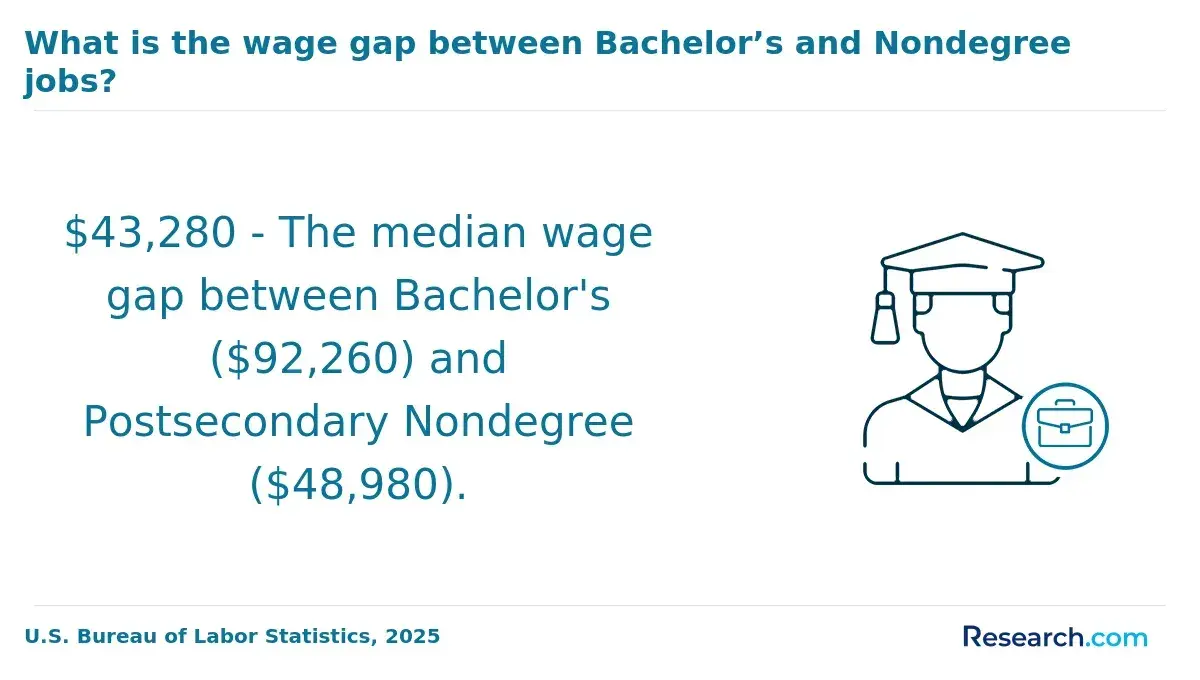
Use occupation-wide wage figures to test whether a career goal justifies the cost - not as a prediction of what an associate graduate will earn. For example, the U.S. Bureau of Labor Statistics reported a 2024 median annual wage of $93,600 for registered nurses. That figure includes working RNs across education levels and experience; an associate nursing degree does not itself confer a license or that wage.
Demand also varies by occupation, location, and employer. Before borrowing, compare current Bureau of Labor Statistics outlook information and local postings for the exact role you want. Weigh likely entry requirements against the aid-adjusted cost, any unpaid placement time, and whether further education will be necessary.
Which Licenses or Certifications Do Online Degree Graduates Need?
Requirements depend on the occupation, not simply the degree title. Prospective RNs must complete an approved nursing program, meet state board requirements, and pass the applicable licensure examination. Some allied-health roles require program-specific accreditation, exams, or state credentials. IT and coding certifications may strengthen an application, but employer preferences and exam eligibility vary.
Before enrolling, identify the exact credential named in local job postings and confirm that the program meets its education requirements. Ask who pays exam fees and whether graduates are eligible to sit for the exam. For roles that do not require a degree, compare the cost and scope of easy certifications to get online with an associate program; a short credential may be useful, but it is not interchangeable with a required license.
Other Things You Should Know About
Sometimes. Confirm required labs, exams, orientations, internships, and clinical work with the school; "online classes" does not always mean no in-person requirements.
It depends on your eligibility, enrollment, school costs, and available grants or scholarships. Review your aid offer for each academic year and distinguish grants from repayable loans.
Choose based on the program's purpose and your next step. AA and AS degrees often support transfer; AAS degrees often emphasize employment. Verify the specific curriculum and receiving school's transfer rules.
No. The program must include required clinical training, and graduates must meet state licensure requirements, including the applicable exam. Confirm program approval before enrolling.
References
- Fast Facts: Tuition costs of colleges and universities (76) | ed.gov https://nces.ed.gov/fastfacts/display.asp
- Pell Grant Enrollment Intensity and Cost of Attendance | ed.gov https://fsapartners.ed.gov/knowledge-center/fsa-handbook/2026-2027/vol7/ch3-pell-grant-enrollment-intensity-and-cost-attendance
- Types of student financial aid | USAGov https://www.usa.gov/student-aid
- DAPIP | Homepage - Office of Postsecondary Education (OPE) https://ope.ed.gov/dapip/
- Eligibility Requirements | Federal Student Aid https://studentaid.gov/understand-aid/eligibility/requirements
- Understanding U.S. Accreditation | EducationUSA https://educationusa.state.gov/understanding-us-accreditation
- Your financial path to graduation | consumerfinance.gov https://www.consumerfinance.gov/paying-for-college/your-financial-path-to-graduation/
- Understanding Your Financial Aid Offer | University of Arizona Office of Scholarships & Financial Aid https://financialaid.arizona.edu/resources/understanding-your-financial-aid-offer
- Paying for College | schev.edu https://www.schev.edu/students/paying-for-college
- Online Associate's Degrees - MDC Online - Miami Dade College https://online.mdc.edu/online-programs/online-associates/


