
2027 Best Associate Degrees With Part-Time Study Options

Co-Founder and Chief Data Scientist
Can you earn a useful associate degree without putting work or family life on hold? Yes - but the best field depends on more than whether a college permits part-time enrollment. Course schedules, clinical placements, transfer plans, and total cost can determine whether you can finish. The College Board reported average published tuition and fees of $4,050 at public two-year colleges for the 2024-25 academic year, before living costs and other expenses. This guide compares six degree fields and shows you how to check which part-time path fits your schedule, budget, and goal.
Key Things You Should Know
- Business, information technology, criminal justice, and transfer-oriented psychology are often easier to schedule around work; healthcare and nursing may require fixed labs or daytime clinical placements.
- A typical associate degree requires about 60 semester credits. At six credits per fall and spring term, that is roughly five years without summer courses, accepted credits, or a heavier course load.
- Published public two-year college tuition and fees averaged $4,050 for 2024-25, but compare each school's part-time charges, program expenses, and financial aid before choosing.
Top 10 Best Associate Degrees With Part-Time Study Options - Part-Time Associate Degrees
Business Programs
A part-time business administration AA or AS can suit students planning to transfer; an accounting or business AAS may emphasize workplace skills. Common courses include accounting, spreadsheets, management, and economics. Evening and asynchronous classes can make scheduling easier, but check whether required courses run every term.
Choose a transfer-oriented degree if a bachelor's is your goal; choose an AAS only after confirming its courses meet your intended employer or transfer school's requirements.
Healthcare Programs
Healthcare associate programs vary substantially. Health information technology may offer more online coursework, while radiologic technology and diagnostic imaging generally require supervised in-person training. A flexible lecture schedule does not make a clinical schedule flexible.
Before applying, confirm placement hours, travel distance, programmatic accreditation where relevant, and whether the program meets your state's certification or licensure requirements. Some programs admit students to the college first and select them separately for the major.
Information Technology Programs
An IT, cybersecurity, or computer support AAS can combine technical courses with general education and prepare students for entry-level job searches. An AS may be a better starting point for a computing bachelor's degree.
Online labs can help part-time students, but verify equipment requirements, scheduled team projects, and how often advanced courses are offered. The degree does not guarantee an IT job; practical projects and relevant certifications may strengthen an application.
Nursing / Pre-Nursing Programs
An Associate Degree in Nursing (ADN) is a potential route toward registered nurse licensure; pre-nursing coursework is preparation for applying, not admission to a nursing program. Nursing is often the least schedule-flexible option here because labs and clinical rotations have set hours.
Check prerequisite sequencing, selective admission criteria, clinical availability, state board approval, and nursing accreditation. Graduates must meet state requirements and pass the NCLEX-RN to become licensed; earning the degree alone is not enough.
Criminal Justice Programs
Criminal justice AA or AS programs commonly emphasize transfer, while some AAS programs focus on workplace preparation. Many theory courses can fit evening or online schedules. Match the degree to a specific goal: policing, corrections, legal support, and federal roles have different hiring, training, and education requirements.
An associate degree does not replace academy training, background checks, or other qualifications an employer requires. Ask whether an internship is mandatory and when it is scheduled.
Psychology / Counseling Programs
A psychology AA or AS can be a flexible, transfer-oriented choice for part-time students interested in human behavior. It is generally a foundation for further study, not a credential to practice as a psychologist or licensed counselor.
Some entry-level human-services positions may be accessible with an associate degree, depending on the employer and duties. If counseling is your goal, map the full bachelor's and graduate-school pathway before enrolling, and confirm how psychology and statistics courses will transfer.
What Are the Best Associate Degrees for Part-Time Students?
The best associate degree for part-time study is the one whose required courses you can attend consistently and whose credential advances your intended goal. Business and IT offer useful starting points for students seeking schedule flexibility and career-focused coursework. Psychology can work well for a planned transfer.
Healthcare and nursing may provide clearer routes to specific occupations, but their supervised training can be difficult to fit around an inflexible job.
This comparison summarizes the main trade-off in each field. It describes degree paths, not verified schedules at every college; confirm the actual course rotation before treating any option as part-time friendly.
| Field | Potential part-time advantage | Constraint to check first | Best fit |
| Business | Lecture-based courses may offer evening or online sections | Whether required courses run in the terms you need | Students seeking broad business skills or a transfer pathway |
| Healthcare | Some specialties offer online academic coursework | In-person labs, placements, and credential eligibility | Students targeting a defined healthcare role |
| Information technology | Online labs and project work may reduce travel | Equipment needs and advanced-course availability | Students prepared to build demonstrable technical skills |
| Nursing / pre-nursing | Prerequisites may be taken gradually | Selective admission and fixed clinical hours | Students who can plan around supervised training |
| Criminal justice | Theory courses may fit evening study | Employer-specific hiring and training rules | Students with a researched public-safety or transfer goal |
| Psychology / counseling | Transfer coursework may fit a gradual schedule | Further education needed for licensed practice | Students planning a bachelor's pathway |
Interest matters, but it should be tested against the work and education a field requires. If you are comparing fun majors in college that pay well, remember that many occupations associated with those majors require credentials beyond an associate degree.
How Long Do Part-Time Associate Degree Programs Take?
Part-time completion commonly takes longer than the familiar two-year estimate. For a 60-credit program, six credits each fall and spring adds up to about five years; nine credits each term adds up to roughly three years and one term. Those are planning examples, not promised timelines. Summer classes, accepted transfer credits, prerequisites, and course availability can change the result.
Ask for a term-by-term plan showing when every required class is offered. This is especially important for clinical programs, where a student may complete prerequisites part time but need a less flexible schedule after admission.
Some schools on a list of competency-based colleges offer self-paced learning; verify that the associate degree you want uses that format and accepts part-time enrollment before factoring it into your timeline.
How Much Do Part-Time Associate Degrees Cost?
Start with the school's full tuition and mandatory-fee schedule, not its advertised per-credit price. The College Board's $4,050 average for public two-year colleges in 2024-25 covers published tuition and fees for a full-time academic year; it is not a quote for your program, residency status, or part-time enrollment.
Nursing supplies, technology, transportation, and extra terms can substantially change what you pay. Compare these costs on the same basis for every school. The categories help reveal why a lower tuition rate may not produce a lower completion cost.
| Cost category | What to compare |
| Tuition and mandatory fees | Per-credit or per-term charges, residency rates, and part-time fees |
| Program expenses | Books, software, equipment, uniforms, exams, and background checks where required |
| Attendance expenses | Travel, parking, childcare, and income affected by required daytime activities |
| Time to finish | Number of terms needed and whether delayed courses add costs |
Request a program-specific estimate and a financial aid offer. Federal aid eligibility can depend on the institution, program, and your enrollment level; part-time students should ask how fewer credits affect grants, loans, and satisfactory academic progress. Also check scholarships, employer tuition assistance, and whether accepted credits reduce the number of courses you must pay for.
Which Associate Degrees Offer Online and Campus-Based Options?
Business, IT, criminal justice, and psychology commonly lend themselves to online or campus-based coursework. Some healthcare subjects can be studied online, but hands-on programs generally require labs or supervised placements. Nursing may offer online lectures while still requiring in-person clinical training.
Online does not necessarily mean study whenever you want. Ask whether classes have live meetings, fixed deadlines, proctored exams, campus visits, or required local placements. A nearby campus with dependable evening sections may be more workable than an online program with daytime live sessions.
If career outcomes are part of your comparison of online degrees that pay well, verify both the degree's actual delivery requirements and the qualifications employers expect for the job.
What Courses Are Included in Part-Time Associate Degree Programs?
Most associate degrees combine general education - such as writing, mathematics, and communication - with courses in the major. An AA or AS often supports transfer, while an AAS often emphasizes occupational preparation; individual colleges may structure them differently.
A program may require around 60 credits, but labs, prerequisites, and professional standards can change its exact requirements.
Expect accounting or management in business; programming or networking in IT; and psychology, statistics, or social science in transfer-oriented behavioral programs. Clinical healthcare and nursing degrees add supervised practice.
Review the course catalog rather than the degree title alone: a course that transfers as elective credit may not satisfy a required bachelor's major course.
What Are the Admission Requirements for Associate Degrees?
Colleges commonly ask associate degree applicants for a high school diploma or equivalent and an application; placement or prerequisite rules vary. Admission to the college is not always admission to a selective major. Nursing and some allied-health programs may separately require specified courses, grades, testing, health documentation, or background checks.
If you have previous college work, request a transfer-credit evaluation early. Ask which courses satisfy degree requirements, not merely how many credits the college accepts. That distinction can affect both your schedule and total cost.
What Jobs Can You Get With a Part-Time Associate Degree?
Career possibilities depend on the major, local employers, experience, and any required license. A business or IT graduate might pursue entry-level administrative, accounting-support, or technical-support positions. Healthcare graduates should match their program to a specific occupation and its credential rules.
Criminal justice graduates may explore support or public-safety pathways, but agency hiring requirements vary. Psychology is more often a stepping stone to further education than a direct path to licensed counseling.
Before enrolling, compare local job postings with the program's courses and required credentials. If postings consistently ask for a bachelor's degree or a license the program does not lead to, consider a transfer-oriented associate degree, a different credential, or another training route.
How Much Can You Earn With an Associate Degree?
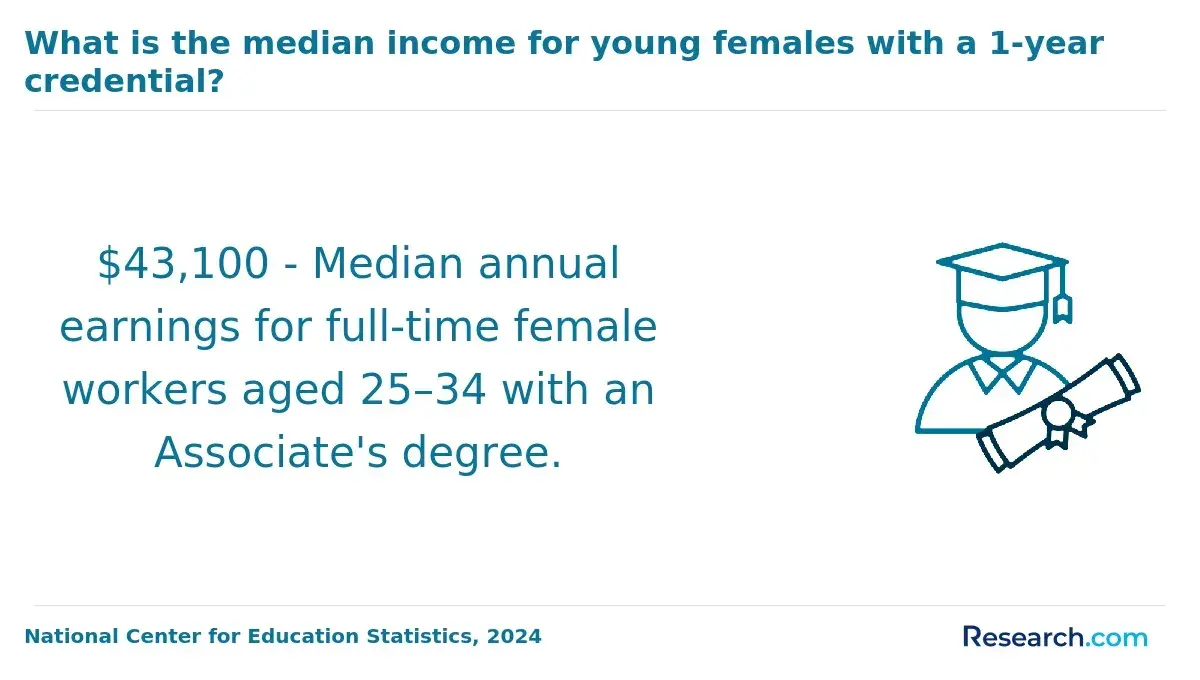
An associate degree does not have one dependable salary figure: occupations, regions, experience levels, and licensing differ. For context, the U.S. Bureau of Labor Statistics reported a May 2024 median annual wage of $93,600 for registered nurses. That is an occupational median, not the expected pay of a new ADN graduate; nurses must also obtain a state license, and individual earnings vary.
Use wage figures only after confirming that an associate-level pathway can lead to the occupation. Then weigh likely entry requirements and local job openings against your full education cost - not just the highest wage associated with the field.
How Do You Choose an Accredited Associate Degree Program?
Start by confirming that the college has recognized institutional accreditation. For a regulated occupation, also check the relevant program's accreditation or approval status and ask the state licensing board whether graduates are eligible for the required exam or license. An accredited college alone does not establish eligibility for every profession.
Before committing, take these steps with an advisor or program director. Their answers should let you compare programs against your actual weekly availability and long-term goal.
- Request a term-by-term part-time plan, including the usual times for labs, clinicals, and courses offered infrequently.
- Get an estimate of total tuition, mandatory fees, and required program expenses through completion.
- Ask for a written evaluation of prior credits and, if transferring, confirm how courses apply to your intended bachelor's major.
- Verify accreditation, any required program approval, and eligibility for occupation-specific exams or licensure.
Be cautious if a school cannot explain its required in-person hours, repeatedly unavailable courses, or credit-transfer rules. If your eventual goal is an online master degree, plan for an appropriate bachelor's degree first; an associate degree alone is not a graduate-admission pathway.
Other Things You Should Know About
Many programs allow it, but some clinical sequences require a set schedule or minimum course load. Ask for a plan covering every term, not just the first semester.
Business, IT, criminal justice, and psychology often have more online coursework. Check for live meetings, exams, internships, and course availability before assuming a particular program is fully online.
An AA or AS is often designed with transfer in mind. An AAS can also transfer, but confirm how its specific courses apply to your intended bachelor's degree before choosing it.
They may qualify, depending on the school, eligible program, aid type, and enrollment level. Ask the financial aid office to estimate your award at the number of credits you realistically plan to take.
References
- Clinical placement models for undergraduate health... - PMC https://pmc.ncbi.nlm.nih.gov/articles/PMC8642754/
- Graduate Labour Market Statistics 2024 | service.gov.uk https://explore-education-statistics.service.gov.uk/find-statistics/graduate-labour-market-statistics/2024
- Transfer pathways | Minnesota MyHigherEd https://myhighered.mn.gov/transfer-students/transfer-pathways
- Transfer Degrees | Colorado Department of Higher Education Home https://cdhe.colorado.gov/transfer-degrees
- Cost of Attendance (Budget) | 2025-2026 Federal Student Aid Handbook https://fsapartners.ed.gov/knowledge-center/fsa-handbook/2025-2026/vol3/ch2-cost-attendance-budget
- Financial Aid Programs - Baltimore City Community College https://www.bccc.edu/paying-for-college/financial-aid-scholarships/financial-aid-programs
- Tuition Rates & Fees - ACC Catalog & Student Handbook https://catalog.austincc.edu/college-entry/paying-for-college/tuition-rates-and-fees/
- AAS Pathways - Transfer Admissions & Engagement https://transfer.appstate.edu/future-students/transferring-credits/aas-pathways
- Articulation Agreements & Transfer Pathways | Oconee Fall Line Technical College https://oftc.edu/programs/agreements-transfer-pathways/
- Clinical Placement | College of Nursing https://www.southalabama.edu/colleges/con/clinical/clinical-placement.html


