
2027 Best Associate Degree Programs for Job Security

Co-Founder and Chief Data Scientist
Which associate degree offers the best chance of steady work - and which only looks promising until you check the hiring requirements? For prospective students and career changers, the distinction matters. The U.S. Bureau of Labor Statistics (BLS) projects registered nurse employment to grow 5% from 2024 to 2034, but an associate nursing degree is only one step toward a required license.
This guide compares career paths by demand, entry requirements, and flexibility so you can identify a practical option, estimate its costs, and check the details that matter before enrolling.
Key Things You Should Know
- Nursing and licensed allied-health programs connect to defined occupations, but admission, clinical placements, exams, and state rules can limit access.
- BLS projects 5% employment growth for registered nurses from 2024 to 2034; openings still vary by location, employer, and qualifications.
- College Board reports average published in-district tuition and fees of $4,050 at public two-year colleges in 2024-25, before books, living costs, and program-specific charges.
Top 10 Best Associate Degree Programs for Job Security
Business Programs
An associate degree in accounting or business administration can prepare students for bookkeeping, payroll, customer operations, or administrative work. Choose courses in spreadsheets, accounting software, and business communication, ideally with an internship. These skills transfer across industries, though routine tasks may be automated and entry-level hiring can be competitive. An Associate of Arts (AA) or Associate of Science (AS) may suit a planned bachelor's transfer; an Associate of Applied Science (AAS) often emphasizes immediate employment. Do not mistake a general business degree for a direct path into management, which typically requires experience.
Healthcare Programs
Career-focused associate programs in dental hygiene, diagnostic medical sonography, radiologic technology, and respiratory therapy offer clearer occupational targets than a general health studies degree. Their work depends on patient care and clinical equipment, but job availability varies locally. Compare programs by required clinical placements, eligibility for certification or licensure, and access to suitable training sites. A general health sciences AS can be useful for transfer, yet it does not substitute for a profession-specific credential. Clinical schedules and selective admission can make these programs harder to complete while working full time.
Information Technology Programs
An IT, networking, or cybersecurity associate degree can support entry into help-desk, technical support, and junior systems roles. Look for hands-on labs, troubleshooting practice, and opportunities to build a portfolio. Employers may also value certifications and experience. Cybersecurity analyst jobs may have attractive growth projections, but an associate degree alone is not a reliable shortcut into them; many employers seek a bachelor's degree or substantial experience. IT suits students willing to keep learning as tools change, rather than those expecting one credential to secure a role indefinitely.
Nursing / Pre-Nursing Programs
An associate degree in nursing (ADN) is a defined route toward registered nurse practice when the program meets applicable approval requirements. Graduates must also satisfy state licensing rules and pass the NCLEX-RN; the degree itself is not a license. Pre-nursing or general science coursework is different: completing it does not guarantee admission to an ADN program. Ask about prerequisite grades, clinical scheduling, program approval, and graduate exam outcomes. Students aiming for employers that prefer a bachelor's degree in nursing should also investigate ADN-to-BSN transfer agreements.
Criminal Justice Programs
A criminal justice associate degree introduces law, courts, corrections, and report writing. It may support applications for security or public-safety jobs, but it does not replace an agency's academy, background check, fitness standards, or other hiring requirements. Police officer eligibility differs by jurisdiction, and some agencies do not require a degree. For job security, compare actual local vacancies and eligibility rules before choosing this major. An AA with a transfer agreement may be more useful if your intended role requires a bachelor's degree.
Psychology / Counseling Programs
A psychology or counseling associate degree is generally a foundation for transfer, not a qualification to practice as a psychologist or licensed counselor. It can introduce human behavior and support applications for certain entry-level human-services roles, depending on the employer. Clinical counseling and psychology roles usually require substantially more education and state licensure. Choose this path when you have a realistic bachelor's or graduate-school plan and have confirmed that your courses will apply to it - not because the associate degree alone promises a counseling job.
What Are the Best Associate Degrees for Job Security?
For a direct route to a defined occupation, nursing and accredited allied-health programs are often the strongest associate-degree choices. They pair specialized training with established hiring requirements. That makes eligibility easier to evaluate, not employment certain. IT can be a good choice for students who prefer adaptable technical work; business offers broader flexibility but less direct access to a specific occupation.
This comparison separates programs that prepare students for workforce entry from those best used as transfer foundations. The right choice depends on which requirements you can complete and which jobs are available where you intend to work.
| Degree field | Likely first step | Main job-security consideration |
| Nursing (ADN) | Seek RN licensure after graduation | Clear credential path, with selective admission and clinical requirements |
| Licensed allied health | Meet occupation-specific exam and state requirements | Defined roles, but specialized programs and local placements matter |
| IT | Apply for support or junior technical roles | Skills can serve many employers, but require regular updating |
| Business | Apply for accounting-support or operations roles | Broad applicability, with competition and automation affecting some tasks |
| Criminal justice or psychology | Check specific employer requirements or transfer | Degree alone may not qualify students for their intended profession |
Job security means a reasonable prospect of finding and retaining work, not protection from layoffs. If your goal requires a bachelor's degree, compare a transfer-oriented associate pathway with accelerated bachelor degree programs; the faster-looking option is useful only if its schedule and accepted credits fit your circumstances.
Which Associate Degree Careers Have the Strongest Job Outlook?
Employment projections help identify demand, but they do not show how easily a new associate-degree graduate can enter a field. BLS projects registered nurse employment to grow 5% from 2024 to 2034. That supports nursing as a field worth investigating, while leaving the more personal questions - program admission, licensure, and local hiring - unanswered.
Information security is an important contrast. BLS projects 29% growth for information security analysts over the same period, yet these roles commonly call for a bachelor's degree and relevant experience. A fast-growing occupation is not necessarily an accessible first job after a cybersecurity associate degree. If you eventually want specialized or senior work, compare advancement requirements before committing to further study, including whether any of the most lucrative masters degrees are relevant to your chosen field.
For any occupation, read the BLS entry-level education description alongside its growth projection. Then inspect local job postings for required licenses, experience, shifts, and certifications. That combination is more useful than a national growth figure alone.
How Much Do Associate Degree Graduates Earn?
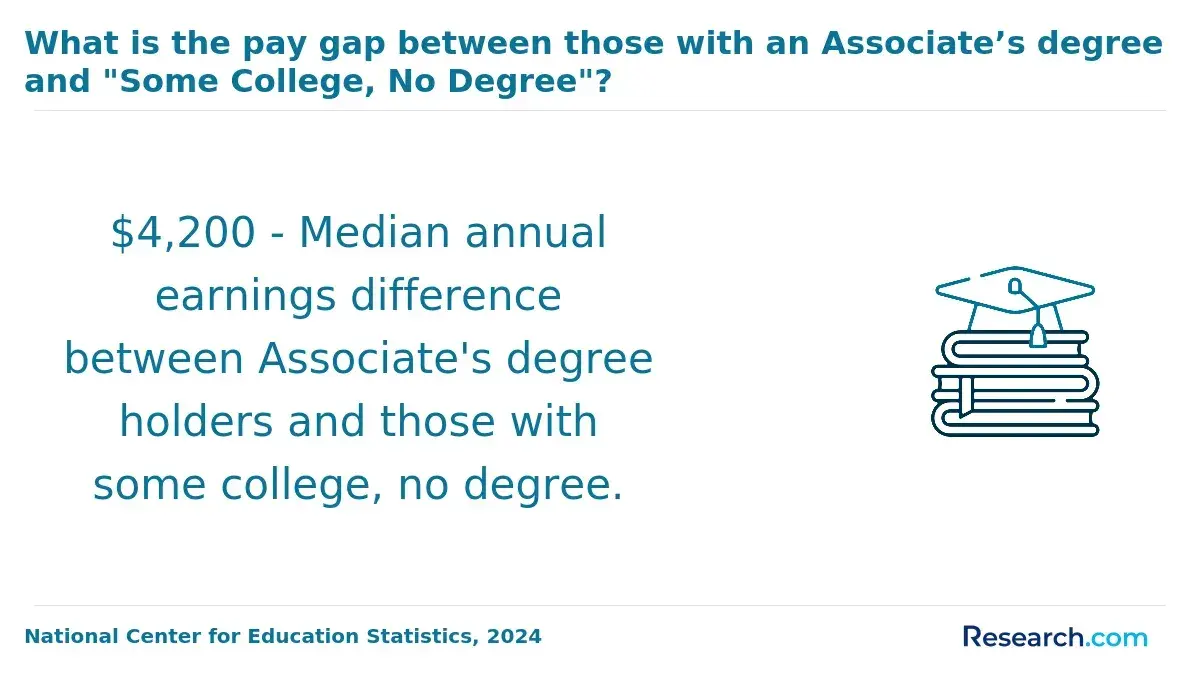
Associate degree graduates do not share a single salary: earnings depend on the occupation, location, experience, and licensing status. BLS reports a May 2024 median annual wage of $93,600 for registered nurses. That is the median for workers in the occupation - not the starting salary of ADN graduates, nor an outcome the degree guarantees.
Use occupational wages to compare potential career destinations, then ask colleges for program-level completion, licensure-exam, and employment outcomes where available. Consider the years of additional education required for your target job as well. A higher-paid occupation can be a poor financial fit if you cannot meet its admission or credential requirements without substantial extra time and expense.
What Accreditation Should an Associate Degree Program Have?
Start by confirming that the college holds institutional accreditation recognized by the U.S. Department of Education or the Council for Higher Education Accreditation. Then check the requirements for your specific occupation. Nursing and allied-health programs may need state approval or programmatic accreditation for graduates to qualify for licensing or certification exams; requirements differ by profession and state.
Before paying a deposit, ask the program to identify the relevant accreditor or approving body and confirm eligibility with your state licensing board or credentialing organization. Accreditation also matters for federal financial aid and can affect transfer, but it does not ensure that every course will satisfy a future bachelor's program.
Are Online Associate Degrees as Effective as Campus Programs?
Online associate degrees can be effective when their instruction, support, and required practical work fit the career goal. Business and some IT coursework may be available online; nursing and allied-health students should expect in-person labs or clinical placements. "Online" may also include scheduled video classes, proctored exams, or fixed attendance requirements.
Ask whether every required course is offered in your preferred format, who arranges local placements, and whether the program meets licensing rules in the state where you plan to work. The same distinction between online coursework and professional requirements applies at later degree levels: labels such as online PhD no dissertation describe a format or academic requirement, not automatic qualification for a profession.
What Courses Do Job-Focused Associate Degree Programs Include?
Most associate programs combine general education with major courses. An AA or AS often emphasizes transferable writing, mathematics, science, and introductory courses; an AAS typically devotes more space to occupation-specific training. The label is a guide, not a substitute for reading the degree plan.
Job-focused examples include accounting software and spreadsheets in business; networking labs and troubleshooting in IT; and anatomy, laboratory work, and supervised clinical practice in health programs. Check prerequisite sequences as carefully as the course list. A required science course offered only in certain terms, or a clinical placement during working hours, can delay completion even when the catalog lists a standard two-year plan.
What Are the Admission Requirements for Associate Degree Programs?
Many community colleges offer broad institutional admission to applicants with a high school diploma or equivalent, but admission to the college is not necessarily admission to a major. Nursing and allied-health programs may separately require prerequisite courses, minimum grades, applications, background checks, health documentation, or other screening.
Ask admissions staff when students can apply to the major, how applicants are selected, and whether prerequisites have waitlists. If you have previous college credit, request an evaluation that shows not just which credits the college accepts, but which ones fulfill your intended program. That distinction can change both your completion date and your cost.
How Long Do Associate Degrees Take and What Do They Cost?
Many associate degrees require roughly 60 semester credits, but prerequisites, clinical hours, course sequencing, and part-time enrollment can extend the timeline. Transfer credit may shorten it only when accepted courses apply to remaining requirements. Ask for a term-by-term plan based on your own transcript and availability.
For a cost benchmark, College Board's 2024-25 published average for in-district tuition and fees at public two-year colleges is $4,050. It is an annual sticker-price measure, not a complete degree price or your likely net cost. Budget for books, transportation, equipment, exam fees, and living expenses; compare financial-aid offers and employer assistance before borrowing. The shortest advertised route is not necessarily the least costly if a demanding schedule forces you to reduce paid work. That principle holds for later study too: even the shortest PhD programs must be judged against their full admission and completion requirements, not their advertised pace alone.
Which Certifications and Licenses Do These Careers Require?
Requirements depend on the job and state, not simply the name of the degree. ADN graduates seeking registered nurse licensure must meet their nursing board's requirements and pass the NCLEX-RN. Dental hygiene and other allied-health graduates may face profession-specific examinations, certification, or state licensing. IT certifications can strengthen an application, but whether one is required depends on the employer and role.
Before enrolling, identify the exact entry-level job you want, check its state or employer requirements, and ask the college to document how its program prepares graduates to meet them. Be wary of a school that describes a degree as sufficient for a licensed occupation without explaining the separate exam and approval steps.
Other Things You Should Know About
Nursing and licensed allied-health degrees offer some of the clearest links to defined occupations. The best fit still depends on your ability to enter the program, complete clinical work, obtain a license, and find local openings.
It can prepare you for technical support and related entry-level work, especially when you gain hands-on experience. It does not, by itself, qualify you for every cybersecurity role; plan to update your skills throughout your career.
Choose by the program's purpose and course requirements. AA and AS degrees are often designed for transfer, while AAS degrees often emphasize workforce preparation, but confirm how the specific degree serves your intended job or bachelor's program.
No. Employers may require a license, certification, experience, or additional education. Compare program outcomes where available and verify the requirements for jobs in the location where you intend to work.
References
- THE VALUE OF EDUCATIONAL DEGREES IN TURBULENT... - PMC https://pmc.ncbi.nlm.nih.gov/articles/PMC4792031/
- Associate's degree: Career Outlook | bls.gov https://www.bls.gov/careeroutlook/subject/associates_degree.htm
- Annual Earnings by Educational Attainment - COE https://nces.ed.gov/programs/coe/indicator/cba/annual-earnings
- Which Workers Are the Most Affected by Automation and What Could Help Them Get New Jobs? | U.S. GAO https://www.gao.gov/blog/which-workers-are-most-affected-automation-and-what-could-help-them-get-new-jobs
- The Overlooked Value of Certificates and Associate's Degrees | georgetown.edu https://cew.georgetown.edu/resource/the-overlooked-value-of-certificates-and-associates-degrees-what-students-need-to-know-before-they-go-to-college/
- Workforce Outcomes for Associate Degree Recipients in Utah | ushe.edu https://udrc.ushe.edu/research/RA12_AssociateDegree/index.html
- Harvard Research: Fewer than 1 in 700 get hired without a college degree | Institute for Business in Global Society https://www.hbs.edu/bigs/joseph-fuller-college-degree-gap
- Fastest Growing Careers | careeronestop.org https://www.careeronestop.org/Toolkit/Careers/fastest-growing-careers.aspx


