2027 Adaptive Learning Capstones: What to Look for in a Data Science Master's

Co-Founder and Chief Data Scientist
An adaptive learning capstone can be a strong reason to choose a data science master's - but only if the program gives you the data, technical preparation, and guidance to complete one well. This guide is for prospective students interested in personalized education technology or in capstones that adapt to their learning needs. It explains how to distinguish a substantial graduate project from a promising description, then weigh that opportunity against program fit, cost, and career goals.
Key Things You Should Know
- Clarify what "adaptive" means: a capstone may build or evaluate a personalized learning system, while a program may instead adapt its capstone support to each student.
- For an adaptive learning project, look for accessible data, a credible comparison method, privacy safeguards, and a deliverable you can explain or demonstrate—not just a prediction model.
- The U.S. Bureau of Labor Statistics projects 35% growth in data scientist employment from 2025 to 2035; that is broad occupational demand, not evidence that a particular capstone will lead to a job.
What Is an Adaptive Learning Capstone in a Data Science Master's Program?
In the project sense, an adaptive learning capstone uses data to inform how instruction changes for a learner. A student might estimate mastery, recommend the next exercise, identify when human support is needed, or test whether personalized feedback improves a defined outcome. The graduate-level challenge is not simply to make recommendations; it is to establish what information the system may use, how its decisions will be evaluated, and when an instructor should override it.
"Adaptive" can also describe the capstone experience: individualized project pathways, feedback, or pacing. That support may be valuable, but it does not mean students can pursue an adaptive learning technology project. Ask programs which meaning they intend and whether education-focused projects are actually feasible. Do not assume a program offers this topic because it lists machine learning or a general capstone.
How Do Data Science Capstones Demonstrate Graduate-Level Skills?
A strong adaptive learning capstone connects an educational decision to defensible analysis. For example, predicting which learners might struggle is useful only if the project explains what intervention could follow, how false alerts would affect students, and what evidence would show the intervention helped.
When reviewing capstone briefs or student work, look for evidence across the full project—not just model accuracy:
- Problem and data: A clearly defined learner population, decision point, available data, and account of missing or potentially misleading records.
- Methods and evaluation: An appropriate baseline, a justified modeling approach, and evaluation that matches the proposed use; an offline prediction score alone does not establish improved learning.
- Responsible implementation: Attention to accessibility, subgroup performance, privacy, human oversight, and the risks of changing instruction based on uncertain predictions.
- Reproducible deliverable: Documented code or analysis, limitations, and a presentation that a technical reviewer and an education stakeholder can understand.
Avoid treating an impressive interface as proof of educational effectiveness. If you are comparing broader project opportunities rather than education technology specifically, reviews of the best master's programs in data analytics can help frame questions about applied work, but inspect each program's actual capstone requirements.
What Should You Look for in an Accredited Data Science Master's Program?
Confirm the institution's current accreditation through the institution and its accreditor, then assess the capstone separately. Institutional accreditation does not establish that a particular adaptive learning project, education-data partnership, or faculty specialty is available. Program authorization for your location also deserves a direct check if you plan to study online.
Ask for the current catalog's capstone description, recent project examples, and the process for approving a student-proposed topic. A useful answer identifies who supervises the work, when students secure data, and what happens if a partner withdraws access. Be cautious when a program promotes industry projects but cannot explain whether students may use suitable education data or produce a portfolio-safe deliverable.
Which Courses Prepare Students for an Adaptive Data Science Capstone?
Look beyond course titles to assignments and sequencing. Statistics and experimental design help students distinguish predictive performance from evidence of learning gains. Machine learning supports mastery estimation or recommendations; data engineering helps turn event logs into reliable analyses. Courses or substantial modules on ethics, privacy, and human-centered design matter when predictions could affect a learner's opportunities.
Education-domain coursework can add value, but it is not a substitute for technical depth. If a program has no learning sciences elective, ask whether an education faculty member or external stakeholder can advise the project. Conversely, a single unit on recommendation systems is not equivalent to building, evaluating, and documenting an adaptive system.
Students considering education or clinical training applications may also compare healthcare-focused career paths through an AI master's; healthcare projects introduce distinct data-access and regulatory questions that should not be assumed to match education projects.
How Do Online and Campus Data Science Capstones Compare?
Either format can support a rigorous adaptive learning capstone. The consequential differences are access to collaborators, feedback, secure computing, and meetings with education partners—not whether the final presentation happens in a classroom. Online students should check time-zone expectations, live meeting requirements, and whether remote access to approved data is possible. Campus students should check whether proximity actually translates into available partnerships or faculty supervision.
For a team project, ask how members are assigned, how contributions are assessed, and whether meetings with stakeholders are scheduled at workable times. If relationships with potential project sponsors are a priority, consider how a program builds professional connections through an AI graduate program—then verify the equivalent opportunities in the data science programs on your shortlist.
What Are the Admission Requirements for Data Science Master's Programs?
Requirements vary by institution. Applicants should check each program's current policy for prior coursework, programming and quantitative preparation, transcripts, recommendations, and any statement or work samples. For an adaptive learning capstone, experience in education can help define a worthwhile problem, but it does not automatically replace the statistical or coding preparation needed to evaluate a solution.
If you have a preparation gap, ask whether a course taken before enrollment fulfills a formal prerequisite or merely helps you get ready. Likewise, an application with fewer written components is not necessarily a lighter technical program. Applicants who want to compare application procedures can review machine learning master's programs without an admissions essay while confirming each school's current requirements directly.
How Long Do Data Science Master's Programs Take and What Do They Cost?
Completion time depends on required credits, course availability, enrollment pace, and when the capstone begins. Compare the published degree plan with your own schedule: a project that requires partner approval or several rounds of data review may be difficult to compress, even when coursework can be accelerated. Readers exploring fast-track artificial intelligence master's study should check whether a shorter schedule leaves enough room for the kind of capstone they want.
Use each school's current tuition and fee schedule to estimate the total cost to complete, not just the advertised per-credit price. Include mandatory fees, any required travel or technology, and the cost of extra terms if your project runs longer. Ask when capstone credits are billed and whether employer tuition assistance applies to them. No single price or duration reliably describes all programs.
Which Careers Can a Data Science Master's Capstone Help You Pursue?
An adaptive learning project can provide relevant evidence for data scientist, machine learning, learning analytics, and education-technology product roles. The strongest portfolio version shows what you personally contributed, how you tested the system, and how you communicated limitations to a nontechnical stakeholder. A project based on restricted student records may still be valuable, but ask early what findings, code, or simulated demonstration you may share with employers.
Choose a capstone that fits your target role. Model development and monitoring are more relevant to a machine learning role; study design and careful interpretation may matter more in learning analytics. A capstone strengthens an application when it demonstrates the work an employer needs, but it does not replace other required experience or guarantee an interview.
What Salary and Job Outlook Can Data Science Graduates Expect?
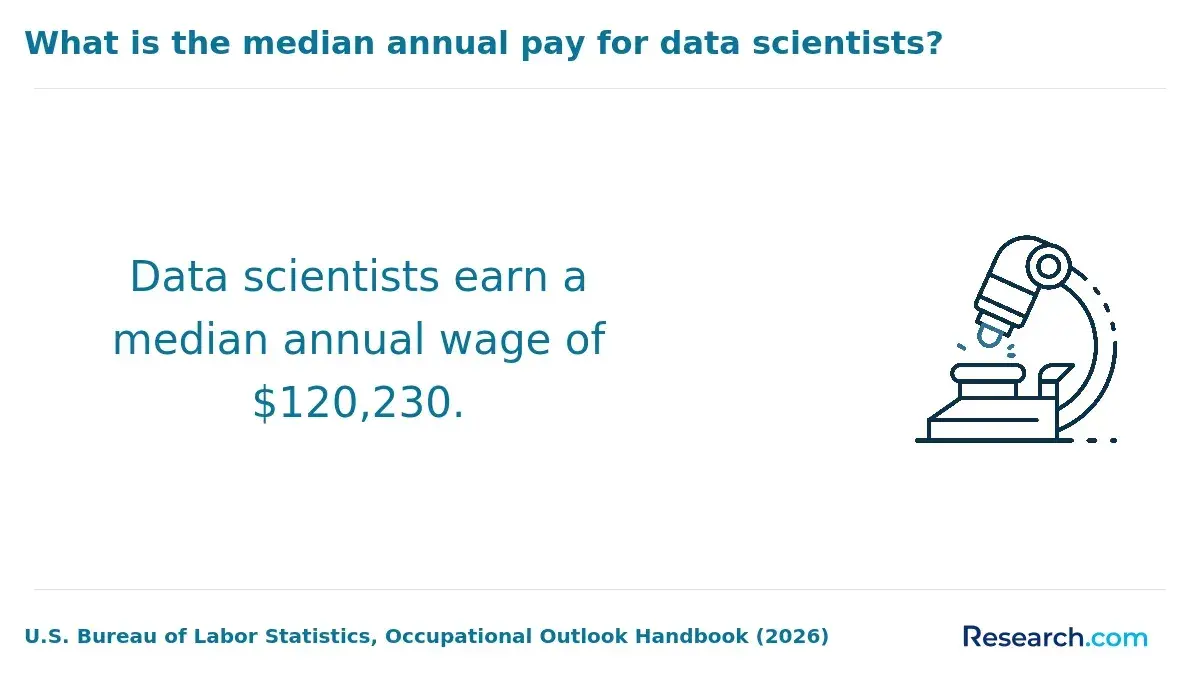
The U.S. Bureau of Labor Statistics reports a $120,230 median annual wage for data scientists in May 2025. That figure describes workers across experience levels and industries, not starting pay for graduates or the earnings attributable to a master's degree. Use it for occupational context, then evaluate roles that match your prior experience, location, and capstone skills.
The BLS projection of 35% employment growth from 2025 to 2035 indicates strong demand for the occupation overall. It does not predict hiring in education technology specifically. Before using a school's graduate outcomes to justify the cost, check which graduates responded, what jobs they held before enrolling, and whether reported pay is a salary level or an increase.
Do Data Science Careers Require Certifications or Professional Licensure?
Data scientist roles generally do not have a universal professional license. Employer expectations for certifications vary, and a certification should not be treated as a substitute for evidence that you can define, evaluate, and communicate a sound project. If your intended work crosses into a separately regulated profession, verify that profession's requirements with the relevant authority rather than assuming a data science degree satisfies them.
For program selection, prioritize the preparation and project access you need over a long list of optional certificates. Ask whether any advertised credential is included in tuition, required for graduation, or simply available at extra cost.
Other Things You Should Know About Data Science
Often, if your program approves it. Synthetic data can demonstrate a working method without exposing student records, but it cannot establish that the method improves outcomes for real learners. State that limitation clearly.
Ownership and publication rights depend on university policy and any sponsor agreement. Review those terms before accepting a project, particularly if you hope to publish code or show the work in a portfolio.
Not necessarily. An offline evaluation or carefully designed prototype can be appropriate when deployment would be impractical or unsafe. The project should be explicit about what was - and was not - tested.
Not if you can identify your own work and explain the team's decisions. Keep a record of your contributions, while respecting any confidentiality restrictions on the final project.
References
- Responsible Practices for Data Sharing - PMC - NIH https://pmc.ncbi.nlm.nih.gov/articles/PMC5967383/
- Rigor and Reproducibility | Clinical & Translational Science Institute https://ctsi.ucla.edu/nih-requirements/rigor
- Designing Longer-Term Team Projects | cornell.edu https://teaching.cornell.edu/teaching-resources/active-collaborative-learning/collaborative-learning/designing-longer-term-team
- Credit hours is not enough: Explaining undergraduate perceptions of course workload using LMS records - ScienceDirect https://www.sciencedirect.com/science/article/pii/S1096751622000380
- Data Science Capstone Experience - Purdue Online https://www.purdue.edu/online/data-science/data-science-capstone-experience/
- Intellectual Property Ownership & Research Security | Research and Partnerships https://research.arizona.edu/compliance/RSP/intellectual-property-ownership-research-security