2027 Social Work Difficult Conversations with Colleagues: Role Clarity and Professional Feedback
Audited and Verified:
Our Editorial and Data Verification Process
Research.com uses government datasets, official education statistics and primary institutional information to support its career and degree guides. Our review process checks factual accuracy, occupational definitions, source dates and the requirements associated with the credentials discussed.
How This Article Was Fact-Checked
Our editorial team verifies salary estimates, employment projections, education requirements and program information against original data providers and official organizations. Salary figures are checked against the relevant occupational definitions and reporting periods. Information about licensure, accreditation and required in-person training is reviewed separately.
Fact-checked and verified on:

Co-Founder and Chief Data Scientist
A disagreement over a referral, an unclear handoff, or feedback about a colleague's documentation can affect both working relationships and client services. For social work students, new graduates, and practicing professionals, the goal is not to avoid difficult conversations; it is to handle them within clear roles, ethical boundaries, and agency procedures.
This guide offers language you can adapt, a way to separate routine friction from safety concerns, and criteria for deciding whether supervision, targeted training, or further education would help.
Key Things You Should Know
- Start a colleague conversation with an observable event and its service impact, then ask about the other person's understanding before agreeing on a next step.
- Clarify who owns each task, who makes the decision, and who covers a handoff; a shared client does not mean every team member has the same authority.
- Use supervision or the appropriate reporting channel promptly when client safety, confidentiality, discrimination, or possible misconduct is at issue; peer feedback alone may be insufficient.
How can social workers navigate difficult conversations with colleagues?
Choose a private setting when possible, and distinguish what you observed from what you inferred. "The referral was still unassigned at yesterday's handoff" is easier to examine than "You never follow through." Explain the effect on service coordination without sharing more client information than the conversation requires.
A useful sequence is to name the concern, invite context, agree on an owner and deadline, and confirm the agreement through an appropriate team channel. For example: "I understood that I would complete the assessment and you would send the housing referral. Has that assignment changed? Let's confirm who will contact the provider." If emotions rise, pause and arrange a specific time to continue rather than pressing for immediate agreement.
Before treating a recurring disagreement as a personal communication failure, check whether caseloads, staffing, unclear procedures, or incompatible instructions are driving it. Ask a supervisor to resolve those conditions. If you are considering a degree primarily to improve workplace communication, first compare supervision, employer training, and focused professional development with the time and field commitments involved in choosing among online social work programs.
How can social workers clarify roles and responsibilities within a team?
Role clarity means knowing who performs a task, who can approve or change a plan, and who is accountable for the handoff. Job titles alone may not answer those questions: agency policy, professional scope, supervision arrangements, and the client's needs also matter. The distinctions below help identify what a team needs to confirm, not what every agency must assign to a particular profession.
| Team responsibility | Question to settle | Common boundary to check |
| Assessment and service planning | Who gathers information, documents the plan, and approves changes? | Required supervision and any activity restricted by license or agency policy |
| Referral and follow-up | Who contacts the provider, updates the client, and checks whether access occurred? | Consent, information-sharing rules, and coverage during absences |
| Urgent concerns | Who receives the initial report and who directs the response? | Current safety procedures, reporting duties, and escalation authority |
At a team meeting, state the proposed assignment aloud and document the agreed owner, backup, and handoff point in the approved workflow. A student or new graduate should also ask which decisions require review before acting. Academic field instruction is distinct from post-degree licensing supervision; understanding required experience in clinical social work matters when a proposed clinical duty or supervision arrangement depends on state rules.

How can social workers give constructive feedback to colleagues?
Give feedback close enough to the event to be useful, but not in front of clients or a group unless immediate safety action is needed. Describe a specific action, explain its effect, and request a workable change. Keep feedback about the colleague's conduct separate from speculation about motive, competence, or character.
For example: "The discharge meeting ended without an agreed transportation contact. I could not tell the family who was following up. Could we name the contact before the next meeting?" Then listen: a missing handoff may reflect an assignment the colleague never received. Agree on what will happen next and revisit it if the pattern continues.
Peer feedback is not a substitute for clinical consultation, formal performance management, or a required report. If repeated feedback reveals a gap in your own specialized preparation, discuss it with a qualified supervisor before considering further study; planning graduate study for clinical social work addresses a different need from improving a team's handoff process.
Escalate when a concern cannot safely wait for peer resolution, when a prior conversation has not corrected a material problem, or when the colleague does not have authority to resolve it. Examples include a credible risk to a client, improper disclosure of confidential information, suspected falsification, harassment, or a proposed task that may exceed someone's lawful scope. Use the agency's applicable safety, reporting, supervisory, and personnel channels; immediate dangers require the response specified by current procedures and law.
Record relevant facts, dates, actions taken, and whom you notified in the appropriate system. Do not put a personnel dispute into a client record unless the entry is necessary for accurate client-service documentation under agency policy. Seek guidance about confidentiality, mandatory reporting, and protected disclosures from the governing rules in your jurisdiction; the NASW Code of Ethics offers professional guidance but does not replace law or agency requirements.
If the dispute concerns whether an online degree or license permits a proposed duty, pause the assumption and verify it with the relevant state board and employer. A resource on online MSW program eligibility by intended state can frame the educational question, but only the governing authority can determine an individual's practice authorization.
What career paths, salaries, and job prospects are available to social workers?
Communication and role clarity matter in child and family services, healthcare, behavioral health, schools, housing, and community agencies. Duties vary: a care coordinator may manage referrals and handoffs, while a clinical role may require a particular state license and supervised experience. Review actual postings for education, license, supervision, and documentation requirements; a job title alone does not establish lawful scope.
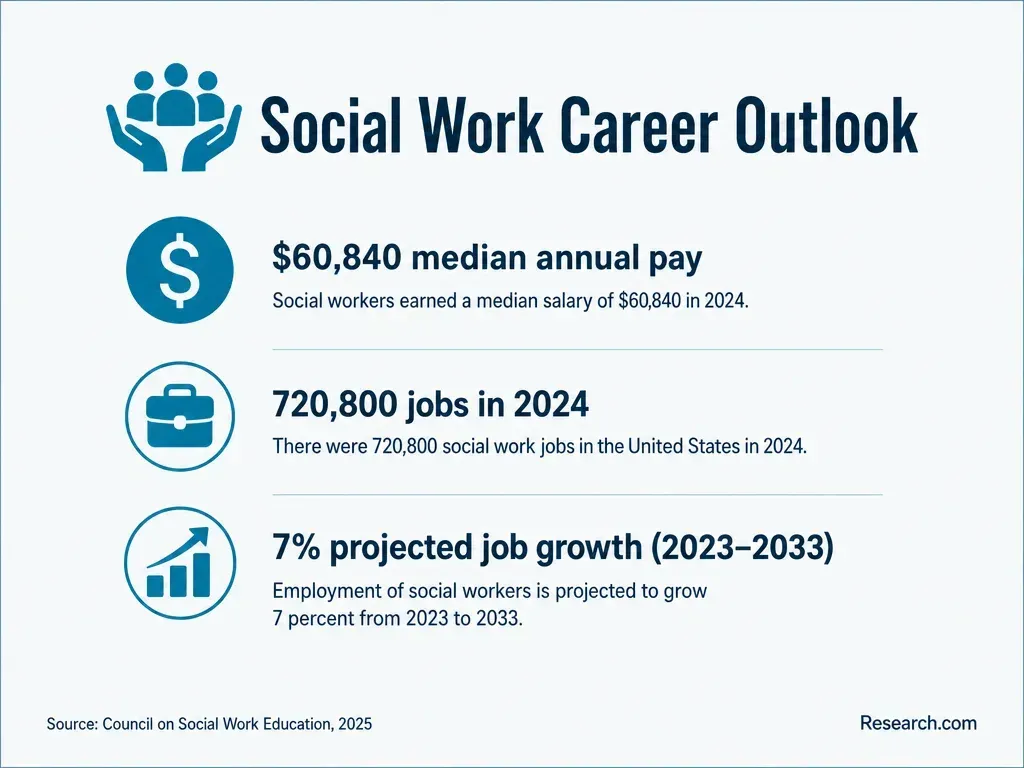
The U.S. Bureau of Labor Statistics reports a May 2025 median annual wage of $61,780 for social workers across specialties and projects 6% employment growth from 2025 to 2035. These occupation-wide figures are context, not an expected salary or job guarantee for a particular graduate. Specialty, location, employer, and experience change the comparison; a guide to comparing social worker pay by location can help frame questions about a specific market.
For workplace fit, ask prospective employers about supervision access, caseload, documentation time, safety procedures, and how teams resolve disputed responsibilities. Those conditions may affect your ability to practice well more immediately than an additional credential.
Other Things You Should Know About Social Work
You can acknowledge an impact without accepting an inaccurate account: "I'm sorry the handoff was unclear. My notes show a different assignment; let's check the plan together."
Do not assume it is. Recording rules depend on state law and workplace policy. Use approved documentation channels and ask for guidance before making a recording.
That depends on the meeting and workplace rules, including any applicable representation rights. Ask who may attend and what the meeting will address before it begins.
Listen without taking over their duties indefinitely. Offer to clarify the immediate handoff, then raise workload or coverage needs with someone who can address staffing and supervision.
- Questions & Answers for Small Employers on Employer Liability for Harassment by Supervisors https://www.eeoc.gov/laws/guidance/questions-answers-small-employers-employer-liability-harassment-supervisors
- Promoting psychological safety - Support for social workers https://support-for-social-workers.education.gov.uk/employer-standards/standard-5/promoting-psychological-safety
- Tool: Formative Feedback | Agency for Healthcare Research and Quality https://www.ahrq.gov/teamstepps-program/curriculum/mutual/tools/feedback.html
- How to give and receive feedback effectively - PMC - NIH https://pmc.ncbi.nlm.nih.gov/articles/PMC5709796/
- DOL Workplace Violence Program https://www.dol.gov/agencies/oasam/centers-offices/human-resources-center/policies/workplace-violence-program
- Effective Feedback in Clinical Education | columbia.edu https://ctl.columbia.edu/resources-and-technology/resources/effective-feedback-clinical/
- Formalize Escalation Procedures to Improve Decision-Making | MIT Sloan Management Review https://sloanreview.mit.edu/article/formalize-escalation-procedures-to-improve-decision-making/
- Social Workers' Ethical Responsibilities to Clients https://www.socialworkers.org/About/Ethics/Code-of-Ethics/Code-of-Ethics-English/Social-Workers-Ethical-Responsibilities-to-Clients