2027 Cultural Humility in Social Work: Lifelong Learning and Professional Relationships
Audited and Verified:
Our Editorial and Data Verification Process
Research.com uses government datasets, official education statistics and primary institutional information to support its career and degree guides. Our review process checks factual accuracy, occupational definitions, source dates and the requirements associated with the credentials discussed.
How This Article Was Fact-Checked
Our editorial team verifies salary estimates, employment projections, education requirements and program information against original data providers and official organizations. Salary figures are checked against the relevant occupational definitions and reporting periods. Information about licensure, accreditation and required in-person training is reviewed separately.
Fact-checked and verified on:

Co-Founder and Chief Data Scientist
A social worker can know a great deal about a community and still misunderstand the person sitting across from them. Cultural humility addresses that gap through ongoing self-reflection, attention to power, and a willingness to learn from clients and communities. It matters wherever workers make assessments, coordinate services, or shape agency decisions. This guide explains what the approach looks like in practice, how students can assess whether a program teaches it well, and how practitioners can keep developing it throughout their careers.
Key Things You Should Know
- Cultural humility is an ongoing practice - not a credential or a claim to know everything about a cultural group - and requires reflection, client-defined priorities, and attention to institutional power.
- Students should look for observed skills, field feedback, and community input, not just a required diversity course; online study still includes program-approved field education.
- Cultural humility matters across social work roles, but neither training in it nor an MSW alone grants a license or independent clinical authority.
What is cultural humility in social work?
Cultural humility is a continuing commitment to examine one's assumptions, recognize differences in power, and treat clients and communities as authorities on their own experiences. Culture can include race, ethnicity, language, religion, disability, gender, family structure, class, migration history, and other parts of identity. No single characteristic tells a social worker what a person needs or values.
The approach fits social work's person-in-environment perspective: a worker considers both an individual's circumstances and the institutions affecting their choices. A client who misses an appointment, for example, may be dealing with an inaccessible bus route or an inflexible work schedule. Humility means asking before interpreting the absence as a lack of motivation.
It is relevant whether someone is entering generalist practice or preparing for more specialized work. A social work degree pathway overview can help prospective students identify the appropriate educational route, but no degree substitutes for learning from the people a worker serves.
How does cultural humility differ from cultural competence?
Cultural competence commonly describes the knowledge and skills used to work effectively across differences. Cultural humility emphasizes that such learning is never finished and that professional expertise does not outrank a client's account of their own life. The concepts can complement each other: workers need usable knowledge, but they must remain willing to revise it.
The distinction matters during assessment. Learning about barriers a community may face can help a worker ask better questions. Assuming every member of that community faces the same barriers turns that knowledge into a stereotype. A better question is, "Which of these issues, if any, affects you?"
For prospective students, an admissions requirement or a course title alone says little about how a school teaches this distinction. When reviewing social work master's application options by selectivity, consider entry requirements separately from evidence that students receive feedback on reflective practice.
What are examples of cultural humility in social work practice?
Cultural humility becomes visible in ordinary decisions about questions, referrals, records, and who participates in planning. These examples describe approaches to practice, not scripts that will fit every client or agency.
- Assessment: Ask how a client describes their support network and priorities rather than assuming which relatives should be involved.
- Language access: Arrange an appropriately qualified interpreter under agency policy and check understanding rather than asking a child to interpret sensitive information.
- Service planning: Ask whether proposed appointments, costs, transportation, or eligibility rules make a referral usable.
- Documentation: Separate a client's stated concerns from the worker's interpretation, and avoid unsupported labels about motivation or family dynamics.
- Community work: Invite affected residents to shape a program's goals and review how their feedback influences decisions.
Workers should adapt these practices to their role, supervision, confidentiality duties, and agency procedures. Someone considering shorter graduate pathways in social work should still ask how the program gives students enough supervised opportunities to practice and receive feedback on these skills.
Cultural humility can make professional relationships more collaborative because it gives clients room to correct assumptions and define what a useful outcome would be. A worker might explain an agency's limits, ask which options feel workable, and revisit the plan when circumstances change. That preserves professional responsibility without presenting the worker as the sole expert.
Trust also depends on what an organization does. Soliciting community feedback while retaining inaccessible hours, unclear eligibility rules, or no language-access process is unlikely to address the barriers people identify. Workers can bring recurring concerns to supervisors and program leaders without disclosing more client information than necessary.
These relationships take time and resources; they are not guaranteed by a particular degree or job title. If graduate education is part of a career decision, comparing lower-cost MSW degrees and career pathways can help weigh tuition against the field learning and community-facing preparation a program actually offers.
Reflection is most useful when it changes a decision. After a difficult interaction, a worker can consider which assumptions they made, what the client actually said, where agency rules constrained the options, and what they should ask or do differently next time. Supervision provides a place to test that reasoning without making the client responsible for the worker's education.
A manageable learning cycle is to identify one recurring practice question, seek relevant client or community feedback through appropriate channels, discuss it in supervision, and check whether a change improves access or collaboration. Continuing education and employer training can add knowledge, but course completion alone does not demonstrate changed practice.
Students balancing work and caregiving should also examine how learning happens, not merely when lectures are available. Asynchronous MSW coursework and scheduling may offer flexibility for reading and assignments, while live skills sessions and approved field placements can still require fixed hours.
What are social workers' salary expectations and job outlook?
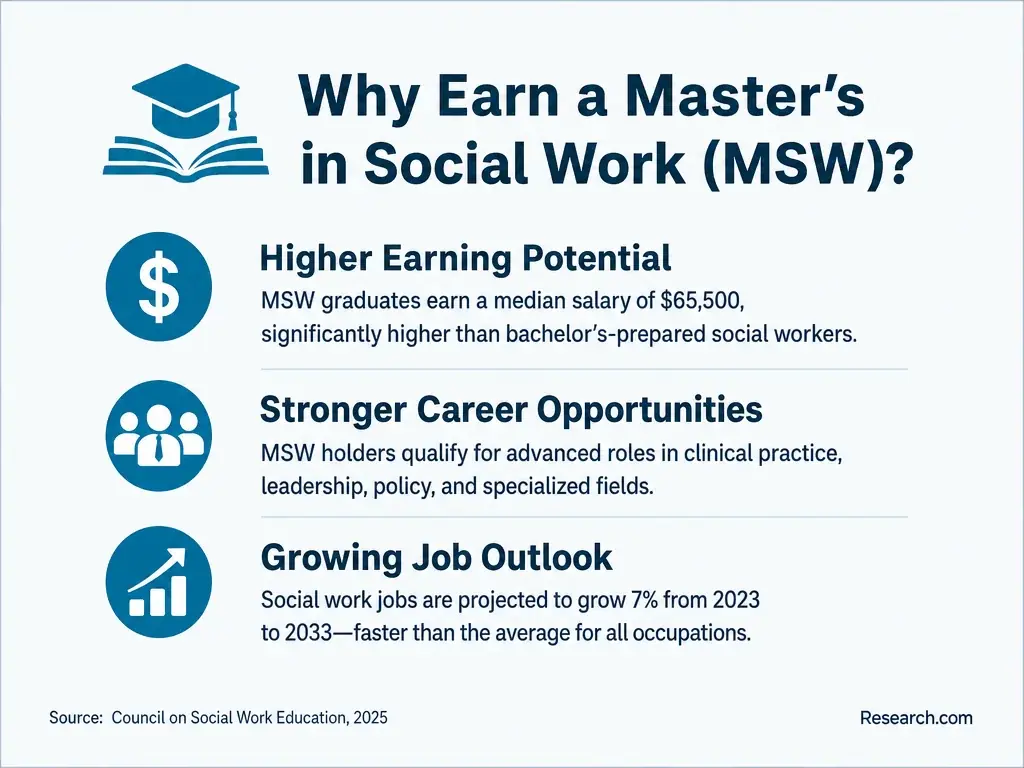
U.S. Bureau of Labor Statistics figures give occupational context, not a promised return from cultural-humility training, an MSW, or a license. The May 2025 median annual wages and projected 2025-2035 employment changes differ by the kind of social work performed.
| BLS occupation | May 2025 median annual wage | Projected employment change, 2025-2035 |
| Social workers, all specialties | $61,780 | +6% |
| Child, family, and school social workers | $59,550 | +4% |
| Healthcare social workers | $67,880 | +8% |
| Mental health and substance abuse social workers | $60,280 | +10% |
A median divides workers in an occupation into two equal groups; it is not an entry-level offer. Pay also varies with location, employer, experience, and duties. Use understanding location differences in MSW earnings alongside local job postings, and compare required credentials and supervision before estimating whether additional education is financially worthwhile.
Other Things You Should Know About Social Work
Correct the record or plan if needed, acknowledge the mistake without asking the client to reassure you, and seek supervision on how to prevent it from shaping future decisions.
Clients may choose to explain what matters to them, but they should not have to provide general cultural education. Workers can prepare independently and ask questions tied to the client's goals.
No. Respectful intentions do not remove a language barrier. Follow applicable language-access requirements and agency procedures for obtaining qualified interpretation.
Document the concern appropriately, discuss it with a supervisor or responsible leader, and identify what the agency can change. Protect confidential information and avoid promising changes you cannot authorize.
- Rethinking Cultural Competence: Shifting to Cultural Humility | nih.gov https://pmc.ncbi.nlm.nih.gov/articles/PMC7756036/
- Section 7. - Building Culturally Competent Organizations https://ctb.ku.edu/en/table-of-contents/culture/cultural-competence/culturally-competent-organizations/main
- The multicultural guidelines in practice: Cultural humility in clinical training and supervision. | apa.org https://doi.apa.org/doi/10.1037/tep0000253
- Full article: Practice-based knowledge perspectives of cultural competence in social work | tandfonline.com https://www.tandfonline.com/doi/full/10.1080/15313204.2022.2046228
- [PDF] The Case for a Cultural Humility Framework in Social Work Practice | Semantic Scholar https://www.semanticscholar.org/paper/The-Case-for-a-Cultural-Humility-Framework-in-Work-Gottlieb/005d61a2ca7790af0d92bca69052c522d41d3d6f
- Standards and Indicators for Cultural Competence in Social Work Practice | socialworkers.org https://www.socialworkers.org/Practice/NASW-Practice-Standards-Guidelines/Standards-and-Indicators-for-Cultural-Competence-in-Social-Work-Practice
- Cultural Humility: What Is It & Why It matters | cahealthadvocates.org https://cahealthadvocates.org/cultural-humility-what-is-it-why-it-matters/