2027 Critical Incident Support in Social Work: Social Work Roles and Preparation Questions
Audited and Verified:
Our Editorial and Data Verification Process
Research.com uses government datasets, official education statistics and primary institutional information to support its career and degree guides. Our review process checks factual accuracy, occupational definitions, source dates and the requirements associated with the credentials discussed.
How This Article Was Fact-Checked
Our editorial team verifies salary estimates, employment projections, education requirements and program information against original data providers and official organizations. Salary figures are checked against the relevant occupational definitions and reporting periods. Information about licensure, accreditation and required in-person training is reviewed separately.
Fact-checked and verified on:

Co-Founder and Chief Data Scientist
A school shooting, workplace death, natural disaster, or other critical incident can leave people needing immediate practical help and longer-term support. Social workers may be part of that response, but their responsibilities depend on their training, license, agency, and the incident itself.
This guide is for students, new graduates, and social services professionals considering crisis-related work. It explains the roles, education, field experience, and credentials that matter - and gives you questions to ask before choosing a program, placement, or job.
Key Things You Should Know
- Critical incident support can include immediate needs assessment, practical assistance, referrals, and follow-up; providing psychotherapy is a separate, license-dependent function.
- A BSW can prepare graduates for generalist response roles, while many clinical roles require an MSW and state-specific licensure or supervised practice. Compare programs by approved field opportunities, supervision, safety training, and total cost - not a "crisis response" label alone.
- BLS projects 10% employment growth for mental health and substance abuse social workers from 2025 to 2035, but that category is broader than incident-response jobs.
What is critical incident support in social work?
Critical incident support is coordinated assistance after an event that overwhelms ordinary coping or disrupts safety, services, or community routines. The incident might affect one family, an entire school, a workplace, or a neighborhood. Social workers consider both immediate concerns - such as safety, shelter, and access to care - and the circumstances that shape recovery, including disability access, family responsibilities, income, and available community supports.
It is not one standardized job or a single treatment. A hospital social worker supporting relatives after a sudden death, a school social worker helping coordinate a school response, and a disaster case manager connecting households to services have different duties. For a broader view of where those duties sit within the profession, see social work master's roles and employment settings.
Support should be responsive to what people say they need, rather than assuming everyone exposed to an incident needs the same intervention. Immediate assistance, ongoing case management, clinical treatment, and community recovery may involve different workers and agencies.
What do social workers do during and after critical incidents?
The first task is to understand the social worker's assigned role within the response. Emergency personnel handle immediate hazards; social workers commonly help people navigate needs and services without taking over functions outside their training or authority.
Typical responsibilities change as the response progresses:
- During the immediate response: Help identify urgent practical needs, communicate available services, support accessible and culturally responsive outreach, and coordinate with the designated response team.
- In the following days: Arrange referrals, assist with benefits or housing navigation, support family or school coordination, document contacts appropriately, and notice when someone needs assessment by a qualified clinician.
- Over time: Follow up on unmet needs, connect people with continuing care, and help agencies identify service gaps while protecting personal information.
Social workers should follow agency safety procedures, consent and confidentiality rules, and applicable reporting requirements. They should not promise confidentiality beyond legal limits or assume that a group debriefing or any other single response is suitable for everyone. Documentation of incident services also differs from records of post-degree clinical supervision; workers pursuing licensure should review social work clinical experience recordkeeping considerations with their supervisor and licensing board.
What degree do you need to work in critical incident support?
There is no universal "critical incident support" degree requirement. Start with the duties in the job posting. Coordinating supplies or referrals may be open to people with human services experience; a position designated for a social worker may require a BSW or MSW; independent clinical treatment generally requires a qualifying graduate degree and state clinical licensure.
These pathways differ in what they prepare you to do:
| Pathway | Potential fit in incident-related work | Important limit |
| Human services experience or adjacent degree | Outreach, logistics, and some service-coordination roles, subject to employer requirements | Does not confer a social work degree or license |
| BSW | Generalist social work, resource navigation, and supervised direct-service roles | Does not by itself authorize independent clinical practice |
| MSW | Advanced practice, clinical preparation, program coordination, or leadership, depending on training | Degree completion is not the same as clinical license issuance |
| DSW or PhD | Practice leadership, education, evaluation, or research when those are the goal | Usually unnecessary for frontline incident-support work |
A traditional MSW can admit graduates from other disciplines, while advanced-standing eligibility generally depends on a qualifying BSW and the program's rules. Compare advanced standing eligibility and traditional MSW options before assuming prior crisis-service experience will shorten the degree.
Useful preparation combines social work foundations with observed practice. Relevant coursework may cover human behavior and social environments, trauma and crisis concepts, assessment, ethics, social policy, community resources, and interprofessional collaboration. Skills practice should include listening without pressuring people to disclose, recognizing role limits, making referrals, and documenting services securely.
For students, the strongest field placement is not necessarily the one with the most dramatic incidents. Look for an approved site with a qualified field instructor, a learning agreement that includes appropriate crisis-related competencies, clear safety procedures, and chances to receive feedback on real work. Hospitals, schools, behavioral health agencies, and disaster-service organizations may offer different kinds of exposure; none guarantees access to a particular incident. Simulations can build readiness but do not establish independent competence.
Ask how the field sequence fits the academic calendar before choosing a faster track. Accelerated MSW study planning is especially important when classes, skills labs, and placement days overlap. Curricular field hours are distinct from any post-degree clinical supervision required by a licensing board.
What are the salary and job outlook for social workers in crisis-related roles?
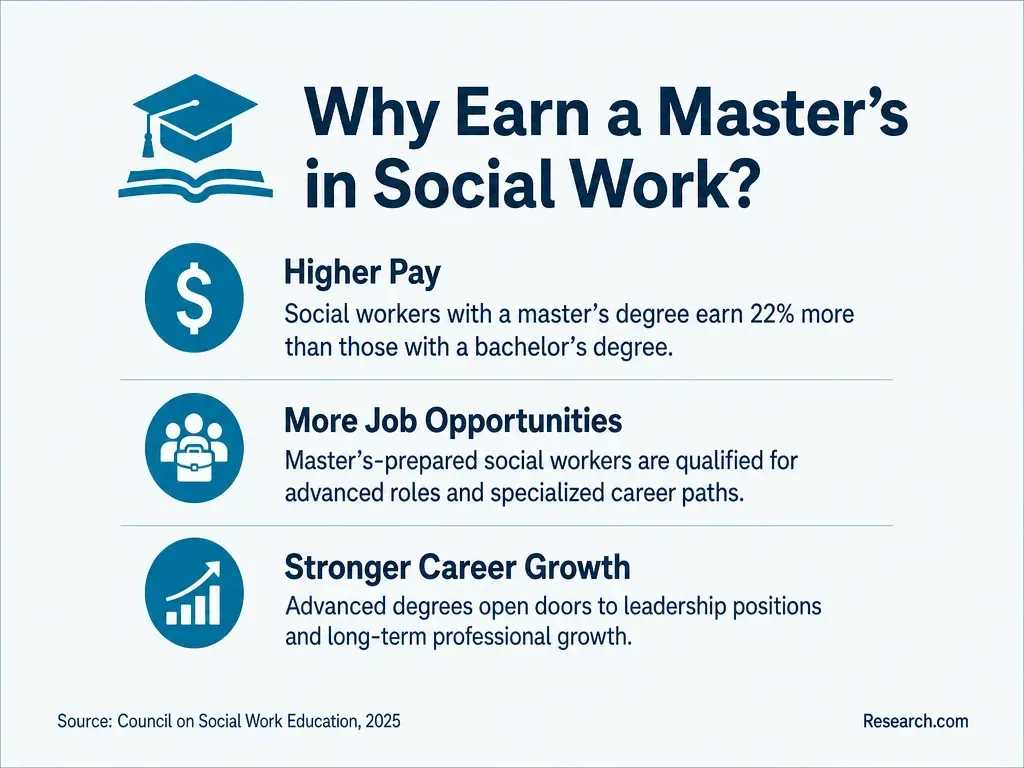
The U.S. Bureau of Labor Statistics does not report a separate occupation called "critical incident support social worker." The closest category depends on the employer and duties. These national figures provide context, not a salary estimate for a particular response-team position.
| BLS occupation | May 2025 median annual pay | Projected employment growth, 2025-2035 |
| Child, family, and school social workers | $59,550 | 4% |
| Healthcare social workers | $67,880 | 8% |
| Mental health and substance abuse social workers | $60,280 | 10% |
| Social workers, all specialties | $61,780 | 6% |
A school response position, hospital social work job, and behavioral health crisis role can have different pay structures, schedules, and license requirements. BLS medians cover experienced and newer workers across many duties; projected growth does not guarantee local openings. Compare actual postings by location, shift or on-call expectations, supervision, and required credentials. For geographic comparison, use state-level salary context for MSW careers alongside current local job advertisements.
Other Things You Should Know About Social Work
No. Critical incident support is a broad set of practical and psychosocial services. A structured group debriefing is a specific approach and should not be treated as the automatic response for everyone exposed to an event.
Only through an authorized organization and within its assigned role, training, and safety rules. Unrequested arrival can disrupt a coordinated response and does not count as approved field education.
Clarify response times, overnight and weekend duties, travel and safety procedures, compensation for on-call time, backup staffing, and access to supervision before accepting the role.
Use supervision and team consultation, follow workload and safety procedures, take available breaks, and seek appropriate support when exposure affects functioning. Personal distress is not a substitute for the agency's responsibility to provide safe staffing and clear escalation routes.
- Care Coordination | Agency for Healthcare Research and Quality https://www.ahrq.gov/ncepcr/care/coordination.html
- NASW Standards for Social Work Case Management | nycourts.gov https://www.nycourts.gov/reporter/webdocs/nasw_standards_socialwork_casemgt.htm
- SAFE-T Suicide Assessment Five Step Evaluation and Triage | samhsa.gov https://library.samhsa.gov/product/safe-t-suicide-assessment-five-step-evaluation-and-triage/pep24-01-036
- Learning from critical incidents - Support for social workers https://support-for-social-workers.education.gov.uk/employer-standards/standard-1/learning-from-critical-incidents
- Emerging social workers during COVID-19 - PMC - NIH https://pmc.ncbi.nlm.nih.gov/articles/PMC10020856/
- 6: Confidentiality | United States Department of Justice https://www.justice.gov/elderjustice/mdt-guide-toolkit/6-confidentiality
- Definition of a Critical Incident - Norfolk Schools https://www.schools.norfolk.gov.uk/article/78042/Definition-of-a-Critical-Incident
- Articles Single session debriefing after psychological trauma | sciencedirect.com https://www.sciencedirect.com/science/article/abs/pii/S0140673602098975
- Understanding Personal Safety for Social Workers | brescia.edu https://www.brescia.edu/2019/03/personal-safety-for-social-workers/
- NASW Standards for Social Work Practice in Health Care Settings | socialworkers.org https://www.socialworkers.org/Practice/NASW-Practice-Standards-Guidelines/NASW-Standards-for-Social-Work-Practice-in-Health-Care-Settings