# 1 position

Audited and Verified:
Our Editorial and Data Verification Process
Research.com uses government datasets, official education statistics and primary institutional information to support its career and degree guides. Our review process checks factual accuracy, occupational definitions, source dates and the requirements associated with the credentials discussed.
How This Article Was Fact-Checked
Our editorial team verifies salary estimates, employment projections, education requirements and program information against original data providers and official organizations. Salary figures are checked against the relevant occupational definitions and reporting periods. Information about licensure, accreditation and required in-person training is reviewed separately.
Fact-checked and verified on:

Co-Founder and Chief Data Scientist

Reviewed by Karolina Broda
Fact-Checker and Data Verification
A low tuition quote does not tell you whether a welding program will get you ready for a shop test - or what it will cost to finish. The U.S. Bureau of Labor Statistics (BLS) reports a May 2025 national median wage of $53,750 for welders, cutters, solderers, and brazers, making the training decision consequential. For students and career changers, this guide compares costs, hands-on training, credentials, and local career options. It also accompanies the Most Affordable Welder Trade Schools in Mckinney for 2027 ranking, created by the Research.com team of data scientists to help you identify programs worth considering.
A welding trade-school program should take you from safety and basic metal preparation to repeated, supervised welds that can be inspected or tested. Common processes include shielded metal arc welding (SMAW), gas metal arc welding (GMAW), and gas tungsten arc welding (GTAW). The useful question is not whether a catalog lists a process, but whether you will spend enough supervised shop time using it in the positions and materials relevant to your target job (BLS Occupational Outlook Handbook; American Welding Society).
These pathways can lead to different credentials and different amounts of practical experience. Confirm the actual shop schedule before treating similarly named certificates as equivalent.
| Pathway | Typical credential or result | Best fit and key trade-off |
| Community-college certificate | Institutional certificate | Students seeking structured shop instruction; check fees, scheduling, and whether the curriculum matches local weld tests. |
| Associate-level welding program | Associate degree | Students who also want broader technical coursework; additional time may not be necessary for an entry-level welding job. |
| Registered apprenticeship | Paid on-the-job training and related instruction, with an apprenticeship completion credential | Students who can secure a position and want to earn while learning; availability and entry requirements depend on the sponsor. |
| Employer-sponsored or direct-entry training | Employer training record or demonstrated job qualification | Applicants ready for a shop test or willing to train on the job; instruction may be narrower or less portable. |
For a McKinney resident, the nearest suitable shop schedule matters: a lower published price may lose its advantage if commuting to frequent in-person labs makes attendance difficult. Collin County Community College District is one public-college option to investigate; ask which welding credentials and sections will actually be available for your intended start term.
Welding skills can support work in metal fabrication, equipment repair, construction, and manufacturing across the broader Dallas-Fort Worth labor market. The distinction matters for McKinney students: the job you want may be outside city limits, and a construction-site role may require travel and worksite safety practices that differ from a controlled fabrication shop. BLS describes welders' work across manufacturing and construction settings; it does not establish that every local employer hires entry-level trainees.
Choose training around the work setting, not just the job title. A fabrication applicant may benefit from print reading, fit-up, and repeatable production welds; someone targeting field work should ask about out-of-position welding, safe equipment setup, and access to work-based training. Check current postings and ask employers which processes, materials, and practical tests they use before paying for an advanced specialty.
The BLS national median annual wage for welders, cutters, solderers, and brazers was $53,750 in May 2025. Half of workers in that occupational group earned less and half earned more; the figure includes experienced workers and multiple job types. It is not a McKinney wage or a likely first paycheck. The BLS Occupational Outlook Handbook is the source for this national benchmark.
For a local pay decision, compare current Dallas-Fort Worth-area postings for the specific process, shift, travel expectations, and experience level you can meet. Overtime or specialty work may change an offer, but should not be assumed when calculating whether training pays off. Broad comparisons with the most profitable college majors answer a different question; evaluate welding against the cost and earnings of the welding pathways actually open to you.
Completion time depends on the credential and shop schedule: a focused certificate can require less time than an associate-level program, while an apprenticeship combines related instruction with extended paid work experience. There is no single McKinney-wide welding clock-hour requirement to quote. Ask for the current catalog's total contact hours, supervised shop hours, weekly lab schedule, and expected finish date; a short calendar duration is less useful if it provides too little practice for your intended weld test.
Part-time study can protect current income but extend commuting and delay job entry. If you are comparing an accelerated associate degree with welding training, do not assume the faster online format can compress required hands-on welding practice. Ask whether prior coursework or documented welding experience earns credit and whether any credit changes the actual shop competencies you must complete.
Online coursework can be useful for blueprint reading, welding theory, math, and some safety instruction. It cannot replace preparing joints, controlling a live arc, or having welds evaluated in a supervised shop. A hybrid program is credible only if its in-person labs are accessible from McKinney, scheduled often enough for practice, and equipped for the processes you intend to use (BLS Occupational Outlook Handbook; American Welding Society).
On-campus training is usually the more direct route for beginners who need equipment access and instructor feedback. Hybrid study may suit an employed student with predictable lab availability. Entirely remote coursework alone should not be treated as proof of practical welding competence or employer qualification. Guides to affordable online universities for job holders may help frame scheduling questions, but welding's in-person shop requirement changes the comparison.
There is no defensible single "average McKinney welding-program cost" without a defined set of currently offered programs and comparable published prices. Request an itemized, term-specific quote from each provider rather than using a ranking position as a price tag. For public-college study, confirm your applicable residency tuition classification; compare that with any career-school quote on the same credential and training hours.
Your job-ready budget should include tuition, mandatory fees, books, tools, welding consumables, helmet and other PPE, transportation to labs or worksites, and any optional certification-test charge. Add income forgone while studying; subtract only aid or paid-training wages you have a realistic basis to expect. Federal Student Aid says federal eligibility depends on the institution, program, and student, while Texas Workforce Commission workforce services can help applicants investigate available training assistance. Ask for written eligibility and out-of-pocket figures before enrolling.
A school may award a welding certificate or an associate degree, depending on the program. Neither automatically makes its holder an American Welding Society (AWS) Certified Welder or establishes qualification for every employer's welding procedure. AWS certification involves a practical performance test under the applicable program requirements; employers may also conduct their own tests for a particular process, material, or position (American Welding Society).
Request a sample completion document and ask whether testing fees are included. If a program advertises an industry credential, identify its issuer and exact assessment. Institutional accreditation concerns the school; industry certification concerns demonstrated skills. Keeping them separate helps you avoid paying for a credential that does not answer the hiring requirement you actually face.
Entry requirements vary by provider and pathway. A school may ask for an application, proof of prior education, or placement information; an apprenticeship or employer route may instead require selection, work eligibility, and the ability to meet jobsite requirements. Verify the current requirements with the program or sponsor rather than assuming admission to a school also secures a paid training position (U.S. Department of Labor, Apprenticeship.gov).
Before applying, ask about required PPE on day one, physical demands, evening lab availability, and accommodations for safe shop participation. If flexibility is the main concern, resources on the best programs for seniors online can prompt useful scheduling questions, but they cannot substitute for confirming access to a welding lab.
Useful welding instruction combines safety, measurement, drawing interpretation, metal preparation, equipment settings, welding processes, inspection, and repair of defective welds. Practice should progress beyond making a bead on flat scrap: ask whether students work on joints, positions, and materials resembling the tests used for their intended jobs. BLS identifies technical skill, attention to detail, and physical stamina as relevant to welding work; the American Welding Society's testing framework shows why process-specific performance matters.
Current equipment may include automated or robotic welding in some workplaces, but a program's value still depends on what you can operate and demonstrate yourself. If automation is your goal, check for actual equipment access and related setup or inspection instruction rather than assuming every welding curriculum includes it.
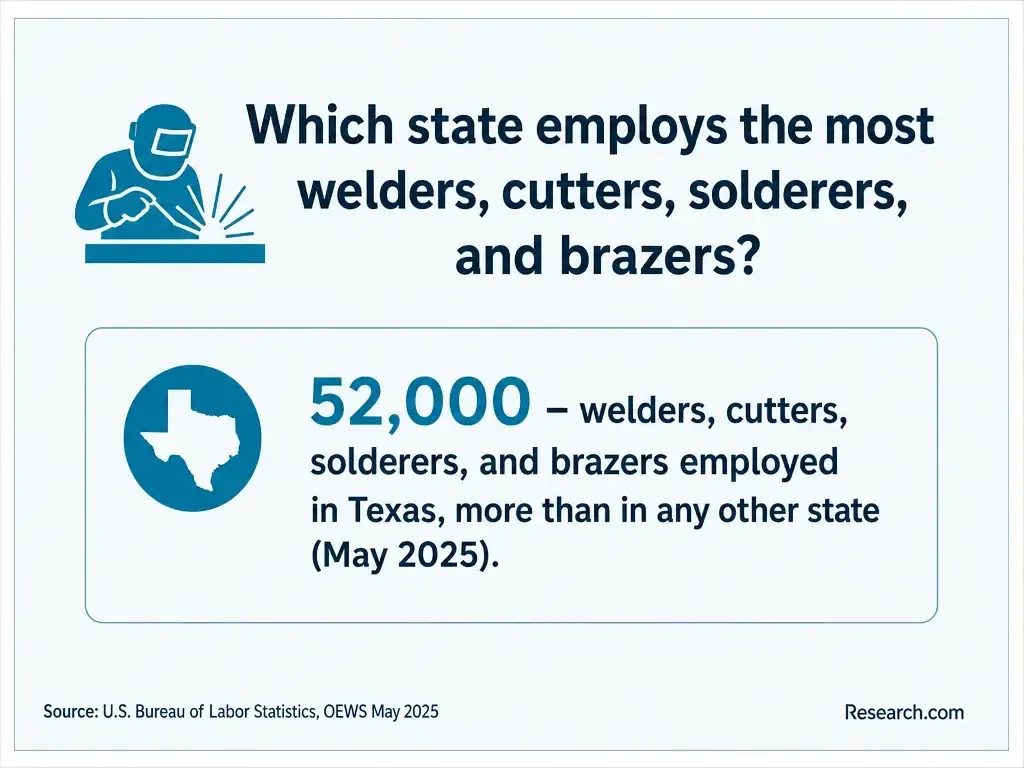
Texas does not issue a general occupational license to work as a welder. The Texas Department of Licensing and Regulation does not list a general welder license, and AWS certification is a separate, voluntary skills credential - not a state license. An employer, contract, or jobsite can nevertheless require a specific qualification test, certification, or safety training. Confirm those conditions for the jobs you plan to pursue rather than paying for a vaguely advertised "licensed welder" program (Texas Department of Licensing and Regulation; American Welding Society).
Likewise, school accreditation, state authorization, apprenticeship registration, and AWS certification describe different things. A registered apprenticeship identifies a structured training arrangement; it does not remove an employer's need to verify the welds required for its work (U.S. Department of Labor, Apprenticeship.gov).
The best-value choice is the least costly credible route to the skills your target job will test, not necessarily the program with the lowest tuition. An affordability ranking is a starting filter: because its score does not include accreditation or shop quality, verify both separately. Institutional accreditation can be checked with a recognized accreditor or the U.S. Department of Education; state oversight, where applicable, is a different question. A list of the best non profit accredited universities is not evidence that a welding shop offers adequate practical training.
Use these questions to compare finalists and catch costly gaps before you commit:
Be wary of a low tuition quote that omits PPE or fees, a "fully online welder" claim without accessible labs, or a promised salary unsupported by local job offers. To assess return on investment, consider completion probability, aid, debt, lost earnings during training, plausible post-training pay, and how long you expect to work - not institution type alone.
Entry-level production or fabrication welding can lead, with experience and the right assessments, to more specialized field work, inspection, supervision, or related fabrication roles. These are progression possibilities, not automatic outcomes of a certificate. AWS offers credentials for particular professional functions; check experience and examination requirements before treating an advanced title as an immediate next step (American Welding Society).
A student who wants to start earning quickly may prefer a focused shop credential followed by employer training. Someone aiming for broader technical responsibilities may value an associate-level program, provided its added time and cost serve a clear goal. Direct-entry work can be sensible if an employer will train and evaluate you safely; trade school may be more useful if you need equipment access, structured practice, or evidence of foundational skills before applying.
The BLS projects 2.4% national employment growth for welders, cutters, solderers, and brazers from 2025 to 2035. That is modest growth for the occupational group, not a forecast of vacancies in McKinney or a promise of placement. Replacement hiring and the fit between your tested skills and an employer's process can matter more to an individual applicant than the national growth rate (BLS Employment Projections).
Use the Dallas-Fort Worth job market as your practical check: review recent entry-level advertisements, separate jobs requiring prior experience from genuine trainee opportunities, and note how far you can commute. Ask each program for documented placement information, including the reporting period and which jobs counted, rather than accepting an unqualified placement claim.
Investing in welding training is an important decision, so an affordability ranking should be transparent about both what it measures and what it leaves out. The Research.com team checks multiple education and occupational sources to improve the ranking's credibility and accuracy. Trade-school programs are compared with programs in the same occupation and geographic market; only programs with completions reported to IPEDS are eligible. That means the ranking cannot represent every apprenticeship, employer training route, or provider outside that dataset.
Most affordable rankings score tuition, cost of attendance, median student debt, and federal loan default rate. Indicator weights use an entropy-based method, which gives more weight to measures that differ more across eligible programs. Accreditation, support services, and other quality indicators are not part of the affordability score. Separately, Research.com's best programs methodology considers student outcomes, earnings and return on investment, costs and debt, and quality and recognition; its stated weights are 20% for relevant programmatic accreditation or industry recognition, 10% for institutional accreditation, 10% for student support, and 60% for outcomes, earnings, and costs, distributed using the entropy-based method.
The ranking draws on the following data sources. Some serve the broader trade-program methodology rather than indicating that a particular health-field accreditor approves welding training.
Use the ranking to narrow your search, then confirm current welding-shop hours, total charges, and employer-relevant skills with each provider. More detail on the approach is available in Research.com's methodology.
# 1 position
# 2 position
Compare the full cost of a public-college certificate with available paid apprenticeships and employer training. The cheapest route depends on your aid eligibility, equipment costs, commute, and whether you earn wages while learning.
You can study some theory online, but practical welding requires in-person equipment use and feedback. Confirm where and when the labs take place before enrolling.
Not universally. An employer may use its own process-specific weld test; ask target employers whether they require an AWS credential and which one (American Welding Society).
A certificate can be a more direct entry route. An associate degree makes sense if its additional technical coursework supports your specific career goal enough to justify the extra time and cost.
Not necessarily. This ranking includes only programs with completions reported to IPEDS, so compare apprenticeships and employer training separately.