2027 Online Marketing Degrees With Digital Marketing Coursework

Co-Founder and Chief Data Scientist
Working professionals aiming to pivot into marketing often confront rigid program schedules that clash with demanding jobs and personal commitments, limiting their ability to gain relevant digital marketing skills swiftly. With online enrollment for bachelor's and master's degrees rising nearly 12% since 2022 according to the National Center for Education Statistics, the growing acceptance of distance learning signals that flexibility is becoming a prerequisite, not a luxury. This shift reflects the necessity for programs that accommodate adult learners balancing multiple priorities while equipping them with up-to-date digital coursework aligned with evolving employer expectations. This article examines online marketing degrees featuring digital marketing curricula and compares their structure, flexibility, and career utility to inform strategic choices for advancing or entering the marketing workforce.
Key Things You Should Know
- Employment projections from the U.S. Bureau of Labor Statistics indicate a 10% growth in marketing analyst roles by 2028, pressuring programs to prioritize advanced data analytics over traditional brand management coursework for employability.
- Employers report 62% preference for candidates with digital marketing practical experience combined with certifications, complicating degree-only pathways and increasing the value of integrated internship offerings in selecting programs.
- Median tuition for online marketing degrees rose 7% in 2024, necessitating critical cost-benefit analyses as extended 4-year programs with broad coursework delay workforce entry by 2+ years, impacting total early-career earnings.
What is an online marketing degree with digital marketing coursework, and who is it best for?
Digital marketing expertise is now a core requirement for leadership roles in marketing, reflected in a steady 6% job growth projection for marketing managers through 2032 with 34,000 annual openings driven by analytical and digital media skills. Professionals aiming to pivot into digital marketing must weigh the practical demands of coursework that deeply integrates SEO, CRM platforms, and data analytics against the initial learning curve, especially if their background is not marketing-oriented.
Online marketing degree programs with digital marketing courses offer targeted technical and analytical skill development but vary widely in how rigorously they incorporate real data projects and evolving software tools. For full-time professionals, program flexibility is a critical factor because sustained skill relevance requires ongoing updates aligned with new platforms and algorithms.
Industry-specific training within these programs can differentiate employability. For example:
- Retail emphasizes e-commerce strategies,
- Technology demands agility with fast-evolving platforms,
- Healthcare prioritizes compliance with specialized marketing regulations.
Evaluating programs must include how well they prepare students for these sectoral nuances to avoid generic skillsets that limit advancement. Those researching cross-functional degrees might consider a bachelor project management as an alternative pathway that complements digital marketing with broader operational skills.
The best online marketing degrees for digital marketing careers balance technical proficiency, practical experience, and sector relevance to optimize career adaptability and employer value in a data-driven marketing landscape.
How do online marketing degrees compare with campus programs for quality, flexibility, and outcomes?
Online marketing degree quality compared to campus programs no longer represents a straightforward choice: both formats offer curricula aligned to employer expectations, but the practical realities diverge significantly. Campus programs facilitate immediate access to in-person networking and internships, essential in relationship-driven sectors like brand management or advertising agencies. However, geographic and scheduling constraints limit accessibility for mid-career workers or career changers.
Conversely, accredited online marketing degrees provide superior flexibility, supporting asynchronous learning that accommodates full-time jobs and family responsibilities. This flexibility enables professionals to pivot efficiently into digital marketing roles without forsaking income. The practical value often lies in balancing this adaptability with the need for hands-on projects and contemporary digital tools-elements both delivery modes increasingly include.
Employers prioritize skill demonstration and project portfolios over whether a degree was earned online or on campus. Notably, the U.S. Bureau of Labor Statistics reports median annual salaries of $155,320 for marketing managers and $140,040 for advertising and promotions managers, underscoring the tangible career outcomes linked to advanced marketing competencies.
Students must weigh personal circumstances and program features carefully: those emphasizing network effects may lean toward campus programs despite their logistical burdens, while those seeking expedited role changes benefit from online offerings. Prospective candidates can explore further options like an MBA in operations management online to complement marketing expertise and enhance cross-disciplinary versatility.
What types of online marketing degrees are available, from certificates to bachelor's and master's?
Choosing the right online marketing degree program involves weighing distinct outcomes tied to certificate programs, associate, bachelor's, and master's degrees. Certificates provide targeted skills in digital channels and analytics, suitable for swift upskilling without committing to a full degree. Associate degrees blend foundational marketing principles with digital coursework, often serving as entry points for junior roles or pathways into bachelor's degrees. Accredited online marketing certificates and bachelor's degrees differ significantly in return on investment, as demonstrated by the Foundation for Research on Equal Opportunity's data: a marketing bachelor's at Penn State, rich in digital marketing courses, offers a lifetime ROI exceeding $800,000, whereas West Texas A&M's equivalent yields under $60,000.
Bachelor's curricula typically combine broad marketing theory with practical digital skills such as SEO and social media management, but program quality and industry relevance greatly influence graduate outcomes. Master's degrees sharpen strategic leadership and advanced analytics, favoring professionals aiming for senior positions or specialization in digital transformation. In practice, working professionals in e-commerce might prioritize certificates or master's programs focused on data analytics instead of traditional bachelor's pathways, balancing time and direct employability.
Prospective students should assess each pathway based on how well it aligns with their immediate job market needs and long-term career objectives, considering institution reputation alongside curriculum rigor. For those exploring operational pivots, related insights on MBA operations management online can provide complementary strategic frameworks.
What digital marketing courses and specializations are typically included in these online programs?
Online degree programs with a digital marketing course curriculum emphasize hands-on skills essential for immediate employer value, such as SEO, pay-per-click advertising, content marketing, social media strategy, and web analytics. Employers expect graduates to move beyond creative concepts to measurable metrics, exemplified by B2B technology firms requiring proficiency in analyzing campaign data. This operational focus is critical as students encounter diverse platforms simultaneously, making iterative project-based learning necessary to build executional competence.
The curriculum often incorporates specializations that address varied market demands, including mobile marketing, e-commerce strategies, and ethical considerations around data privacy laws like GDPR and CCPA. This specialization differentiates candidates, for instance, between retail roles emphasizing user engagement and healthcare marketing where user experience must align with compliance risks.
Understanding customer segmentation and applying data-driven decision-making tools, such as CRM and Google Analytics, directly influences workforce readiness by aligning skill sets with employer expectations for ROI-driven campaigns. The practical nature of these programs reflects the rising enrollment trend in online bachelor's degrees across business and marketing fields; for specialized focus, some students explore complementary paths like an online sports management bachelor's degree, which has its own distinct market.
Prospective students facing this common digital marketing specializations in degree programs must weigh the challenge of mastering multiple disciplines simultaneously while navigating legal frameworks that impact campaign design and brand integrity.
How can you verify that an online marketing program is properly accredited and respected by employers?
Choosing an online marketing program involves careful scrutiny of both accreditation and curriculum relevance to current labor market demands. Regional accreditation from recognized bodies is not just a formality but a critical filter ensuring federal aid eligibility and employer recognition. Without this, credentials often lack real-world value.
Programs emphasizing practical skills in SEO, social media marketing, and Google Analytics align better with actual job requirements. For instance, a student aiming for digital marketing roles in e-commerce should prioritize programs with employer partnerships offering hands-on internships or projects involving real data analytics. These connections materially improve readiness-not just theoretical understanding-for roles projected to grow by 30% according to LinkedIn's 2024 Jobs on the Rise report.
Evaluate graduate outcomes rigorously: look for transparent data on graduation and employment rates within six months, plus evidence of active industry collaboration. Generic marketing certificates without digital specialization tend to carry little weight in dynamic sectors such as technology or media, where demonstrable, accredited skills are non-negotiable.
Beyond accreditation, recruit feedback and alumni success rates are invaluable for gauging genuine market acceptance. This multi-dimensional approach mitigates the risk of investing in programs that don't convert into tangible career progress in the evolving marketing landscape.
What are the usual admission requirements for online marketing degrees at different education levels?
Choosing an online marketing degree, just like social media degrees, requires weighing varied admission standards against career objectives and workforce demands. Associate programs primarily demand a high school diploma, offer accessible entry points, and avoid standardized tests, serving candidates targeting foundational competence with minimal initial barriers.
Bachelor's degrees require a high school diploma plus standardized test scores like the SAT or ACT in many cases, alongside GPA benchmarks and supporting materials. Given a total tuition range from $14,000 to $50,000 (per ReliableSoft data), prospective students must assess if program rigor justifies financial and time investments based on their goal to enter or advance within competitive marketing roles.
Graduate-level candidates face more stringent expectations, including completed bachelor's degrees, relevant professional experience (1-3 years), and GRE or GMAT scores. Tuition ranges between $11,000 and $35,000, often reflecting program specialization and institutional prestige. For working professionals aiming to pivot strategically, programs emphasizing applied digital marketing skills align better with employer preferences than those focused solely on theory.
Doctoral paths demand strong research skills, prior academic excellence, and advanced degrees, with quantitative aptitude becoming critical for success in marketing science research roles.
Applicants must also navigate practical hurdles such as technology reliability and time management, influencing progress and completion rates in remote learning environments.
- Associate degrees suit entry-level candidates seeking foundational skills without extensive prerequisites.
- Bachelor's programs hinge on standardized testing and academic performance, balancing cost with career entry potential.
- Master's degrees prioritize professional experience and applied skillsets favored by employers in digital marketing strategies.
- Doctorates require intensive research focus and are best suited for those targeting academic or high-level analytical marketing roles.
How long do online marketing degrees take to complete, and what schedules do they offer?
Time-to-completion for online marketing degrees varies widely, reflecting tradeoffs between depth, flexibility, and workforce engagement. Associate degrees typically require about two years, bachelor's degrees four, and master's programs from one to two years full-time. Part-time enrollment stretches these timelines but remains critical for those balancing job demands and personal obligations.
Most online marketing programs lean heavily on asynchronous formats, allowing professionals to manage coursework around variable schedules. While some programs use limited synchronous sessions for collaboration, the essential skill sets-digital marketing tactics, data analytics, content strategy-are primarily developed through flexible, self-paced study. This structure serves distinct student profiles:
- A full-time marketing professional may prefer a part-time master's program extending to 18-24 months, prioritizing income continuity and applied experience over speed.
- A recent graduate aiming for rapid role transition might select an accelerated one-year master's track, accepting heavier weekly workloads for faster credentialing.
Financial considerations also shape pacing decisions. Average net annual tuition for online business or marketing master's hovers around $8,500 after aid, making longer enrollments cumulatively costlier despite manageable yearly expenses. Choosing between faster program completion with higher yearly outlay versus extended duration to distribute costs hinges on individual financial strategy and career timing.
Employers increasingly demand proven, current digital marketing competencies rather than degree duration alone. Candidates benefit most from programs integrating practical projects and adaptable schedules that align skill acquisition with evolving market realities.
How much do online marketing degrees cost, and what financial aid or employer benefits can help?
Online marketing degrees pose wide cost variances with immediate impact on return on investment and debt management strategies. Bachelor's programs at community colleges and public regional universities typically remain below $20,000, while private or specialized schools charge upwards of $40,000 to $60,000. Graduate marketing degrees, particularly MBAs with marketing concentrations, often start near $30,000 and can top $100,000 at elite institutions, escalating financial risk relative to uncertain salary outcomes.
Financial aid plays a pivotal role in affordability. Federal Pell Grants offer up to $7,395 annually for eligible undergraduates and do not require repayment, benefiting lower-income students disproportionately. Fixed-rate federal student loans around 7% interest demand disciplined repayment planning based on realistic earning potential. Employer tuition reimbursement is a strategic funding source, frequently covering complete costs when linked to corporate advancement objectives, though it typically involves obligations such as retention agreements and alignment with job responsibilities.
Job market concentration in digital marketing specialties-social media, SEO, digital advertising, and content marketing-makes these competencies critical. For example, a mid-level retail marketing professional leveraging employer benefits can pivot into higher ROI digital roles while avoiding personal debt. Conversely, self-funded students must assess upfront costs against median entry-level salaries between $45,000 and $60,000, emphasizing financial foresight before committing to an online marketing degree.
What careers can an online marketing degree with digital marketing coursework lead to?
Employers prioritizing candidates for digital marketing roles increasingly expect proficiency in data interpretation and technical tools. The 2024 forecast by eMarketer estimates U.S. digital ad spending at $306 billion, nearly 76% of total media ad investment, demanding expertise in analytics and campaign optimization. Graduates who rely solely on theoretical knowledge face obstacles securing roles without hands-on competency in platforms such as Google Analytics, AdWords, and CRM systems.
Consider an MBA graduate shifting into digital marketing: success requires bridging brand strategy experience with skills in programmatic advertising and conversion rate optimization. This synthesis enables eligibility for specialized roles in sectors like e-commerce or B2B technology-a practical career pivot demanding deliberate skill acquisition beyond the classroom.
Students pursuing online marketing degrees must circumvent common limitations, such as scarce client projects and restricted networking. Actively engaging in internships or freelance opportunities strengthens practical readiness and employer appeal. Additionally, understanding data privacy compliance is vital for campaign management in regulated industries like healthcare and finance, where legal constraints complicate digital strategies.
Long-term career advancement hinges on niche specialization and adaptability as technological innovations reshape marketing functions. Fields such as marketing automation or AI-powered customer analytics require continuous learning, reflecting employer expectations for evolving skill sets beyond initial credentials.
What salaries, job outlook, and certifications can digital marketing graduates expect in the current market?
Salary expectations for digital marketing graduates entering the 2026 workforce typically start between $45,000 and $60,000 annually, with mid-career earnings rising to $70,000-$95,000 depending on specialization and region. However, these figures mask significant variation tied to practical experience and certification status. Without relevant credentials, graduates often face extended job searches and limited promotion opportunities.
Job growth in digital marketing is forecasted to outpace most fields at 13% through 2034. Demand is strongest in roles focused on SEO, content strategy, and paid media management within fast-evolving sectors like e-commerce, healthcare, and technology, where digital transformation drives sustained investment.
Certifications such as Google Ads, Meta Certified Digital Marketing Associate, and HubSpot Content Marketing increasingly tip hiring scales when academic credentials are comparable. For example, a marketing professional pivoting into healthcare should combine digital marketing skills with niche certifications in health informatics or regulatory compliance to remain competitive. Employers seek data-driven decision-making validated through certifications or demonstrated campaign success.
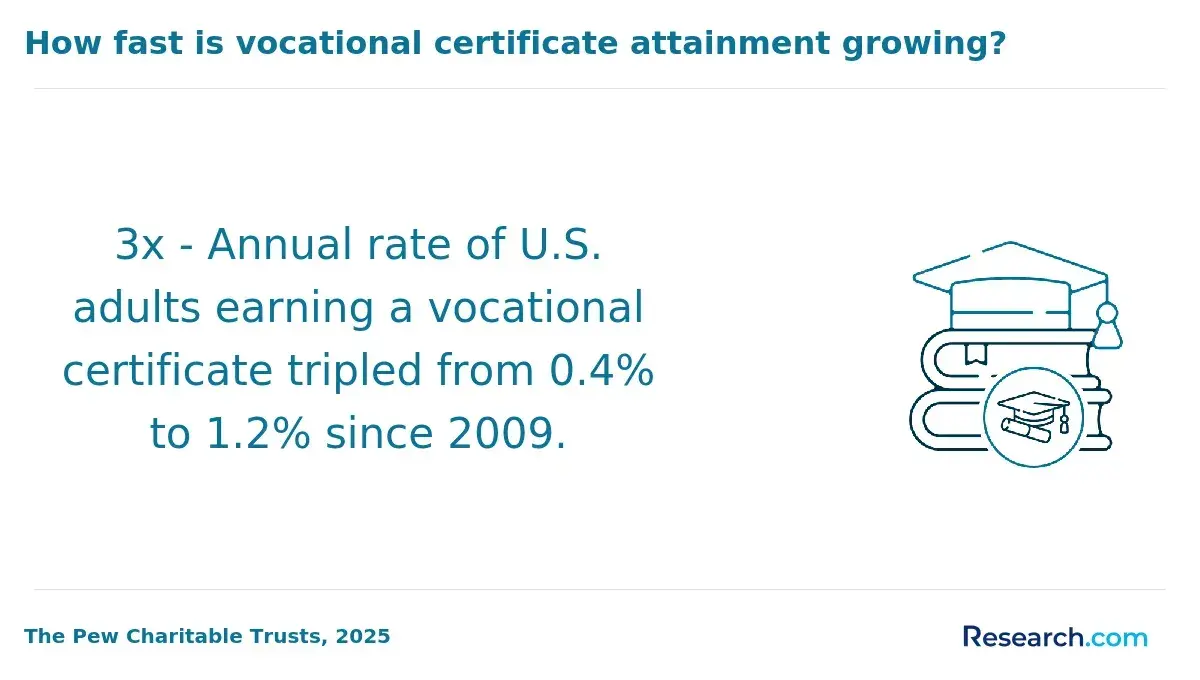
- Professional microcredentials are growing rapidly (40% annual enrollment increase per Coursera data) because they provide practical, up-to-date skills faster than traditional degrees.
- Continuous skill updating is vital; many hiring managers prioritize candidates who invest in relevant certificates or hands-on portfolios.
- The ability to adapt and acquire credentials aligned with emerging tools, such as social media analytics, is often a differentiator.
Source: U.S. Bureau of Labor Statistics, industry salary surveys, and Coursera enrollment data.
Other Things You Should Know About Marketing
Both analytics and creative skills are essential in marketing, but employers often prioritize analytics because data-driven decision-making directly impacts campaign ROI. Programs with strong analytics training provide a measurable edge in roles requiring optimization and performance tracking. However, students aiming for brand management or content-focused careers should prioritize creative skill development. Balancing both areas is ideal, but if you must choose, align your program strength with your targeted job function.
Online marketing degrees often demand more self-discipline since coursework relies heavily on asynchronous learning and individual projects. The workload can be as intense as traditional degrees, especially when digital campaigns and analytics tools require hands-on practice. Employers expect competency in real-world software and platforms, so programs with practical assignments mirror workplace demands despite flexible pacing. Prospective students should assess if they can manage independent study alongside professional or personal obligations.
Internships or real-world project experiences are crucial in 2027, as they provide hands-on industry insights and real-world skills that complement theoretical knowledge. Employers often look for practical experience, making it a significant advantage for graduates entering the competitive digital marketing job market.
Most programs require a completed application, official high school or transfer transcripts, and a minimum GPA, often 2.0 to 2.5. Some schools also ask for a personal statement or résumé. Bachelor’s programs usually require 120 credit hours, with 30 to 36 in marketing and digital media courses.
References
- Launch a Digital Marketing Career | Get Job-Ready | Google https://grow.google/certificates/digital-marketing-ecommerce/
- Digital Marketing Bachelor's https://www.fullsail.edu/degrees/digital-marketing-bachelor-degree-program
- The 20 Best Online Digital Marketing Certificates 2017-2018 - Best Marketing Degrees https://www.bestmarketingdegrees.org/top-online-digital-marketing-certification-programs/
- Marketing Degrees: Understanding the Different Types https://online.maryville.edu/online-bachelors-degrees/marketing/resources/different-types-of-marketing-degrees/
- How long does it take to learn Digital Marketing https://powerful-marketers.com/how-long-does-it-take-to-learn-digital-marketing/
- Best IT Training & Placement Company in India | Tops Technologies https://www.tops-int.com/blog/how-long-does-it-take-to-learn-digital-marketing-properly-in-india
- Low-Cost Accredited Online Degrees That Employers Actually Recognize (2026 Guide) https://www.nexford.edu/insights/low-cost-accredited-online-degrees-that-employers-actually-recognize-guide
- Which Online Degree Programs Are in Demand: Evidence From Accounting and Marketing Majors https://articlegateway.com/index.php/JABE/article/view/7616
- 11 High-Paying Job Roles You Can Pursue After Digital Marketing https://geu.ac.in/blog/career-path-for-digital-marketing
- BS in Digital Marketing https://www.umassglobal.edu/academic-programs/bs-digital-marketing