2027 Search and Information Retrieval in an Online Data Science Master's: Courses, Projects, and Program Selection

Co-Founder and Chief Data Scientist
An online data science master's can teach search and information retrieval in very different ways: as a brief machine-learning example, a dedicated course, or a substantial project. If you want to build search systems, evaluate retrieval quality, or work on retrieval-augmented AI, that difference matters more than a program's title.
This guide shows you what to look for in course descriptions and project requirements, then how to weigh format, cost, and career fit before applying.
Key Things You Should Know
- Look for coursework in indexing, ranking, retrieval evaluation, and search-system design - not just a passing reference to vector databases or large language models.
- A strong portfolio project compares retrieval approaches using relevant queries and documented metrics; a working chatbot alone does not demonstrate search expertise.
- The U.S. Bureau of Labor Statistics reports a $120,230 median annual wage for data scientists in May 2025, but that occupation-wide figure is not a predicted salary for search specialists or new graduates.
What is search and information retrieval in an online data science master's?
Information retrieval is the process of finding and ranking useful items - such as documents, products, images, or records - in response to a query. Search is its most familiar application. In a data science master's, the subject can combine statistics, machine learning, natural language processing, databases, and software engineering.
Graduate-level study should go beyond calling a search API. A student might build a text index, compare keyword and embedding-based retrieval, train or apply a ranking model, and evaluate whether relevant results appear near the top. For retrieval-augmented generation, the same foundations help determine whether an AI system retrieved appropriate evidence before its generated answer is assessed.
Useful preparation includes Python, SQL, probability, basic linear algebra, and the ability to test software. Deeper machine-learning work may require optimization and neural-network fundamentals. A program need not require every skill at admission, but its course sequence should give you a realistic path to acquire them.
What courses cover search and information retrieval in data science programs?
Relevant material may appear under information retrieval, natural language processing, text mining, machine learning, databases, recommender systems, or AI systems. The table distinguishes course labels from evidence of search-specific depth; titles alone cannot establish what students actually build or evaluate.
| Course area | Potential search content | Evidence to seek in a syllabus |
| Information retrieval or search | Indexing, query processing, ranking, relevance evaluation | Retrieval assignments with judged queries and ranking metrics |
| Natural language processing or text mining | Tokenization, embeddings, document representation | Exercises connecting text models to retrieval performance |
| Machine learning | Learning to rank, model validation, error analysis | A ranking task rather than classification alone |
| Databases or data engineering | Indexes, data pipelines, latency, scalable storage | Implementation and performance trade-offs for searchable data |
Use a depth test when comparing catalogs: is search merely mentioned, taught as one unit, offered as a dedicated course, available as an advanced elective, or practiced in a substantial project? Check prerequisites and rotation schedules too. An impressive elective is less useful if it is rarely offered or cannot fit your degree plan.
If your main interest is building AI applications rather than studying retrieval itself, AI degree programs for online students offer another comparison set. Still inspect their syllabi: an AI label does not establish that retrieval evaluation or search engineering is covered.
What projects build search and information retrieval skills?
A strong project starts with a defined user and search task, not a preferred tool. For example, a student could help researchers find relevant papers in a permitted document collection, then test whether the system retrieves useful results for realistic questions. The following sequence turns that idea into evidence of skill.
- Define the collection, intended users, representative queries, and what counts as a relevant result; document data rights and privacy constraints.
- Build a reproducible baseline, such as keyword retrieval, before adding embeddings, reranking, or retrieval-augmented generation.
- Assess quality with relevance judgments and appropriate ranking measures; inspect failed queries rather than reporting only an average score.
- Compare improvements against costs such as latency, storage, maintenance, and, where applicable, model-service charges.
- Publish permitted code, setup instructions, evaluation methods, and limitations; use synthetic or public data when private documents cannot be shared.
For a program-selection decision, ask whether students can obtain project supervision, use suitable computing resources, and choose their own dataset or capstone topic. Do not assume every capstone permits search projects. A demo that returns plausible answers but lacks a baseline, relevance evaluation, or source-rights review is a weaker portfolio signal.
How do online and campus-based data science master's programs compare?
Delivery mode does not determine technical rigor; course access and project support do. This comparison identifies the practical trade-offs to check when search-system work is your goal.
| Consideration | Online program | Campus-based program |
| Schedule | May accommodate work, but live sessions and group deadlines can still be fixed | Usually requires regular on-campus attendance |
| Search coursework | Depends on the online course catalog and elective availability | Depends on the campus catalog and enrollment access |
| Project support | May rely on remote office hours, shared tools, and virtual teams | May offer in-person labs and faculty meetings |
| Location-related costs | May avoid relocation, though travel requirements should be checked | May involve commuting or relocation |
Choose online study if you need location flexibility and can secure access to the courses, supervision, and tools your project requires. Campus study may suit you better if in-person collaboration or a particular lab is central to your goals. Ask both programs whether online and campus students can take the same search-related electives; do not assume identical catalogs.
What are the admission requirements for an online data science master's?
Requirements vary by institution. Applicants should check the official admissions page for the required degree, transcripts, quantitative preparation, programming experience, recommendations, and any tests or language-proficiency rules that apply to them. A course that would help you succeed is not necessarily a formal prerequisite.
For retrieval-focused study, compare your background with the prerequisites of the specific NLP, machine-learning, and database courses you hope to take. If you lack programming or math preparation, ask whether approved preparatory courses can address the gap before you apply or after enrollment; obtain confirmation rather than assuming self-study fulfills an admission condition.
Applicants considering a more AI-centered route can also review guidance on choosing an AI master's with a non-CS degree. Prior experience with documents, user behavior, or domain-specific information can strengthen a search project, but it does not replace a program's stated prerequisites.
How long does an online data science master's take and cost?
There is no reliable single duration or price for online data science master's programs. Total time depends on required credits, course availability, enrollment pace, prerequisites, and whether a capstone must be completed in sequence. For a search-focused student, the shortest advertised timeline may not leave room for the electives or project that justify enrolling.
Compare each school's current tuition schedule using the credits you would actually need, then add mandatory fees. Budget separately for materials, required technology, possible travel, and any extra terms needed to reach a desired elective. Employer assistance and scholarships may lower your personal cost, but eligibility and conditions vary. Ask for a written degree plan and a current estimate of charges before treating a published tuition figure as your total cost.
If speed is your main constraint, you can compare accelerated artificial intelligence master's degrees as an alternative. Verify that an accelerated schedule still allows substantive retrieval coursework and a project; a faster credential is not automatically the better search preparation.
How can you verify accreditation for an online data science master's?
Check the institution's current accreditation status directly with its recognized institutional accreditor or the U.S. Department of Education's accreditation records. Confirm that the degree is awarded by that institution, particularly when a third-party company helps deliver the online program. Institutional accreditation is not, by itself, proof of depth in information retrieval.
Before enrolling, also confirm that the program accepts students residing in your state and whether any required campus activities are feasible. Then return to the academic evidence: current syllabi, faculty expertise, elective access, and project rules tell you more about search preparation than accreditation alone. Be cautious if a provider blurs the distinction between a university degree and a nondegree certificate.
What careers use search and information retrieval expertise?
Search skills can support roles in search engineering, relevance or ranking, applied machine learning, data science, and AI application development. Employers may use different titles for similar work. The distinguishing tasks are often building retrieval pipelines, measuring result quality, analyzing queries, and improving the balance between relevance, speed, and operating cost.
Domain knowledge changes the problem. In healthcare-related work, for example, finding evidence within clinical or research information calls for particular attention to data access, privacy, and the consequences of irrelevant results. Students pursuing that path may want to compare AI master's options for healthcare alongside data science programs, then examine the actual projects and data-governance training in each.
Choose target roles before choosing electives. A relevance-engineering goal favors ranking evaluation and production systems; an AI application goal may put more weight on NLP and retrieval-augmented generation. A master's can provide structured preparation and supervised work, but employers may also value demonstrable projects and relevant experience; the degree is not a universal hiring requirement.
What salaries and job outlook can data science graduates expect?
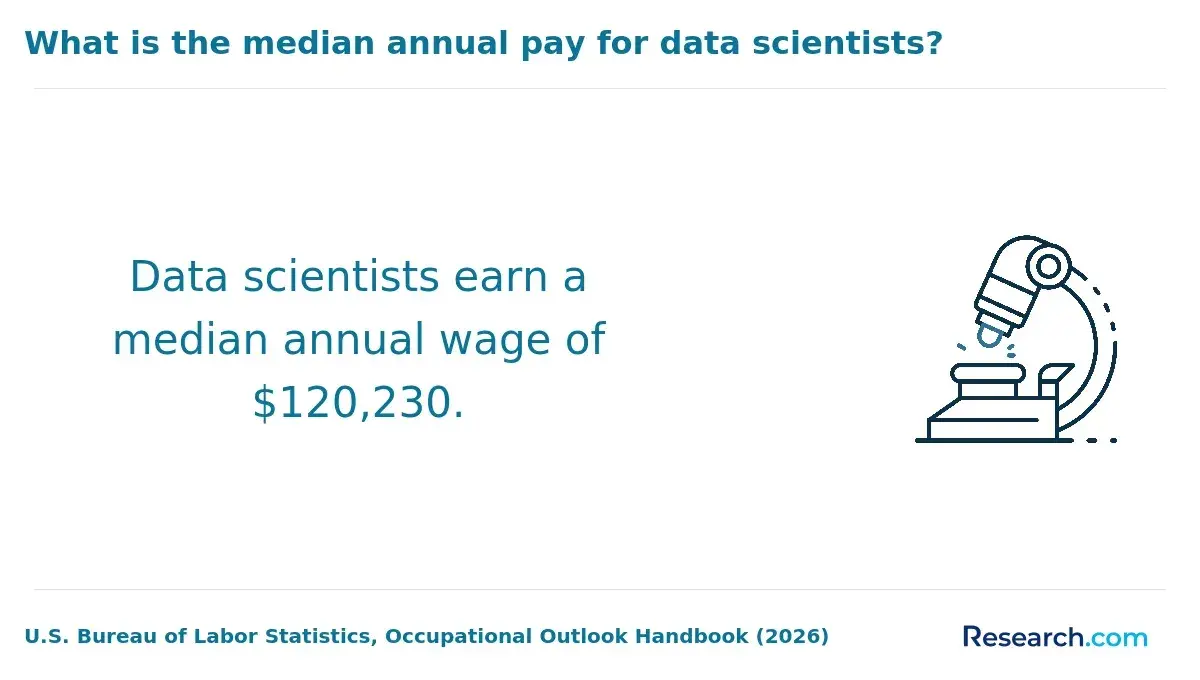
According to the U.S. Bureau of Labor Statistics, the median annual wage for data scientists was $120,230 in May 2025. That is an occupation-wide figure, not an entry-level offer, a search-specific median, or evidence of what a particular master's program's graduates earn. Experience, employer, location, and job duties all affect individual pay.
BLS projects data scientist employment to grow 35% from 2025 to 2035. The projection signals demand for the broader occupation, not a guarantee of an opening in information retrieval. When evaluating a program's claimed career outcomes, ask which graduates responded, what roles they entered, and whether reported salaries reflect experienced professionals or career changers.
Which certifications and program features matter when choosing a master's?
A vendor certificate can document familiarity with a particular platform, but it is not a substitute for evaluating retrieval methods across tools. Give more weight to a program that lets you design, test, explain, and improve a search system than to one that lists many product names without assessed work.
For a shortlist, verify four things in current program materials: a reachable path through search-related courses; assignments that assess ranking or retrieval quality; support for a substantial, lawful project; and a schedule and total cost you can sustain. Ask the program for recent syllabi and examples of permitted capstone scopes. Treat vague promises of "AI-ready" skills without course-level evidence as a warning sign.
If search is part of a broader move into AI, use AI program selection for a planned career change to weigh that wider goal. Choose the master's whose assessed work matches the role you want - not simply the program with the most search-related keywords on its website.
Other Things You Should Know About Data Science
Only with the employer's permission and any required privacy or legal review. Otherwise, publish the methods and code with an approved public or synthetic dataset rather than exposing documents, queries, or results.
No. Search usually responds to a query; recommendation often suggests items without one. They overlap in ranking methods, so recommender coursework can be useful, but check whether it also teaches query-based retrieval.
Not for every project. Keyword search, evaluation, and smaller-scale experiments can often use modest computing resources. Training large models may require more; check the actual course assignments and available resources.
No. A well-evaluated document or product search system can show stronger retrieval skills than a chatbot with untested search results. Choose an interface that serves the project's user and evaluation goals.
References
- Clinical Information Retrieval: A Literature Review - PMC - NIH https://pmc.ncbi.nlm.nih.gov/articles/PMC11052968/
- Cost of Attendance (Budget) | 2026-2027 Federal Student Aid Handbook https://fsapartners.ed.gov/knowledge-center/fsa-handbook/2026-2027/vol3/ch2-cost-attendance-budget
- Detail for CIP Code 11.0401 | ed.gov https://nces.ed.gov/ipeds/cipcode/cipdetail.aspx
- Online Master's in Data Science (MSDS) | Northwestern University https://sps.northwestern.edu/masters/data-science/
- Information Science Courses | University at Albany https://www.albany.edu/graduate-bulletin/information-science-courses.php
- M.S. in Data Science, Online | virginia.edu https://datascience.virginia.edu/degrees/msds-online
- What Is Information Retrieval for AI Applications? | Unstructured https://unstructured.io/insights/what-is-information-retrieval-for-ai-applications
- A practical guide to search relevance metrics and evaluation | Meilisearch https://www.meilisearch.com/blog/search-relevance-metrics