2027 Online Interdisciplinary Studies Degree Programs With No Letters of Recommendation Required

Co-Founder and Chief Data Scientist
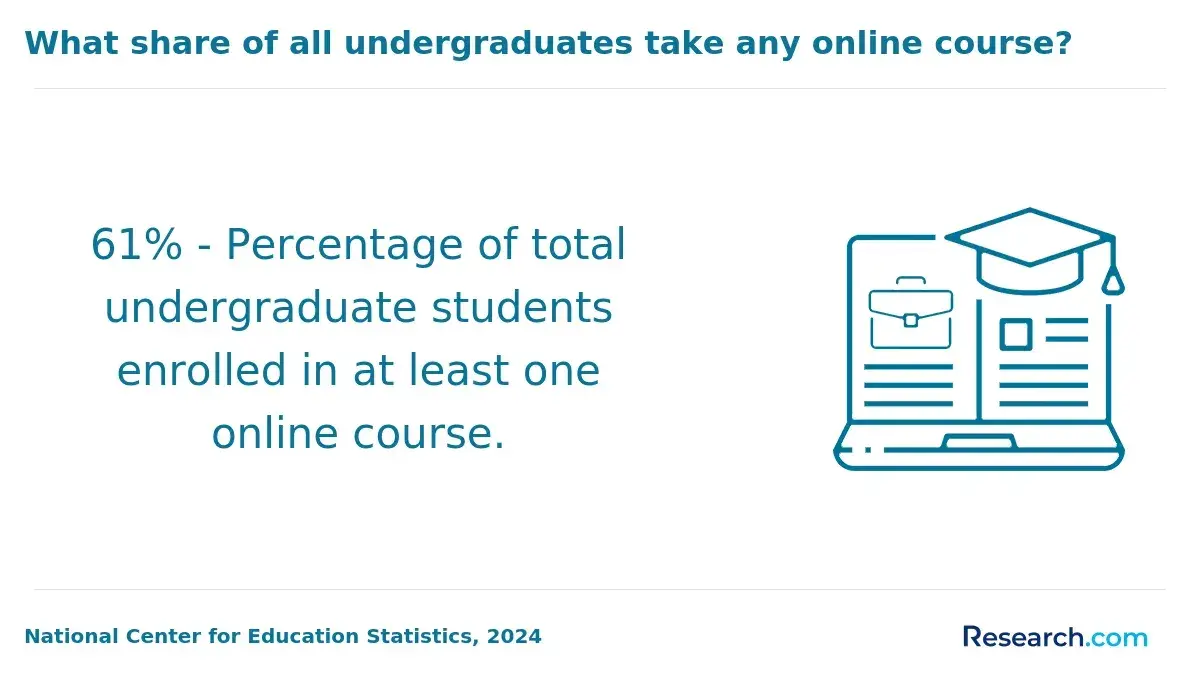
An online Interdisciplinary Studies degree can be a practical option when you need a flexible bachelor's completion path but do not have recent professors or supervisors available to write recommendations. The National Center for Education Statistics reported that more than half of U.S. postsecondary students took at least one distance education course in fall 2022, underscoring the scale of online learning.
This guide helps working adults, transfer students, and career changers identify programs with genuinely streamlined admissions, understand what schools review instead, and compare cost, accreditation, flexibility, and career fit before applying.
Key Things You Should Know
- "No letters of recommendation required" means recommendation letters are not part of the standard application for that specific online program; applicants may still need official transcripts, a minimum GPA, a personal statement, placement information, or transfer-credit records.
- Most recommendation-free online Interdisciplinary Studies options are undergraduate or degree-completion programs. Graduate interdisciplinary programs more often request professional or academic references because they assess advanced research, leadership, or specialized preparation.
- Compare institutional accreditation, transfer policies, total tuition, curriculum concentration options, and career relevance - not admission simplicity alone. For context, College Board reported average published tuition and fees of $11,610 at public four-year in-state institutions for 2024-25.
Which Online Interdisciplinary Studies Degree Programs Require No Letters of Recommendation?
Online Interdisciplinary Studies programs may also be called general studies, liberal studies, integrated studies, or individualized studies. These bachelor's programs generally let students combine coursework from two or more areas, such as business and communication, social science and public service, or technology and management.
No-recommendation policies are most common in undergraduate admission and transfer admission. A school may not list letters on its university-wide application, but applicants should still confirm the requirement on the exact online degree page because honors tracks, selective concentrations, and graduate pathways can use different standards.
The programs below are examples of online or online-supported interdisciplinary-style bachelor's pathways that prospective students can screen for recommendation-free admissions. Requirements can change by term, residency status, academic history, and applicant type, so treat this as a comparison starting point rather than a substitute for written confirmation from admissions:
| Institution or program type | Typical online degree label | Recommendation-letter pattern to verify | Important comparison point |
| Arizona State University Online | Bachelor of Arts in Interdisciplinary Studies | Undergraduate application materials generally emphasize academic records rather than recommendation letters | Review available concentrations and first-year versus transfer admission standards |
| University of West Florida Online | Bachelor of Arts in Interdisciplinary Studies | Undergraduate applicants should confirm whether letters are absent from the current checklist | Check concentration design, residency requirements, and transfer evaluation |
| Public university degree-completion programs | General Studies, Liberal Studies, or Integrated Studies | Often use transcripts and transfer-credit reviews instead of references | Verify whether the program is fully online and accepts your lower-division credits |
| Private nonprofit online universities | General Studies or interdisciplinary bachelor's completion degree | May use a simplified application with transcripts and identity documentation | Compare per-credit tuition, institutional aid, and course-session schedule |
A broad interdisciplinary degree is not interchangeable with a profession-specific credential. For example, students pursuing clinical creative work should review admission and fieldwork expectations for art therapy masters, which commonly have more specialized prerequisites than a general interdisciplinary bachelor's program.
Before paying an application fee, ask the admissions office: "For the online Interdisciplinary Studies bachelor's program and my entry term, are recommendation letters required, optional, or waived only under certain conditions?" Request the answer by email or save the current admissions checklist.
What Are the Admission Requirements for Online Interdisciplinary Studies Degree Programs With No Recommendation Letters?
Removing recommendation letters does not remove academic review. Colleges still need evidence that an applicant can complete college-level reading, writing, and quantitative work. Requirements differ most sharply between first-year applicants, transfer applicants, returning students, and students seeking a second bachelor's degree.
The following comparison shows the materials commonly used in place of references. It helps applicants collect documents early and avoid mistaking a simplified application for an incomplete one:
| Applicant type | Common required materials | Requirements that may vary | What the school is assessing |
| First-year applicant | Application, high school transcript, and identification or residency information | Minimum GPA, test-optional policy, placement testing, and prerequisite coursework | Academic preparation and readiness for introductory college courses |
| Transfer applicant | Application and official transcripts from each college attended | Transfer GPA, minimum completed credits, and course equivalencies | Prior college performance and how credits fit degree requirements |
| Adult or returning student | Application and prior academic records | Resume, brief statement, prior-learning assessment, or placement evaluation | Readiness, persistence, and appropriate course placement |
| Graduate applicant | Bachelor's transcript and application | Statement of purpose, resume, writing sample, prerequisite courses, interview, or references | Advanced academic and professional preparation |
Many bachelor's programs publish a minimum GPA, but there is no universal Interdisciplinary Studies cutoff. A transfer GPA around the school's stated threshold may establish basic eligibility without ensuring admission, particularly if enrollment is limited.
Test-optional policies also do not necessarily mean test scores cannot help an applicant whose transcript needs additional context.
Applicants should make a checklist from the program's current page, then verify these details before submitting:
- Whether official transcripts are needed at application, after admission, or both.
- Whether all prior institutions must be disclosed, including withdrawn or incomplete coursework.
- Whether an essay, goal statement, or resume is required for the online program.
- Whether math, writing, foreign-language, or lower-division general education prerequisites apply.
- Whether the school has separate deadlines for admission, financial aid, transcript evaluation, and course registration.
Are Online Interdisciplinary Studies Programs With No Letters of Recommendation Easier to Get Into?
Not necessarily. A program that does not request references has streamlined the evidence it collects; it has not automatically lowered its academic standards. Many online bachelor's completion programs use transcripts, transfer-credit reviews, and required foundation courses because those materials directly show prior college performance.
Recommendation-free admission can be especially helpful for applicants who have been out of school for years, work independently, changed careers, or cannot reasonably ask a former instructor for a letter. It may also reduce application delays. However, it is not a promise of acceptance, a waiver of GPA expectations, or proof that a program has open admission.
Admissions may be more accessible when a school has multiple start dates, accepts rolling applications, or is designed for transfer students. Those operational features should be evaluated separately from selectivity. A learner with weak recent grades may need to demonstrate readiness through successful transferable coursework, a placement process, or a clear explanation of academic improvement.
Common mistakes can lead students to choose poorly. Avoid the following assumptions:
- Assuming "no recommendations" means no transcript review or guaranteed admission.
- Confusing a university-wide application policy with the requirements of a particular online concentration.
- Choosing the quickest application instead of checking whether the curriculum supports a target job or graduate-school plan.
- Overlooking academic-dismissal, GPA, English-proficiency, residency, or technology requirements that may still apply.
- Assuming a broad degree automatically meets licensure requirements for regulated careers such as counseling, teaching, or clinical practice.
An interdisciplinary degree is usually strongest when the student can explain the purpose behind the course combination. For example, pairing organizational leadership with communication may support administrative or project-focused roles, while combining data literacy with social science can support research, operations, or community-program work.
The value comes from documented skills, relevant experience, and a coherent academic plan - not from the absence of recommendation letters.
What Do Online Interdisciplinary Studies Programs Evaluate Instead of Letters of Recommendation?
Recommendation letters give an admissions committee outside perspective on an applicant's performance and potential. When a program does not use them, it commonly relies more heavily on records that can be reviewed consistently across a large online applicant pool.
These materials can play different roles in an admissions decision, particularly for applicants with nontraditional academic histories:
| Alternative material | What it can demonstrate | How to strengthen it |
| Official transcripts | Course completion, GPA trends, and academic readiness | Submit records from every institution early and review them for missing grades or holds |
| Personal statement | Academic goals, career direction, and context for gaps or changes | Connect the proposed concentration to a realistic educational or career objective |
| Resume | Work history, leadership, technical skills, and relevant responsibilities | Use specific duties and outcomes rather than a generic job list |
| Writing sample or placement assessment | College-level communication and course placement readiness | Follow instructions precisely and complete work independently |
| Transfer-credit evaluation | How prior learning applies to degree requirements | Provide course descriptions or syllabi promptly when requested |
A concise personal statement can matter even when it is optional. It should explain why an interdisciplinary curriculum fits the applicant's goals, identify the intended areas of study, and address only relevant context, such as a documented return to school after work or military service. It should not claim that recommendation-free admission makes the program less rigorous.
Students considering careers that require a defined sequence of courses should check that the flexible degree can include those classes.
Interdisciplinary study can be a good fit for communications, nonprofit administration, project coordination, operations, sales, human resources support, and graduate study pathways, but employers and graduate programs may expect specific coursework, portfolios, credentials, or experience.
How Can You Tell if an Online Interdisciplinary Studies Degree With No Recommendation Requirement Is Accredited and Legitimate?
Accreditation is more important than whether a program requests recommendations. Institutional accreditation indicates that a college has been evaluated by a recognized accrediting agency. For most students, this affects federal financial-aid eligibility, credit transferability, and whether employers or graduate schools are likely to recognize the degree.
Use a deliberate verification process rather than relying on an advertisement, an education marketplace listing, or a school name that resembles a well-known university:
- Confirm that the college is accredited by an agency recognized by the U.S. Department of Education or the Council for Higher Education Accreditation.
- Match the institution's legal name and accreditation status with the exact school offering the online degree.
- Read the program page to confirm that the degree title, delivery format, curriculum, and awarding institution are clearly identified.
- Review faculty profiles, student-support services, library access, complaint procedures, and published tuition information.
- Ask whether the degree is the same credential issued to campus students and whether the transcript identifies online delivery.
- For a career with licensing or certification rules, contact the relevant state board or certifying body before enrolling.
Be cautious if a provider promises a degree in an implausibly short period without evaluating transfer credit, will not identify its accreditor, pressures applicants to enroll immediately, or refuses to provide a complete cost estimate. Legitimate schools can have streamlined applications while still being transparent about academic standards, outcomes, and student obligations.
Programmatic accreditation is usually not expected for a general Interdisciplinary Studies degree. It becomes more relevant when a concentration feeds into a regulated field. A broad bachelor's degree alone generally does not qualify someone for professional licensure in areas such as clinical counseling, teaching, nursing, or behavior analysis.
How Much Do Online Interdisciplinary Studies Degree Programs With No Letters of Recommendation Cost?
The lack of recommendation letters does not determine tuition. Total cost depends primarily on the institution, residency rules, number of transfer credits accepted, required fees, course load, and whether online students pay a flat rate or a separate distance-learning rate.
As a national benchmark, College Board reported average published 2024-25 tuition and fees of $11,610 for in-state students at public four-year colleges and $41,540 at private nonprofit four-year colleges. These figures are not online-program prices and do not show what an individual student pays after grants, but they illustrate why comparing net cost is more useful than comparing application convenience.
When estimating an online degree, separate the costs that affect your actual budget:
- Per-credit tuition for lower-division, upper-division, and out-of-state coursework.
- Mandatory technology, distance-learning, graduation, proctoring, or course-material fees.
- Costs of textbooks, subscriptions, equipment, internet access, and any required in-person activity.
- Credits likely to transfer and the number of credits that must be completed through the institution.
- Institutional scholarships, employer tuition assistance, grants, and federal aid eligibility.
Students with substantial prior credit may reduce both time and tuition by choosing a transfer-friendly degree-completion option. Those starting with few credits should compare four-year degree plans carefully.
An accelerated route can be useful when prior credits, year-round terms, and course availability make it feasible; review options for a best 1 year bachelor degree online only after confirming that the pace, transfer rules, and residency requirement are realistic.
Ask for a written estimate based on your transcript evaluation, not a general tuition range. Also ask whether tuition is locked for continuing students and whether a dropped course creates financial-aid repayment consequences.
Can You Get Financial Aid for an Online Interdisciplinary Studies Degree With Streamlined Admissions?
Yes, eligible students can generally use federal financial aid for an online degree offered by an eligible accredited institution. Streamlined admissions and financial-aid eligibility are separate processes: being admitted does not establish aid eligibility, and submitting the FAFSA does not guarantee that all program costs will be covered.
Start the aid process as early as possible because colleges may have their own priority deadlines for campus-based grants and scholarships. The FAFSA is used to assess eligibility for federal grants, work-study, and Direct Loans; the final offer depends on factors such as enrollment intensity, cost of attendance, remaining eligibility, and institutional policy.
Before accepting aid, compare the following items in each school's offer:
- Grants and scholarships that do not ordinarily require repayment.
- Federal Direct Loan amounts, interest terms, and annual or lifetime borrowing limits.
- Whether part-time enrollment changes grant or loan eligibility.
- Whether repeated, withdrawn, or non-completed courses affect satisfactory academic progress.
- The school's estimate of indirect costs, including books, technology, transportation, and living expenses.
Employer tuition benefits can be valuable for working adults, especially when an interdisciplinary concentration supports a current role. Students considering a more career-specific administrative pathway can also compare an office administration college option if an associate degree better matches their time, budget, and job target.
Borrow conservatively and compare the degree's likely role in your career plan. Interdisciplinary Studies can support many occupations, but it is broad by design; students should budget for any additional certifications, software skills, internships, or graduate education their preferred field requires.
How Long Does an Online Interdisciplinary Studies Degree With No Letters of Recommendation Take to Complete?
A standard bachelor's degree requires about 120 semester credits, but completion time depends far more on transferable credit and enrollment pace than on the recommendation-letter policy. Many online programs offer multiple start dates, eight-week terms, asynchronous coursework, or year-round calendars, which can help students fit coursework around employment and family responsibilities.
The table below shows planning ranges rather than promises. Actual time can change if required courses are not offered in a preferred term, credits do not transfer as expected, or a student needs to reduce enrollment:
| Starting point | Typical remaining work | Likely planning consideration |
| No transferable college credit | Most or all of a 120-credit bachelor's curriculum | Plan for a traditional multi-year path, adjusted for course load and term structure |
| Associate degree or substantial transfer credit | Upper-division major, general education gaps, and residency credits | A degree-completion plan may be shorter if credits apply directly |
| Some prior college credit | Varies after formal transcript evaluation | Do not estimate completion time from an unofficial credit count alone |
| Prior learning or military training | Depends on institutional evaluation and applicable policies | Confirm whether evaluated credit applies to the degree, not merely as elective credit |
Students should review weekly workload, not just program length. Accelerated courses often cover the same learning outcomes in fewer weeks and can require significant reading, writing, and project work. A slower, consistent schedule may be more sustainable and less expensive than repeatedly withdrawing from overloaded terms.
Can You Transfer Credits Into an Online Interdisciplinary Studies Degree Program With No Recommendation Letters?
Often, yes. Transfer flexibility is one reason many adults consider Interdisciplinary Studies. Because these degrees combine multiple disciplines, elective space can make it easier to use prior coursework than in a tightly sequenced major. Still, each institution decides which credits it accepts and how those credits satisfy general education, concentration, elective, and residency requirements.
To get a reliable transfer estimate, follow these steps before committing to enrollment:
- Request official transcripts from every college, university, military-training provider, or approved credit source you attended.
- Ask for a preliminary evaluation and then a written degree plan showing how each accepted course applies.
- Check the maximum number of transfer credits and the minimum credits that must be completed at the degree-granting institution.
- Provide syllabi or catalog descriptions when a course title does not clearly show equivalency.
- Compare whether accepted credits satisfy core requirements or only unrestricted electives.
- Keep copies of the evaluation and ask how future course substitutions are approved.
Transfer acceptance is not the same as degree applicability. A school may accept a course onto the transcript while requiring additional coursework because the class does not meet a specific learning outcome. This distinction affects both completion time and total cost.
Students planning a specialized helping-profession pathway should be particularly careful. For instance, a broad bachelor's curriculum may not include the verified behavior-analysis, psychology, or supervised-experience elements needed for later training. Compare degree planning with the curriculum expectations of BCBA online programs if behavior analysis is a long-term goal.
How Should You Compare Online Interdisciplinary Studies Degree Programs That Do Not Require Letters of Recommendation?
The best choice is the program that combines legitimate institutional quality, a workable degree plan, manageable cost, and coursework relevant to your next step. Recommendation-free admission should be one filter, not the deciding factor.
Use this comparison framework when narrowing your list. It focuses attention on factors that can change the usefulness and affordability of the credential:
| Comparison factor | What to verify | Why it matters |
| Admissions policy | Whether letters are not required for your exact program, term, and applicant category | Prevents an avoidable incomplete application |
| Accreditation | Recognized institutional accreditation and any relevant specialized approval | Supports aid access, transferability, and recognition |
| Curriculum | Concentrations, required courses, electives, capstone, and career-relevant skills | Determines whether flexibility serves a clear professional purpose |
| Transfer plan | Accepted credits, degree applicability, and residency requirement | Can substantially affect time to degree and cost |
| Online experience | Synchronous requirements, course length, tutoring, advising, accessibility, and technology support | Helps determine whether the format fits your schedule and learning preferences |
| Total cost | Tuition, fees, aid, materials, and expected remaining credits | Gives a more meaningful affordability comparison than advertised tuition alone |
| Career alignment | Internships, portfolio opportunities, alumni support, and graduate-school prerequisites | Connects a broad degree to a concrete next step |
Ask admissions advisors for answers in writing, especially about recommendation letters, transfer credits, online attendance requirements, and total estimated charges. Then speak with an academic advisor about whether your intended concentration supports your career plan.
Admissions staff can explain entry requirements; academic advising is often better positioned to explain course sequencing and graduation requirements.
Interdisciplinary study is a sound choice for learners who want to combine fields and can articulate the skills they are building. It may be a weaker fit for someone who already knows they need a tightly prescribed credential.
For example, students targeting a technical graduate specialization should compare prerequisite mathematics, programming, and computing coursework with the entry expectations of a cyber security masters program before selecting a broad undergraduate concentration.
Other Things You Should Know About Interdisciplinary Studies
No. Colleges may use Interdisciplinary Studies, Integrated Studies, Liberal Studies, General Studies, or Individualized Studies. Read the curriculum rather than choosing based on the title alone, because concentration options and required courses can differ substantially.
Usually, yes. Recommendation-free undergraduate applications can be useful for returning students without recent academic contacts. You will still commonly need transcripts from prior schools, and some colleges may request placement information or a brief explanation of your educational history.
Only if the school explicitly allows it and the letter adds meaningful, current evidence of your academic or professional readiness. Do not send extra materials that the application instructions do not permit; a strong transcript, statement, and complete application are often more important.
Check when you begin researching, before you submit the application, and again after admission if you defer enrollment. Requirements, deadlines, fees, and document rules can change between terms, so use the school's current program-specific information and save written confirmation of key details.
References
- Interdisciplinary Studies | Georgian Court University | Lakewood, New Jersey https://georgian.edu/academics/undergraduate-programs/interdisciplinary-studies/
- Online MSW Programs No GRE Required - MasterofSocialWork.com https://www.masterofsocialwork.com/faqs/gre-requirements-online-msw-programs
- Financial Aid For Online Colleges https://www.affordablecollegesonline.org/financial-aid/financial-aid-for-online-colleges/
- 2026 Guide to Scholarships For College Students https://www.onlineu.com/resources/financial-planning/scholarships
- Aid for Non-Traditional Students - Finaid https://finaid.org/otheraid/nontraditional/