2027 Online Data Science Master's Options for Professionals in St. Paul, Minnesota

Co-Founder and Chief Data Scientist
For a St. Paul professional, the best online data science master's may be based outside Minnesota. The decision depends less on a school's distance from downtown than on its curriculum, work-friendly schedule, total cost, and access to the career support you will actually use.
This guide compares credible program options and explains which details to confirm before applying - especially if you hope to keep working while studying.
Key Things You Should Know
- St. Paul residents can consider national online programs; confirm Minnesota enrollment eligibility and any required campus visits before applying.
- Compare degree type, live-session requirements, projects, and total cost - not tuition or university proximity alone.
- Data scientist employment is projected to grow 35% nationally from 2025 to 2035, but that forecast does not describe Minnesota's job market or guarantee a graduate a position.
What is an online data science master's degree?
An online data science master's is a graduate degree centered on using statistics, computing, and domain knowledge to turn data into defensible findings or working analytical systems. Programs vary: one may emphasize statistical modeling, another machine learning and engineering, and another business decisions. "Online" describes delivery, not necessarily flexibility; some courses have live meetings, team deadlines, or fixed exam times.
For an employed St. Paul applicant, the useful distinction is between the degree you want on your résumé and the work you want to do afterward. If your goal is building production software, a computer science degree with data-focused coursework may fit better. If you want to lead measurement and decision-making, examine how much statistics and applied project work the data science curriculum requires.
Which accredited online data science master's programs serve St. Paul professionals?
St. Paul residents need not limit their search to nearby campuses. The following are university degree options to investigate, not a ranking or a claim that every course, price, or enrollment policy is identical. Confirm the current degree title, institutional accreditation, Minnesota enrollment eligibility, and any in-person requirement directly with each university before applying.
This comparison separates data science degrees from a related analytics alternative, so you can shortlist programs by academic fit rather than location alone.
| University and option | Credential distinction | Best reason to investigate it | What to verify |
| University of Texas at Austin, online Master of Science in Data Science | Data science master's | A direct data science credential from a national university | Current course sequence, assessment schedule, and total program charges |
| University of Colorado Boulder, online Master of Science in Data Science | Data science master's | An online option worth comparing if enrollment flexibility matters | Current entry pathway, pacing rules, and whether its assessment model suits you |
| University of Wisconsin online Master of Science in Data Science | Data science master's offered through a UW partnership | A regional university-system option for a Minnesota resident | Degree-granting campus, Minnesota eligibility, course schedule, and support available to remote students |
| Georgia Tech, Online Master of Science in Analytics | Analytics master's, not a degree titled data science | A comparison option if applied analytics matches your target role | Whether its curriculum and credential fit the jobs you plan to pursue |
Institutional accreditation applies to the university; it does not mean every data science curriculum has a separate program-level accreditation. Check the university's current accreditation status and the precise institution awarding the degree. If you are evaluating several schedules while keeping a full-time job, program selection for employed data science master's applicants offers a broader framework.
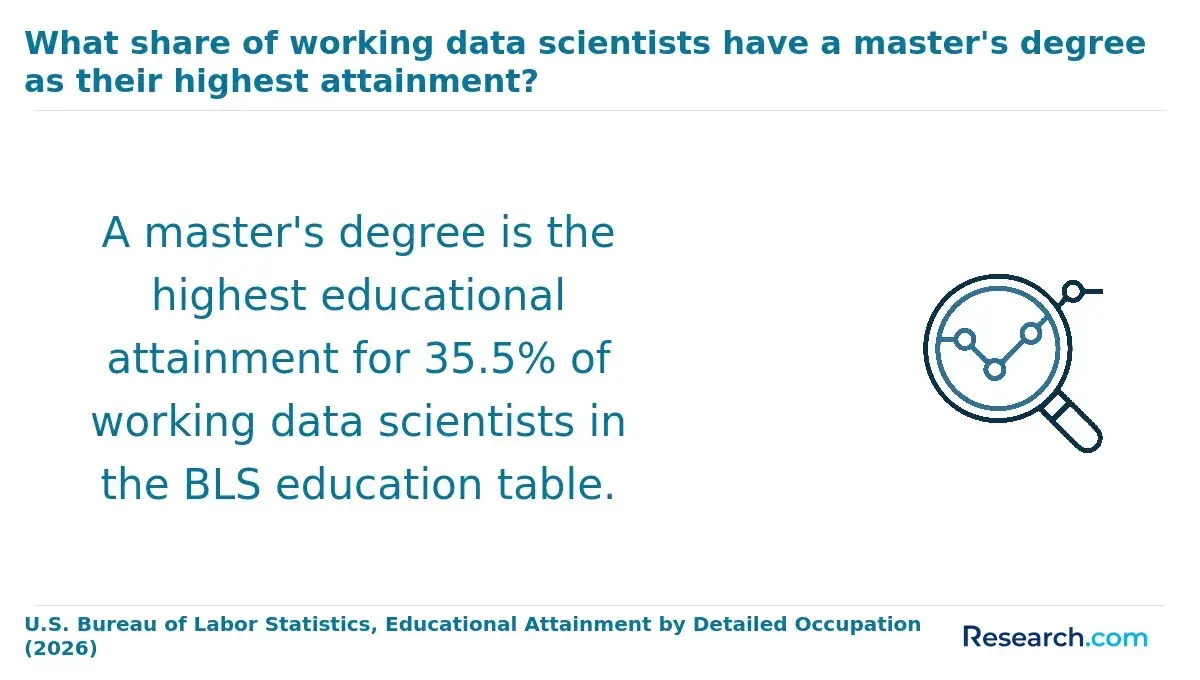
How do online and campus-based data science master's programs compare?
Online study makes a national search practical without leaving a St. Paul job. Campus study may make face-to-face faculty contact, recruiting events, and peer relationships easier to access. Neither format establishes that teaching or outcomes are better; compare the specific program experience instead.
The most consequential format differences for an employed student are scheduling and access to people, not where lectures are watched.
| Decision factor | Online program | Campus-based program |
| Work schedule | May reduce travel, but live sessions and group work can still conflict with work | Requires attendance at set places and times |
| Networking | May connect students across locations; relationship-building often takes more initiative | Can make local peer contact and campus events easier |
| Location-related cost | Can avoid relocation; occasional travel may still be required | Commuting or relocation can add expense |
Choose online study if keeping your current job and avoiding routine travel are priorities. Consider a campus-based option if regular in-person collaboration is central to how you learn - and its timetable is feasible. For either format, ask whether St. Paul students can use career services, attend recruiting events remotely, and work on projects with local employers.
What courses do online data science master's programs typically include?
Expect some combination of programming, probability and statistics, data management, machine learning, visualization, and applied projects. The balance matters more than the course labels. A professional targeting data engineering should look for substantial database and pipeline work; someone targeting experimentation should examine statistical inference and study design.
AI-related coursework deserves a closer read as employers consider how models are deployed and governed. A course title alone does not show whether students practice evaluating bias, privacy, model reliability, or human oversight. Ask to see recent syllabi and project descriptions; if governance is a career priority, compare responsible AI tracks in graduate programs with the depth offered in data science programs.
A useful capstone should let you explain the problem, data limitations, method, evaluation, and decision supported. For St. Paul professionals, a project connected to an employer or local organization may be particularly valuable - but only if data access and confidentiality rules allow it.
What are the admission requirements for an online data science master's?
Requirements vary by university. Applicants commonly need a bachelor's degree and must provide academic records; programs may also ask for recommendations, a statement of purpose, a résumé, or evidence of preparation in programming, calculus, linear algebra, or statistics. A particular course or test is required only if the program's current admissions policy says so.
Before paying an application fee, match your transcript and work experience against each program's stated prerequisites. If you have used analytics at work but lack formal coursework, ask whether that experience can demonstrate readiness or whether you must complete a graded course. Preparation resources are not automatically substitutes for admissions prerequisites. Applicants considering an AI-focused alternative can examine AI master's programs with bridge courses, then confirm how a specific school treats bridge work.
How long does an online data science master's take and cost?
Time to completion depends on required credits or courses, how often classes are offered, and how many you can take while working. A faster advertised pathway may assume a workload you cannot sustain. Ask for a part-time course plan showing prerequisites, course availability, and the maximum time allowed to finish.
There is no reliable single price for the options above: universities can charge by credit, course, or term, and published tuition may exclude mandatory fees. Build a comparable estimate for each school using all required courses plus mandatory fees, then add likely books, software, travel, and financing costs. Subtract employer assistance only after confirming eligibility, reimbursement limits, and any obligation to remain employed. To widen a cost-conscious shortlist, explore affordable online data science programs, but verify current charges with each university.
A common mistake is comparing one program's tuition-only figure with another's total estimate. Request a written cost breakdown based on your intended pace and Minnesota residency, and ask how the estimate changes if you take a term off.
What careers can an online data science master's prepare you for?
Potential paths include data scientist, machine learning practitioner, analytics specialist, and data-focused product or research roles. The realistic next step depends on your prior experience: an analyst may use the degree to deepen modeling skills, while a software engineer may emphasize machine learning systems. A new degree does not replace evidence that you can solve problems with data.
Compare each program's project opportunities and career support against your target employers. Ask whether career services serve online students, whether alumni work in roles you want, and whether you can speak with graduates who studied while employed. An alumni network is most useful when you can actually access it; alumni network considerations for AI master's applicants can also help frame those questions for adjacent technical degrees.
How much can data science professionals earn in Minnesota?
A current Minnesota-specific data scientist wage figure is not established here, so a national figure should not be presented as St. Paul pay. The U.S. Bureau of Labor Statistics reports a $120,230 national median annual wage for data scientists in May 2025. That is the midpoint for employed workers in the occupation - not an entry-level offer, a Minnesota median, or a salary attributable to a master's degree.
For a personal financial decision, compare actual openings in the Twin Cities with your current compensation and likely target role. Account for your experience and the degree's full cost rather than assuming a national occupational median will become your post-graduation salary.
What is the job outlook for data science careers in Minnesota?
The BLS projects 35% national employment growth for data scientists from 2025 to 2035. That signals substantial expected growth in the occupation nationally, but it is not a Minnesota forecast and does not show how many suitable openings will be available to a particular graduate in St. Paul.
Before enrolling, review current Twin Cities postings for the roles you want and note recurring requirements: methods, programming tools, industry knowledge, and experience level. If the jobs that interest you consistently require production engineering rather than analysis, let that finding shape your program choice. National growth is encouraging context, not a substitute for checking local fit.
Which certifications and standards matter in data science?
Data science does not generally have a single license required to practice. A cloud, analytics-platform, or programming certification can demonstrate familiarity with a tool, but its value depends on the employer and role; it is not interchangeable with graduate-level statistical or project experience.
Standards of practice matter more broadly: document data provenance, validate models appropriately, protect confidential information, and explain limitations to decision-makers. For St. Paul professionals working with employer data, ask a prospective program how it handles proprietary capstone material and whether students can complete a meaningful project without exposing sensitive records.
Other Things You Should Know About Data Science
Possibly, but obtain employer approval and confirm the program's project, publication, and data-security rules first. A public or de-identified dataset may be safer if permission is uncertain.
Do not assume so. Tell the university before moving and ask whether it can continue enrolling students at your new address under its applicable policies.
That depends on the university and credential. Ask the registrar for the exact diploma wording and confirm the degree-granting institution before enrolling.
Not necessarily. Entry terms and course sequencing differ. Ask when you could start, which required courses would be available first, and whether delaying enrollment would change your expected completion plan.
References
- Federal Pell Grants | studentaid.gov https://studentaid.gov/understand-aid/types/grants/pell
- Academic Years, Academic Calendars, Payment Periods, and Disbursements | 2025-2026 Federal Student Aid Handbook https://fsapartners.ed.gov/knowledge-center/fsa-handbook/2025-2026/vol3/ch1-academic-years-academic-calendars-payment-periods-and-disbursements
- Post-Secondary Employment Outcomes Tool Shows What You Might Earn Depending on the College You Attend | Census.gov https://www.census.gov/library/stories/2022/06/job-and-earnings-prospects-by-college-and-degree.html
- Online Program - UChicago Data Science Institute https://datascience.uchicago.edu/education/masters-programs/online-program/
- M.S. admissions | Data Science https://cse.umn.edu/datascience/graduate-admission-requirements
- Online Master's in Data Science | Saint Mary's University of Minnesota https://www.smumn.edu/degree/masters/data-science/
- Admissions - UVA School of Data Science https://datascience.virginia.edu/msds/admissions
- Online Master of Science in Data Science | CSP Global Concordia University, ST. Paul https://online.csp.edu/programs/ms-masters-in-data-science/
- Master's in Data Science - University of Notre Dame https://datascience.nd.edu/masters/
- Applications Process & Requirements | Illinois https://siebelschool.illinois.edu/admissions/graduate/applications-process-requirements