
2027 Online BA in Psychology - Mental Health After Military Human Resources Training: Compare Transfer Credit and Remaining Coursework
Audited and Verified:
Our Editorial and Data Verification Process
Research.com uses government datasets, official education statistics and primary institutional information to support its career and degree guides. Our review process checks factual accuracy, occupational definitions, source dates and the requirements associated with the credentials discussed.
How This Article Was Fact-Checked
Our editorial team verifies salary estimates, employment projections, education requirements and program information against original data providers and official organizations. Salary figures are checked against the relevant occupational definitions and reporting periods. Information about licensure, accreditation and required in-person training is reviewed separately.
Fact-checked and verified on:

Co-Founder and Chief Data Scientist
Military human resources training may earn college credit toward an online psychology BA, but the amount a school accepts is not necessarily the amount that moves you closer to graduation. That distinction matters if you are using limited education benefits or planning a transition into mental health support work.
This guide shows veterans and service members how to compare credit evaluations, identify remaining psychology requirements, estimate time and cost, and check whether the degree fits a civilian career goal.
Key Things You Should Know
- Request a degree audit, not just a transfer-credit total: military personnel training may count as electives while psychology, statistics, and research methods remain unfinished.
- For illustration, a 120-credit degree with 48 credits applied to its requirements leaves 72 credits - notwithstanding any additional credits the school accepts but cannot use toward graduation.
- An online psychology BA can support applications for nonclinical mental health roles, but it does not by itself qualify a graduate to diagnose conditions or provide psychotherapy.
What Is an Online Bachelor's Degree in Psychology for Mental Health Careers?
An online bachelor of arts in psychology teaches psychological science through courses delivered primarily online. A mental health focus, if a school formally offers one, may add study of psychological disorders, substance use, prevention, or service systems. It does not turn the BA into clinical training. Check whether "mental health" is an official concentration, a set of electives, or simply a description of possible careers.
For someone trained in military human resources, the degree can add knowledge of behavior, research evidence, and ethical support practices to existing experience in personnel administration and communication. It may be useful for nonclinical service coordination or as preparation for a separate graduate program. If addiction services are the primary goal, compare the actual courses and credential implications of online undergraduate addiction psychology program comparisons rather than assuming every psychology BA covers that field equally.
How Can Military Human Resources Training Transfer Into a Psychology Degree?
Military human resources training can transfer when an institution awards credit for documented learning and determines that the credit fits its degree rules. A Joint Services Transcript (JST), or a Community College of the Air Force (CCAF) transcript when applicable, gives evaluators a record of formal training and coursework. American Council on Education credit recommendations can inform a decision, but they do not require a college to award credit or assign it to a particular psychology requirement.
The distinctions below explain why two schools can accept the same military record yet leave different amounts of work to complete.
| Prior learning | Possible application | Key question for the evaluator |
| Military personnel or leadership training | General education or free electives, if approved | Which degree requirement does each awarded credit satisfy? |
| Military training in data, instruction, or organizational processes | Potential elective or course equivalency | Is a syllabus or other evidence needed for a specific substitution? |
| Prior college psychology or statistics courses | General education, major, or prerequisite requirements | Does the course meet the department's content, grade, and recency rules? |
| Associate-degree coursework | Individual courses or an approved general education block | Does the school recognize the credential, and which requirements remain? |
Send official military and college transcripts to the transfer-credit office, then ask the psychology department to review disputed major equivalencies. Keep syllabi for statistics, research, and psychology courses. Compare the resulting audits across distance learning psychology degree options; an advertised maximum transfer allowance is less useful than a written account of where your credits apply.
How Much Coursework Remains After Military and Prior-College Credits Transfer?
Calculate remaining coursework from credits applied to the degree, not credits merely accepted by the institution. In an illustrative 120-credit program, 48 applicable credits leave 72 credits to complete. If the school also accepts other military credits as electives beyond the degree's available elective space, those credits do not lower that balance. The school's approved degree audit - not this example - controls your actual total.
Then inspect what makes up the balance: unfinished general education, introductory or upper-level psychology, statistics and research methods, electives, and any minimum credits that must be earned at the graduating institution. A course can satisfy the overall credit total without meeting a major requirement. Prerequisite sequences and the frequency of upper-level online courses can also delay graduation after the arithmetic appears favorable.
Ask each school for a term-by-term plan showing when required courses will run and whether your prior statistics course meets the psychology major's standard. If speed is a priority, choosing an accelerated psychology degree route should mean comparing your audited remaining courses and realistic workload, not relying on a program's shortest advertised completion time.
Online and campus-based psychology BAs can cover comparable academic subjects, but delivery changes access to faculty, research activities, and a workable schedule. An asynchronous class may accommodate employment or service obligations; it may still impose weekly deadlines, group work, or scheduled exams. A campus program may simplify access to a research lab or local organizations, but commuting can restrict course choices.
Before choosing either format, ask how students complete statistics labs, research projects, and any required internship or capstone; whether meetings are live; and whether travel is required. Confirm that an online student can obtain the courses needed to finish the major on the proposed schedule. If a different specialty is tempting because of a short advertised timeline, compare accelerated bachelor's program choices in forensic psychology against your mental health goal and transfer audit rather than treating speed or the specialty name as a better fit by default.
Most psychology BAs combine general education with introductory psychology, major-area courses, statistics, research methods, upper-level work, and electives or a capstone. Exact requirements vary by institution. For a military HR transfer student, the crucial comparison is often whether prior personnel and leadership learning fills elective space while the scientific core still must be taken.
Prioritize statistics and research methods early if later courses require them. Developmental, social, and abnormal psychology can help you understand people and mental health systems; coursework on disorders is not permission to assess or treat them. If your intended job is in substance-use services, use information about addiction recovery occupations and education to check whether psychology electives address the job's actual duties or whether a state-recognized credential calls for different preparation.
Admission to an online college, acceptance into its psychology major, and approval of transfer credit are separate decisions. Schools commonly ask for an application and official prior-college transcripts; military learners should also ask how to submit the JST or CCAF transcript. A department may impose additional major-entry or course-grade rules. Do not assume that being admitted means a proposed statistics substitution has been approved.
Before applying, request the school's current transfer policy, major requirements, document deadlines, and process for a written evaluation or appeal. If your aim is eventually to enter a licensure-track graduate program, check that program's prerequisites independently; a BA admission decision says nothing about later graduate eligibility. Include future tuition in that decision: psychology master's fees and total study costs are relevant only if a particular master's actually advances your goal, and a general psychology master's should not be assumed to qualify you for counseling licensure.
Completion time depends on the audited remaining courses, how often they are offered, and the number you can manage each term. Compare programs using a proposed schedule rather than dividing credits by a full-time load: statistics may precede research methods, and a final capstone may have its own prerequisites.
For cost, multiply the required credits you expect to take at each school by its published per-credit tuition, then add mandatory fees and any books, software, travel, or placement expenses. Ask whether military or veteran tuition rates apply to you, and confirm your individual VA education-benefit eligibility and remaining entitlement with the appropriate VA and school certifying officials.
An online schedule or reduced course load can affect benefit payments; do not assume that all benefits cover the full bill. If an addictions-specific alternative is under consideration, online substance use counseling bachelor's aid resources can help frame aid questions, but the school's current charges and your award notice determine the comparison.
No. An online psychology BA, including one with mental health courses, does not by itself authorize psychotherapy, diagnosis, independent psychological assessment, or use of a protected licensed title. Requirements depend on the occupation and state; counseling, social work, psychology, and substance-use counseling have distinct educational and supervised-practice pathways.
Choose the BA for its undergraduate preparation or nonclinical career value, not as a substitute for a qualifying professional degree. If licensed counseling is the objective, check a state licensing board's educational requirements against specific graduate programs and account for the additional expense using mental health counseling degree fees and aid planning. A graduate program's title alone is not proof that it meets your state's rules.
Military HR experience may be directly relevant to civilian personnel, training, or administrative roles. A psychology BA can add useful preparation for nonclinical work such as behavioral-health intake support, service coordination, victim-services support, or research assistance, but employers may require particular experience, screening, or additional credentials. In support roles, respectful communication, accurate documentation, confidentiality, and appropriate referral matter more than implying clinical authority.
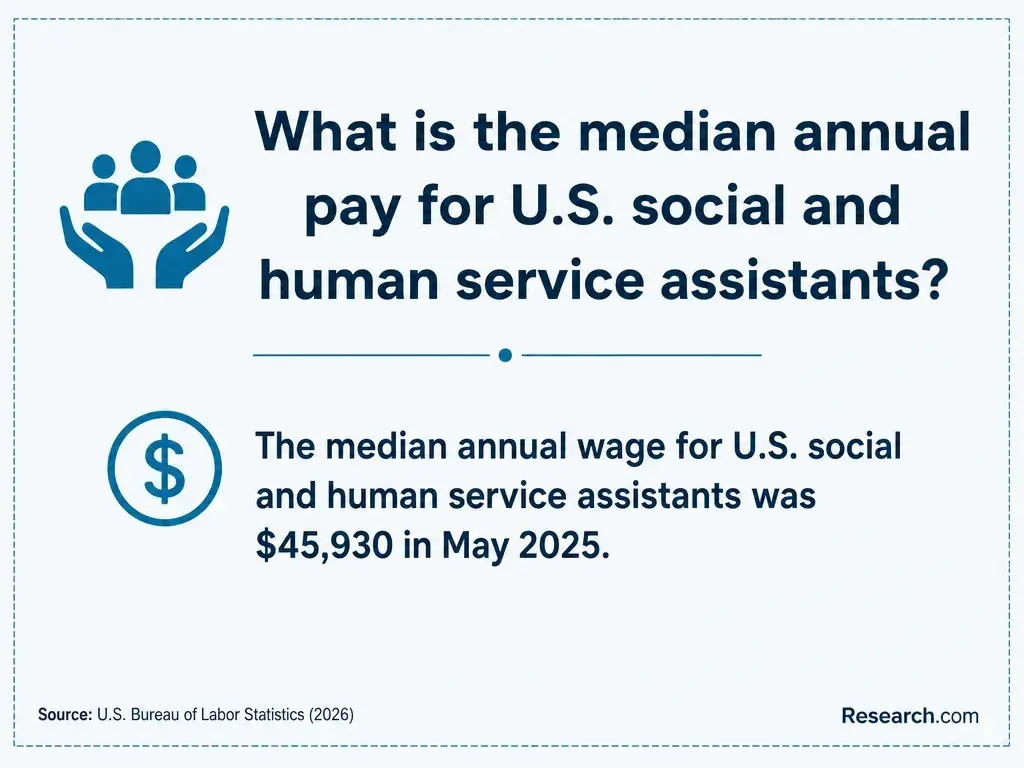
Compare job postings in your intended location before paying for another degree: identify the required credential, actual duties, and whether your military experience already meets the employer's standard. Published occupation-wide wages are not a salary forecast for psychology BA graduates, and pay varies with employer, location, duties, and experience. If your interests shift toward justice settings, graduate-level forensic psychology career research can inform a separate career investigation; a forensic degree does not itself grant investigative or clinical authority.
How Can Students Choose an Accredited Online Psychology Program?
Start by confirming the institution's recognized institutional accreditation and its authority to award the degree. Do not look for APA accreditation of a general undergraduate psychology BA: APA accreditation applies to specified professional psychology training programs, not ordinary BA majors. Next, compare each school's written credit evaluation, psychology course schedule, online participation requirements, advising, and veteran support.
Ask for an audit that separates accepted credits from credits applied to graduation, identifies unresolved substitutions, and states the remaining residency and upper-level major requirements. Get a cost estimate based on those remaining courses and ask how appeals, interruptions in enrollment, and benefit certification work. If a substance-use counseling bachelor's is an alternative, substance abuse counseling undergraduate education investment is a useful comparison point - but verify its curriculum and your state's credential rules before choosing it over psychology.
The best fit is the program that applies more of your documented learning to requirements you need, offers a feasible path through the remaining courses, and supports your specific civilian goal at a cost you can substantiate.
Other Things You Should Know About Psychology
Diploma wording is set by the institution. Ask the registrar for its current diploma and transcript policies before enrolling.
Possibly. Check the school's accepted exams, score thresholds, credit limits, and degree-audit placement before paying for an exam.
Only if the program permits workplace-based projects and approves the topic, supervision, and any access to employee information in advance.
Contact the school promptly about its military absence, withdrawal, and reentry policies, and ask the school certifying official how a schedule change may affect VA benefits.
- Military Training Evaluation Program (MTEP) | dantes.mil https://www.dantes.mil/credit4training/
- About GI Bill Benefits | Veterans Affairs https://www.va.gov/education/about-gi-bill-benefits/
- Behavioral Health Career Descriptions | samhsa.gov https://www.samhsa.gov/about/careers/behavioral-health-workforce/careers-by-state/descriptions
- Psychology Program FAQs | University of La Verne https://health.laverne.edu/psychology/faq/
- How Long Does It Take to Get a Bachelor's Degree? | American National University https://an.edu/how-long-to-get-bachelors-degree/
- Course and Program Format Definitions | UMaine Online https://online.umaine.edu/courses-and-program-format-definitions/
- Course Policies | West Chester University Catalog https://catalog.wcupa.edu/undergraduate/academic-policies-procedures/course-policies/
- Section 11-Credit Earned from Military Training and Courses | Northern Virginia Community College Academic Catalog https://catalog.nvcc.edu/cpl-manual/credit-earned-military-training-courses/
- Military Credit Excess SAP: Guidelines & Policies | iu.edu https://transfer.iu.edu/policies/military-credit-excess-SAP.html
- Online Psychology Bachelor's Degree | University of West Florida https://uwf.edu/programs/online/psychology-ba/


