
2027 MLIS Programs for Academic Library Assessment Coordinators

Co-Founder and Chief Data Scientist
Choosing an MLIS for academic library assessment means looking beyond a general promise of "data skills." Coordinators need to measure how library services support students and researchers, then turn findings into decisions. The U.S. Bureau of Labor Statistics projects 2.6% employment growth for librarians and media collections specialists from 2025 to 2035. Because that broad occupation is growing slowly, relevant experience matters when comparing programs.
This guide shows prospective students and career changers how to evaluate curricula, accreditation, applied opportunities, and costs without mistaking a course listing for career preparation.
Key Things You Should Know
- Look for an ALA-accredited master's program with assessable research-methods coursework and an opportunity to produce a real assessment work sample; a relevant elective alone is not a formal specialization.
- An MLIS is common in academic librarian hiring, but assessment and institutional research positions may accept other graduate degrees; the job description determines which credential fits.
- The May 2025 median salary for the broader librarian and media collections specialist occupation was $68,270 - not a verified salary for assessment coordinators or graduates of any particular program.
What does an academic library assessment coordinator do?
An academic library assessment coordinator helps a college or university library determine whether its services meet defined goals. The work may include designing surveys, evaluating information-literacy instruction, analyzing service-use patterns, coordinating usability studies, and presenting findings to library leaders and campus partners. The coordinator's value lies not just in producing a dashboard, but in explaining what the evidence can - and cannot - support.
Projects often involve librarians, campus institutional research staff, faculty, and students. For example, an assessment might combine student feedback with observations of a research-help service, then recommend a change and measure its effect. Responsible practice also means limiting access to sensitive records and avoiding claims about individual student success from library-use data alone. Depending on the institution, similar work may appear under titles such as assessment librarian, user experience librarian, or planning and assessment specialist.
Is an MLIS required for academic library assessment careers?
There is no universal MLIS requirement for assessment work. An academic library position classified as a professional librarian may require or prefer a master's degree from an ALA-accredited library and information studies program. A campus assessment or institutional research position, even when it works closely with the library, may instead emphasize education research, statistics, public administration, or another relevant background.
Read postings for the actual position, not just its title: check the required degree, whether ALA accreditation is specified, the expected methods experience, and whether the role includes librarian responsibilities. An MLS, Master of Information, or institution-specific LIS degree may be relevant if the particular program and employer's requirements align; the degree name alone does not establish ALA accreditation. Applicants who already have strong research-methods training may benefit more from library experience or targeted coursework than from a second master's degree.
Which MLIS programs best prepare students for library assessment?
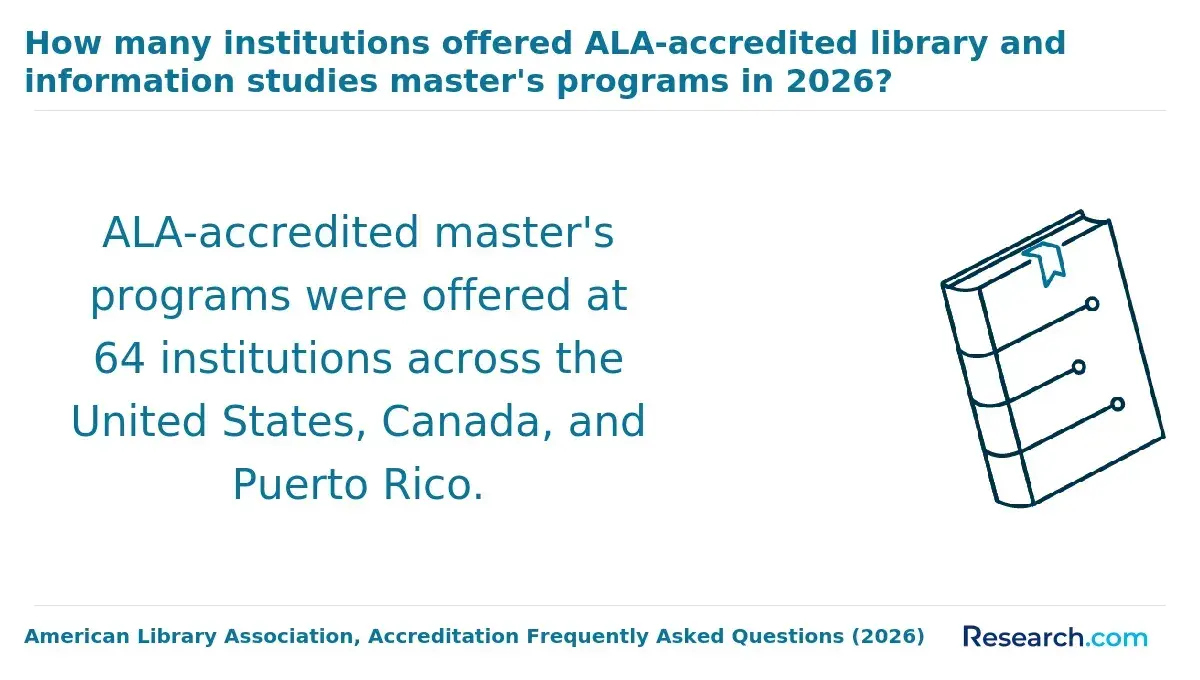
The strongest choice is a program whose verified curriculum lets you study research methods and apply them to a library problem. There is no basis for treating a generally relevant MLIS as a named "library assessment" concentration unless the university documents that track. Start with an accredited online MLIS comparison, then check each program's current catalog and ask whether the courses you need will run during your likely enrollment.
The distinctions below help separate a promising catalog description from preparation you can count on when selecting a program.
| Evidence level | What it establishes | Important limitation |
| Documented specialization | The school formally identifies a track or concentration. | Its title does not establish that assessment methods are covered in depth. |
| Relevant coursework | Published courses address methods, evaluation, data analysis, or related skills. | A catalog entry does not guarantee a seat or a convenient offering. |
| Applied opportunity | A documented practicum, capstone, or project can support work-based learning. | The availability of a library assessment placement may vary. |
| General LIS alignment | Core study provides context about libraries and their users. | Specialized assessment preparation has not been established. |
Ask a prospective program for a feasible course sequence and examples of eligible applied projects. A useful final product could be a survey instrument, an analysis with clearly stated limitations, and a short report recommending a service change. Choose a program for the work you can realistically complete, not the number of appealing electives in its catalog.
How does ALA accreditation affect academic library career options?
ALA accreditation applies to a specific master's program, not automatically to every degree offered by its university. It matters because some academic librarian employers specify graduation from an ALA-accredited program. Before applying, confirm the exact program in the current ALA directory and compare the employer requirements for roles you want. Institutional accreditation is a separate consideration and does not substitute for this check.
ALA accreditation does not verify an assessment concentration, the availability of a particular elective, or an internship placement. For a librarian-track applicant, it can preserve eligibility for postings with that requirement; for an applicant targeting nonlibrarian assessment roles, methods training and demonstrated projects may weigh more heavily. Neither path guarantees eligibility for every position.
What coursework prepares MLIS students for library assessment work?
Build a course plan around the full assessment cycle: define a useful question, collect appropriate evidence, analyze it, and communicate a decision. When reviewing catalogs, look for these complementary areas rather than relying on a single course labeled "assessment."
- Research design and evaluation: survey construction, interviews, observation, sampling, and the limits of each method.
- Quantitative analysis: descriptive statistics, data cleaning, visualization, and interpretation without overstating causation.
- User research and accessibility: usability testing and methods that include people with different access needs.
- Academic library practice: information-literacy instruction, research services, and the institutional context behind library goals.
- Management and communication: reporting results, working with stakeholders, and using findings to plan a service change.
If those topics are spread across departments, ask whether MLIS students may enroll in outside electives and whether those credits count toward the degree. An applied project is especially valuable when it shows the question, method, limitations, and recommendation - not just a polished chart. When using AI to help summarize responses or draft a report, verify its output and follow the institution's privacy rules for survey and service data.
Are online or campus-based MLIS programs better for assessment careers?
Neither format is inherently better. Compare whether you can take the needed methods courses, collaborate on projects, and obtain supervised assessment experience while meeting work and family commitments. Students comparing Southern online library degree options should still verify each program's course schedule, tuition rules, and any in-person requirements.
This format comparison highlights the constraints most likely to affect an assessment-focused course plan.
| Format | Potential advantage | Constraint to verify |
| Online | May allow students to remain employed and use their workplace for an approved project. | Live meeting times, elective availability, and whether a local placement is permitted. |
| Campus-based | May provide easier access to campus library partners and in-person research activities. | Commuting, scheduled class times, and whether relevant placements are actually available. |
Online does not necessarily mean asynchronous, and a campus location does not guarantee a library assessment internship. Ask how the program approves project sites and what happens if a preferred elective is unavailable when you need it.
What are the admission requirements for MLIS programs?
Applicants generally need a bachelor's degree and must submit the materials required by the specific graduate program, which may include transcripts, a statement of purpose, recommendations, and a résumé. Minimum grades, test policies, prerequisites, and deadlines vary. Assessment experience is useful material for an application, but it should not be assumed to replace a published degree requirement.
Use the statement of purpose to connect a concrete library question - such as how to evaluate instruction - to the program's documented courses or projects. If you have previous graduate study, ask whether eligible credits can be transferred before planning your schedule; policies often limit both the credits accepted and how they apply. A best transfer friendly MLIS comparison is a starting point, not confirmation that your particular credits will count.
How long do MLIS programs take and what do they cost?
Time to completion depends on required credits, enrollment pace, course sequencing, and whether an applied project must be arranged. Calculate tuition by multiplying the credits you must complete by the applicable per-credit rate, then add mandatory fees and likely costs for materials, technology, travel, and any placement. Published tuition alone is not a total attendance cost, and online enrollment does not automatically qualify a student for in-state rates.
Compare a full program budget - not just a low advertised rate - when reviewing best low cost library degree options. Ask each school for the current tuition schedule, fees, expected course sequence, and available funding. Scholarships, assistantships, employer reimbursement, and federal aid have separate eligibility rules; confirm your options with the school's financial aid office rather than treating possible funding as a discount. Borrowing should be weighed against your existing earnings and the qualifications in jobs you intend to pursue.
What salaries and job outlook apply to academic library assessment coordinators?
The BLS does not provide a separate salary or growth series for academic library assessment coordinators. Its broader librarians and media collections specialists occupation had a May 2025 median annual salary of $68,270 and projected employment growth of 2.6% from 2025 to 2035. Those figures provide occupational context, not an expected offer for an assessment job; pay and prospects vary with employer, location, duties, and experience.
Assessment roles can be particularly competitive when an employer wants both librarian qualifications and demonstrated research skills. Review local postings for required methods, software, and degree language before committing to an MLIS. For a wider view of specialized hiring hurdles, see difficult library careers to break into. A portfolio that explains an assessment's limitations can help show the judgment behind your technical skills.
Which certifications and professional standards support library assessment careers?
No single assessment certification is a universal requirement for academic library coordinators. Employers are more likely to evaluate the degree and experience specified in their posting, along with evidence that an applicant can design ethical studies and explain results. A short course or certificate in statistics, survey methods, accessibility, or data visualization may address a skill gap, but it is not a substitute for an ALA-accredited degree when a librarian job explicitly requires one.
ACRL's Standards for Libraries in Higher Education offer a professional framework for connecting library evidence to institutional goals. Use such standards to shape meaningful questions, not as a checklist that proves a service caused a student outcome. For practical preparation, document how you obtained consent where appropriate, protected data, interpreted findings, and recommended a change.
Other Things You Should Know About Library Science
It should show measures tied to a decision, with clear definitions, dates, and limitations. A chart of service use is more useful when readers know whom it covers and what change the library is considering.
Do not publish identifiable or restricted records. Follow your institution's policies, obtain approval when needed, and use aggregated, de-identified, or synthetic examples to demonstrate your methods.
Involve the people responsible for the service and those with relevant methodological or privacy expertise. Their review can catch misleading interpretations and make recommendations more practical.
It may assist with an approved workflow, but first check data-use rules. Review the summaries against original responses, watch for missing or distorted viewpoints, and do not enter protected responses into an unapproved tool.
References
- Department Expectations: Curriculum | New York State Education Department https://www.nysed.gov/college-university-evaluation/department-expectations-curriculum
- NCDS Data Internship | NNLM https://www.nnlm.gov/offices/ncds/internship
- A Practical Guide to Writing Quantitative and Qualitative... - PMC https://pmc.ncbi.nlm.nih.gov/articles/PMC9039193/
- What Is Qualitative vs. Quantitative Study? - National University https://www.nu.edu/blog/qualitative-vs-quantitative-study/
- Master of Library & Information Studies (MLIS) | ua.edu https://cis.ua.edu/departments/slis/mlis/
- Application Requirements | Pratt Institute https://www.pratt.edu/admissions/graduate-admissions/apply/application-requirements/
- Master's Degree (MSLS) in Library & Information Science | University of Kentucky https://online.uky.edu/masters/library-information-science/msls
- Design effective assessments | Portland State University | OAI+ Faculty Teaching Resources https://oaiplus.pdx.edu/design-effective-assessments/
- Cost of Attendance | Cal State LA https://www.calstatela.edu/financialaid/cost-attendance
- MLIS Focus Areas | lsu.edu https://www.lsu.edu/chse/sis/courses-focus-areas/focus-areas.php


