2027 Data Structures and Algorithms in an Online Data Science Master's: Courses, Projects, and Program Selection

Co-Founder and Chief Data Scientist
Data structures and algorithms can be a foundation of an online data science master's - or a topic covered only briefly. That difference matters if you want to build efficient data pipelines, work with large datasets, or pursue technically demanding roles.
This guide helps prospective students assess course depth, project opportunities, and program fit before committing to a degree.
Key Things You Should Know
- Look beyond course titles: a dedicated algorithms course, assessed programming work, and a substantial project provide stronger evidence of depth than a syllabus mention.
- Relevant projects compare approaches using runtime, memory use, correctness, and data scale - not just a model's predictive accuracy.
- The U.S. Bureau of Labor Statistics projects 35% employment growth for data scientists from 2025 to 2035; that outlook does not establish what an individual graduate will earn or whether a particular curriculum is worth its cost.
What Is Data Structures and Algorithms in an Online Data Science Master's?
Data structures are ways to organize information for computation, such as hash tables, trees, heaps, and graphs. Algorithms are procedures for tasks such as searching, sorting, finding paths, and optimizing a result. In data science, the practical question is often not merely whether code works, but whether it still works within acceptable time and memory limits as data grows.
A master's program may teach these ideas in a dedicated computer science course, embed them in data engineering or machine learning, or expect students to know them before admission. Online delivery does not determine the technical level. Learning objectives, assignments, assessments, and prerequisites are better evidence.
This subject is especially valuable if you expect to build production pipelines or computational tools. If your goal is primarily statistical interpretation or business reporting, basic fluency may matter more than advanced algorithm design. Neither path makes the other less rigorous; they emphasize different work.
What Do Data Structures and Algorithms Courses Cover in Data Science Programs?
Foundational coverage usually includes arrays and linked structures, dictionaries or hash tables, trees, graphs, sorting and searching, recursion, and time- and space-complexity analysis. More advanced work may include dynamic programming, graph algorithms, randomized methods, or optimization. A data science course may apply these ideas to database queries, nearest-neighbor search, network analysis, or scalable machine learning.
The table distinguishes levels of exposure that can otherwise look similar in a course catalog. A program need not offer every level, but its depth should match the work you hope to do.
| Evidence in the curriculum | What it likely demonstrates | What remains unclear |
| Topic named in a course description | Some exposure | Whether students implement or analyze algorithms |
| Unit within a broader course | Focused instruction and possibly an assignment | How far beyond standard examples the work goes |
| Dedicated course with coding assessments | Sustained practice implementing and evaluating methods | Whether applications use realistic data scale |
| Advanced elective and substantial project | Opportunity to apply methods to a harder problem | Whether the elective runs when you need it |
Before comparing programs, check whether the syllabus requires students to justify an algorithm choice, test correctness, and measure performance. A course title alone cannot answer those questions. Also examine the expected preparation: programming fluency and comfort with mathematical reasoning make complexity analysis much easier to use, even where they are not formal admission requirements.
What Projects Use Data Structures and Algorithms in Data Science?
A strong project makes the computational trade-off visible. For example, a student might build a recommendation retrieval system, compare indexing methods for repeated queries, or use graph algorithms to analyze connections in a network. Each can be framed around a real question: Which approach returns useful results quickly enough as the dataset grows?
For portfolio value, the project should show the problem, the chosen structure or algorithm, a reasonable baseline, and reproducible tests. Compare runtime and memory under stated conditions, then explain limitations. A faster result on one small dataset does not prove that an approach scales.
Predictive modeling projects can also demonstrate algorithmic skill when students examine how data representation, retrieval, or optimization affects training and inference. By contrast, running a library function without explaining its behavior shows tool use, not necessarily understanding. Ask whether the program permits algorithm-focused capstones or only predefined project formats, and whether students can access suitable data and computing resources online.
What Are the Admission Requirements for an Online Data Science Master's?
Requirements vary by institution. Programs may evaluate an applicant's undergraduate preparation, programming experience, mathematics, statistics, transcripts, recommendations, or statement of purpose. Some expect prior coursework; others provide introductory or bridge options. A self-paced course may prepare you to succeed without satisfying a formal prerequisite, so confirm equivalencies with admissions staff before applying.
If algorithms are your main knowledge gap, test your readiness by implementing a basic search or graph traversal, explaining its complexity, and writing tests for unusual inputs. If programming itself is new, build that foundation before choosing a program that starts with graduate-level algorithm assignments. Applicants comparing structured preparation options can also examine artificial intelligence graduate bridge programs for questions to ask about foundation coursework; eligibility for any data science program must be checked separately.
How Long Does an Online Data Science Master's Take and Cost?
Completion time depends on required credits, course availability, enrollment pace, prerequisites, and any capstone sequence. A short advertised timeline may assume full-time study or courses offered in a particular order. Ask for a sample schedule at the pace you can actually maintain, especially if an algorithms course is a prerequisite for later electives.
Compare total estimated tuition and mandatory fees, not tuition per credit alone. Include required software or computing resources, possible travel, and the effect of taking fewer courses while working. Ask how long published rates remain valid and whether charges differ by residency or enrollment status. For a closer look at scheduling trade-offs, see online data science master's duration comparisons; verify current figures directly with each school.
A lower-cost program may be the better choice if it provides the depth you need. Paying more specifically for algorithms instruction makes sense only when the added courses, feedback, and projects address a skill gap relevant to your goals.
Are Online Data Science Master's Programs Accredited?
An online program may be offered by an institution with recognized institutional accreditation, but do not assume that accreditation from a program's marketing page. Verify the institution's status through the accreditor or an official U.S. Department of Education or CHEA directory. Institutional accreditation and any specialized recognition are distinct; specialized accreditation is not a universal requirement for data science degrees.
Accreditation alone does not show how well a program teaches algorithms. Check the actual curriculum, faculty support, and assessment methods. Also confirm that the institution can enroll students in your state and whether any in-person activity is required before you pay an application fee.
How Do Online and Campus-Based Data Science Master's Programs Compare?
The meaningful comparison is access to instruction and practice, not an assumption that one format is inherently more rigorous. An online student may have flexible access to recorded material but need to coordinate remote group projects and seek help through scheduled office hours. A campus student may find in-person discussion easier but face commuting and fixed attendance times. Policies differ by program.
For algorithms, ask whether students in either format receive feedback on code quality and complexity, access to computing resources, and opportunities to revise their work. Check whether exams or live sessions conflict with your schedule. If your intended work emphasizes reporting and applied analysis rather than algorithm design, choosing a data analytics master's degree may be a more useful comparison than choosing between delivery formats alone.
What Careers Can a Data Science Master's Prepare You For?
Algorithmic depth is most directly useful in roles that involve designing or improving computational systems: data scientist positions with substantial coding, machine learning engineering, data engineering, and some research-oriented work. Responsibilities vary widely under the same job title. Read target job descriptions for evidence that employers expect scalable processing, optimization, graph methods, or production software rather than assuming every data scientist role requires advanced algorithms.
Domain knowledge can matter alongside technical skill. Someone targeting clinical applications, for example, should evaluate data governance and healthcare context as well as computational coursework; artificial intelligence master's preparation for healthcare work offers a related route to compare. A master's degree can strengthen preparation, but it is not a substitute for demonstrable work or a guarantee of entry into any role.
What Salary and Job Outlook Can Data Science Graduates Expect?
The U.S. Bureau of Labor Statistics reports a median annual wage of $120,230 for data scientists in May 2025. That figure describes workers in the occupation, not new master's graduates or the salary increase attributable to a degree. Experience, location, employer, industry, and the responsibilities of a particular role all matter when evaluating an offer.
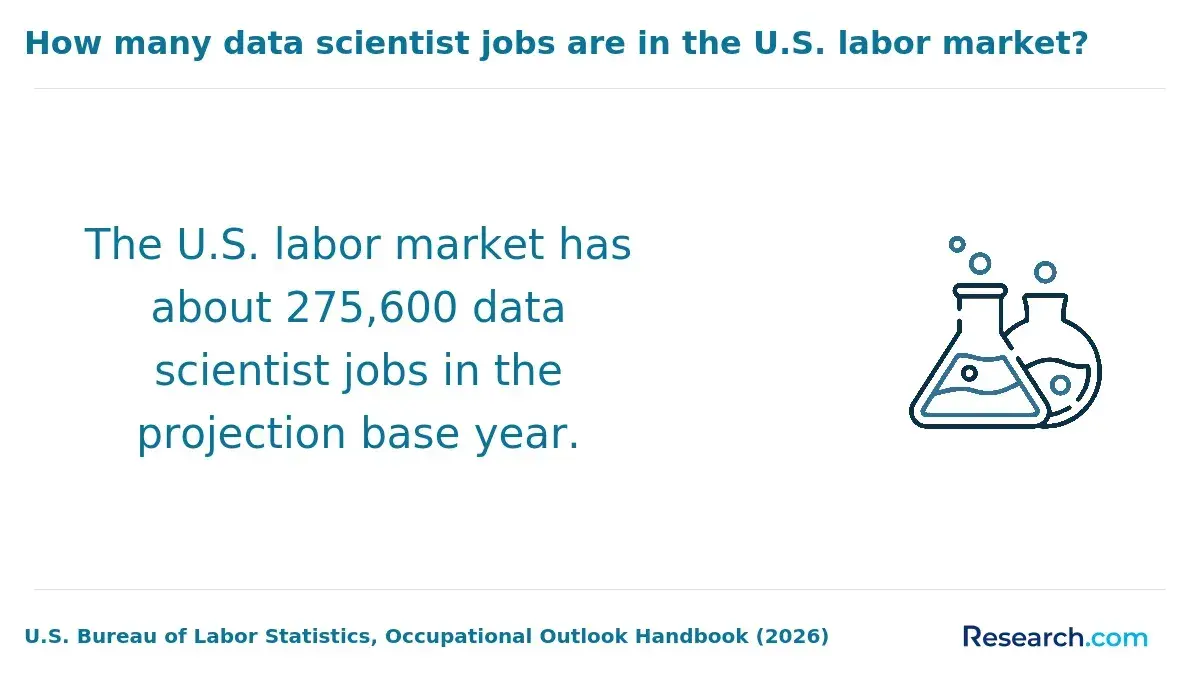
BLS projects about 24,800 data scientist openings per year, on average, from 2025 to 2035, including openings created when workers leave the occupation. This indicates a sizable occupational market, not guaranteed placement for graduates. Compare a program's cost against realistic roles you can pursue given your existing experience; use a guide to industry-specific data science salaries to explore why a single national figure may not describe your target market.
How Can You Choose a Reputable Online Data Science Master's Program?
Start with the work you want to do, then inspect evidence of learning rather than relying on a ranking or a list of course names. Request current syllabi and a sample study plan if public descriptions do not show the detail you need.
Use the following checks to narrow a shortlist before applying:
- Match the depth to your goal. Identify whether algorithms are assumed, taught in a required course, or available only as an elective; check whether the elective is regularly offered.
- Inspect the work. Ask for examples of assessed coding, complexity analysis, performance testing, and eligible capstone topics.
- Confirm practical access. Verify prerequisites, online help and computing resources, course sequencing, and any live or in-person requirements.
- Compare verified costs and outcomes. Request a total-cost estimate and ask how any published employment results were collected and whom they represent.
A warning sign is a promise of advanced technical preparation without corresponding assignments or projects you can verify. Another is a completion or salary claim presented without its assumptions or population. Choose the program that supplies credible evidence for the skills you need at a schedule and cost you can sustain; if no program does, targeted prerequisite study may be the better next step.
Other Things You Should Know About Data Science
It can provide useful concepts and practice, but interviews have their own formats and time constraints. Check the course's assignments, then prepare separately for the kinds of assessments used by your target employers.
Not necessarily. Many learning exercises can run on an ordinary computer, while larger projects may require remote computing. Ask the program what equipment and computing access it expects students to provide.
Follow each course's academic-integrity rules. Even where tools are permitted, you should be able to explain, test, and defend submitted code - including its complexity and limitations.
The underlying ideas transfer, but implementation details do not always. Practice expressing the same method in the language commonly used in your target coursework or role.
References
- Rethinking Rigor: Challenging Students & Supporting Meaningful Learning - Teaching + Learning Lab https://tll.mit.edu/rethinking-rigor-challenging-students-supporting-meaningful-learning/
- MS in Data Science | columbia.edu https://datascience.columbia.edu/education/ms-data-science
- 2026 UNC Online Master of Applied Data Science (MADS) https://online.unc.edu/online-masters-programs/masters-data-science/
- Online Master's in Data Science and Analytics | OU Online https://online.ou.edu/program/ms-in-data-science-and-analytics/
- Data Science, M.S. | New York Tech https://www.nyit.edu/academics/degrees/data-science-ms/
- Master's in Data Science - Pace University Online https://online.pace.edu/graduate-programs/ms-in-data-science/
- How to Pick the Best Master's in Computer Science Program | MDS@Rice https://csweb.rice.edu/academics/graduate-programs/online-mcs/blog/how-to-pick-best-mcs-program
- Master's in Data Science: Curriculum | NYU CDS https://cds.nyu.edu/masters-in-data-science-curriculum/
- Application Prerequisites | Computer Science https://csc.ncsu.edu/academics/graduate/application-prerequisites/
- Master's in Data Science | utexas.edu https://cdso.utexas.edu/msds