
2027 Data Science Master's Admissions with a Three-Year Bachelor's Degree

Co-Founder and Chief Data Scientist
A three-year bachelor's degree may qualify you for a data science master's, but its length alone does not settle the admissions question. For applicants educated outside the U.S. - and anyone whose degree differs from a program's usual entry credential - the decisive issues are degree equivalency, the university's policy, and evidence of quantitative and programming preparation. This guide shows you what to verify before paying an application fee and how to identify programs where your academic record is a realistic fit.
Key Things You Should Know
- A three-year bachelor's is not automatically accepted or rejected; each university decides whether it meets its graduate-degree requirement.
- Whether your degree is eligible for admission and whether your coursework meets the data science program's prerequisites.
- Send the university your degree title, institution, country, transcript, and course descriptions, then ask what evaluation it requires. Strong labor-market demand does not change eligibility: the U.S. Bureau of Labor Statistics projects 35% growth in data scientist employment from 2025 to 2035.
Can You Get a Data Science Master's With a Three-Year Bachelor's Degree?
Yes, potentially. U.S. graduate schools set their own rules for recognizing prior degrees. Some assess a three-year credential as meeting their bachelor's-degree requirement; others require a degree they consider equivalent to a four-year U.S. bachelor's or specify additional study. A program's willingness to review your application is not the same as a decision that your degree satisfies its formal eligibility rule.
For 2026 entry, check the current graduate-school policy and the data science program's admissions page. If either is unclear, ask admissions for a written determination or its required evaluation process. State your exact degree, awarding institution, country, graduation date, and any postgraduate study. Ask: "Does this credential meet the degree requirement for this data science master's, and must I obtain a course-by-course credential evaluation?"
A credential evaluator can describe U.S. comparability, but the university makes the admissions decision. Do not assume that a favorable evaluation guarantees admission - or that an evaluator's general description overrides a published program rule. If your degree does not qualify, ask whether additional recognized undergraduate or postgraduate study could change that decision before enrolling in courses.
What Do Data Science Master's Programs Require for Admission?
Degree eligibility is only the first screen. Programs may also request transcripts, statements of purpose, recommendations, a résumé, and evidence of English proficiency where applicable. Some specify prior coursework; others assess readiness across the full application. Test requirements and document rules vary, so use the requirements for your intended entry term rather than a general admissions checklist.
For a three-year-degree applicant, the most useful evidence is specific: a transcript showing relevant courses, syllabi when course titles are ambiguous, and projects or work that demonstrate how you use mathematics and code. A portfolio can strengthen an application, but it does not automatically replace a required credit-bearing course. Likewise, substantial professional experience does not automatically resolve a degree-equivalency requirement.
Before applying, confirm which office decides credential eligibility and which decides prerequisite readiness. This distinction helps you avoid spending time explaining your Python experience to a department when the unresolved question belongs to the graduate admissions office.
How Do You Verify Accreditation for a Data Science Master's?
First, confirm that the degree-awarding institution holds recognized U.S. institutional accreditation. Check the institution's stated accreditor against the U.S. Department of Education's recognized-accreditor information or the accreditor's own institution directory. For a university outside the U.S., verify its official recognition in its home jurisdiction and ask the U.S. program how it evaluates that institution's credentials.
Do not confuse institutional accreditation with a separate endorsement of the data science curriculum: a program may sit within an accredited university without holding program-specific accreditation. Also confirm which institution will award the master's if a course platform or another organization handles delivery.
This check matters before you commit to tuition or seek aid, but accreditation alone does not establish your eligibility, the quality of a particular curriculum, or access to every form of financial aid. If you plan to study online from another state, verify the program's authorization to enroll residents of your state as well.
Which Prerequisites Prepare You for Graduate Data Science Study?
Common preparation areas include programming, statistics, calculus, linear algebra, and sometimes database work. The required depth differs: an introductory statistics course may satisfy one program but fall short of another's expectations for probability or mathematical statistics. A three-year degree may cover these subjects thoroughly, lightly, or not at all; course content is more informative than degree length.
The table separates typical evidence of readiness from gaps worth investigating. It is a planning aid, not a substitute for a program's prerequisite policy.
| Preparation area | Evidence to look for in your record | Potential gap |
| Programming | Assessed coding coursework or substantial documented projects | Limited experience writing and debugging code independently |
| Statistics and probability | Courses covering inference, uncertainty, and model evaluation | Experience using tools without understanding the underlying methods |
| Calculus and linear algebra | Transcripted study relevant to optimization and matrix-based methods | Missing mathematical foundations for technical courses |
| Data handling | Database coursework or projects involving real datasets | Little practice cleaning, joining, and checking data |
If a gap is formal, ask whether a credit-bearing course from an accepted institution will fulfill it. Self-study and online courses can help you prepare and demonstrate initiative, but count as a prerequisite only if the program says they do. Applicants considering a related field can also compare AI master's routes with additional preparation; a bridge course is useful only if it addresses the skills and eligibility rules that apply to you.
What Do You Learn in a Data Science Master's Program?
A data science master's commonly combines statistical reasoning, programming, data management, machine learning, and communication of results. The balance matters more than the degree title. An applicant with strong mathematics but little software experience may benefit from substantial coding and data-engineering practice; an experienced programmer may need deeper statistical modeling and experimental design.
Review required courses, not just elective descriptions. Look for assessed work that takes a problem from data preparation through model evaluation and an explanation of limitations. If you want to work with consequential AI systems, inspect whether ethics, privacy, and governance are taught through required coursework or only mentioned in a catalog summary. Graduate AI degrees with governance coursework offer a related curriculum comparison, but admission to those degrees still requires a separate credential check.
Are Online or Campus Data Science Master's Programs Better?
Neither format changes the basic need to establish degree eligibility and prerequisite readiness. Online study can suit applicants who must keep working or cannot relocate; campus study may better suit someone seeking in-person collaboration or access to particular facilities. Compare actual scheduling, support, and project requirements rather than assuming every online course is self-paced or every campus course is taught in person.
This choice matters especially when you may need foundation courses before starting the master's. Ask whether those courses can be completed remotely, whether they delay entry into the degree, and whether synchronous meetings fit your time zone. For applicants balancing a job with study, data science master's study options for the workforce can help frame the scheduling comparison. Confirm state enrollment eligibility directly with any online program on your shortlist.
How Long Does a Data Science Master's Take and Cost?
Length and price depend on the program's required credits, tuition schedule, fees, and whether you study full time or part time. A three-year bachelor's does not necessarily add time: extra coursework is relevant only if the school requires it for eligibility or prerequisites. Do not treat an optional foundation course as a required additional term without checking the policy.
To compare offers fairly, calculate tuition for the full required curriculum and add mandatory fees, materials, and any travel or campus visits. Price prerequisite courses separately, including whether their credits count toward the master's; also consider income you might forgo by reducing work. Published tuition can change by entry term and residency, so request a current individualized estimate. Inexpensive online master's degrees in data science may provide a shortlist, but compare total costs only after confirming that each school accepts your credential.
What Careers Can You Pursue With a Data Science Master's?
Depending on prior experience and the program's technical emphasis, graduates may pursue data scientist, machine learning, analytics, or data-focused engineering roles. The title of your bachelor's degree need not define your career path, but the skills you can demonstrate will shape which roles are realistic. Employers may expect production software skills for engineering-heavy positions and stronger statistical design for research-oriented positions.
Choose programs by comparing their required projects with the work you want to do. A well-documented project that defines a problem, tests a method against an appropriate baseline, and explains uncertainty gives employers more to assess than a list of tools alone. A master's can deepen those skills, but it is not a substitute for role-specific experience or evidence of applied work.
How Much Can Data Science Master's Graduates Earn?
The U.S. Bureau of Labor Statistics reports a $120,230 median annual wage for data scientists in May 2025. That figure describes people employed in the occupation, not the starting salary of new master's graduates or the pay increase caused by a degree. Experience, location, industry, responsibilities, and the role you enter all affect an individual offer.
Use salary data to test whether a program's total cost makes sense for your likely career move - not to predict a guaranteed return. If you already work in analytics, compare prospective roles with your current compensation rather than with an occupation-wide median. Industry pay patterns for data science degree holders provide another lens for that comparison, though an industry average cannot predict your offer.
What Is the Job Outlook for Data Science Careers?
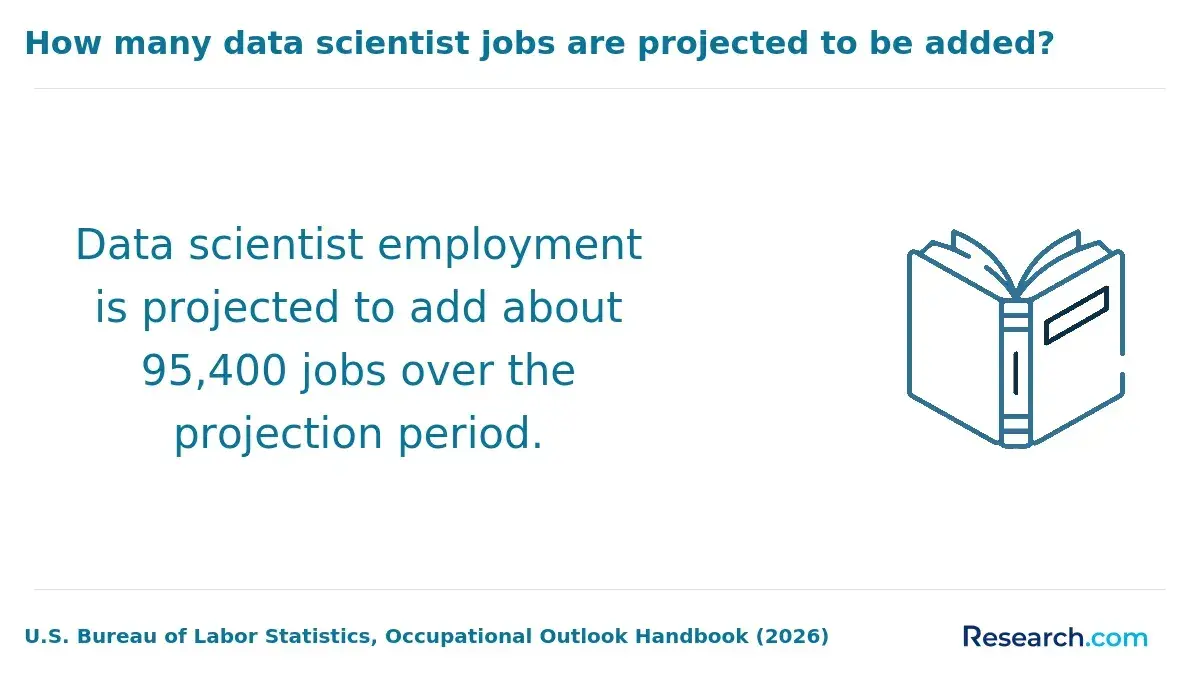
The U.S. Bureau of Labor Statistics projects 35% growth in data scientist employment from 2025 to 2035. That occupation-wide projection signals demand for the work, but it does not measure hiring outcomes for graduates of a particular master's program or guarantee an entry-level opening.
For a prospective student with a three-year bachelor's, the practical question remains whether an eligible, affordable program will develop skills that match the jobs you intend to seek. Before enrolling, compare job descriptions for your target roles with the program's required coursework and ask the school whether it publishes graduate outcomes with a clear reporting period and response rate.
Other Things You Should Know About Data Science
Often, programs allow applications before graduation, but they may require final proof of the degree before enrollment. Check the deadline for submitting your final transcript and whether an offer would be conditional.
Follow the school's instructions. Some request grades exactly as issued; others require an approved credential evaluation. An unofficial self-conversion may not be accepted.
Possibly. Waiver rules vary by institution and may depend on where or in what language you studied. Ask for the specific policy rather than assuming your degree qualifies you for a waiver.
Briefly provide context if it helps an admissions reader understand your academic path, but keep the statement focused on your preparation and goals. Submit any formal equivalency evidence through the process the university specifies.
References
- Application Process | UCLA MASDS https://master.stat.ucla.edu/application-process.html
- Master of Science in Applied Data Science | CSUSB https://catalog.csusb.edu/colleges-schools-departments/natural-sciences/computer-science-engineering/applied-data-ms/
- Required Academic Credentials from Non-U.S. Institutions | umich.edu https://academicservices.engin.umich.edu/required-academic-credentials-from-non-u-s-institutions/
- Graduate Admission Requirements | University of Cincinnati Admissions https://www.admissions.uc.edu/apply/graduate/requirements.html
- Admissions: Graduate Students | General Information https://catalog.nyit.edu/general_information/admissions_graduate/
- Equivalence of a U.S. Bachelor's Degree | Syracuse University https://www.syracuse.edu/admissions-aid/application-process/international/graduate/equivalence-us-bachelors/
- Master's Degree - Data Science - On Campus | Monroe University https://www.monroeu.edu/academics/king-graduate-school/masters-degree-data-science
- How Much Do Data Scientists Need to Know About Statistics? | virginia.edu https://datascience.virginia.edu/news/how-much-do-data-scientists-need-know-about-statistics
- Computational & Data Science | The University of Utah https://psm.utah.edu/degree-programs/comp-data-sci.php
- Three-year Bachelors Degrees | The Graduate School https://grad.ncsu.edu/faculty-and-staff/three-year/


