2027 Data Lakehouses in an Online Data Science Master's: Courses, Projects, and Program Selection

Co-Founder and Chief Data Scientist
A data lakehouse can be a useful part of a data science master's curriculum - but seeing the term on a program page does not tell you how deeply students learn it. If you want to work with large, evolving datasets, compare programs by the courses that teach data architecture, the projects that require you to build reliable pipelines, and the support available to online students.
This guide shows you what to look for and when a broader or more specialized degree may be the better choice.
Key Things You Should Know
- Look beyond the word "lakehouse": substantive training connects data storage and processing with SQL, governance, and machine learning workflows.
- Prioritize a project that moves data from ingestion to a documented, reproducible analysis; a tool demonstration alone provides weaker evidence of skill.
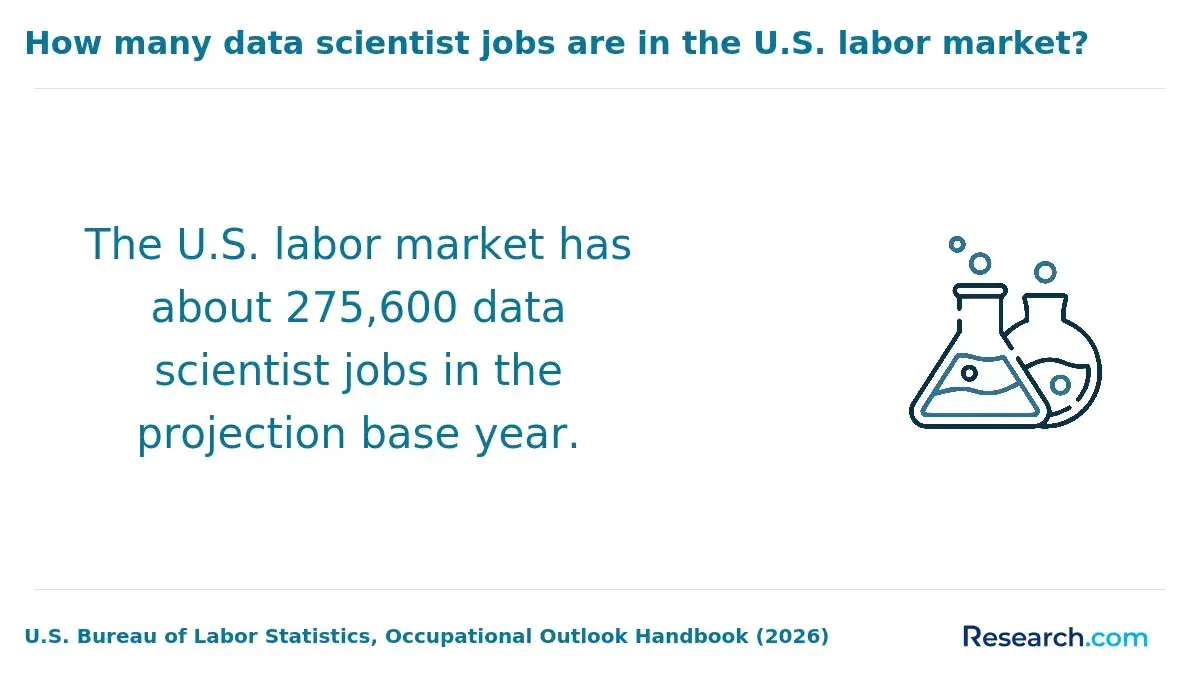
- The U.S. Bureau of Labor Statistics reports a $120,230 median annual wage for data scientists in May 2025, but that occupation-wide figure is not a predicted graduate salary.
What Are Data Lakehouses in Data Science?
A data lakehouse is an approach to storing and managing data that combines flexible storage for varied data types with features commonly associated with analytical databases, such as structured tables, reliable updates, and controlled access. For data scientists, the goal is to make raw and prepared data usable across exploration, reporting, and model development without losing track of how it was produced.
Studying the subject at graduate level means more than learning a platform name. Students should be able to explain data formats and table management, design ingestion and transformation workflows, evaluate data quality, and decide how analysts and models will access the resulting datasets. The distinction matters because a model can perform poorly - or be impossible to reproduce - when its underlying data is inconsistent or undocumented.
Why Study Data Lakehouses in an Online Data Science Master's?
Lakehouse training is most valuable if you expect to work on data science projects where data must be collected, updated, shared, and governed - not merely downloaded as a clean file. It helps connect modeling decisions to the engineering work that makes a model usable. An online master's can provide structured practice alongside statistics and machine learning, particularly when courses share datasets or build toward a substantial project.
It is less central if your goal is primarily theoretical modeling or research using established datasets. In that case, advanced statistics or machine learning coursework may deserve more room in your schedule. Students especially interested in responsible use of shared data can also compare program comparisons for AI ethics master's tracks; governance coursework complements, but does not replace, hands-on data architecture.
Which Data Lakehouse Courses Should an Online Master's Include?
Lakehouse skills may appear across several courses rather than in one titled "Data Lakehouses." The course combinations below show the depth to seek in syllabi, assignments, and elective descriptions.
| Course area | What substantive coverage would include | Why it matters |
| Databases and data management | SQL, data modeling, storage choices, and data quality | Establishes how trustworthy analytical tables are organized |
| Data engineering or distributed computing | Ingestion, transformation, orchestration, and scalable processing | Connects source data to repeatable analytical workflows |
| Cloud data systems | Access controls, storage and compute decisions, and operational trade-offs | Shows how a design works beyond a classroom dataset |
| Machine learning operations or applied ML | Reproducible features, model inputs, and monitoring considerations | Links managed data to downstream model use |
A catalog mention may signal only one lecture. A dedicated course provides more time for design and implementation; an advanced elective or multi-course project can add meaningful depth. Request recent syllabi and check whether students build and test workflows, not just compare products. If your main interest is modeling rather than data architecture, online graduate ML programs with lower total tuition may offer a more appropriate comparison set.
What Projects Build Data Lakehouse Skills in Online Master's Programs?
A strong project solves an analytical problem while showing how data reaches the analysis. For example, a student could combine regularly updated public datasets, retain raw inputs, create validated tables, and use those tables for a forecasting or classification task. The valuable evidence is the complete workflow, not the size of the dataset or the number of tools named.
When reviewing project opportunities, look for assignments or capstones that require these connected deliverables:
- A defined question, documented data sources, and a reason for the chosen storage and processing design.
- Repeatable ingestion and transformation steps, with checks for missing, duplicated, or changed records.
- Clear access or privacy decisions and a record of which data version supports each result.
- An evaluation of both analytical performance and operational limits, such as update failures or processing cost.
- Code, documentation, and a presentation that another person could use to review or reproduce the work.
Ask whether online students can choose datasets, obtain appropriate computing access, and receive feedback on architecture as well as modeling. A capstone that permits only a pre-cleaned dataset may still teach valuable analysis, but it offers less direct lakehouse practice.
How Do Online and Campus Data Science Master's Programs Compare?
Delivery format does not establish technical depth. An online program may offer the same courses as its campus counterpart, or a different curriculum; verify the actual requirements. The practical difference is often how students access computing environments, collaborate on pipeline projects, and get help when a workflow fails.
Online study may suit a working professional who can attend scheduled sessions and complete collaborative work remotely. Campus study may be preferable if in-person lab access, face-to-face project work, or local recruiting is important to you. Before choosing, ask both programs about live attendance, time-zone expectations, group-project scheduling, cloud or lab access, and instructor feedback. For a broader look at scheduling fit, see data science graduate programs for working students.
What Are the Admission Requirements for Online Data Science Master's Programs?
Requirements vary by institution. Programs may evaluate a bachelor's degree, quantitative preparation, programming ability, professional experience, statements, recommendations, or standardized tests. Do not assume that knowing a lakehouse product either fulfills an admissions prerequisite or is required for entry.
For lakehouse-focused study, preparation in Python or another programming language, SQL, statistics, and basic data structures is especially useful. If you lack one of these, check the program's published prerequisite policy: a preparatory course can strengthen your readiness without necessarily satisfying a formal requirement. Ask admissions staff which prerequisites must be completed before enrollment and which can be taken during the degree.
How Much Do Online Data Science Master's Programs Cost and Take?
There is no dependable single price or completion time for an online data science master's. Credit requirements, tuition rates, mandatory fees, course availability, and study pace differ by program and can change. A useful comparison multiplies the required credits by the applicable tuition rate, adds mandatory fees, and then accounts for any separately billed materials, computing, or travel.
Lakehouse-intensive coursework raises a specific cost question: who pays for cloud processing and storage used in assignments? Ask whether credits, managed labs, or spending limits are included. Also confirm whether required courses run often enough for your planned pace; a low published tuition figure is less useful if scheduling extends the time you expect to enroll. Compare the resulting total with adjacent options, including cost-conscious artificial intelligence study options, while checking whether those options actually teach the data systems you need.
What Careers and Salaries Follow Data Lakehouse Training?
Lakehouse experience can support work in data engineering, analytics engineering, machine learning engineering, or data science, depending on the rest of your skills. Data engineers typically emphasize pipelines and reliable data delivery; data scientists typically emphasize analysis and modeling. Actual job titles and qualifications vary by employer.
The U.S. Bureau of Labor Statistics reports that the median annual wage for data scientists was $120,230 in May 2025. That is a benchmark for the occupation, not a salary attributable to lakehouse training or a master's degree. Prior experience, responsibilities, location, and industry all affect offers. Use industry choices and data science earning potential as context when weighing roles, rather than treating an occupation-wide median as your likely starting pay.
What Is the Job Outlook for Data Science and Data Engineering Careers?
The Bureau of Labor Statistics projects U.S. data scientist employment to grow 35% from 2025 to 2035. That points to substantial occupation-wide demand, but it does not measure openings specifically for lakehouse specialists or guarantee a job for graduates. Data engineering roles do not all fall under one BLS occupation, so applying the data scientist projection to every data engineering title would be misleading.
For career planning, read postings for your target role and identify whether employers ask for pipeline development, SQL, cloud platforms, model deployment, or a combination. Favor programs and projects that let you demonstrate the recurring requirements, rather than selecting a degree solely because one occupation has a strong growth projection.
How Can You Choose an Accredited Online Data Science Master's?
Start by verifying the institution's accreditation through the institution and its accreditor, then confirm that the program can enroll students in your state. Accreditation is an institutional quality check, not proof that a particular degree teaches lakehouses well. Curriculum and project evidence must answer that separate question.
A shortlisting process works best when it tests the claims most likely to affect your decision:
- Confirm accreditation, state enrollment eligibility, degree requirements, and the current tuition and fee schedule.
- Request recent syllabi and identify where students actually implement data ingestion, table management, quality checks, and analytical use.
- Ask to see permitted examples or descriptions of online project outcomes, including how computing access and technical feedback work.
- Compare the required courses and electives against the role you want; do not mistake a platform logo or single lecture for substantial training.
Choose the program with the strongest verified combination of technical depth, achievable project work, scheduling fit, and affordable total cost for your goals - not simply the one with the most prominent technology name on its website.
Other Things You Should Know About Data Science
Not necessarily. Local and open-source tools can help you practice data ingestion, table management, and reproducibility. Check whether a course requires a specific paid environment before spending money.
A certification can document familiarity with a platform, but it usually covers a narrower set of skills than a graduate curriculum. Choose based on the roles you want and whether you need broad statistical and computing preparation or focused platform practice.
Only if you have appropriate permission and meet your employer's confidentiality and data-handling rules. If publication is restricted, discuss a public-data alternative with your instructor before starting the project.
That depends on where course workloads run. Programs that provide remote computing environments may place fewer demands on your device. Ask for current hardware requirements and whether cloud access is included before buying equipment.
References
- Building a healthcare data warehouse - PMC - NIH https://pmc.ncbi.nlm.nih.gov/articles/PMC12748234/
- Data Lakehouse: A survey and experimental study | sciencedirect.com https://www.sciencedirect.com/science/article/pii/S0306437924001182
- Course Info | CDS https://codas.uchicago.edu/course-info/
- The Lakehouse: State of the Art on Concepts and Technologies | springer.com https://link.springer.com/article/10.1007/s42979-024-02737-0
- What is Microsoft Fabric - Microsoft Fabric https://learn.microsoft.com/en-us/fabric/fundamentals/microsoft-fabric-overview
- What is a data lakehouse? | Engineering | ClickHouse https://clickhouse.com/resources/engineering/data-lakehouse
- From SQL & Python to PySpark, Delta Lake & Lakehouse | SQL School https://sqlschool.com/databricks-training-course-from-sql-python-to-pyspark-delta-lake-lakehouse/