2027 CU Boulder Online MS-DS vs. Rice Online MDS: Cost, Curriculum, Admissions, and Format

Co-Founder and Chief Data Scientist
CU Boulder's online Master of Science in Data Science (MS-DS) and Rice's online Master of Data Science (MDS) present different decisions for working adults: how to enter, what to study, how to schedule it, and what the degree will cost.
This comparison separates established program differences from details that need a current quote or policy check, so you can identify the better fit without treating an advertised tuition figure or a data scientist's salary as a promised outcome.
Key Things You Should Know
- CU Boulder offers a performance-based route through designated courses; confirm Rice's current application requirements directly rather than assuming the same route applies.
- Compare a written, degree-completion estimate from each school. A current, equivalent total for both programs cannot be verified here, so a precise price gap would be misleading.
- CU Boulder's 30-credit, self-paced model favors scheduling control; Rice may appeal to students seeking its particular course and faculty experience, but confirm live-session, project, and support expectations before choosing.
How do CU Boulder Online MS-DS and Rice Online MDS compare?
The clearest established difference is how students can begin: CU Boulder uses performance-based admission, while Rice's current application process should be checked against its published requirements.
The table keeps confirmed CU features separate from Rice details that require confirmation:
| Decision factor | CU Boulder online MS-DS | Rice online MDS |
| Entry route | Earn admission through designated pathway coursework at the required standard | Confirm current application materials and admissions criteria |
| Academic requirement | 30 graduate credits | Confirm the current catalog's credit and graduation requirements |
| Scheduling proposition | Self-paced online coursework offers substantial control over when to study | Confirm course calendars, deadlines, and any required live participation |
| Best reason to investigate | You want to demonstrate readiness in coursework before committing to the full degree | You want Rice's specific curriculum and learning experience, subject to confirming their fit |
Neither degree title, by itself, establishes stronger technical training. Compare required courses and the work you will produce. If your target is more business analytics than data science, you can also compare data analytics master's degrees before committing to either option.
What does each online data science master's curriculum include?
CU Boulder's MS-DS combines graduate-level data science coursework with room for electives within its 30-credit requirement. Its pathway courses also let prospective students test the academic work before completing the degree.
For Rice, use the current online MDS degree plan, not a general description of the university's data science offerings, to identify required courses, electives, prerequisites, and any culminating project.
Compare syllabi for actual work in programming, statistics, machine learning, data management, and communicating results. A course title does not reveal how much coding, mathematical reasoning, or independent project work it requires.
If advanced AI is your goal, check whether either degree offers the preparation you need; some programs offering foundations for an AI master's may be a better match for a specific preparation gap.
How much do CU Boulder Online MS-DS and Rice Online MDS cost?
A reliable 2026 price comparison needs current figures from both institutions, calculated on the same basis. A verified, like-for-like total is not available here. Do not treat an older advertised tuition figure for either degree as your enrollment-year bill.
Request an itemized estimate for the pace and start date you intend to use. It should separate these costs:
- Tuition: The applicable rate multiplied by every credit or course required to graduate, including any admission-pathway coursework that counts toward the degree.
- Required charges: University, course, platform, or graduation fees, if applicable.
- Variable expenses: Books, software, equipment, financing costs, and any travel your chosen activities require.
Then ask about employer reimbursement, scholarships, payment timing, and financial-aid eligibility. The lower tuition quote is not necessarily the lower total cost, especially if fees differ or a schedule would require you to reduce paid work.
Avoid calculating "payback" from an occupation-wide salary: your likely salary change depends heavily on your existing role and experience.
What are the admission requirements for each online data science program?
For either school, preparation in programming, calculus, linear algebra, and statistics can make graduate study more manageable; that advice is not a claim that each subject is a formal prerequisite. Ask admissions which gaps must be resolved before entry and which can be addressed during the program.
CU Boulder's Its performance-based admission route evaluates results in designated pathway courses rather than relying on a conventional application as the sole entry gate.
Check the current pathway list, minimum grade standard, enrollment instructions, and how completed credits apply before registering. Admission through a pathway is not the same as automatic degree completion.
For Rice, obtain the current online MDS admissions checklist directly from the program. Verify degree eligibility, transcripts, technical preparation, recommendations, testing policy, deadlines, and whether requirements differ for your applicant category. Do not assume that Rice accepts CU Boulder-style pathway coursework in place of its own application process.
How long do the CU Boulder and Rice online programs take?
CU Boulder's 30-credit requirement and self-paced delivery let students vary their course load, so a single completion time would obscure the effect of work and other commitments.
For Rice, request the current course rotation and a degree plan for your intended pace; a marketed completion timeframe may assume courses are taken in a particular sequence.
Before enrolling, map required courses onto a calendar that includes your busiest work periods. Confirm the maximum time allowed to finish, whether courses run every term, and what happens if you pause.
If speed matters more than a data science degree specifically, AI graduate programs that can take less than two years offer a separate comparison - but assess their subject matter as well as their timelines.
How do the online formats differ for flexibility and student support?
CU Boulder's self-paced model is attractive if your work hours change or you cannot reliably attend a weekly class. The trade-off is that you must create your own study routine. Do not infer that "online" means every assessment can be completed at any time.
For Rice, distinguish recorded content from required live meetings and fixed submission deadlines. Ask both programs how students receive instructor feedback, technical help, academic advising, and career support.
A scheduled class can provide useful structure, but it is a poor fit if required sessions conflict with your time zone or shift work. Get the participation and assessment policies for actual courses, not just a general online-learning description.
What careers can graduates pursue after either data science master's?
Depending on previous experience and the projects completed, either degree could support applications for data scientist, machine learning, analytics, or data-focused engineering roles.
A master's alone does not establish readiness for every position: employers may also expect production coding, domain expertise, or experience working with real organizational data.
Choose projects that demonstrate the work your target job requires, then compare each program's course options against job descriptions. For a healthcare focus, privacy constraints and domain knowledge matter alongside modeling skills; AI master's programs for healthcare technology careers provide another route to evaluate.
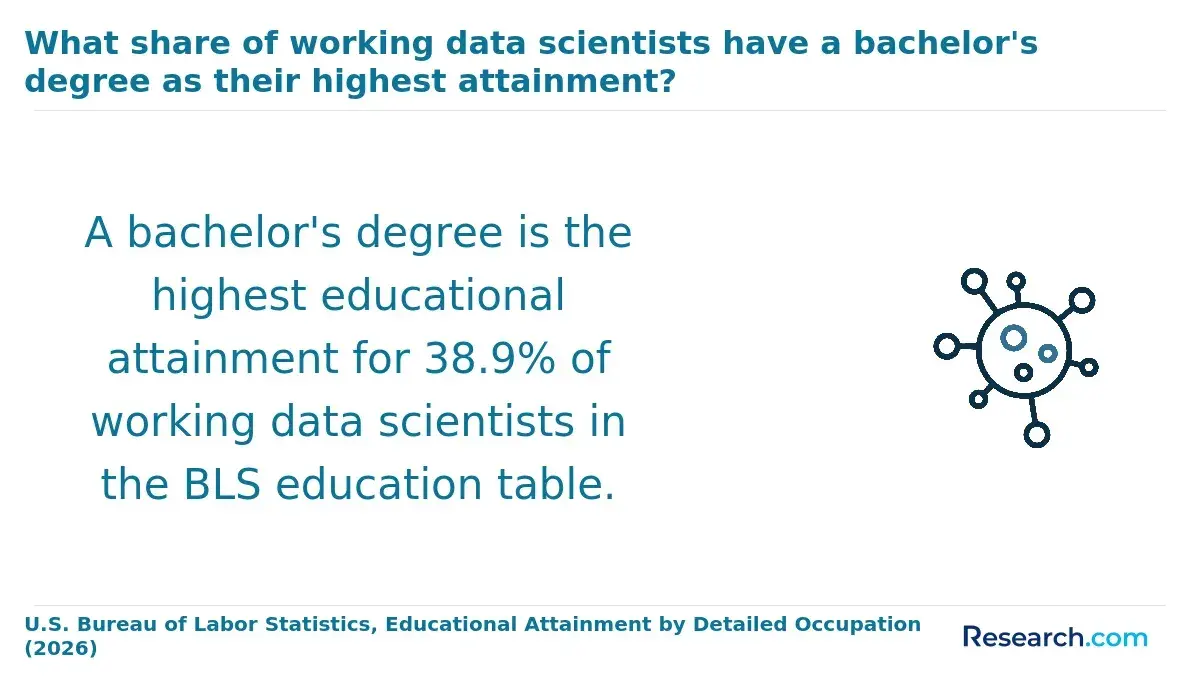
The U.S. Bureau of Labor Statistics projects 35% growth in data scientist employment from 2025 to 2035, but growth across an occupation does not predict an individual graduate's hiring prospects.
What salaries can graduates expect with an online data science master's?
The U.S. Bureau of Labor Statistics reports a $120,230 median annual wage for data scientists in May 2025. That is an occupation-wide benchmark, not an expected starting salary for graduates of CU Boulder or Rice and not evidence that either degree causes a particular pay increase.
For a useful personal comparison, start with your current compensation and examine advertised pay for roles you could realistically pursue after graduation.
Account for location, industry, prior experience, and whether you are entering data science or advancing within it. These factors can matter more than the degree's name; pay comparisons for graduates entering data science industries can help frame the industry part of that decision.
How do accreditation and professional standards apply to these degrees?
CU Boulder and Rice are accredited universities. Institutional accreditation matters when evaluating a graduate credential, but it does not certify that the two online curricula teach identical skills or provide identical career services.
Verify each institution's current accreditation status through the university or its institutional accreditor if it is a condition of your employer's tuition benefit.
Data scientist is not generally a state-licensed occupation. Instead of looking for a licensing pathway, inspect how each program teaches responsible data use, model evaluation, and communication of limitations. Those practices matter when work involves sensitive information or decisions affecting other people.
Which online data science master's program should you choose?
Choose CU Boulder for further consideration if performance-based entry and substantial control over study pace solve your biggest barriers.
Choose Rice for further consideration if its verified courses, teaching arrangements, and support better serve your goals - and its full cost and schedule work for you. There is no defensible universal winner without a current Rice degree plan and equivalent written cost estimates.
Before paying a deposit or starting pathway coursework, make the same final check for both schools: obtain the current graduation requirements and course schedule, price the entire degree including required charges, and ask to see the participation and project expectations.
A common mistake is choosing by institutional reputation or an advertised tuition figure while leaving the actual weekly workload and total bill unexamined.
Other Things You Should Know About Data Science
Do not assume either answer from the program's marketing page. Ask each registrar how the degree title appears on the diploma and official transcript if that distinction matters to you.
Transfer or prior-learning policies are program-specific. Send each school the course syllabus and transcript, and obtain a written determination before subtracting any credits from your cost estimate.
That depends on your employer's benefit rules and the school's billing arrangements. Check reimbursement limits, grade requirements, payment deadlines, and whether you must pay upfront.
Online access does not automatically establish eligibility from every location. Ask the program about enrollment restrictions, assessment access, time zones, and any location-dependent services before applying or registering.
References
- Cost of Attendance (Budget) | 2025-2026 Federal Student Aid Handbook https://fsapartners.ed.gov/knowledge-center/fsa-handbook/2025-2026/vol3/ch2-cost-attendance-budget
- How It Works | Computer Science | Student Support & Advising Services https://www.colorado.edu/cs/academics/online-programs/how-it-works
- What Is a Capstone Project? | FNU https://www.fnu.edu/what-is-a-capstone-project/
- What's the Difference Between Asynchronous and Synchronous Learning? | Ohio State Online https://online.osu.edu/content-hub/blogs/whats-the-difference-between-asynchronous-and-synchronous-learning/
- Determine Credit Hours: Create a New Course | iu.edu https://facultystaffcentral.indianapolis.iu.edu/classes/create-course/credit-hours.html
- How Much Should We Assign? Estimating Out of... - Rice CTE https://cte.rice.edu/blog/2016/workload
- What Does Asynchronous Mean? A Simple Guide to Online Learning Formats - Professional Development at Charlotte https://professional.charlotte.edu/what-does-asynchronous-mean-a-simple-guide-to-online-learning-formats/
- How Many Credits Do You Need to Graduate College? | snhu.edu https://www.snhu.edu/about-us/newsroom/education/how-many-credits-to-graduate-college
- MSA Curriculum | Master of Science in Analytics - Georgia Tech https://www.analytics.gatech.edu/curriculum/msa-curriculum
- Data Science: Applied Statistics Emphasis | The University of Arizona https://www.arizona.edu/degree-search/majors/data-science-applied-statistics-emphasis