2027 Berkeley MIDS vs. Pace Online MS in Data Science: Cost, Curriculum, Admissions, and Format

Co-Founder and Chief Data Scientist
Berkeley MIDS and Pace's online MS in Data Science offer different paths for working adults, but a familiar university name or a promising course list is not enough to choose between them. The consequential differences are what you will pay, which skills you will practice, and whether required activities fit your schedule.
This comparison separates established program distinctions from details that need a current quote or catalog check, so you can decide which offer is worth pursuing.
Key Things You Should Know
- Berkeley MIDS awards a Master of Information and Data Science; Pace awards an MS in Data Science. Compare the actual courses and projects, not just the degree titles.
- Do not compare tuition-only figures with all-in estimates. Obtain each school's current charge per credit or unit, required fees, and total academic requirements before judging cost.
- Berkeley's live-class model makes meeting times especially important; confirm Pace's current live-session rules and both programs' project, travel, and completion requirements before enrolling.
How do Berkeley MIDS and Pace's Online MS in Data Science compare?
The clearest established distinction is the credential: Berkeley's Master of Information and Data Science (MIDS) is offered through its School of Information, while Pace offers a Master of Science in Data Science. Neither title, by itself, establishes greater technical depth or better employment outcomes. For an applicant, the useful comparison is the coursework, required projects, schedule, and complete price attached to each degree.
The table identifies what can be compared directly and where a current program document is needed. Treat an unanswered item as a question for admissions, not as an advantage for either school.
| Decision point | Berkeley MIDS | Pace online MS in Data Science |
| Credential | Master of Information and Data Science | Master of Science in Data Science |
| Institution | University of California, Berkeley | Pace University |
| Online scheduling | Account for scheduled live instruction; confirm available section times | Confirm which courses have live meetings and when they occur |
| Comparable cost | Request tuition, required fees, and any travel costs for your enrollment plan | Request the same categories for your enrollment plan |
| Technical fit | Check required courses, elective availability, and project scope | Check the same items against the same target role |
A strong choice depends less on which program has the broader description and more on whether its required work develops skills you cannot already demonstrate.
What are the tuition costs and total expenses for each data science master's?
A defensible current tuition-total comparison requires each school's published rate for your entry term and the number of billable credits or units you will take. Without matching current schedules and fee policies, a precise Berkeley-versus-Pace total - or a claim that one is cheaper - would be unreliable. Ask both schools for a written estimate based on the same intended pace.
Separate the charges below rather than relying on a single advertised figure. This is particularly important if a quote omits expenses that depend on how you attend.
- Tuition: Multiply the applicable per-credit or per-unit rate by the required coursework, accounting for any additional courses you may need.
- Required fees: Ask which technology, student, graduation, or other charges are mandatory and whether they recur each term.
- Situational expenses: Budget separately for books, equipment, travel if required, and interest if you borrow.
- Work-related costs: Consider whether the schedule would force reduced hours, unpaid leave, or missed shifts; subtract confirmed employer assistance from your personal estimate.
Request a term-by-term bill, not just a tuition rate. If one estimate includes fees and the other does not, normalize them before comparing. Financial aid eligibility and employer reimbursement rules also deserve confirmation before treating an award or benefit as available money.
Which program has the stronger data science curriculum and specializations?
Neither degree title proves a stronger curriculum. Berkeley MIDS comes from an information school; Pace's degree is explicitly an MS in Data Science. Those are useful starting points for reading the catalogs, not substitutes for comparing required technical work.
For each program, inspect the current syllabi or course descriptions for statistics, programming, data management, machine learning, responsible data use, and substantial applied work. Then distinguish a topic briefly covered in a required course from a dedicated advanced elective you can actually take during your enrollment. Elective availability, prerequisites, and project supervision can matter more than a long list of course names.
Someone aiming for data engineering should prioritize pipelines and data systems; an aspiring model developer should look closely at statistical foundations, evaluation, and implementation. If your goal is broader analytics rather than a data scientist role, review data analytics master's degree options before assuming either of these degrees is the closest fit.
What are the admission requirements for Berkeley MIDS and Pace?
Check each program's current application page for its degree requirement, transcripts, recommendations, essays, English-language policy where applicable, and any test or technical-preparation rules. Requirements can change by entry term. Do not assume that a GRE score, a computer science bachelor's degree, or professional experience is either mandatory or sufficient without checking the relevant program's stated policy.
Even where a subject is not a formal prerequisite, readiness matters. Applicants with limited programming or statistics experience should ask how their prior coursework, work projects, or independent study will be assessed - and which skills they should strengthen before the first term. A preparation course is not automatically a waiver of an admissions requirement. For applicants weighing a more AI-focused route, AI master's programs with bridge courses offer another model for addressing background gaps.
How do the online formats differ between Berkeley MIDS and Pace?
Berkeley MIDS uses live online instruction, so scheduled class times are a meaningful constraint for students balancing work, caregiving, or time zones. Do not assume that every online course at Pace is self-paced: obtain its current schedule and identify which activities require attendance at a set time. For both programs, ask whether group meetings, exams, presentations, or any in-person activities add obligations beyond regular class meetings.
The practical test is to put a proposed first-term schedule next to your work calendar. A program can be fully online yet still be a poor fit if its meetings repeatedly conflict with shifts or if project teams must meet when you are unavailable. Conversely, live discussion may be valuable if you want a predictable class routine and regular interaction. Verify any travel requirement directly rather than assuming "online" means no travel.
How long does each data science master's program take to complete?
Completion time depends on the academic requirements, course sequence, available start dates, and how many courses you take each term. A school's fastest advertised path may not be realistic alongside full-time work. Ask each program for a sample schedule at the pace you can sustain, including when required courses and your final project are offered.
Also ask what happens if you take a term off or cannot get a needed course: the answer may change your actual finish date more than a headline timeline. If speed is your overriding priority, use a guide to shorter online data science master's degrees to put both options in context, then verify each candidate's feasible - not merely fastest - schedule.
What careers and salaries can graduates expect from each program?
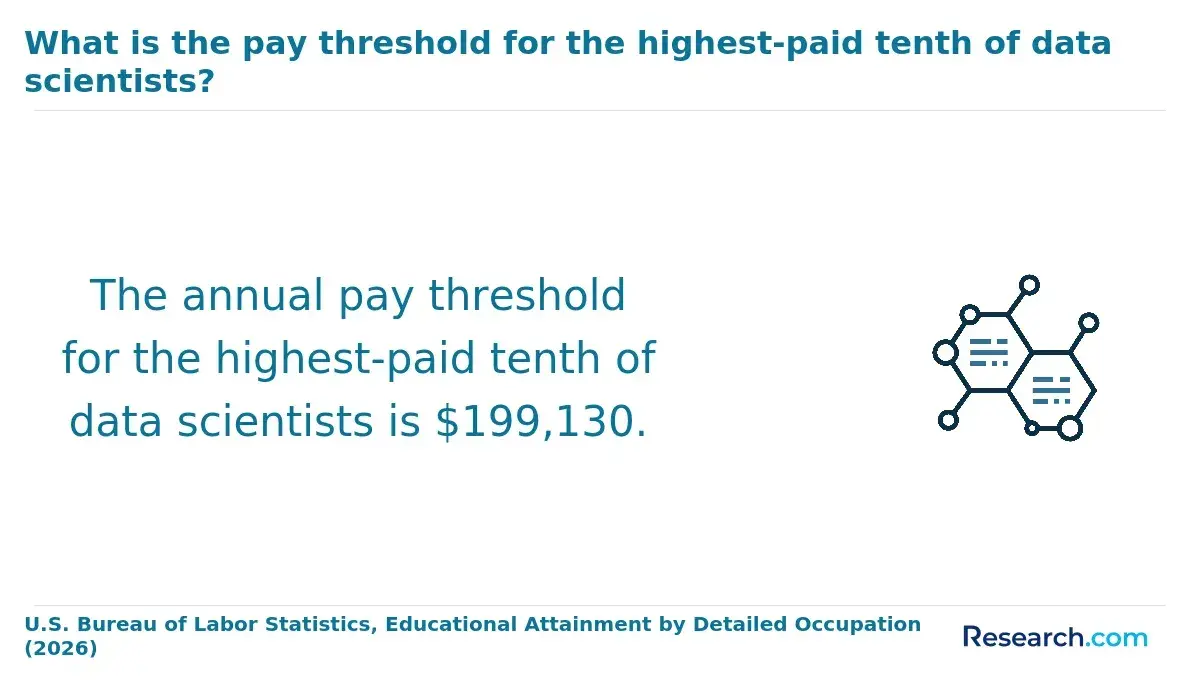
Both degrees can support applications for data-focused roles, but neither guarantees a particular job or salary. The U.S. Bureau of Labor Statistics reports a $120,230 median annual wage for data scientists in May 2025. That is a national occupational median, not an entry-level offer, a Berkeley or Pace graduate outcome, or the salary increase caused by either degree.
Compare each program's projects and career support against the jobs you intend to pursue. A student targeting analytics leadership may value stakeholder-facing projects differently from someone targeting machine-learning implementation. If clinical applications are your aim, examine how a program handles healthcare data, privacy, and domain-specific projects; AI master's degrees relevant to clinical data work provide an adjacent comparison.
When requesting graduate outcomes, ask for the reporting period, number of respondents, prior experience, and whether figures describe salaries or salary changes. Without comparable, transparent program-level evidence, the BLS median cannot establish which degree produces better results.
How do Berkeley and Pace compare on accreditation and degree recognition?
These are degrees from different universities, with different institutional reputations and alumni communities. Rather than treating name recognition as a complete quality measure, confirm each institution's current accreditation in the U.S. Department of Education or recognized accreditor's directory, and check any employer policy that matters to you. Institutional accreditation does not certify that two data science curricula teach the same skills.
Recognition can matter most when it helps you reach a particular employer, professional community, or geographic network. Ask each school which alumni and career services online students can use, then seek evidence of relevant connections rather than assuming a university's overall reputation translates into access to your target field.
Which program offers better value for working professionals?
The better value is the program whose incremental benefits justify your personal cost and scheduling burden. Berkeley MIDS may be worth a higher verified net cost to a student who specifically wants its instruction, projects, and professional network. Pace may be the better purchase if its confirmed curriculum meets the same career goal at a lower verified net cost or with a more workable schedule. Neither conclusion should be drawn from brand or an incomplete tuition quote alone.
Define the benefit before calculating a return: is it a transition into technical work, stronger performance in your current role, or access to a network? Then compare net expense, time you can commit, and the evidence each school offers for that benefit. Alumni access is worth testing through conversations with graduates in your target role; artificial intelligence master's alumni communities illustrate why the usefulness of a network depends on the connections you can actually make.
A common mistake is to apply the national data scientist salary to a graduate's projected earnings and call the difference "ROI." Your prior salary, experience, location, target role, and employer are all relevant; the degree alone does not cause the occupational median.
How should students choose between Berkeley MIDS and Pace Online?
Make the choice from comparable documents and a realistic weekly calendar. These steps turn broad program descriptions into a decision you can defend:
- Choose a target role and identify the technical and applied skills your current résumé does not yet demonstrate.
- Request each program's current course plan, project requirements, elective schedule, and a sample timetable at your intended pace.
- Get written, term-by-term cost estimates covering tuition and required fees; add your own financing, equipment, and any travel or lost-work costs.
- Confirm live-attendance, group-work, and in-person requirements against your work and caregiving schedule.
- Speak with admissions and, if possible, recent graduates about the specific courses and career support relevant to your goal.
Choose Berkeley MIDS if its verified learning experience and network justify its full cost and scheduled commitments for you. Choose Pace if its verified courses and projects meet your goal with a better financial or scheduling fit. If neither provides the technical depth, price, or flexibility you need, keep looking rather than forcing a choice between two names.
Other Things You Should Know About Data Science
Yes, if you can explain your contribution, methods, results, and limitations without disclosing confidential information. Ask the program whether such work can also inform a course or final project; approval is not automatic.
Wait for the program's current equipment and software guidance. Required tools, remote-computing access, and minimum specifications may affect what you actually need.
Confirm eligibility directly with the program before applying. Enrollment availability, live-class time zones, and any in-person requirements may affect your plans.
That depends on your employer's policy. Check annual limits, grade requirements, approved-school rules, reimbursement timing, and any obligation to remain employed after payment.
References
- What Can I Do With a Degree in Data Science? Career Paths & Skills | Harvard SEAS https://seas.harvard.edu/news/what-can-i-do-degree-data-science-career-paths-skills
- Required Materials - Admissions | Northeastern https://admissions.northeastern.edu/application-information/required-materials/
- UC Berkeley iSchool Online Master's in Data Science (MIDS) https://ischoolonline.berkeley.edu/data-science/
- Balancing Synchronous and Asynchronous Activities | Teaching Commons https://teachingcommons.stanford.edu/teaching-guides/remote-teaching-guide/online-learning-activities/balancing-synchronous-and
- Importance of Software Skills in Data Science | virginia.edu https://datascience.virginia.edu/news/importance-software-skills-data-science
- Tuition & Financial Aid | MS in Data Science - Pace Online https://online.pace.edu/graduate-programs/ms-in-data-science/tuition-and-financial-aid/