Most Affordable Welding Schools & Training - Budget-Friendly Welding Trade Programs in Phoenix for 2026

Co-Founder and Chief Data Scientist
Welding school is a practical investment: you are comparing program cost, schedule, hands-on training time, certification preparation, and how quickly the credential can lead to paid work. This 2026 guide focuses on affordable welder trade schools in Phoenix for students who want job-ready training without taking on unnecessary expense.
The Research.com team developed this ranking to help readers identify programs worth closer review. Use it as a starting point for comparing tuition, program length, training format, admissions requirements, financial aid, and career outcomes. Before enrolling, confirm current costs, accreditation, certification preparation, and placement support directly with each school.
This guide is for first-time students, career changers, working adults, and current tradespeople who want to add welding skills. It explains what Phoenix welding programs typically include, what graduates can earn, where they can work, and how to choose a program that fits your budget and career goals.
Key benefits of finishing welder trade school in Phoenix
- Graduates from welder trade schools in Phoenix can expect an average salary around $20.86 per hour, with many earning between $43,000 and $48,400 annually. That makes welding a realistic path for students who want a faster route into skilled work than a traditional four-year degree.
- Welding training can lead to entry-level jobs and, with experience, specialized roles such as tower or shipyard welding. These paths may offer higher wages because they require stronger technical skill, safety awareness, and the ability to work in demanding environments.
- Online and hybrid welder trade school options can help students balance work, family, and training. The best programs still include hands-on welding practice, because employers need graduates who can safely operate equipment, read blueprints, and produce consistent welds.
- Most Affordable Welding Schools & Training - Budget-Friendly Welding Trade Programs in Phoenix for 2026
- What can I expect from welder trade schools in Phoenix?
- Where can I work after finishing welder trade schools in Phoenix?
What can I expect from welder trade schools in Phoenix?
Welder trade schools in Phoenix usually combine classroom instruction with supervised shop practice. You can expect to study welding safety, blueprint reading, basic metallurgy, equipment setup, weld inspection, and common welding processes such as Gas Metal Arc Welding, Shielded Metal Arc Welding, Flux-Cored Arc Welding, and Gas Tungsten Arc Welding.
Programs at schools such as VTI and UTI typically emphasize hands-on repetition. That matters because welding is a skill trade: students need time under a hood to learn travel speed, angle control, heat settings, joint preparation, and how to correct defects. Classroom theory supports the work, but lab performance is what builds job readiness.
Schedule flexibility is also common in Phoenix. Some schools offer evening or weekend options for students who are employed or have family responsibilities. Program length varies, with some training paths running as intensive nine-month courses and others using shorter sessions. Before enrolling, ask how many hours are spent in the lab, which welding processes are covered, and whether the program prepares students for OSHA 10 or AWS credentials.
Where can I work after finishing welder trade schools in Phoenix?
After finishing a welder trade school program in Phoenix, graduates can pursue jobs in manufacturing, construction, fabrication, infrastructure, repair, and industrial maintenance. Many entry-level roles involve joining, cutting, fitting, or repairing metal parts while following drawings, specifications, and safety procedures.
Manufacturing employers may hire graduates to weld frames, machinery parts, brackets, assemblies, or equipment components. Construction employers may need welders for structural steel, piping, commercial buildings, and infrastructure projects. These jobs often reward workers who can read blueprints, maintain consistent weld quality, and work safely around heavy equipment.
Some graduates pursue more specialized sectors, including aerospace and automotive work. These roles may require tighter tolerances, more advanced materials such as stainless steel or titanium, and stronger certification credentials. AWS certification can be especially useful when employers need proof of skill for specific processes or positions.
In Phoenix, the welding job market hums with over 400 openings monthly, giving graduates multiple ways to turn trade school training into full-time, contract, or project-based work.
After finishing a welder trade school program in Phoenix, graduates may earn around $20.86 per hour on average. Some graduates from schools such as Lincoln Tech or Universal Technical Institute may see annual earnings near $48,000 annually, depending on employer, schedule, overtime, certification, and skill level.
Starting wages often fall between $17.55 and $23.22 per hour. Welders who gain experience, improve their technique, and qualify for more demanding work can reach the $29+ per hour range, which can push annual salaries beyond $60,000.
Pay varies by industry and jobsite. Structural work, pipe welding, rig welding, aerospace work, and jobs requiring certification may pay more than basic entry-level production welding. The Phoenix-Mesa-Scottsdale area can also offer stronger wage opportunities than some nearby towns, making the city a practical launch point for new welders.
- Admission commonly requires a high school diploma or GED. Some programs accept students as young as 16 with parental consent.
- Programs combine classroom instruction with hands-on training and typically last between 287 and 300 hours over 6 weeks to 7 months.
- Tuition varies widely, ranging from $2,070 to $7,854 at Gateway Community College and up to $18,945 at the Vocational Training Institute, including books and fees.
- Graduates may be able to pursue certifications from the American Welding Society and other organizations such as API and ASME.
- Entry-level welders in Phoenix earn between $35,000 and $45,000 annually, with higher wages available for experienced and certified professionals.
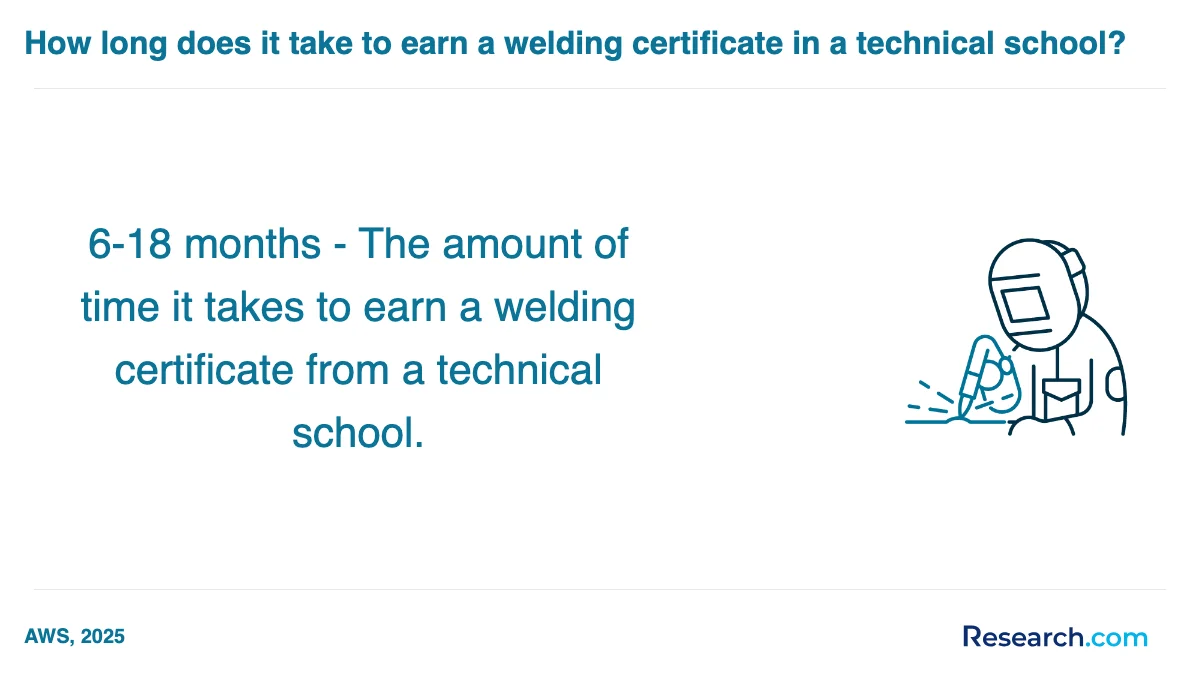
Most welder trade school programs in Phoenix can be completed in about 6 to 12 months, depending on the school, credential, course load, and schedule. Accelerated programs may suit students who can attend full time and spend long hours in the lab. Longer schedules may work better for students balancing employment, childcare, or transportation limits.
Program length is not the only factor to compare. A shorter program can be a good value if it includes enough shop time, covers the welding processes required by local employers, and prepares students for certification testing. A longer program may be worth the added time if it provides more supervised practice, broader process training, or stronger career services.
Before enrolling, ask how many total hours are required, how many are hands-on welding hours, whether make-up labs are available, and whether the school offers day, evening, or weekend options. The right timeline is the one that lets you finish without sacrificing the practice needed to become employable.
The main difference is how much of the program happens in a real welding lab. On-campus welding programs give students direct access to booths, machines, materials, safety equipment, and instructors who can correct technique immediately. That in-person feedback is important because small changes in angle, heat, speed, or fit-up can determine whether a weld passes inspection.
Online programs are usually best for theory-based topics such as safety, blueprint reading, welding symbols, basic math, and career preparation. Hybrid options, including programs associated with The Refrigeration School, Inc. and UEI College, may deliver some academic content online while requiring students to complete hands-on lab work in person.
For most students, a fully online welding program is not enough by itself. Welding employers expect practical ability, not just course completion. If you choose an online or hybrid option, verify where the lab training occurs, how many supervised welding hours are included, and whether the program prepares you for AWS or other relevant certification testing.
The cost of welder trade schools in Phoenix depends on the institution, credential length, included supplies, and certification fees. Some comprehensive programs, such as those offered by the Refrigeration School, Inc., may cost nearly $20,000 when tuition, materials, and welding gear are included. Other options, such as Gateway Community College, list tuition fees for welder trade schools in Phoenix around $4,700.
Mesa Community College charges $85 per credit hour, but students should also budget for items that may not be included in tuition. Tools and uniforms can add $500 to $1,500, and certification tests may cost another few hundred. These additional expenses matter because welding students need proper protective gear, consumables, and testing opportunities to move from training into employment.
Living costs should also be part of the decision. In Phoenix, median rents just shy of $1,000 for studios can affect whether a lower-tuition program is truly affordable. Compare the full cost of attendance, not just advertised tuition. Students researching which trades are most in demand can use welding school costs alongside wage potential to judge whether the investment fits their goals.
Financial aid for welder trade schools in Phoenix may include federal grants, scholarships, workforce funding, loans, school payment plans, and institutional aid. Availability depends on the school, program eligibility, student financial need, and whether the institution participates in specific aid programs.
Students should start by completing the FAFSA if their school is eligible for federal student aid. Pell Grants can reduce costs without repayment. Direct Subsidized Loans may also be available, with interest handled differently while eligible students are in school. Borrow only what you need, because loans must be repaid even if your job search takes time.
Other options may include a $1,000 Imagine America scholarship, the Adult Tuition Assistance Grant for qualifying non-traditional students who pass the qualifying exam, and WIOA funding that can offer up to $10,000 for Phoenix welders preparing for high-demand careers. Ask each school’s financial aid office which programs apply, what deadlines matter, and whether aid covers tools, books, testing fees, or only tuition.
Most Phoenix welder trade schools require a high school diploma or GED. Some may accept students as young as 16 with parental consent, but age rules, enrollment policies, and documentation requirements vary by school.
Students should also be prepared for basic math, reading, and measurement. Welding requires interpreting drawings, understanding dimensions, following safety instructions, and making accurate adjustments. Strong attendance and attention to detail are also important because hands-on skills build through repeated practice.
Programs may require or recommend the following:
- High school diploma or GED
- Basic math and reading skills
- Physical ability to handle equipment and stand for long periods
- Background check and drug screening, depending on the school or employer pathway
Physical readiness matters. Welders often work while standing, bending, lifting, wearing protective gear, and focusing for long periods. If you have medical or mobility concerns, ask the school what accommodations are available and what jobsite conditions graduates should expect.

Typical welder trade school courses in Phoenix are designed to move students from safety fundamentals to supervised welding practice and, in some cases, certification preparation. Students usually begin with shop safety, OSHA rules, personal protective equipment, fire prevention, ventilation, and safe handling of welding machines and materials.
Core technical courses often include blueprint reading, welding symbols, layout, measurement, basic metallurgy, joint design, cutting processes, and weld quality. These topics help students understand not only how to weld, but why a weld succeeds or fails.
Common welding process courses include:
- Gas Metal Arc Welding (GMAW/MIG) for fast, versatile welds in manufacturing and fabrication
- Shielded Metal Arc Welding (SMAW/Stick) for construction, repair, and outdoor work
- Flux-Cored Arc Welding (FCAW) for thicker materials and production settings
- Gas Tungsten Arc Welding (GTAW/TIG) for precision work on cleaner, more controlled welds
Students may practice flat, horizontal, vertical, and overhead welds, including 1F to 4F positions. Some programs also include pipe welding, fabrication, fit-up, and preparation for AWS certifications. The strongest programs provide enough lab time for students to make mistakes, correct them, and produce consistent work before graduation.
Welder trade school programs in Phoenix may offer training in several process-based and industry-based specializations. Gas Metal Arc Welding (GMAW), often called MIG welding, is widely used in manufacturing and construction because it is efficient and adaptable. Universal Technical Institute near Avondale is one example of a school associated with this type of hands-on training.
Gas Tungsten Arc Welding (GTAW), or TIG welding, is often used where precision and clean welds matter, including aerospace and automotive applications. The Refrigeration School, Inc. is associated with training that can include this process. Shielded Metal Arc Welding (SMAW), taught at schools such as Mesa Community College, remains valuable for outdoor, structural, and repair work because of its rugged flexibility.
Flux-Cored Arc Welding (FCAW) can be useful for thicker materials and production work, while pipe welding prepares students for more demanding weld positions and tighter quality expectations. Students who want to broaden their technical background can also explore affordable online maintenance technician training as a complement to welding skills.
AWS certifications can strengthen a graduate’s profile, especially when applying for jobs that require documented skill in a specific welding process, position, or material.
The best welder trade school program in Phoenix is the one that matches your budget, schedule, career target, and need for hands-on training. Do not choose based on tuition alone. A low-cost program that lacks lab time, certification preparation, or employer connections may be less valuable than a slightly more expensive option with stronger outcomes.
Compare programs using these factors:
- Hands-on lab hours: Welding is learned by doing. Ask how much time students spend in booths and what materials they practice on.
- Processes covered: Look for training in Gas Metal Arc Welding, Shielded Metal Arc Welding, and any specialized processes tied to your goals.
- Instructor experience: Instructors with field experience can explain jobsite expectations, safety habits, and common mistakes.
- Certification preparation: Programs that prepare students for American Welding Society credentials may improve employment options.
- Schedule and location: Night classes, weekend labs, and nearby campuses in places like Glendale can make completion more realistic for working adults.
- Career services: Ask about employer partnerships, job placement help, resume support, and graduate hiring outcomes.
If you need additional flexibility, you can compare local training with diploma programs online, but remember that welding still requires in-person practice to build job-ready skill.

Welder trade school graduates in Phoenix can pursue several career paths, from entry-level production welding to specialized fabrication, construction, and inspection roles. Many begin as MIG, TIG, stick, or flux-cored welders in fabrication shops, manufacturing plants, construction firms, or repair operations.
Common paths include:
- Welding technician roles in automotive assembly lines
- Structural steel welding for buildings and infrastructure
- Pipe fitting and pipe welding on industrial or commercial projects
- Fabricator/welder jobs building custom metalwork
- Heavy equipment welding on industrial sites
- Supervisory positions such as welding foreman, including team leadership and quality control
Some graduates move toward aerospace welding, where precision and material knowledge are especially important. Others branch into related fields such as crane operation or equipment maintenance. With additional experience and certification from the American Welding Society, welders may also pursue roles as welding inspectors, instructors, or quality specialists.
The welding job outlook in Phoenix Arizona is supported by steady employer demand, including over 183 active welder job postings. Students comparing training options can also review affordable online welding certification programs while keeping in mind that hands-on practice remains essential.
The job market for welder trade school graduates in Phoenix is active across aerospace, structural steel construction, manufacturing, custom ironwork, equipment repair, and industrial fabrication. Employers often look for applicants who can demonstrate safe work habits, process knowledge, blueprint reading ability, and consistent weld quality.
Graduates with hands-on training and certifications, including credentials from the American Welding Society, may be more competitive for jobs that require documented skill. One graduate might pursue full-time work fabricating aerospace components and earn around $46,500 a year, while another may enter heavy equipment manufacturing with an hourly rate climbing above $22.
Welding jobs in Phoenix may also include benefits such as health coverage, retirement plans, and paid time off, depending on the employer and position. To improve your chances, build a portfolio of completed welds when possible, keep certification records organized, practice interview explanations of your process experience, and apply to employers in multiple sectors rather than only one type of shop.
Students comparing routes into the field should understand that trade school, vocational training, and certificate programs can overlap, but the key hiring factor is whether the program gives you enough practical skill to pass employer tests and perform safely on the job.
Most Affordable Welding Schools & Training - Budget-Friendly Welding Trade Programs in Phoenix for 2026
# 1 position
Refrigeration School Inc - Welding Technology/Welder.
certificate or diplomaThe Welding Technology/Welder program at Refrigeration School Inc offers a hybrid format with some distance-education options. It prepares students to apply technical skills in various welding methods, including arc welding, resistance welding, and high-energy beam welding. Instruction covers welding metallurgy, structural design, safety, and relevant codes. Graduates have median earnings of $35,808 one year after completion. The program is accredited by the Accrediting Commission of Career Schools and Colleges.
# 2 position
GateWay Community College-Central City - Welding Technology/Welder.
certificate or diplomaThe Welding Technology/Welder program at GateWay Community College-Central City offers hybrid instruction combining in-person and distance learning. It prepares students with technical skills in various welding methods, including arc welding, brazing, and high-energy beam welding. The curriculum covers materials, welding metallurgy, safety, and industry codes. Graduates earn a median income of $25,087 one year after completion. The program is accredited by the Higher Learning Commission.
Frequently Asked Questions about welder
Employers in Phoenix seek welder trade school graduates with strong technical skills, including proficiency in various welding techniques such as MIG, TIG, and Stick welding. According to the U.S. Bureau of Labor Statistics, welders with versatile skills are more likely to secure higher-paying jobs in Arizona's construction and manufacturing sectors.
In addition to technical ability, attention to detail and safety awareness are critical. Welding involves hazardous materials and environments, so graduates must follow OSHA safety standards rigorously to reduce workplace accidents.
Employers also value graduates who demonstrate problem-solving skills and the ability to read blueprints accurately. These competencies ensure welders can interpret project requirements and adapt to changing job conditions efficiently.
Strong communication skills are increasingly important as well, allowing welders to collaborate effectively with supervisors and team members on complex projects in Phoenix's growing industrial market.
After completing a welder trade school program in Phoenix in 2026, you can pursue certifications such as Certified Welder (CW) from the American Welding Society, which validates skills in specific welding processes and positions, enhancing employment prospects.
Students can gain practical experience through internships, apprenticeships, and part-time jobs arranged by their welding trade school. Many programs in Phoenix partner with local companies to provide hands-on training, ensuring students apply classroom knowledge in real-world settings.
To prepare for the job market in Phoenix post-welding school, focus on honing necessary skills and obtaining certifications such as AWS certification. Networking within local industry circles and utilizing school career services for job placement can significantly enhance your prospects in 2026.
- What Education Is Needed for a Welding Career? | Tulsa Welding School https://www.tws.edu/blog/welding/what-education-is-needed-for-a-welding-career/
- What to Consider When Choosing a Welding School | Pennco Tech https://www.penncotech.edu/questions-to-ask-when-considering-welding-schools/
- Welding Trade School | Edvisors https://www.edvisors.com/plan-for-college/careers/welding-trade-school/
- How to Become a Welder | UEI College https://www.uei.edu/guides/vocational-education/how-to-become-welder/
- Course Expectations https://www.ncavts.org/programs/welding/course-expectations
- Welding | ontariocolleges.ca https://www.ontariocolleges.ca/en/programs/professions-and-trades/welding
- Welding Trade Schools & Training Programs https://www.best-trade-schools.net/programs/skilled-trades/welding/
- Finding the Perfect Welding Job After Technical School https://www.high.net/careers/blog/finding-perfect-welding-job-after-technical-school/
- How to find a Welding Job after Graduating Welding School? - YouTube https://www.youtube.com/watch
- What Comes After Welding School? Job Outcomes and More https://ftccollege.edu/trade-blog/what-comes-after-welding-school-job-outcomes-and-more/