
2027 CU Boulder Online MS-DS vs. Grand Canyon Online MS in Data Science: Cost, Curriculum, Admissions, and Format

Co-Founder and Chief Data Scientist
CU Boulder and Grand Canyon University offer different routes to an online master's in data science. CU Boulder's performance-based pathway may appeal to applicants who want to demonstrate readiness through coursework; Grand Canyon's conventional admissions process may suit students who prefer an application decision before starting the degree.
For working professionals comparing the two, the choice also depends on verified total cost, technical content, and how much scheduling structure they want. This comparison shows what to check before committing to either program.
Key Things You Should Know
- Admissions: CU Boulder uses a performance-based pathway; Grand Canyon uses a conventional application process. The distinction matters if your academic record does not fully reflect your current skills.
- Cost: Do not compare tuition quotations until both schools confirm the credits, per-credit rate, mandatory fees, and any costs associated with your enrollment route.
- Fit: Choose by the courses and learning schedule you will actually use - not by the degree title or a general salary statistic.
How do CU Boulder and Grand Canyon's online data science master's programs compare?
The central difference is the route into - and through - the degree. The table separates program characteristics from details that can change by catalog year or enrollment route.
| Decision factor | CU Boulder online MS in Data Science | Grand Canyon online MS in Data Science |
| Entry route | Performance-based admission through designated coursework | Conventional graduate application and admission review |
| Learning approach | Online courses with flexibility to progress through the available course sequence | Online courses organized around scheduled class sessions |
| Curriculum decision | Check required mathematics, statistics, computing, and available electives | Check required technical courses, applications, and project expectations |
| Cost comparison | Confirm the current degree-wide tuition and any fees | Confirm the current credit requirement, online graduate rate, and fees |
Neither format is automatically more rigorous. Compare the current course descriptions and assessments for the skills you need, then request a written cost estimate for the same goal: completing the full degree.
What is the total cost of each online data science master's degree?
A dependable current total requires each school's applicable tuition schedule and degree requirements. Rather than treating an unverified advertised figure as a final bill, calculate both programs on the same basis. These are the prices and costs to request from each university:
- CU Boulder: The current tuition per credit, credits required for the degree, and any mandatory charges or separately priced enrollment steps.
- Grand Canyon: The current online graduate tuition per credit, required degree credits, and mandatory course or university fees.
- Both: Expected books, software, equipment, financing costs, and any tuition reimbursement available through your employer.
Multiply each school's applicable per-credit tuition by its required credits, then add mandatory fees before comparing totals. Ask how a retaken course or an approved transfer credit would change your bill. If affordability is the deciding factor, compare the resulting quotes with other cost-conscious online data science degrees. Sticker price alone cannot establish a return on investment.
Which online data science program offers the stronger curriculum?
There is no defensible overall winner without a target role and the current course plans. For a technical data scientist role, give greater weight to statistical inference, programming, machine learning, data engineering, and substantial assessed projects. For analytics work, examine how thoroughly each program covers data preparation, interpretation, communication, and applied decision-making.
Read course descriptions rather than relying on labels such as "AI" or "advanced analytics." Determine whether a topic is required, elective, or briefly introduced, and whether students build and evaluate models using real data. If responsible AI is central to your goal, check the actual coverage of bias, privacy, and governance; a separate guide to master's-level preparation in responsible AI governance can help define what substantive coverage looks like.
A useful next step is to place the two current course lists side by side and mark the classes that directly address your skill gaps. Ask each program for a recent syllabus or project description where a course title leaves the depth unclear.
What are the admission requirements for each data science master's program?
CU Boulder's performance-based route lets prospective students demonstrate academic readiness by meeting specified standards in designated courses. Grand Canyon's route involves a conventional graduate admissions review. Confirm the current pathway courses and required grades with CU Boulder, and the current degree, GPA, documentation, and any exception policies with Grand Canyon; those operational details may change.
Performance-based admission is particularly relevant if you can succeed in graduate-level quantitative work but have an uneven earlier transcript. It does not make the coursework easier. Conversely, a conventional application may provide an admission decision before you commit to degree coursework. Neither route removes the need to prepare in programming and statistics.
If your real goal is an AI-focused degree rather than a broader data science degree, compare these requirements with AI master's pathways for graduates from other fields before choosing on admissions flexibility alone.
How long do the online data science programs take to complete?
Neither program has one reliable completion time for every student. The number of courses you take at once, course availability, preparation for technical subjects, and time off all affect your finish date. Request a term-by-term plan based on the hours you can realistically study while working, not the fastest advertised scenario.
Ask CU Boulder how often required courses are available and how its enrollment route affects sequencing. Ask Grand Canyon when required online classes start and whether any must be taken in a particular order. If finishing an AI-focused credential quickly is your overriding priority, AI master's degrees with shorter completion times provide a separate comparison; speed should not displace the coursework you need.
How do the online learning formats differ between CU Boulder and Grand Canyon?
CU Boulder's model centers on online coursework and a performance-based entry route. Grand Canyon's online program follows a more conventional class schedule. In practical terms, CU Boulder may suit a self-directed learner who wants flexibility in when to begin; Grand Canyon may suit someone who works better with recurring course deadlines and a defined class structure.
Do not assume that "online" means identical weekly demands or that every activity can be completed at any hour. Before enrolling, ask both schools for a sample course schedule showing deadlines, live-session expectations, group work, exam arrangements, and instructor access. This is especially important if you work shifts or cannot reliably attend meetings during standard hours.
Are CU Boulder and Grand Canyon accredited for data science degrees?
CU Boulder and Grand Canyon University are institutionally accredited by the Higher Learning Commission. Institutional accreditation applies to the university; it should not be described as a separate accreditation of either data science master's program.
Before enrolling, confirm each institution's current accreditation status through the accreditor and check whether the online program can enroll students where you live. State authorization and accreditation answer different questions. If you expect an employer to reimburse tuition or another university to consider your credits later, ask that organization about its own eligibility rules.
What careers can each online data science master's program prepare you for?
Depending on the courses completed and prior experience, either degree could support applications for data scientist, analytics, or related technical roles. The better career fit depends on evidence you can show an employer: code, sound statistical reasoning, documented projects, and the ability to explain results. A degree alone does not establish proficiency in every specialty.
Choose electives and projects backward from actual job postings in your target industry. If relationships with graduates matter to your transition, ask both schools what networking and career services online data science students can use, rather than assuming a university-wide network is equally accessible to every student. Readers weighing an AI specialization can also examine AI graduate study and access to alumni networks.
What salaries and job prospects can data science graduates expect?
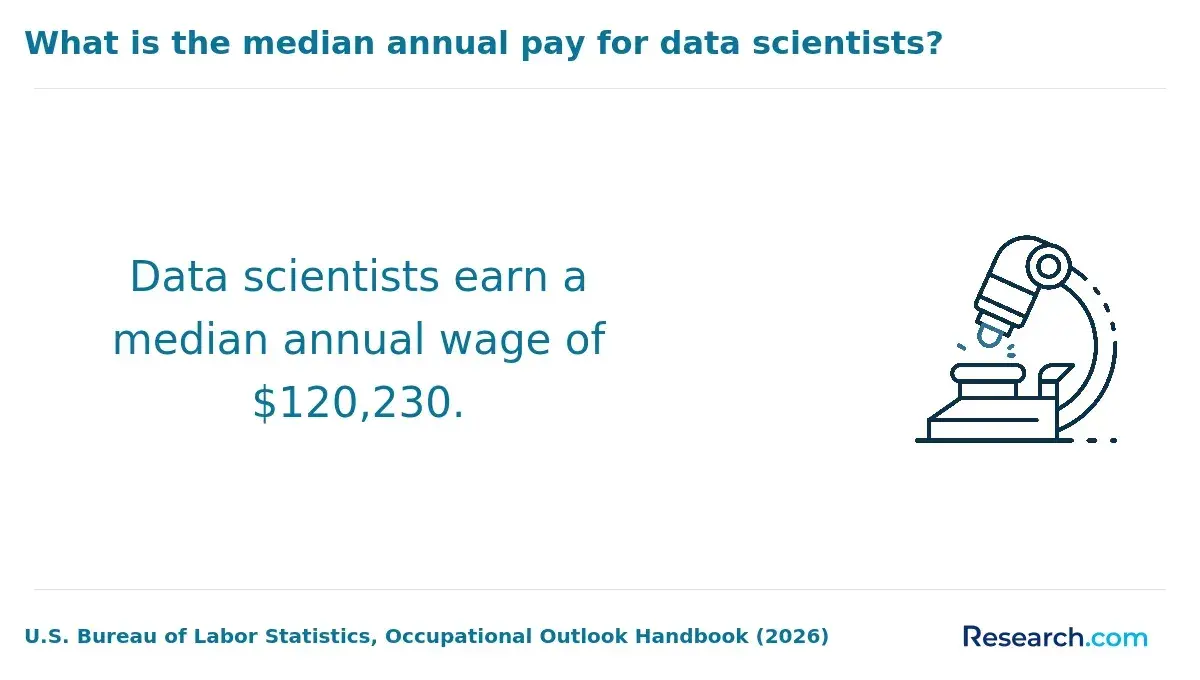
The U.S. Bureau of Labor Statistics reports a $120,230 median annual wage for data scientists in May 2025. That is an occupation-wide figure, not a starting salary or an outcome measured for graduates of either university. Your prospects will depend on prior experience, technical skills, location, industry, and the positions you pursue.
BLS also projects strong growth in data scientist employment from 2025 to 2035. Growth can create opportunities, but it does not guarantee an offer after graduation. For a realistic financial decision, compare your likely target roles and local job postings with the full degree cost and any income you might give up while studying.
Which online data science master's program should you choose?
Choose CU Boulder if demonstrating readiness through coursework appeals to you and its current course plan matches your technical goals. Choose Grand Canyon if you prefer a conventional admissions decision and its scheduled online classes, curriculum, and verified total cost fit your circumstances better. Neither is the right choice solely because of its institutional name or an advertised completion time.
Before paying for a course, get three items from each school: a written estimate covering the entire degree, a current required-course plan, and a sample weekly schedule. A common mistake is comparing one school's tuition-only quote with another's fuller estimate. Another is assuming a machine-learning course title means extensive hands-on work. Resolve both questions with the schools, then choose the program that closes your most important skill gaps at a manageable cost and pace.
Other Things You Should Know About Data Science
Diploma wording is an institutional policy. Ask each registrar for the exact diploma and transcript wording if it matters to you or your employer.
Transfer-credit limits and eligible courses depend on each program's current policy. Obtain a written evaluation before assuming earlier credits will reduce your course load or cost.
It may help establish preparation, but doctoral programs set their own research, mathematics, recommendation, and admissions requirements. Check prospective doctoral programs before selecting master's electives.
Only with appropriate employer permission and compliance with course rules and privacy obligations. If permission is uncertain, ask the instructor about approved public or synthetic datasets.
References
- Professional Master of Science in Data Science | Student Support & Advising Services https://www.colorado.edu/bursar/costs/graduate-costs/professional-masters/professional-master-science-data-science
- Graduate Admissions Requirements | Rhode Island College https://www.ric.edu/admissions-financial-aid/graduate-admissions/graduate-admissions-requirements
- Types of Assessments - Teaching Resources https://teaching-resources.delta.ncsu.edu/types-of-assessment/
- Courses | Master of Science in Data Science | University of Connecticut https://masters.datascience.uconn.edu/courses/
- What Can I Do With a Degree in Data Science? Career Paths & Skills | Harvard SEAS https://seas.harvard.edu/news/what-can-i-do-degree-data-science-career-paths-skills
- Synchronous vs. Asynchronous Learning | Saint Leo University https://www.saintleo.edu/about/stories/blog/synchronous-vs-asynchronous-learning-for-course-delivery
- Admission & Requirements, Data Science | American University https://www.american.edu/programs/shared/data-science/online/curriculum.cfm


