2027 Research University Roles You Can Target With a Biological Sciences Degree

Co-Founder and Chief Data Scientist
Graduates armed with a biological sciences degree often face a critical bottleneck: identifying university-based roles that align with both their specialized skill sets and evolving institutional priorities. As higher education adapts, full-time faculty positions remain limited, pushing many toward staff scientist roles, research coordinators, or specialized lab managers.
A National Center for Education Statistics report found that over 40% of enrollment growth in sciences stems from nontraditional and part-time students, signaling a shift toward flexible program delivery and diverse career trajectories. This article maps viable academic research and support roles for biological sciences graduates, offering clarity for navigating these complex career landscapes effectively.
Key Things You Should Know
- Postgraduate research roles in biological sciences require 2.5-3 years average time-to-degree, increasing opportunity costs for mid-career pivots despite offering a 15% higher median wage than bachelor-only positions per NSF 2024 data.
- Industry demand concentrates around data-intensive bioinformatics and regulatory affairs, with 40% of university biological sciences hires citing interdisciplinary analytics skills as a hiring threshold per 2024 AAAS workforce analysis.
- Public research universities increasingly prioritize grant-funded roles, creating a bottleneck where 60% of biological sciences PhDs face underemployment or adjunct positions, impacting long-term job security per recent NIH workforce projections.
What research university roles can you pursue with a biological sciences degree?
Postdoctoral training remains a near-universal requirement for most research university careers for biological sciences graduates, framing early-career trajectories around extended periods of modest compensation and high competition. For instance, around 70% of U.S. postdocs are concentrated in biological and biomedical sciences, with median salaries near $62,000 in 2024 according to the National Science Foundation. This sets a financial baseline that candidates must weigh against the eventual opportunity to secure tenure-track or independent investigator roles.
Transitioning to faculty or senior research scientist positions hinges on tangible outputs like publication records and successful grant applications. A molecular biology postdoc targeting a principal investigator role in pharmacology must combine wet lab expertise with targeted grant writing aligned to translational research priorities. Conversely, biological sciences graduates interested in computational biology within agricultural science departments need strong bioinformatics and data analytic capabilities.
Alternatives like laboratory manager roles often involve less postdoctoral experience but demand proficient organizational skills and oversight responsibilities. Candidates must recognize that entering academic research positions with a biological sciences degree comes with tradeoffs between autonomy and financial security, heavily influenced by dependence on grant cycles.
Given this competitive landscape, continuous skill development and academic networking are imperative. For those exploring practical career paths, evaluating jobs with a biology degree beyond traditional postdoc tracks can be beneficial.
How does a biological sciences degree prepare you for careers in academic research?
Graduates with a biological sciences degree face distinct operational demands in academic research roles, requiring more than foundational laboratory skills. Proficiency in experimental design, statistical analysis, and data interpretation is essential for contributing to hypothesis-driven projects with reproducible results. Mastery of molecular techniques like PCR and microscopy enables candidates to navigate the iterative troubleshooting typical in research environments. Practical application of these skills during degree-associated research projects builds critical judgment, such as adjusting DNA extraction protocols when experimental data conflict.
Careers in academic research with a biological sciences degree often begin in support positions; laboratory technicians made up 6% of first job destinations for biology graduates in the UK in 2024, highlighting the sector's reliance on personnel who manage routine experiments while supporting lead investigators. However, progression beyond these roles usually demands additional qualifications, reflecting employer expectations for advanced competencies in compliance, grant-writing, and safety protocols that undergraduate programs may insufficiently cover.
Common skill gaps include applied bioinformatics and quantitative data analysis, creating barriers that require supplementary training or certifications. Students evaluating this pathway should weigh these hurdles carefully, particularly when pursuing roles where these competencies influence employability. For those seeking flexible study options, a nutritional science degree online may present alternative curricular emphases and practical experiences relevant to biological sciences graduates aiming at research roles.
What entry-level lab and research assistant positions are open to biological sciences majors?
Entry-level research assistant jobs for biological sciences majors often require more than foundational knowledge; employers look for practical skills in molecular biology techniques such as PCR, microscopy, and spectrophotometry. Positions like clinical laboratory assistants and research technicians are chiefly available within biotech, pharmaceutical, and academic settings, where precision in protocol adherence and equipment maintenance directly impacts data reliability. Candidates without certifications in phlebotomy or lab safety training may encounter slower hiring or mandatory on-site skill development.
Biological sciences lab technician positions hiring near me reflect an employment growth rate notably higher than national averages, with the medical and clinical lab assistant sector growing by 17% between 2023 and 2024. These roles frequently involve sample management under strict regulatory frameworks, especially in pharmaceuticals, where additional proficiency in data analysis software or laboratory information management systems (LIMS) is often necessary to move beyond entry-level tasks.
Academic research opportunities emphasize experimental design experience, usually gained through undergraduate internships, but typically offer less direct involvement in hypothesis generation at the outset. Real-world constraints include erratic schedules during critical experiments and compliance with evolving biosafety standards, factors critical for assessing long-term commitment and career trajectory in the field.
Prospective candidates should balance degree work with certification and hands-on skills to navigate these tradeoffs effectively. For those weighing broader interdisciplinary options, this is a masters in library science worth it evaluation illuminates comparative program value.
Which advanced degrees or specializations best support research careers in biology?
Advanced degrees for biological sciences research careers must be evaluated through the prism of immediate market demand and long-term specialization. Master's programs in molecular biology, bioinformatics, or clinical research management align closely with the 6-7% projected growth in clinical trial coordinator roles, a direct consequence of expanding clinical trial operations through 2028. These degrees emphasize protocol design and regulatory compliance, skills essential for roles in pharmaceutical or medical device research settings.
By contrast, PhD programs remain the principal pathway for independent research scientists and academic faculty but carry significant tradeoffs such as extended time-to-degree and often mandatory postdoctoral work-factors that delay workforce entry. Targeted specializations like immunology or biostatistics can accelerate placement in biotech companies or government laboratories where niche expertise is prioritized.
Professional certifications in Good Clinical Practice or regulatory affairs, combined with master's degrees, notably enhance candidacy for positions such as Clinical Research Coordinator. Those eyeing translational research benefit from interdisciplinary training incorporating computational biology and systems pharmacology, broadening applicability across both academic and private sectors. Practical decision-making must balance program length, specialization relevance, and employer expectations, especially as personalized medicine and gene editing redefine industry pipelines.
For working professionals considering flexible educational options, particularly those researching environmental engineering schools online, it is essential to assess program affordability and alignment with career objectives before investing time and financial resources.
Prospective students might also evaluate a library science degree as an alternative interdisciplinary option that intersects with biological sciences in data management and information curation.
How do research roles differ across biology subfields like genetics, ecology, and microbiology?
Choosing a specialization within biological sciences requires nuanced evaluation of evolving workforce demands and skill alignments. Genetics roles prioritize computational proficiency in bioinformatics and data analysis, driven by a notable 25% growth in bioinformatics-related jobs from 2020 to 2024, concentrated in genomics and precision medicine. This creates a tangible expectation for genetics researchers to integrate advanced computational methods alongside laboratory expertise.
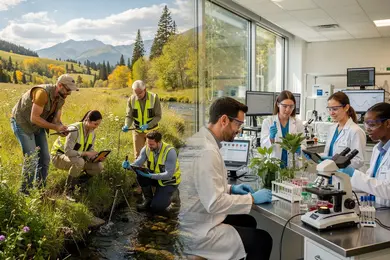
Conversely, ecology emphasizes field-based research, longitudinal environmental studies, and geospatial statistical modeling over intensive computational work. Candidates must be prepared for collaborative roles involving policy interfaces and managing remote sensing data, reflecting limited direct overlap with genetics' digital-heavy ecosystem.
Microbiology balances laboratory techniques and computational use but leans toward mastery in lab protocols, regulatory compliance, and pathogen management rather than deep bioinformatics specialization. Its practical applications span health, agriculture, and industrial biotech, requiring versatile skill sets distinct from genetics and ecology.
Key considerations for prospective students include:
- Genetics demands continual tech skill development with higher computational intensity and faster job growth.
- Ecology minimizes computational burnout risks but involves logistical challenges inherent to complex fieldwork.
- Microbiology offers a pragmatic middle ground, focusing on lab standards and practical pathogen expertise.
Aligning educational goals with these differentiated skill sets and sector-specific demands can significantly affect long-term employability and job market integration in biological sciences.
What is the typical salary range for research positions requiring a biological sciences degree?
Salary outcomes for research roles in biological sciences hinge on sector, skill set, and geography rather than degree alone. Entry-level technicians in academic or government settings typically earn $45,000 to $55,000 annually, while specialized scientists with advanced credentials in biotech or environmental consulting can command $70,000 to $95,000 or more. For instance, conservation scientists employed by federal agencies or nonprofits usually make $60,000 to $80,000, aligning with steady demand projected by the U.S. Bureau of Labor Statistics, which anticipates 3,500 openings per year and 6% growth through 2032.
Employers prioritize candidates who demonstrate specific technical proficiencies such as data analysis, field research techniques, and regulatory compliance, all of which directly affect compensation offers. Location is a significant variable; positions in urban biotech hubs often pay premiums, whereas rural or academic roles may provide stronger benefits or lower living costs but lower salaries. Mid-career professionals face the practical tradeoff of investing time and finances into certifications or graduate degrees to boost earning potential versus maintaining flexibility.
Negotiating salary requires emphasizing quantifiable impacts on research outcomes and grant success, especially within academia where funding volatility can limit raises despite high expertise. Strategic advancement involves balancing sector-specific employment landscapes, geographic mobility, and continuous skill development aligned with evolving employer expectations.
What is the job outlook for research-focused careers in biological sciences?
Epidemiology roles within biological sciences research are expanding rapidly, driven by urgent demands for disease control and health data expertise across government and private sectors. Job growth for epidemiologists is projected at 27% over a decade, with a median wage above $78,000 annually, indicating strong labor market valuation for quantitative and analytical skills.
However, securing competitive positions requires more than foundational biology knowledge. Employers prioritize candidates adept in statistical software, coding languages such as R or Python, and bioinformatics integration-skills essential for advancing pharmaceutical development and public health initiatives.
Practical workplace effectiveness also depends on clear communication across interdisciplinary teams, translating complex scientific data into actionable insights for policy and clinical settings. Without complementary data science or grant-writing capabilities, biological sciences graduates risk limited job mobility or stalled advancement, especially in environments demanding high-throughput data management and external funding acquisition.
Long-term success correlates with continuous credentialing, peer-reviewed publications, and active participation in professional networks. Those targeting epidemiology-related research benefit substantially from advanced degrees or specialized public health certifications, which facilitate adaptability to shifting biological threats and research priorities.
- The integration of computational tools with traditional lab techniques is increasingly non-negotiable.
- Interdisciplinary communication skills can differentiate candidates in crowded job markets.
- Ongoing professional development is necessary to maintain relevance amid evolving research methodologies.
How do online biological sciences programs compare with campus programs for research preparation?
Online biological sciences programs often fall short in providing the hands-on laboratory experience that federal research employers require. Despite the $70 billion federal investment in health and life sciences R&D, practical lab skills remain the defining criterion for many roles funded by NIH, CDC, and EPA. Campus-based programs deliver direct access to research facilities, advanced instrumentation, and live collaboration, which translate into verified competencies and stronger employment prospects in government and private labs.
Working professionals pursuing online degrees face the added challenge of arranging separate internships or practicums to gain necessary lab experience, delaying readiness for technical positions. By contrast, campus students benefit from integrated lab work and faculty mentorship linked to active federally funded projects, often opening pathways to research roles through established networks.
Employers in research contexts prioritize candidates who can demonstrate real-world lab expertise and teamwork under pressure-advantages that campus education inherently supports but that online coursework rarely provides without significant external effort.
Prospective students should consider these tradeoffs: online biological sciences programs align better with careers focused on data analysis or bioinformatics, whereas pursuing federally funded research positions demands comprehensive laboratory training and direct exposure to experimental methods.
Which accreditations and research resources should you look for in biology programs?
Accreditation from regional agencies such as MSCHE or WASC combined with program-specific validation by entities like the American Society for Microbiology (ASM) or the Council on Education for Public Health (CEPH) directly affects the credibility and practical readiness of biology programs. For professionals targeting nonprofit research or NGO roles-where 15% of global health funding is directed to biology-related areas according to WHO global health expenditure reports from 2024-these accreditations validate training aligned with sector demands.
Access to specialized research infrastructure (e.g., BSL-3 labs) and formal connections with public health institutions materially influence a graduate's ability to contribute immediately in contexts like vaccine development or infectious disease research. Programs lacking such resources often leave students underprepared for emerging health challenges prevalent in nonprofit research environments.
Students should also prioritize programs embedded in consortia or databases linked to agencies like NIH or CDC, which enhance skillsets in managing large-scale biological datasets-critical for careers in conservation biology or epidemiological modeling within NGOs.
Finally, transparent placement records and employer networks tied explicitly to nonprofit and global health sectors provide practical insight into employability prospects. This combination of accreditation, research access, and confirmed career pathways substantially shapes long-term outcomes for students pursuing careers within nonprofit-driven biological sciences research.
How can you choose a biological sciences program aligned with your research career goals?
Biological sciences programs must be evaluated primarily on how well their curriculum and research opportunities align with targeted career roles that increasingly demand interdisciplinary expertise. For those aiming at synthetic or systems biology roles-fields merging biology, engineering, and data science-programs integrating molecular biology, bioinformatics, and computational modeling offer a necessary blend of experimental and quantitative skills. From 2019 to 2024, synthetic biology startups secured over $40 billion in venture funding globally, underscoring a labor market shift toward hybrid skill sets rather than traditional siloed biology backgrounds.
Practical factors such as access to specialized labs, internships in biotechnology hubs, and industry collaborations heavily influence employability and post-graduation outcomes. Research universities with active technology transfer offices provide invaluable experiential learning, which is often underemphasized in classical programs.
Deciding between breadth and depth depends on career objectives: computational biology roles require heavy coding and data science skills supplemented by biology electives, whereas ecological research demands fieldwork and environmental training. Credible programs openly share graduate employment data aligned with these distinctions.
Finally, transparency in faculty expertise and research funding signals program vitality. Programs lacking this often reflect outdated focuses misaligned with evolving interdisciplinary demands, affecting graduates' workplace readiness and long-term career trajectories.
Other Things You Should Know About Biological Sciences
A biological sciences degree offers practical skills that extend beyond pure research, such as data analysis, critical thinking, and technical lab techniques. However, career transitions into fields like biotech business development, regulatory affairs, or science communication often require additional specialized training or professional experience. Students should prioritize programs with interdisciplinary electives or internships to expand employability outside traditional research roles.
In 2027, a biological sciences degree equips graduates with lab skills, critical thinking, and interdisciplinary knowledge, essential for roles like laboratory technician or research associate at research universities. These skills bridge theory and practice, enabling contributions to research projects and innovation.
Employers in research laboratories prioritize candidates from programs with robust lab components, research projects, and publication opportunities. Graduates from teaching-focused programs may have stronger foundational knowledge but often lack specialized research experience, limiting immediate research employability. Students targeting research-centric roles should prioritize institutions with active faculty-led projects and access to modern lab technologies to meet these rigorous employer standards.
Choosing to enter graduate school immediately after a biological sciences bachelor's depends on career objectives and market conditions. For research-intensive tracks, immediate continuation often provides continuity in knowledge and competitive advantage for academic positions. However, gaining work experience before graduate studies offers practical insights and may improve graduate research focus and funding opportunities. For those uncertain about specialization, gaining 1-2 years of relevant lab or field employment before applying is a strategic approach.
References
- Can Online Biology Courses Replace In-Person Labs? https://www.straighterline.com/blog/can-online-biology-courses-replace-in-person-labs
- Accreditation https://www.rsb.org.uk/accreditation.html
- Biology departments need an accreditation body https://smallpondscience.com/2013/10/07/biology-departments-need-an-accreditation-body/
- Recent Jobs - Royal Society of Biology https://jobs.rsb.org.uk/jobs/
- Careers in Biology https://www.aibs.org/careers/
- How To Become A Biologist | Biology Degrees And Careers https://www.learnhowtobecome.org/science-technology-careers/biology/
- Top 15 Highest‑Paying Pharmacy Jobs in the UK 2025 (Including Salaries) https://apexlearning.org.uk/highest-paying-biology-degree-jobs-2025-2026/
- Research Guides: Biology Subject Guide: Internet Resources https://libguides.cedarcrest.edu/c.php
- Careers in Biological Sciences: Opportunities, Skills, and the Future of Work https://www.hyperec.com/blog/careers-in-biological-sciences-opportunities-skills-and-the-future-of-work/
- 5 fascinating career paths for biology majors https://www.ecologyproject.org/post/5-fascinating-career-paths-for-biology-majors